In this guide
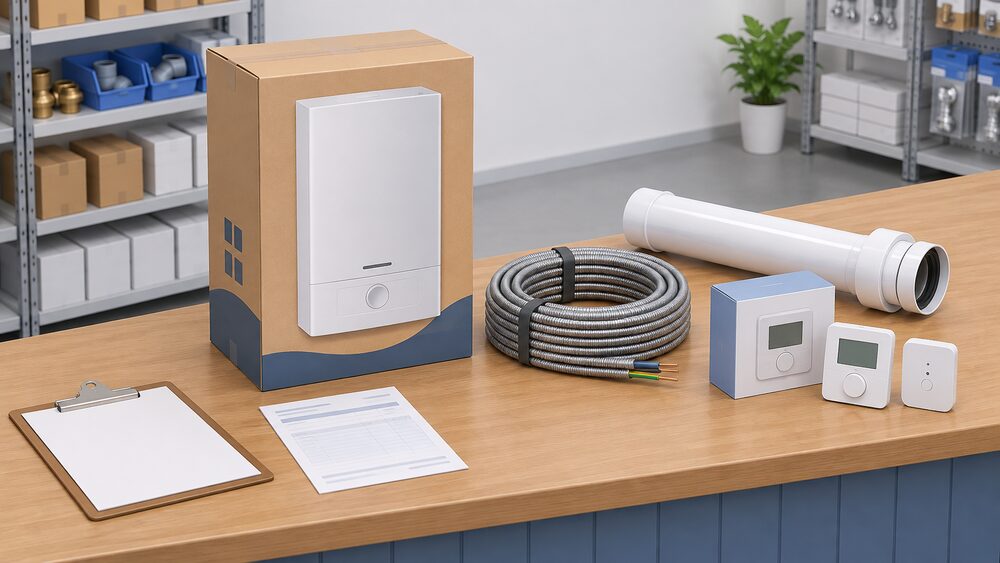
A builders' merchant or trade retailer is where the equipment in a home energy installation is bought before it is fitted: the boiler, the cylinder, the cable, the flue, the mounting system and the controls. The trade counter sells to account holders, usually installers, and the online distributor sells to anyone with a card. Both routes are open to a householder in principle. What is not open is the grant route: Boiler Upgrade Scheme applications are not made by homeowners, because an approved heat pump installer submits the application on the household's behalf1.
That single fact explains most of the awkwardness in this channel. A householder can buy a heat pump, a boiler or a kit of parts and then look for someone to fit it. What that householder cannot do is buy the kit and claim the £5,000 grant themselves, because the application runs through the installer2. The merchant is a supplier of goods, not a route to funding.
The channel matters for energy independence because it is where the physical kit comes from. A merchant's stock position, its delivery terms and its returns policy decide how quickly a broken boiler part can be replaced, and whether a household waiting on a repair is waiting days or weeks. It also decides what is on the shelf at all: the phase-out of new gas boilers for existing homes is scheduled for 2035, and what merchants stock follows what can legally be installed3.
The merchants and trade retailers in this guide
The merchant channel is not one business. It is a set of overlapping routes: the general builders' merchant with a trade counter, the specialist plumbing and heating merchant, the electrical wholesaler, the renewables distributor, and the online retailer that sells the same goods without a counter at all. A householder buying a flue extension, a length of armoured cable or a set of heating controls may deal with any of them.
What unites them is that they distribute goods rather than install them. Under the product safety regime, any person who distributes, meaning makes the product available, in the UK and is not the manufacturer or importer of the product carries duties as a distributor7. That is the legal shape of the merchant's role: it is in the supply chain, and it has obligations that come with being there, but it is not the party that commissions the installation.
The trade account is the dividing line in practice. Account holders get counter pricing, credit terms and delivery; casual buyers get retail pricing and whatever the counter will sell them. The distinction is commercial, not legal. Traders cannot contract out of UK consumer law, so a householder buying over a merchant counter or from a distributor's website keeps the statutory rights that go with a consumer purchase8.
Where the merchant's role ends is set by other rules. Flue installation, including external flues, chimneys and soil and vent pipes, should be carried out by a suitably qualified installer9. The merchant can sell the flue; it cannot sign off the run. The same boundary applies to the electrical side, where the fixed parts of an installation, the wiring, the socket-outlets, the light fittings and the consumer unit, sit inside a regulatory regime that a merchant does not administer10.
For a household, the practical consequence is that the merchant is a source of parts and equipment, and the installer is the source of the work, the notification and the paperwork. The two are separate purchases, and the second is the one that carries the certification.
Travis Perkins: the UK's biggest merchant group, by the numbers

Travis Perkins is the largest merchant group in the UK, and the way to understand its scale is to look at what consolidation does to a supply chain. Travis Perkins is the UK's largest builders' merchants11. The wider trade is concentrated in the same way: City Plumbing is the UK's largest builders' merchant with more than 350 branches across the UK, and UK Plumbing Supplies is the UK's largest independent plumbers' merchant with over 300 locations12. Searches for plumbers account for 23% of all searches for tradespeople in the UK13.
The comparable market is domestic energy supply, where six large companies dominate the domestic market with 91% market share, and Octopus is now the largest electricity supplier and second largest gas supplier in Great Britain14. There are approximately 53.7 million domestic customer accounts in Great Britain15. Those two figures describe a market where a handful of large operators set the terms for tens of millions of households, and the merchant trade has consolidated along similar lines.
What that means for a householder is straightforward. The trade counter a plumber uses is likely to belong to a national group, and the pricing, delivery and returns terms at that counter are group terms rather than a local trader's discretion. A merchant group's branch network is what makes next-day delivery of a boiler part possible in most of the country, and it is also what makes the terms uniform.
The independence question here is about resilience rather than ownership. A household that depends on a national merchant network for a replacement part depends on that network's logistics, not on a local stockroom. That is usually faster and more reliable than a single merchant's shelf, and it is also a dependency: when a part is out of stock nationally, it is out of stock everywhere at once.
Merchant counter or online distributor: which route suits which buyer
The two routes sell much the same goods and differ in what happens around the sale.
The trade counter suits a buyer who knows the part, wants it today, and can collect. It is built for account holders, and the counter conversation is where substitutions and compatibility questions get resolved. The online distributor suits a buyer who knows the part number or the specification and wants it delivered, and it is the route a householder is more likely to use because it does not require an account.
The protections are similar on both routes, because they follow the buyer rather than the channel. Traders cannot contract out of UK consumer law8. Where a dispute arises, the escalation route depends on who the counterparty is: a dispute against an energy supplier, for example, requires the supplier to be the correct supplier to raise the dispute against, matching the company name written on the account holder's bill12. The same discipline applies to a merchant dispute, in that the claim runs against the business that took the order.
There is a live tension in how suppliers handle customers who are not comfortable online. In the energy market, suppliers have emphasised that consumers must retain access to non-digital routes and human interaction, particularly where customers are in vulnerable circumstances16. That principle is not a merchant rule, but it explains why trade counters persist alongside websites: a counter is a non-digital route, and for some buyers it is the only workable one.
For a householder, the choice usually comes down to urgency and specification. A part needed today points to a counter. A part that can wait, and where the specification is already settled, points to delivery. Neither route includes fitting, and neither route includes the notification that a notifiable installation requires.
SWA cable: the sheath that suits outdoor and buried runs
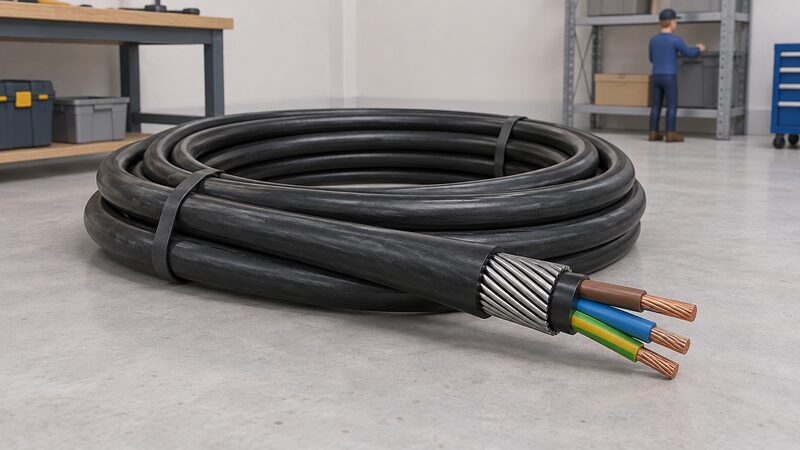
Steel Wire Armoured cable is the cable generally used for a shed electrical installation, because it is heavy-duty, weather-resistant, and designed for outdoor use and burial underground17. That combination is what separates it from standard internal cable, which has neither the mechanical protection nor the weather resistance for a buried or exposed run.
The armour does a second job. The SWA armour provides the circuit protective conductor, so the steel sheath forms part of the earthing path for the circuit18. That is a design feature rather than an accessory, and it is one reason the cable is specified as a system rather than bought by the metre on appearance alone.
Sizing follows the run. 4mm² 3-core SWA is typically suitable for runs up to 30m at 32A18. A longer run, or a higher load, moves the specification, and the specification is the electrician's call rather than the counter's.
The installation route matters as much as the cable. The most common way of installing electricity in a shed is to run cables under the ground from the property, connecting the cable to the property's consumer unit or fuse box17. Cables can also be run over the ground, or overhead17. Where power demands are higher, an electrician may need to install a small, dedicated consumer unit inside the shed17.
"Steel Wire Armoured cable (SWA) is the cable generally used for this type of electrical installation"
For energy independence, a shed supply is a small but real step: it moves lighting, tools or a workshop circuit off an extension lead and onto a properly protected circuit. The dependence that remains is the same as for the house, because the shed supply is drawn from the property's consumer unit and therefore from the grid.
Flues, extensions and the small parts that hold an install together
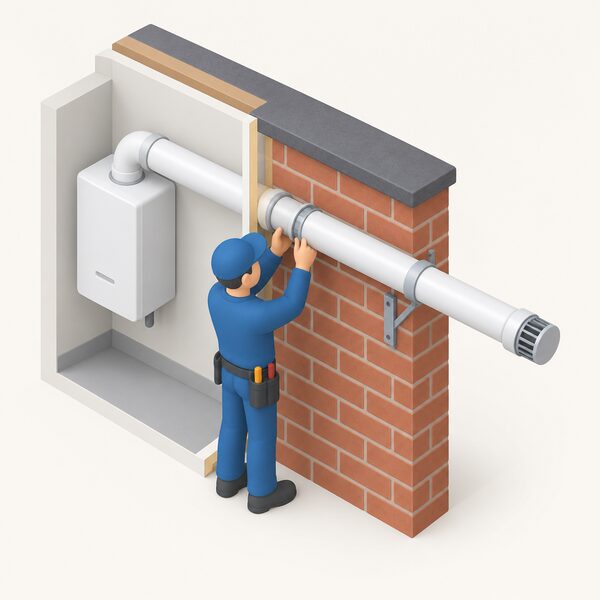
The small parts are where a merchant earns its place in an installation. A flue run that needs an extension, a bracket that suits a particular wall, a control that matches an existing system: these are the items that decide whether a job finishes on the day or waits for a delivery.
The rule that governs the flue side is about who fits it, not who sells it. Installation should be carried out by a suitably qualified installer, and that applies to external flues, chimneys, and soil and vent pipes as well9. A merchant can supply the flue and its extensions; the competence requirement sits with the person who installs them.
Delivery terms are commercial and vary by distributor. One maker's own product page offers free UK delivery on electric fan heaters, which illustrates the pattern rather than setting a rule for the trade11. Where a distributor publishes a free-delivery threshold, two different figures appear for the same distributor, £75 and £50, and the conflict is not resolved. A householder ordering flue parts should treat the threshold as something to confirm at the point of order rather than assume.
Returns are the other half of the small-parts problem. A flue extension bought in the wrong size is a return, and the return terms are the distributor's. Because traders cannot contract out of UK consumer law, the statutory position on faulty or misdescribed goods holds regardless of what a counter sign says8.
Promotions and discount codes come and go
Discount codes are the most perishable thing in this channel, and the clearest example is not a merchant code at all. BOILERS125 is a £125 discount on boilers from BOXT, and it expires on 30 September 202619. It cannot be combined with other promotional codes19.
The pattern generalises. A code is tied to the company running it, carries an end date, and usually excludes stacking with other offers. A code seen on a merchant or retailer page is therefore a claim about a moment, not a standing price. The same applies to service-plan promotions: a 50% discount on the first three months of selected Boiler Care plans bought online closes at 23:59 on 5 October 202620.
For a householder comparing a merchant price against a quote, the useful discipline is to separate the two numbers. The merchant price is for goods. The quote is for goods plus labour plus certification plus the risk that the job takes longer than expected. A discount code moves the first number and leaves the second alone.
How grant schemes and the gas boiler phase-out shape what merchants stock
Merchants stock what can be installed, and what can be installed is being legislated. New gas boilers are scheduled to be phased out for existing homes in 20353. The UK Government has consulted on exempting certain households from the phase out of fossil fuel boilers, including gas, in 2035, and on delaying the ban on installing oil and LPG boilers, and new coal heating, for off-gas-grid homes from 2026 to 20353.
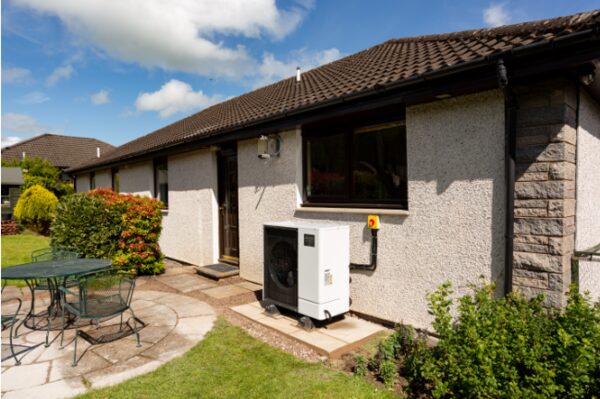
The grant side pulls stock in the other direction. The Boiler Upgrade Scheme provides upfront capital grants to support the installation of heat pumps and biomass boilers in homes and non-domestic buildings21. The grant value is £5,0002. Grants for heat pump installations run across England and Wales1.
The uptake pattern is the interesting part for a merchant deciding what to hold. As of November 2025, around 39% of grants had been made to homes off the gas grid6. In England and Wales, the majority of properties in receipt of grants were on the gas grid, at 55,909 properties, or 62%5. A merchant reading those two figures sees demand from both grid-connected and off-grid homes, which is why heat pump stock sits alongside gas spares rather than replacing them.
The scheme's end date is genuinely unclear across the documents. One official guidance page states the scheme is open to domestic and small non-domestic properties and runs from 2022 to 202522. Installer guidance dated 28 April 2026 states the scheme has been extended to 2030, and applies to applications properly made on or after 28 April 20264. A separate page says the scheme is currently set to end in 2028.
Support also runs upstream of the merchant counter. Support is available for installers and manufacturers to expand supply chains, which is the part of the scheme that touches wholesalers and distributors directly23.
Where a merchant stops and an installer starts
The boundary is worth stating plainly, because it is where most householder confusion sits.
A merchant sells goods. It does not commission a heat pump, notify a building control body, or certify an electrical circuit. The grant route makes the point sharply: homeowners do not need to apply directly, because an approved heat pump installer will submit an application on their behalf1. A householder who buys a heat pump from a distributor and then hires a separate installer has stepped outside that route.
The consumer code structure sits on the installer side too. The consumer codes currently approved for the purposes of the Boiler Upgrade Scheme are the Home Insulation and Energy Systems Contractors Scheme (HIES) and the Renewable Energy Consumer Code (RECC)4. Installers must continue to hold membership with one of the two approved consumer codes, RECC or HIES, until further notice, for work under the Boiler Upgrade Scheme4. Property owner rights are protected by the consumer codes HIES and RECC, certified by the Chartered Trading Standards Institute, and membership of HIES or RECC is a condition of MCS certification13.
Self-builds are the one route where a householder's own labour is contemplated. Eligible self-builds are owned by individuals and built either through a builder or as a DIY project, not by companies or developers, and must meet criteria including that the building was built principally with the labour or resources of the first owner, has never been owned wholly or partly by a person who is not an individual, and was first occupied after the first commissioning date of the heat pump13.
Enforcement runs alongside. The UK Government has taken immediate action to suspend installers and protect consumers under ECO424. That is the mechanism that keeps the installer side of the boundary meaningful.
For a household, the split is simple to hold in mind. Buy parts from a merchant if that is what is needed. Buy the installation, the certification and the grant application from a registered installer, and check the registration before signing. The installer requirements for grants page sets out what a scheme expects of the firm doing the work, and checking an installer before you buy covers the verification steps.
Sources24 cited
- £5 million to help Welsh households invest in greener homes, Welsh Government, 2026-03-05
- Notice of approved grant categories and values for the Boiler Upgrade Scheme, GOV.UK, 2026-07-21
- Delivering net zero for Scotland's buildings, Scottish Government, 2023-11
- Boiler Upgrade Scheme guidance for installers V5, Ofgem, 2026-04-28
- Boiler Upgrade Scheme BUS statistics July 2026, Department for Energy Security and Net Zero, 2026-07
- Boiler Upgrade Scheme statistics, House of Commons Library, 2025-11
- Regulations: consumer connectable product security, GOV.UK, 2024-01-08
- Consumer law and contracting out, House of Commons Library, 2026-09-17
- Building regulations: flue, chimney or soil and vent pipe, Welsh Government, 2026-09-17
- Electrical safety standards in the private and social rented sectors: guidance, GOV.UK, 2025-11-01
- Electric fan heaters, Pro Breeze, 2026-09-23
- Digital Power Energy Supply UK Ltd, Energy Ombudsman, 2026-09-19
- BUS PO guidance V2.3, Ofgem, 2023-09-25
- State of the energy market report: retail, Ofgem, 2025-04-15
- Debt Relief Scheme Impact Assessment, Ofgem, 2025-11-06
- Consumer vulnerability strategy progress report, Ofgem, 2026-07-21
- Wiring a shed: a guide for homeowners, NICEIC, 2026-09-17
- Section 722 EV charging complete guide, Elec-Mate, 2026-07-02
- BOXT boilers, BOXT, 2026-09-30
- ScottishPower home services, ScottishPower, 2026-10-05
- Boiler Upgrade Scheme quarterly report issue 15, Ofgem, 2026-02-27
- Home and business grants, schemes and advice, East Herts Council, 2026-09-17
- Support for installers and manufacturers to expand supply chains, Parliamentary Office of Science and Technology, 2026-09-19
- Written statement: Housing Cabinet Secretary responds to UK Government action on GBIS and ECO4, Welsh Government, 2025-01-23
 Energy IndependenceHow the choice of installer or retailer shapes a household's long-term control over its energy system, from certification and consumer codes to spare parts, servicing access and what happens when a firm stops trading.
 The Full Installers GuideHow do you find an installer you can trust, and what should you check before signing anything?
 Buying Energy Equipment OnlineWho fits your solar panels, battery or heat pump when you buy them online, and who puts things right if they go wrong?
 Buying Direct or Via InstallerCan you buy a heat pump yourself and still get the grant, or does it have to go through an installer?
 The Full Brands GuideWhich boiler, heat pump or solar brand can you trust, and who actually owns it?
 National Home Energy InstallersWho actually turns up to fit your boiler or solar panels when you book with a big national company?