
In this guide
BOXT is a national online installer that sells boilers, heat pumps, EV chargers and solar through its own website, with fixed prices published before a survey and installation carried out by engineers it accredits. Boilers start at £1,790, heat pumps from £4,799, and the company is running a £125 discount on all boiler installations with the code BOILERS125 until 30 September 20261.
The model is quote-without-a-survey selling: the householder configures the job online, pays a fixed price, and the company states that an order placed by 3pm can be installed the next working day by a BOXT accredited engineer1. That is the company's own claim, and it sits alongside independent guidance that boiler installation generally takes anywhere from 4 to 6 hours to 3 to 4 days depending on whether the job is a like-for-like replacement or a switch to a different boiler and heating system2.
For a household thinking about energy independence, the position is mixed. BOXT sells the technologies that reduce reliance on a gas supplier, including heat pumps, solar and battery systems and EV chargers, but it is a single national company standing between the household and the work, and the longest guarantees and the price promise both depend on its terms being met.
The range: boilers, heat pumps, EV chargers and solar
BOXT's product lines cover the main domestic low-carbon technologies: heat pumps, EV chargers, and solar PV with battery systems3. That is the same set of technologies that group-buying schemes now bundle, running from solar panels and battery storage to heat pumps and EV chargers4, and the same combination that Energy Systems Catapult studied in 47 homes fitted with everything: heat pumps, solar, batteries and EVs5.
Selling them through one retailer has a practical consequence. A home energy management system can integrate EV chargers, heat pumps and PV diverters, so the equipment works as a system rather than as separate appliances6. Where one company supplies and fits several of those devices, the interfaces between them sit with that company rather than being split across three installers.
The regulatory backdrop differs by technology and by nation. In Northern Ireland, a homeowner or property owner must choose the equipment and nominate an EV charge point or heat pump installer, who carries out checks and submits the connection application on their behalf7. EV charge points themselves are covered by product certification schemes testing safety, security, quality and reliability for both home and commercial use8. For solar, the advice is that a home energy management system is what allows the generation, storage and charging to be coordinated6.
What BOXT does not change is the underlying dependence. A heat pump still runs on electricity from the grid and a supplier; solar and a battery reduce the amount drawn but do not remove the connection; an EV charger is a load on the same supply. The independence gain is in the fuel and in the metering, not in the absence of a network.

Prices: boilers from £1,790 and heat pumps from £4,799
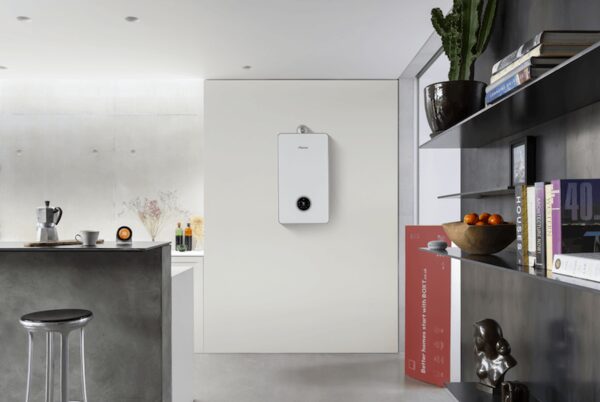
BOXT publishes starting prices rather than a full list. Boiler installations start at £1,790 and heat pump installations from £4,7991. Those are the company's own figures and they are starting points: the final price depends on the property, the output required and the work needed.
The wider market context matters when reading them. Independent guidance puts a system boiler at £1,580 to £5,000 including installation9. On heat pumps, the figures diverge sharply by source and date. A parliamentary committee report in May 2024 stated that at around £11,600, an average heat pump was then four times more expensive than a gas boiler10. Nesta put the cost of buying and installing a heat pump at about £10,500, with a range from £8,000 to £15,00011. A September 2026 news item cited £13,500 for a heat pump against £2,500 for a replacement boiler12, and an earlier estimate put heat pump installation anywhere between £2,400 and £14,05013.
| Item | Published figure | Source type |
|---|---|---|
| Boiler installation, from | £1,7901 | Company |
| Heat pump installation, from | £4,7991 | Company |
| System boiler, including installation | £1,580 to £5,0009 | Independent |
| Heat pump, buy and install | about £10,500, range £8,000 to £15,00011 | Independent |
| Heat pump, average | around £11,60010 | Official |
| Heat pump installation | £2,400 to £14,05013 | Independent |
The gap between a company's starting price and independent averages is the single most important thing to understand about online fixed pricing. A starting price describes the cheapest configuration the company will sell; an average describes what households actually paid across a range of properties. Both can be true at once.
The £125 discount and how to claim it
BOXT is advertising £125 off all boiler installations using the code BOILERS125 at checkout. The promotion runs until 30 September 2026 and cannot be combined with other promotional codes1.
Three conditions shape what the discount is worth. It applies to boilers, so it does not reduce the price of a heat pump, an EV charger or a solar installation bought on its own. It is a checkout code, so it has to be entered at the point of order rather than claimed afterwards. And because it cannot be stacked with other codes, a household holding a second promotional code has to compare the two rather than assume both apply.
The discount is small against the price of the work. £125 against a £1,790 starting price is a modest reduction, and it is worth reading as a marketing deadline rather than as a change in the underlying cost of an installation. The figures that determine the bill are the boiler output, the system type and the flue and siting work, not the code.
The price promise: beating like-for-like quotes by £50

BOXT guarantees to beat any like-for-like boiler installation quote by £501. The phrase doing the work in that sentence is "like-for-like", and it is where most price promises are tested.
Independent guidance is explicit on the point: get at least three quotes and check you are being quoted like for like14. Two quotes can differ by hundreds of pounds while covering different things, and a comparison that ignores scope is not a like-for-like comparison. The elements that have to match include the boiler make and model, the output, whether the system type is changing, the flue route, the controls supplied, the warranty terms and what happens to the old appliance.
Research into heat pump quotes illustrates how far apart apparently similar figures can be. In modelled examples, a £4,900 quote broke down as £2,000 for the unit, £2,000 for installation and £600 for electrical work, while a £5,300 quote included £2,000 for the unit, £2,400 for installation, £600 for electrical and £400 for design and features15. Same headline technology, different content.
A price promise is a contractual term, so the householder's protection is in the wording. It is worth asking in writing what evidence the company requires, whether it will accept a quote from any installer, and what happens if it disputes that the comparison is genuinely like for like. The general framework for comparing quotes is set out in comparing installation quotes and getting quotes for a home energy installation.
Finance, service plans and repair costs
BOXT advertises a boiler repair visit for £891. That is a visit price, and it does not by itself establish what parts or further labour would cost, or whether a repair falls under a manufacturer's guarantee rather than being chargeable.
On finance, the material available does not state whether BOXT lends directly or introduces a third-party provider, so the position is unconfirmed. What is documented is narrower: grant payments under the Boiler Upgrade Scheme are issued into UK bank accounts that accept pound sterling16. That is a condition on how grant money is paid, not a statement about consumer credit.
Public funding routes show what else exists. Bristol City Council's energy loan funds loft and cavity wall insulation, boiler replacements, underfloor insulation and first-time central heating17. Retrofit assessment, the professional survey that precedes a whole-house retrofit, costs £150 to £30018, and the guidance is to check fees, independence, qualifications, funding rules and installer standards before committing19. Those are separate from anything a retailer sells.
Service plans are the other recurring cost. The material available does not set out what a £8.99 a month plan includes, so the contents cannot be confirmed here. The terms that decide whether a plan is worth anything are what is excluded, whether parts are included, and whether cover depends on the boiler being serviced on schedule. The wider subject is covered in workmanship warranties and aftercare and financing a home energy installation.
Coverage and installation lead times, including next-day delivery

BOXT states that an order placed online by 3pm can be installed the next working day by a BOXT accredited engineer1. That is the company's own service claim, and it is the fastest published lead time in this market.
Independent guidance gives the realistic range. Boiler installation can take anywhere from 4 to 6 hours to 3 to 4 days, depending on whether the job is a like-for-like replacement or a switch to a new type of boiler or heating system2. By system type, a conventional boiler installation is likely to take 1 to 3 days because it is bulky and needs space, a system boiler 2 to 3 days because it includes a water cylinder that has to be fitted in, and a biomass boiler around 2 to 3 days in most cases2.
| Job type | Typical installation time |
|---|---|
| Combi, like-for-like | a few hours2 |
| Conventional boiler | 1 to 3 days2 |
| System boiler | 2 to 3 days2 |
| Biomass boiler | around 2 to 3 days2 |
| Any boiler, overall range | 4 to 6 hours to 3 to 4 days2 |
The two sets of figures are not in conflict so much as measuring different things. A next-day installation describes when the engineer arrives; the independent range describes how long the work occupies the property. A like-for-like combi swap can be finished in a day, while a conversion from a regular boiler to a combi involves draining, removing a cylinder and tank, and re-routing pipework, which is why the range stretches to days.
Coverage is national in the sense that the company sells across the UK, but the practical constraint is engineer availability in a given postcode on a given date. The general questions to ask of any national installer are set out in national home energy installers and online fixed-price installation.
What BOXT means for household energy independence
The technologies BOXT sells are the ones that move a home off gas. A heat pump replaces a gas boiler as the heat source, solar and a battery generate and store electricity on site, and an EV charger moves transport fuel onto the same supply. That is a real reduction in dependence on a gas supplier and on imported gas.
What remains is substantial. A heat pump runs on electricity from the grid and a supplier, so the household swaps one network dependence for another. Solar and battery reduce the amount drawn but do not remove the connection. An EV charger is an additional load on the same supply. And the transaction itself creates a dependence on a single company for the installation, the workmanship warranty and the aftercare.
Policy is pushing in the same direction as the products. The Scottish Government set out phasing out the need to install new or replacement fossil fuel boilers in off gas areas from 2025 and in on gas areas from 203020. That is a Scottish position and it does not apply across the other three nations, where the rules differ.
The practical test for a household is not whether a company sells low-carbon kit but what happens after the installation. Who holds the workmanship warranty, how long it runs, what voids it, and what the route is if the company stops trading. Those questions are covered in installers and energy independence and when your installer goes bust.
Complaints, redress and what to check before ordering

The first route for a complaint is the company that did the work. Where a dispute is about installation quality, workmanship or the behaviour of an installer on a funded job, official guidance is to raise it with the installer in the first instance, then the installer's consumer code, such as HIES or RECC, or the MCS installation quality complaints process21. Ofgem handles complaints about the Boiler Upgrade Scheme itself, and can be contacted at feedback@ofgem.gov.uk21; suspected fraud or misuse of the scheme can be reported to counterfraud@ofgem.gov.uk22. Complaints about an Energy Company Obligation installation go through Ofgem's complaints process page23.
Independent guidance splits the routes by the nature of the problem: a certification body or competent person scheme for a technical installation problem, the installer's consumer code if the installer is not dealing with the query, and the manufacturer if the issue is that the product is not functioning24. For a dispute with an installer, the consumer code is the contact point24.
Before ordering, the checks that apply to any installer apply here. Get at least three quotes and confirm they are like for like14. Check registration and competence for the specific technology, since gas, electrical and heat pump work each sit under different schemes. And read the contract terms on deposits, cancellation and warranty conditions, which are covered in checking an installer before you buy and installation contracts and your cancellation rights.
"Get at least three quotes and check you are being quoted like for like."
Sources24 cited
- BOXT, BOXT, 2026
- How long does it take to fit a boiler?, Uswitch, 2026
- Simple guide to retrofit services, Home Energy Scotland, 2026
- Group buying, Switch Together, 2026
- Grid impacts of heat pumps, EVs and solar revealed, Energy Systems Catapult, 2025
- Making the most of your solar PV panels, Centre for Sustainable Energy, 2026
- EVs and heat pumps connection applications, NIE Networks, 2026
- Powering trust in electric vehicle charging with BSI Kitemark certification, BSI, 2026
- New boiler costs, Uswitch, 2025
- Public Accounts Committee report, UK Parliament, 2024
- Heat pumps as an employee benefit, Nesta, 2026
- Heat pump and boiler cost comparison, Energy Utilities Alliance, 2026
- UK homeowners confused about boiler phase out plans, IGEM, 2023
- What to check before appointing an installer, FENSA, 2026
- Making the case for low carbon technologies, LCP, 2024
- Would performance guarantees increase consumer confidence in heat pumps, Nesta, 2026
- Boiler Upgrade Scheme guidance for installers, Ofgem, 2023
- Review of retrofit assessment in Scotland, Scottish Government, 2025
- Letter to complain about the poor standard of a service, Citizens Advice, 2026
- Heat in buildings bill regulatory impact assessment, Scottish Government, 2023
- Boiler Upgrade Scheme guidance for property owners, Ofgem, 2026
- Boiler Upgrade Scheme guidance for property owners V5, Ofgem, 2026
- Energy Company Obligation contacts, guidance and resources, Ofgem, 2026
- Consumer charter guide, Flexi-Orb, 2025