
In this guide
The installer or retailer a household chooses decides more than who drills the holes. It decides who holds the certificate, who can service the equipment, whether spare parts and software remain reachable, and how much of the system a household genuinely controls. A solar array, a heat pump or a battery that is certified, documented and handed over properly is an asset the household owns outright. The same hardware fitted without certification or paperwork is a stranded one.
The rules that shape this are mostly about registration. Installers under UK Government schemes must be TrustMark registered and, or, MCS certified1. MCS is an independent certification scheme for microgeneration installation companies and products, covering solar photovoltaic panels, biomass, wind, heat pumps and heat products2. TrustMark is responsible for ensuring installers comply with PAS and MCS standards and that appropriate guarantees are in place3.
Independence is not the same as isolation. A certified installation still depends on the grid for import and export, on a supplier for billing, and often on a manufacturer for parts and app updates. What registration buys is a documented chain: a certificate, a competent person's sign-off, and a complaints route that survives the installer leaving the scheme.
What an installer has to do with household energy independence
The link between installer choice and independence runs through certification. Most building work requires either an installer registered with a competent person scheme or approval from a Building Control body8. A registered competent person can self-certify compliance with the building regulations, which removes the local authority from the process and puts the paperwork in the installer's hands8. That is convenient, and it is also the point at which a household either receives a complete record or does not.
The same pattern repeats across technologies. Electrical installation work in homes and gardens should be done by an installer registered with a competent person scheme who can self-certify that the work meets the required standards9. For electric vehicle chargers, the recommendation is a reputable company and an installer with the relevant qualifications10. Windows should be fitted by an installer registered to a competent person scheme to make sure they meet building regulations11. Solid fuel fired boilers should be fitted by an installer registered with the Competent Person Schemes13, and biomass appliances by a suitably qualified installer14.
What this means for independence is concrete. A certified installation carries a certificate of compliance, which is what a future buyer, insurer or grant administrator asks for. An uncertified one leaves the household to seek approval retrospectively from a Building Control body, either at the local authority or a registered building control approver, who will check compliance and issue a certificate if satisfied12.
The dependence that remains is real. Certification does not make a home self-sufficient. It ties the installation to a scheme, a standards body and, usually, a manufacturer's parts network. The household owns the asset; it does not own the standard.
TrustMark and MCS: the two quality marks and what each covers

The two marks do different jobs, and households often treat them as interchangeable. MCS certifies, quality assures and provides consumer protection for microgeneration installations and installers, covering small-scale renewable electricity technologies such as solar photovoltaic panels, biomass, wind, heat pumps and heat products2. It is a certification scheme for installation companies and products, aiming to ensure consistent standards and provide confidence to consumers5.
TrustMark operates at the level of the installer and the guarantee. Under the Great British Insulation Scheme, TrustMark is responsible for ensuring installers comply with PAS and MCS standards and that appropriate guarantees are in place3. The Scottish Government has said it will promote PAS 2035 and PAS 2030 and MCS standards to ensure installations are good quality and fit for purpose15.
Government schemes layer the two. The ECO4 delivery guidance requires measures to be installed by or under the responsibility of a TrustMark registered installer, with a relevant certificate of lodgement for measures covered by PAS, including MCS16. The West Midlands Combined Authority's devolved retrofit pilot requires all measures installed by TrustMark-registered and PAS2030:2023-certified contractors for energy performance measures, or MCS-certified contractors for low-carbon heating measures17.
There is a limit worth knowing. A Scottish consultation on a Heat and Energy Efficiency Technical Suitability Assessment noted that existing quality assurance schemes such as MCS for renewable heating and TrustMark for energy efficiency are not covered by that assessment, because they do not cover the subsequent installation of measures where existing schemes already apply18.
"MCS is an independent certification scheme for microgeneration installation companies and products."
How to find a certified installer near you
The official route is direct. Households should use the government-endorsed Microgeneration Certification Scheme to find certified installers, and get at least three quotes from reputable installers4. MCS maintains a searchable directory of certified businesses, and the certificate itself names the installer and the product.
For work covered by a competent person scheme, the same logic applies with a different register. A registered competent person can self-certify compliance with the building regulations8. Installers who are members of a relevant competent person scheme can self-certify certain types of building work, including solar PV installation, avoiding separate building regulations approval20. For wind turbines attached to the house, an installer registered with the relevant competent person scheme may be authorised to self-certify the work without involving local authority building control21.
Where a scheme does not cover the work, the household falls back on Building Control. Approval can be sought from the relevant Building Control Body, either at the local authority or a registered building control approver, who will check compliance and issue a certificate of compliance if satisfied12.
Grant-funded work narrows the field further. Under the Boiler Upgrade Scheme, the installer must be registered with TrustMark and the relevant body for the type of eligible measure, must comply with relevant PAS certification, and must not be the borrower, a member of the borrower's household or immediate family22. That last condition matters: a self-install route does not qualify for the grant.
| Route | Who checks the work | What the household receives |
|---|---|---|
| Registered competent person | The installer self-certifies | Certificate of compliance on completion8 |
| MCS certified installer | MCS certification and scheme oversight | MCS certificate and handover documents5 |
| Unregistered installer or DIY | Local authority or registered building control approver | Certificate of compliance if satisfied12 |
Vetting and consumer protection: what registration guarantees

Registration is a floor, not a guarantee of a good job. What it guarantees is a set of conditions the installer has agreed to meet, and a route to redress if they are not met.
Consumer codes sit alongside the certification marks. Before registering under the Domestic Renewable Heat Incentive, an investor had to be a member of the Renewable Energy Consumer Code or the Home Insulation and Energy Systems Quality Assured Contractors Scheme, both approved by the Chartered Trading Standards Institute23. Those codes cover conduct: how a sale is made, what a deposit may be, and how a complaint is handled.
The registration conditions themselves are specific. Under the Boiler Upgrade Scheme, the installer must remain registered with TrustMark until the installation work has been completed22. That is a continuing obligation, not a one-off check at the point of sale.
There is also a documented weakness in the oversight record. A parliamentary committee reported that neither TrustMark nor the Department for Energy Security and Net Zero had been able to provide minutes of meetings which took place between 2022 and 202424. As of November 2025, 22 installers had been fully reinstated after meeting requirements on TrustMark's six-point plan, including full remediation of the problems identified24. Reinstatement after remediation is the scheme working, but it also shows that registration can be lost and regained.
For the household, the practical reading is this: check the register entry is current, check the certificate is issued in the installer's name, and keep the documents. Registration protects the household that can produce the paperwork.
Getting quotes: why at least three, and what to compare
The recommendation to gather at least three quotes appears in independent guidance for windows and doors, and the reasoning carries across technologies: it is the only way to see how differently the same job can be priced and specified11. The same three-quote advice appears in official guidance on solar, alongside the instruction to use the MCS directory4.
Comparing quotes is not a matter of picking the lowest number. What differs between them is scope. A quote that excludes scaffolding, a structural survey, an electrical condition report or the cost of making good is not comparable with one that includes them. An Electrical Installation Condition Report must be carried out by a registered electrician and will be an added cost25.
The certification route also differs between quotes, and that changes what the household ends up owning. A quote from a registered competent person includes self-certification and a certificate on completion8. A quote from an unregistered installer may leave the household to obtain approval from a Building Control body separately12.
For grant-funded work, the installer's registration status is not negotiable. Under the Boiler Upgrade Scheme the installer must be registered with TrustMark and the relevant body for the measure, and must not be the borrower or immediate family22. A quote from an installer who cannot meet that condition cannot deliver the grant.

Costs and payback: what a typical solar installation involves
A typical solar panel installation costs around £6,100 for a system of around 3.5 kWp, and saves between £530 and £650 a year on electricity bills for a typical home without electrical heating or an electric vehicle4. Those two figures are the ones to hold on to, and they come from the same official guidance, dated October 2025.
Solar photovoltaic panels capture energy from the sun and turn it into electricity for the home to use4. They could power a home, reduce bills and may earn money26. Installing them may also require approval under the Building Regulations26, which is where the installer's registration status becomes a cost item rather than a formality.
The payback arithmetic is sensitive to things the headline figures do not capture. A home with electrical heating or an electric vehicle uses more of what it generates, which changes the value of self-consumption. A home with a shaded or complex roof may need more panels to reach the same output. The £530 to £650 range is stated for a typical home without electrical heating or an electric vehicle, so it is a starting point rather than a prediction4.
What the installation does for independence is partial and worth stating plainly. A solar array reduces the amount of electricity bought from a supplier, and it depends on the grid for everything it does not generate and for export payments. It does not remove the connection, the meter or the supplier. It shifts the balance.
Grants, VAT and scheme deadlines that shape the timing
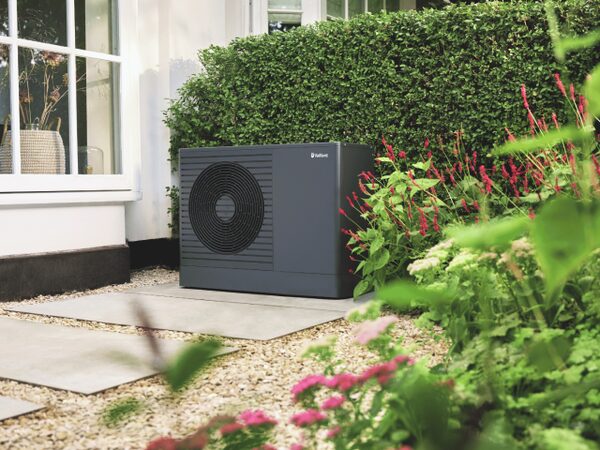
Timing is set by scheme rules and tax treatment, not by the household's convenience. The Boiler Upgrade Scheme offers grants of up to £7,500 towards heat pump installation until 202827. The 0% VAT rate on installing energy-saving materials, including heat pumps, runs until March 202728.
Scotland has its own funding timeline. The Scottish Government's Heat Pump Skills Fund is available until 31 March 202729. The Scottish Government is also committed to prohibiting the use of polluting heating systems across all homes and business premises by the end of 204529.
Wales operates through a different mechanism. Under the Green Homes Wales loan terms, the award of an Installation Grant Offer Letter is discretionary, and there is no guarantee that any particular amounts of Installation Grant will be available for any particular period30. That is a material difference from a scheme with a published budget: in Wales the grant is not something a household can plan around with certainty.
The installer's registration status interacts with all of these. Grant-funded work requires a TrustMark registered installer who remains registered until the work is complete22. A household that signs with an installer who later leaves the scheme has a problem that the deadline does not solve.
Where the installer shortage bites: heat pumps and the skills gap
The constraint on heat pump rollout is not only cost. A lack of qualified heat pump installers is a potential barrier to rollout, as are constraints imposed by planning rules and the need for electricity infrastructure upgrades7. That assessment comes from parliamentary research, and it names the skills gap first.
The scale of what is being asked is set by the target. The Government target is 600,000 heat pump installations a year by 20287. Meeting that requires a workforce that does not currently exist at that size, which is why training funding has been attached to the problem.
The skills gap has a second edge, and it concerns quality rather than quantity. MCS requires installers to provide a design-stage prediction of system efficiency, not to verify actual performance, and MCS does not require remediation of systems that are underperforming relative to their design31. A household can therefore hold a valid MCS certificate for a system that does not deliver what the design predicted, and the scheme does not compel a fix.
That is a limit on what certification means. It confirms the installation met the standard at design and commissioning. It does not guarantee the running costs or the comfort level. For a household weighing independence, the honest position is that certification protects the process, and the performance risk stays with the owner.
If something goes wrong: complaints, remediation and the Find and Fix service

The complaints route depends on what has gone wrong and who is responsible. For energy supply problems, contact the energy supplier about late, incorrect or missing bills, back billing, being overcharged, a faulty meter, poor customer service, and refusing to refund credit from an account32. The Energy Ombudsman provides an independent service, separate to Ofgem, for problems with an energy supplier, an energy broker, a network operator, or a heat network supplier32.
For installation problems, MCS is the first contact for issues with the installation process, the installer, or the MCS certificate or product5. If the complaint is not resolved, the household can approach the MCS Administrator, who will advise how to make a complaint about the MCS installer6. For MCS certified installations, a complaint must be made no more than two years after the date the system was commissioned5.
The Feed-in Tariff route has its own clock. If a domestic or micro business FIT generator has not reached a mutually agreeable outcome after 8 weeks, the Energy Ombudsman can be approached6.
In Northern Ireland, the Consumer Council gives free advice and can investigate complaints about natural gas and electricity33. In England and Wales, the Citizens Advice consumer service can help with problems with energy bills or supply, and may refer a household to the Extra Help Unit where a complaint is difficult or urgent, the household cannot deal with the supplier alone due to personal circumstances, is considered vulnerable, or is at risk of disconnection34. Energy suppliers also refer customers struggling to pay bills to organisations such as Advice NI for free, independent debt advice33.
What owning the installation means afterwards: certificates, registration and handover
Ownership is proved by documents. A registered installer is approved to carry out the work so that it complies with building regulations without involving local authority building control, and a certificate is issued on completion12. For electrical work, the competent person should provide a completed Electrical Installation Certificate showing the work was tested for safety35.
The installer's obligation does not end at commissioning. Under the Boiler Upgrade Scheme, the installer must remain registered with TrustMark until the installation work has been completed22. That condition exists because a certificate issued by a business that has left the scheme is harder to rely on.
MCS may contact a property owner for a short, routine verification on behalf of Ofgem, by email or by telephone on 0333 103 8198, and property owners should aim to respond within seven days27. MCS can also be reached on 0333 103 813027. This is a verification of the installation, not a sales approach.
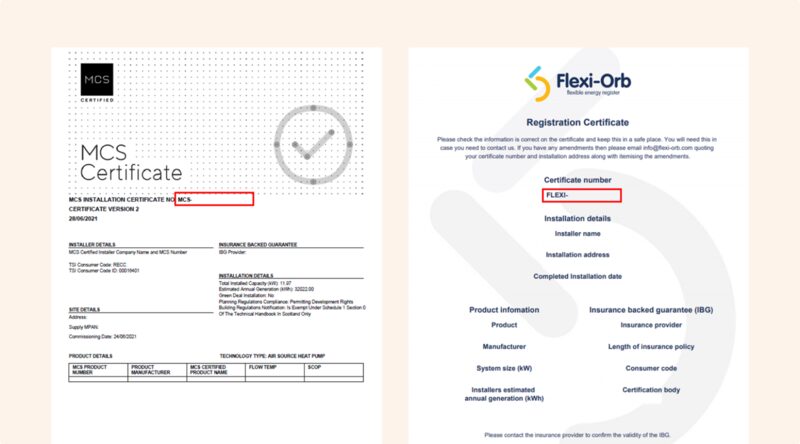
What the household keeps is the basis of its independence: the certificate, the handover documents, the registration record, and the knowledge of which scheme the installer belonged to. Those documents are what a future grant application, insurance claim or house sale depends on. Without them, the equipment still works, but the household cannot prove how it was installed or to what standard.
Sources35 cited
- Consumer protection and energy schemes, House of Commons Library, 2026
- ECO4 Flex and GBIS Flex information document, Ceredigion County Council, 2025
- Great British Insulation Scheme delivery guidance, Ofgem, 2023
- Solar panels, London Borough of Hammersmith and Fulham, 2025
- Domestic Renewable Heat Incentive: who to contact, Ofgem, 2026
- Feed-in Tariffs: dispute resolution, Ofgem, 2026
- Heat pumps, Parliamentary Office of Science and Technology, 2026
- Building regulations: general information, Planning Portal, 2026
- Do I need building regulations approval for electrical work?, Planning Portal, 2026
- Electric vehicle charging: building regulations, Planning Portal, 2026
- Windows and doors, Energy Saving Trust, 2026
- Doors and windows: building regulations, Planning Portal, 2026
- Building regulations: boilers and heating, Welsh Government, 2026
- Building regulations: biomass fuelled appliances, Welsh Government, 2026
- Draft heat in buildings strategy, Scottish Government, 2021
- ECO4 delivery guidance version 4.0, Ofgem, 2026
- WMCA devolved retrofit pilot FAQs, West Midlands Combined Authority, 2026
- HEETSA partial business regulatory impact assessment, Scottish Government, 2025
- Boiler Upgrade Scheme guidance for installers, Ofgem, 2026
- Solar photovoltaic (PV) panels, Wirral Council, 2026
- Wind turbines: building regulations, Planning Portal, 2026
- Boiler Upgrade Scheme, Ofgem, 2026
- Domestic RHI annual report, scheme year 11, Ofgem, 2025
- TrustMark and DESNZ meeting minutes, Public Accounts Committee, 2026
- Plug-in solar panels, Electrical Safety First, 2026
- Solar photovoltaic (PV) panels, London Borough of Bromley, 2026
- Boiler Upgrade Scheme guidance for property owners, Ofgem, 2026
- Find an installer, Vaillant, 2026
- Heat pump training, Energy Saving Trust, 2026
- Green Homes Wales loan standard terms and conditions, Development Bank of Wales, 2026
- Heat pump transition report, Department for Energy Security and Net Zero, 2026
- Complain about your energy supplier or network operator, Ofgem, 2026
- Advice if you're struggling to pay your energy bills, nidirect, 2026
- Complain about your energy supplier, Ofgem, 2026
- Building regulations: electrics, Welsh Government, 2026
 Energy Independence and MakersWhich brands let you keep control of your heating, solar or car charging, and which tie you to their app and their cloud?
 Builders' Merchants and TradeWondering whether you can buy a boiler, heat pump kit or the parts for an outdoor cable run from a builders' merchant rather than through an installer?
 Energy Independence RulesExamines how the regulatory framework helps or hinders a household trying to generate, store and use its own energy, from connection rules to export arrangements and metering obligations.
 Suppliers and IndependenceCan you really cut your energy bills by making your own power, and how much of your supplier do you still need?
 Local Control vs the CloudCan your solar, battery or charger still work if the maker's app or servers disappear?
 National Home Energy InstallersWho actually turns up to fit your boiler or solar panels when you book with a big national company?