

In this guide
NAPIT Registration is authorised by the government to operate Competent Person Schemes in support of self certification against the Building Regulations in England and Wales1. In plain terms, a NAPIT registered installer can sign off their own notifiable work as compliant, without a building notice or an approved inspector, and the householder receives a Building Regulations Compliance Certificate as evidence. NAPIT itself is a certification body and training provider with over 20,000 members in the electrical industry2.
That authorisation is the whole point of registration for a householder. Competent person schemes are described by government as a way for tradespeople to prove their ability to carry out certain work to required standards, instead of you applying for building regulations approval3. Work self-certified through a scheme does not have to be checked by a local council or by a private approved building inspector4. Schemes also carry insurance-backed warranties and complaints procedures if there is a problem with the work3, and NAPIT's own schemes require that installers warrant relevant work for a period of at least 6 years5.
Registration is not, however, a blanket badge of quality across every trade. It is granted by scope: a business certified for electrical work is not thereby certified for heating, ventilation or microgeneration. Membership of a competent person scheme is voluntary for installers4, and an unregistered installer can still do the work lawfully, provided building control is engaged and a notification fee is paid6. The checks that matter to a household are therefore whether the business is certified, and whether it is certified for the specific work being bought.
What registration means for a household buying energy work
NAPIT defines a member as a business or tradesperson who has demonstrated their competence, holds the necessary insurances and has the right processes and procedures in place to assure compliance10. It describes itself as a leading Government-approved membership scheme operator7. Registration therefore bundles three things a household would otherwise have to arrange or verify separately: a competence assessment, valid insurance, and a route to notify building control.
For home energy work specifically, the practical consequences are narrow but real. A solar installer registered under an approved competent person scheme for microgeneration removes the need for a building regulations application for panels on a roof11. Installers accredited by NAPIT can also submit a building regulations application on the householder's behalf where one is required12. For heat pumps, a registered competent person is expected to install and commission the system to the standards set out in the approved document, and to give a copy of the Building Regulations compliance certificate to the occupier13.
The independence angle is worth stating plainly. Registration does not make a home less dependent on the grid, a supplier or a manufacturer. What it does is protect the legal and documentary standing of the kit that delivers that independence: an unnotified consumer unit change, an uncertificated solar array or an undocumented heat pump becomes a problem at sale, because the certificate will also show up in solicitors' searches if you come to sell your home3. It also gives a household a defined escalation route when work is defective, in place of a purely contractual dispute.
Competent Person Schemes: the legal basis for self-certification
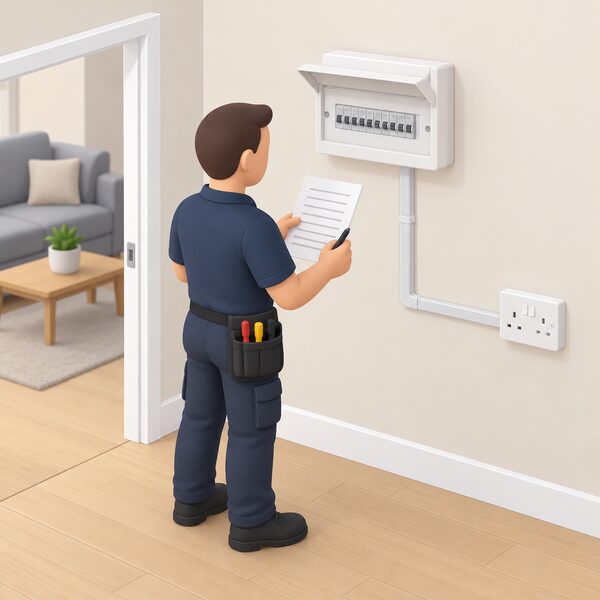
A competent person scheme allows an installer registered with it to self-certify that their work complies with building standards3, and this is instead of getting building regulations approval4. For electrical work, Welsh government guidance is specific: the electrician must be registered by an organisation authorised by the Secretary of State and be able to certify the work as safe without notifying building control, and the local authority is then notified about the work by the electrician14.
NAPIT is one of several authorised operators. Government guidance names NAPIT, ELECSA and NICEIC among competent person schemes relevant to solar work11. For mechanical ventilation and air conditioning systems in dwellings the registered schemes are BESCA, Blue Flame Certification, Certsure and Napit15. For renewable technologies including heat pumps there are currently six registered competent person schemes: APHC, BESCA, Certsure, HETAS, NAPIT and OFTEC15.
Two limits on the legal basis deserve emphasis. First, the authorisation is for England and Wales1; Scotland operates a building warrant system and Northern Ireland its own arrangements, so a NAPIT certificate does not carry the same statutory self-certification effect there. Second, scheme membership is voluntary, and installers who do not join can still use local council or private inspectors if they prefer4. Choosing a registered installer is a route through the regulations, not the only lawful route.
Different trades have their own designated schemes, and NAPIT does not displace them. Gas appliances should be installed and maintained by an engineer on the Gas Safe Register16. Oil fired and solid fuel fired boiler installers should be registered with the relevant Competent Person Schemes6, and for a log burner official guidance recommends a HETAS-registered installer who can certify the work18. Related detail sits on competent person schemes, Gas Safe registration and HETAS registration.
What NAPIT registration covers: electrical, heating and renewables
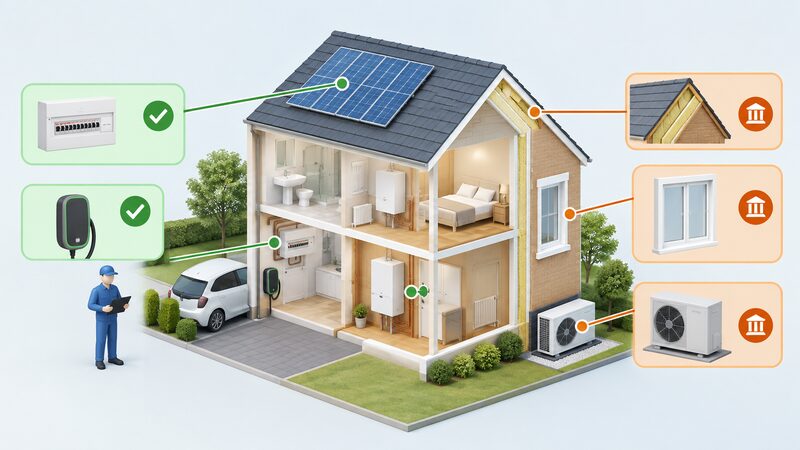
NAPIT reports over 20,000 registered installers working across electrical, heating, plumbing, ventilation, microgeneration, and building trades7. On the consumer side it groups certification into notifiable electrical work and into heating, plumbing, ventilation and air-conditioning, windows, doors, roofing and insulation, plus small scale renewable energy work1.
| Work type | What registration allows | Source type |
|---|---|---|
| Notifiable electrical work in dwellings | Self-certification; local authority notified by the electrician14 | Official |
| Heating, plumbing, ventilation and air conditioning | Compliance certificate posted within 30 days of completion1 | Independent |
| Solar PV on a roof | No building regulations application needed if the installer is from an approved microgeneration CPS11 | Official |
| Heat pumps and other renewables | One of six registered competent person schemes for renewable technologies15 | Official |
| Windows, doors, roofing, insulation | Certificate showing the work was done by a registered installer19 | Official |
Scope also moves over time. From 1 October 2026, businesses certified on an electrotechnical scheme will be required to hold specified qualifications for electric vehicle charging equipment, solar photovoltaic systems and electrical energy storage systems20. That is the direction of travel for household low carbon kit: the competence bar for the work that underpins self-supply is being raised, not relaxed.
NAPIT also publishes technical guidance for its sector. Its Practical Guide: Solar Photovoltaic Systems & Battery Storage A4:2026 is aimed at electricians and renewable contractors and covers expected performance, PV self consumption and grid independence, array mounting and roof interactions, cable type, location, connections, inspection and testing, alongside health and safety, the Wiring Regulations and British and Harmonised standards21.
NAPIT's scale, and how it sits against other schemes
NAPIT reports over 20,000 members in the electrical industry2, and an earlier account of it as an electrical competent person scheme with over 16,500 registered businesses8. The two figures are not in conflict: one counts members and the other counts businesses, and they are dated differently, the businesses figure from 20228 and the membership figure from 20262. NAPIT Certification is accredited by the United Kingdom Accreditation Service (UKAS) to certificate installers across a wide range of schemes5.
| NAPIT | NICEIC | |
|---|---|---|
| Reported size | over 20,000 members in the electrical industry2 | over 40,000 currently certified businesses22 |
| Who is certified | businesses and tradespeople demonstrating competence10 | businesses, not individuals, unless they are a sole trader22 |
| Trades assessed | electrical, heating, plumbing, ventilation, microgeneration, building7 | electricians, plumbers, renewable energy installers, and gas and heating engineers22 |
| Consumer remedy | no compensation or funding of third party rectification9 | under the Platinum Promise, NICEIC will step in and address issues with technical standards, subject to its terms and conditions23 |
Both bodies appear on official lists of competent person schemes for the same work11, so for Building Regulations purposes the choice between them does not change the household's legal position. Where they differ is in the consumer remedies each offers beyond the member's own obligations, and in who exactly is certified. NICEIC registration and the NICEIC Platinum Promise are covered separately.
How installers are checked: assessment, insurance and inspection
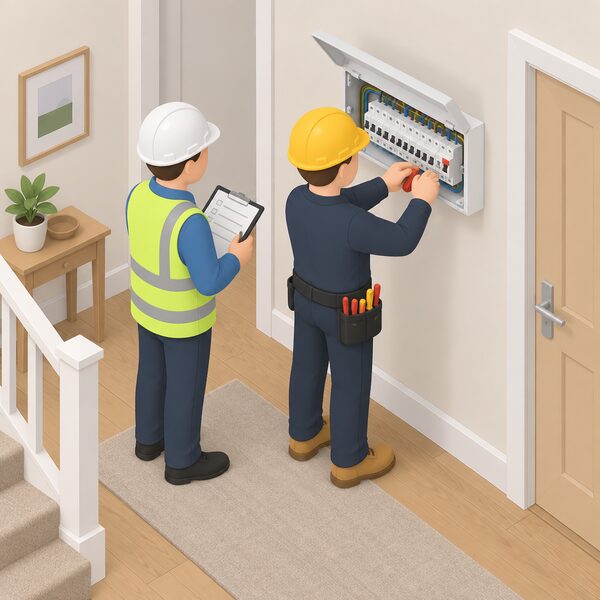
Approval is not a paperwork exercise. Government guidance states that an applicant's work will be assessed to check the installer meets the level of competence required before approval4. NAPIT members are required to hold valid insurances and are regularly assessed to provide assurance of their ongoing competence1.
After approval, there will then be ongoing inspections, yearly for the first 2 years4. Schemes have different application processes and different fees, and an installer is expected to choose a scheme that supports their trade or types of work4. That last point explains why scope matters so much on the consumer side: a business joins for the trades it actually performs, and the certification covers no more than that.
Qualification requirements are tightening. The revised Electrotechnical Assessment Specification takes effect on 1 October 2026, and from that date businesses certified on an electrotechnical scheme with any certification body will be required to hold qualifications covering electric vehicle charging equipment, solar PV systems and electrical energy storage systems20. For households commissioning batteries, chargepoints or solar, this is the clearest formal competence requirement attaching to the electrical side of the install. More on the underlying credentials sits on installer qualifications and training.
Certificates and compliance: what should arrive after the work
When work is complete you will receive a certificate showing the work was done by a registered installer19. A registered installer will be approved to carry out the work to comply with building regulations without involving local authority building control, and a certificate is issued on completion24. That certificate can be used as evidence of compliance3.
The timing is where the documents diverge. For notifiable heating, plumbing, ventilation and air-conditioning, windows, doors, roofing and insulation work, and for electrical work, NAPIT states the installer notifies NAPIT and a Building Regulations Compliance Certificate should be posted to the householder within 30 days of completion1. For small scale renewable energy work, NAPIT states a certificate should arrive within 30 days of completion whether or not the work is done under MCS1. Approved Document L gives the same 30 day period for heat pump work13. General government guidance on competent person schemes, however, says the scheme will give you a certificate within 8 weeks of completion3. Both figures are official or scheme-issued; the documents set different outer limits.
"Give a copy of the Building Regulations compliance certificate to the occupier"
Approved Document L also requires that the certificate, or a copy of the information on it, is given to the building control authority13. Where building control is involved directly instead, the local authority issues a Building Regulations completion certificate, or a registered building control approver issues a final certificate, once it has decided the work meets all the Building Regulations requirements13. For solar, installers should provide a certificate for the electrical installation and make the notification to building control via their certification body such as NAPIT12. NICEIC notes that for smaller jobs a Minor Electrical Installation Work Certificate would generally be expected shortly after the electrician finishes the job22.
The complaints procedure, and what it will not do

NAPIT can investigate complaints made against NAPIT registered businesses and registered tradespeople where a lack of technical competence is a concern9. The process applies when a company certificated by NAPIT has been contracted or subcontracted to carry out work covered by the scope of their certification, and a complaint may be made by any person who has had work completed by a member who was certified for the relevant scope of work at the time25. It is NAPIT's policy to review all complaints with impartiality25.
The sequence is defined:
- The consumer or their representative must have formally contacted the member directly and allowed a minimum of 14 days for the member to acknowledge the complaint25.
- The complaint is submitted using the complaints form found on the NAPIT website25.
- Receipt is acknowledged within 5 working days, and the standard of service is that any communication will be responded to within 10 working days, unless this is outside NAPIT's control25.
- Where further investigation is required, this may be completed via desktop review or inspection25. Site inspections are not always necessary and are at the discretion of NAPIT9.
- Non-routine matters that fall outside of procedure are referred to the NAPIT Compliance Panel25.
Where a consumer acts through someone else, NAPIT requires evidence of authority for a representative to act on their behalf25.
Two further limits bind the outcome. Rectification work should be done without further charge, providing it was included in the original contract of work9. And NAPIT can only require the scheme member to make an installation compliant at their expense: if the householder will not allow them back, NAPIT's involvement can go no further, except action over safety or non-compliance with the Regulations9. A household that has lost confidence in the installer, which is common in exactly these disputes, may therefore find the scheme remedy unavailable in practice.
The process also excludes work carried out as part of the plan for a new build property constructed within the last ten years25. Complaints about NAPIT's own handling must first be raised to the complaint handler assigned to the case25. NAPIT shares data with government departments, enforcement authorities, consumer protection organisations, technical experts, manufacturers, scheme owners, legal counsel and other certification or registration bodies25; it cannot remove personal data while a complaint is ongoing, or if a guarantee related to the complaint has not yet expired25, and data access is available by making a Subject Access Request25.
For comparison, NICEIC's route allows a consumer to complain to NICEIC if the contractor does not respond or the proposed resolution is unsatisfactory, with the consumer facilitating any necessary site visits if an NICEIC inspector needs to review the installation26. Where insulation is involved, a separate complaint about the installation follows the steps set out in the TrustMark complaints process27. Escalation generally is covered on complaining about an installer and the step-by-step on how to complain about a NAPIT registered installer.
Sanctions and enforcement
Scheme membership has teeth only if it can be withdrawn. NAPIT reported that in the past year, over 450 sanctions had been taken to support compliance, ranging from additional inspection and formal action through to 92 certification withdrawals8. That account dates from 2022, and no more recent figure is published here.
Sanctions connect directly to the complaints process: if rectification work is not done satisfactorily, or no resolution was agreed, the installer may jeopardise their NAPIT certification9. What a complainant will not learn is the detail. Where sanctions are imposed on a member's certification, NAPIT can share the status of the membership, but the specific details as to any sanctions imposed will not be disclosed to the consumer or their representative25.
The result is asymmetric. A household can find out whether a business is still certified, which is the fact that matters when deciding whether to trust a quote or an outstanding guarantee, but not what has been found against it. Certification status is the check available; a disciplinary history is not.
NAPIT and the MCS Installer Scheme

Competent person registration and MCS certification answer different questions. A competent person scheme answers the Building Regulations question; MCS answers the renewable technology quality and grant eligibility question. MCS certification ensures that certified installers install renewable technologies to industry-recognised standards, and that they only use renewable technologies that have been tested for quality, reliability and performance in line with MCS Product Standards28.
MCS certification is what funded schemes require. Under the Domestic Renewable Heat Incentive, an eligible renewable technology must be installed and commissioned by an MCS certified installer who can provide an MCS certificate29. In Northern Ireland, renewable technologies installed under NISEP require installers to be registered with MCS30. The Warm Homes: Local Grant looks for certification on the MCS Installer Scheme for low carbon technology installations like heat pumps, solar panels and battery storage20. The Energy Saving Trust advises that reputable renewables installers should be certified under the Microgeneration Certification Scheme, and points households to a finder for MCS accredited installers in their area31.
NAPIT registration and MCS certification are commonly held together by the same firm, but neither implies the other. NAPIT's own consumer guidance is explicit that a Building Regulations Compliance Certificate should arrive within 30 days for small scale renewable energy work whether or not the work is completed under MCS1. A household buying solar or a heat pump with grant funding needs both documents for different purposes. See MCS certified installers and installer requirements for grants.
Checking registration before the contract is signed
The check to make is not "is this firm registered" but "is this firm registered for this work". Official guidance puts it directly: you are advised to check your installer is a member of a scheme covering the work they will be undertaking11. For boilers, compliance is generally achieved by employing an installer who is registered under an approved scheme6. For electrical work in homes and gardens, most work requires using an installer registered with a competent person scheme or seeking approval from a building control body14. For windows, choosing an installer registered to a competent person scheme is the straightforward way to ensure the windows are fitted to building regulations32.
Registration with other bodies may also be required, depending on how the work is funded:
- Grant and loan schemes commonly require TrustMark registration. Under the Warm Homes: Social Housing Fund, all installers are required to be TrustMark registered, or equivalent, and compliant with the corresponding requirements set out on TrustMark's website33.
- Green Homes Wales loan terms require the installer to be registered with TrustMark and the relevant body for the type of eligible measure, to comply with relevant PAS certification, to remain registered until the installation work has been completed, and not to be the borrower or a member of the borrower's household or immediate family34.
- TrustMark is also described as a competent person register for finding an installer that will assess your circumstances and property to identify suitable measures35.
If the installer is not in an approved competent person scheme, the consequences are defined rather than fatal: the installer will not be able to self-certify that their work is compliant6, building control must be engaged and a notification fee paid6, and where the plans or building notice route is used an Electrical Installation Certificate must be provided when work is finished36. For windows, using an installer who is not registered with a scheme means applying for building control approval before installing the window32. Government guidance nevertheless states it is best to use an installer registered with a competent person scheme who can self-certify compliance37.
For the household, that is where registration meets independence. The panels, battery, chargepoint or heat pump reduce reliance on imported energy; the certificate is what keeps that equipment lawful, saleable and supported by a route of redress. Neither the scheme nor the certificate removes the dependence on the installing business itself, which remains the party responsible for remediation, nor on the manufacturer behind the equipment. Further reading sits on the installers and retailers guide and on checking an installer before you sign.
Sources37 cited
- NAPIT consumer advice, NAPIT, 2026-09-17
- NAPIT on pay-per-mile proposals for electric vehicles, NAPIT, 2026-02-24
- Building regulations approval: use a competent person scheme, GOV.UK, 2026-09-17
- Building regulations competent person schemes, GOV.UK, 2026-09-17
- NAPIT advice for households, NAPIT, 2026-09-17
- Building regulations: boilers and heating, Welsh Government, 2026-09-17
- NAPIT welcomes Climate Change Committee report, NAPIT, 2025-02-26
- The importance of registration for electrical inspection and testing, NAPIT, 2022-10-03
- NAPIT frequently asked questions, NAPIT, 2026-09-17
- NAPIT glossary of terms, NAPIT, 2026-09-19
- Installing solar panels on your home, Brighton and Hove City Council, 2026-09-17
- Building regulations guidance for renewables, Bedford Borough Council, 2026-09-17
- Approved Document L, Volume 1: Dwellings, GOV.UK, 2026
- Building regulations: electrics, Welsh Government, 2026-09-17
- Future Homes and Buildings Standards consultation response, GOV.UK, 2026-03
- Gas safety and carbon monoxide, nidirect, 2025-11-24
- Boilers and heating: building regulations, Planning Portal, 2026
- Building control for refurbishing a dormer roof with insulation, Planning Portal, 2026
- Building regulations: doors and windows, Welsh Government, 2026-09-17
- What the Warm Homes Plan and Future Homes Standard mean for installers, NICEIC, 2026-04-23
- NAPIT Practical Guide: Solar Photovoltaic Systems and Battery Storage A4:2026, NAPIT, 2026-09-17
- Householders and landlords help hub, NICEIC, 2026-09-17
- How to work with your tradesperson, NICEIC, 2026-09-17
- Doors and windows: building regulations, Planning Portal, 2026
- Complaints against members policy, NAPIT, 2026-09-20
- Consumer complaints resolution process, NICEIC, 2026-09-17
- What to do if you have poor quality wall insulation, GOV.UK, 2025-01-23
- Why MCS certification matters, MCS, 2026-08-17
- Domestic Renewable Heat Incentive: applicants, Ofgem, 2026
- NISEP list of schemes 2026-27, Utility Regulator Northern Ireland, 2026-04
- Cold calling: tips to avoid rogue traders and installers, Energy Saving Trust, 2026-05-20
- Windows and doors advice, Energy Saving Trust, 2026-05-20
- Warm Homes: Social Housing Fund wave 3 scheme guidance addendum, GOV.UK, 2026-06
- Green Homes Wales loan standard terms and conditions, Development Bank of Wales, 2026-09-17
- Energy Company Obligation scheme and home energy efficiency, Leeds City Council, 2026-09-20
- Electrical safety and building regulations, Cumberland Council, 2026-09-17
- Electrics: building regulations general information, Planning Portal, 2026
 Using an Installer in EnglandHow do you check an installer is registered to sign off their own work, and what happens if they are not?
 Checking an InstallerBefore you sign anything, how do you know your installer is genuine?
 Installer in Northern IrelandHow do you check an installer in Northern Ireland is properly registered, and who do you complain to if the work goes wrong?
 Competent Person SchemesIf a tradesperson says they can sign off their own work, how do you know they are genuinely registered?
 Installing Heating ControlsSwapping a thermostat or programmer looks simple, but which jobs can you safely do yourself and which need a registered installer?
 Manufacturer Approved NetworksDoes an approved installer badge mean better work, or just a longer warranty on the boiler or heat pump?