

In this answer
Short answer
A complaint about a TrustMark registered business runs through a defined three stage process, and the first stage is not TrustMark at all. TrustMark's own guidance sets out a 3 stage process for resolving complaints: contact the business and explain your concerns, then, if no satisfactory resolution is reached, escalate the complaint to the business's Scheme Provider1. TrustMark's role is not to investigate specific consumer complaints but to ensure that the Scheme Provider has handled the complaint appropriately, correctly and in accordance with their dispute procedures2.
That distinction shapes everything that follows. TrustMark is the Government Endorsed Quality Scheme covering work a consumer chooses to have carried out in their home, and it holds the right to suspend or remove Registered Businesses from the scheme3. It does not award compensation, and consumers are not entitled to compensation specifically under the TrustMark Scheme from the Department for Business and Trade, TrustMark, Scheme Providers or Registered Businesses, unless legislation states otherwise2.
What a household does have is a route: a written complaint to the business, a referral to the Scheme Provider, a review by TrustMark of how that provider handled matters, and, for funded insulation, a free audit and remedial service where external wall measures are found wanting.
What TrustMark is and what work it covers
TrustMark is the Government Endorsed Quality Scheme which covers work carried out in or around homes8. It is described in the same terms by the Energy Saving Trust, as a government-endorsed quality scheme for work carried out around the home9, and by local authority grant pages, which refer to it as a government endorsed quality scheme10. Its scope is domestic: Scottish Government quality assurance material notes that TrustMark covers domestic work11.
Registration matters most where public money is involved. OFTEC lists access to Government funded installation work as a benefit of TrustMark registration8, and the ECO4 innovation measure rules state that all innovation measures must be lodged with TrustMark (or an equivalent) and delivered by TrustMark (or an equivalent) registered businesses12. In practice this means a household receiving grant-funded insulation or heating work is usually dealing with a business whose registration is a condition of the funding, not an optional badge.
The scheme's stated homeowner benefits are Government Endorsed Quality, robust consumer protection, the TrustMark Online Directory, competent and quality work backed by guarantees, a Customer Charter, Trading Standards integration, free advice and information, and verified consumer reviews13. Scheme Providers sit beneath TrustMark and are responsible for the conduct of their Registered Businesses; they must do their best to help resolve disputes between businesses and their customers, possibly using independent alternative dispute resolution for complex cases2.
For a household's energy independence, registration is a check on the firm rather than on the equipment. It does not make a home self-sustaining, and it does not remove reliance on the grid, a fuel supplier or the manufacturer of whatever is fitted. What it does is attach a named body, a Scheme Provider, to the work, so that a defect has somewhere to go beyond the trader who installed it. That is the practical value: a second party with a contractual interest in the standard of the job.

How to complain: the process step by step
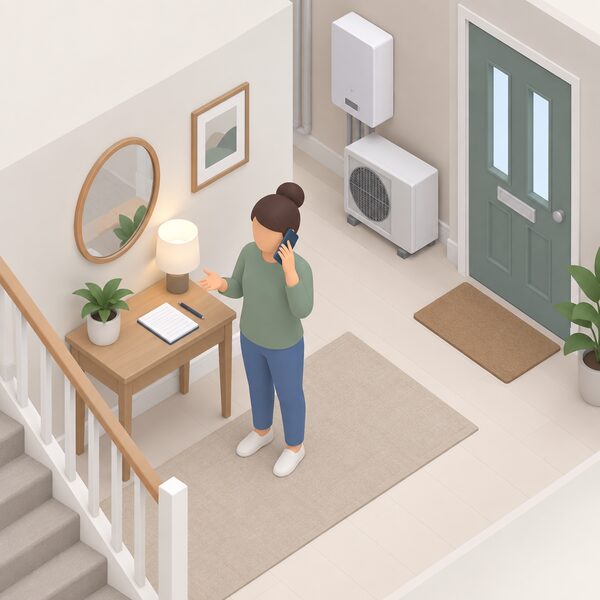
The process is sequential, and skipping a stage is the most common reason a complaint stalls. TrustMark's guidance describes a 3 stage process for resolving complaints1.
- Contact the business and explain your concerns1.
- If you are unable to reach a satisfactory resolution with the business, escalate the complaint to the business's Scheme Provider1.
- If the Scheme Provider does not resolve it, the matter can be referred to TrustMark, which may review whether the correct procedures have been followed by the Scheme Provider14.
Stage 2 is where the substance usually sits. Under the TrustMark Framework Operating Requirements, Scheme Providers are responsible for the conduct of their Registered Businesses and must do their best to help resolve disputes between businesses and their customers, possibly using independent ADR for complex cases2. A Scheme Provider is therefore the body with both the remit and the leverage to press a member firm.
There are four circumstances in which TrustMark cannot take a complaint forward at all: the business was not registered with TrustMark at the time they did the work; the business no longer holds an active registration with TrustMark or has ceased to trade; the complaint is related to a financial or commercial matter, as these are contractual matters between the householder and the business; or legal action has been instigated by either party1.
Where a business has ceased trading, the complaint route closes and a different set of questions opens about deposits, guarantees and unfinished work. The guide to what happens when an installer goes bust covers that position, and the wider escalation route for complaining about an installer sets this process alongside the other schemes.
What TrustMark itself will and will not do about your complaint
TrustMark's role is not to investigate specific consumer complaints but to ensure that the Scheme Provider has handled the complaint appropriately, correctly and in accordance with their dispute procedures1. The HIES consumer code states the same limit in plainer words: TrustMark does not investigate individual complaints or award compensation14.
What it does instead is monitor. All complaints, whether or not they fall within its remit, are considered as part of its ongoing monitoring of Scheme Providers and Registered Businesses, with appropriate action taken if requirements are not met2. TrustMark also undertakes ongoing monitoring of Scheme Providers and, for works lodged in its Data Warehouse, carries out both desktop monitoring and risk-based inspections on works carried out by Registered Businesses15. A complaint that cannot be investigated as a dispute is still evidence about a firm.
The compensation position is worth stating without decoration. Consumers are not entitled to compensation specifically under the TrustMark Scheme from the Department for Business and Trade, TrustMark, Scheme Providers or Registered Businesses, unless legislation states otherwise2. Any money recovered comes from the business, from a guarantee product, or through the courts, not from the scheme.
This is the same division of labour seen elsewhere in consumer protection. Ofgem does not directly get involved with complaints about energy suppliers or network operators, including heat network suppliers and operators, and does not investigate individual disputes16. The Chartered Trading Standards Institute, which runs the Trusted Payments app, states that it does not approve, vet or endorse the individual traders who use the app, and cannot guarantee the outcome of any project, warranty claim or Ombudsman decision17. NICEIC's complaints scope does not extend to complaints relating to the way certified businesses run their business18. A scheme's leverage is over membership, not over the outcome of a private contract.
For a household, that means the complaint is worth making even where no money follows. Suspension or removal from the scheme is a real sanction, and monitoring decisions are taken on the pattern of complaints rather than on any single one.
Escalation beyond the business: the Ombudsman and Trading Standards

Beyond the Scheme Provider, the route depends on what the complaint is about. For disputes with a TrustMark Registered Business, the Dispute Resolution Ombudsman is the escalation body, and its first eligibility condition is that you have raised your dispute with the TrustMark Registered Business, which it labels Stage 11.
The Energy Ombudsman is a different body with a different remit, and it is a common source of confusion. It handles consumer complaints about energy bills, mis-selling, problems with energy supply and problems with switching supplier19. It only handles disputes involving suppliers trading in Britain19, and a complainant must have complained to the supplier already20. Its escalation conditions are that a reported problem is not fixed within 8 weeks, that the householder and the energy company cannot agree on a fix, that a deadlock letter is received, or that the householder is not happy with the decision received21. None of that covers a badly installed heat pump or a defective wall insulation job.
Trading Standards sits alongside both. Local authority trading standards services handle consumer advice on problems with services22, and the Trusted Payments guidance from the Chartered Trading Standards Institute covers paying for home improvements17. TrustMark's own listed benefits include Trading Standards integration13. Where a business is registered with a specialist scheme as well, that scheme may take the complaint directly: OFTEC asks that concerns over the standard of work completed by an OFTEC registered business under the PAS2030 specification or by the government endorsed TrustMark scheme be reported to OFTEC so they can be investigated in accordance with its procedure23.
The redress landscape is not tidy. Ofgem's own consultation material notes that in the third party intermediary market, multiple dispute resolution schemes co-exist and some TPIs are signing up to multiple schemes, complicating the redress landscape for consumers9. A household should expect to identify which scheme a business actually belongs to before assuming a particular ombudsman will take the case.
Warranties and guarantees: the protection that comes with registered work
Every TrustMark Registered Business is required to offer a minimum 2-year guarantee on any works carried out, subject to terms and conditions1. Under ECO4 Innovation rules, all innovation measures must be lodged with TrustMark (or an equivalent) and delivered by TrustMark (or an equivalent) registered businesses2, so the guarantee travels with the measure rather than depending on an individual trader's goodwill. For works completed and lodged under government-funded or capital schemes, a copy of the guarantee information is obtained from the Registered Business first, then their Scheme Provider, then info@trustmark.org.uk3. A complaint needs details of what the problem is4. Scheme Providers are responsible for the conduct of their Registered Businesses under the TrustMark Framework Operating Requirements and must do their best to help resolve disputes between businesses and their customers, using independent alternative dispute resolution for complex cases5. TrustMark lists the wider benefits for householders as government endorsed quality, robust consumer protection, the TrustMark Online Directory, competent and quality work backed by guarantees, a Customer Charter, Trading Standards integration, free advice and information, and verified consumer reviews6. For a household investing in fabric or heating measures, this structure is the practical limit of protection: it covers workmanship and scheme compliance, not the continued trading of the firm that did the work, and it does nothing to reduce the household's reliance on a grid connection or a supplier.
All registered businesses are required to offer a minimum 2-year guarantee on any works carried out, subject to terms and conditions4. For work funded through the Energy Company Obligation, the protection is longer: parliamentary research briefing material records a minimum two-year warranty for work, and a minimum 25-year guarantee for certain measures installed under the ECO5.
Getting hold of the guarantee paperwork is a defined process. For works completed and lodged under government-funded or capital schemes, the Registered Business should have provided the guarantee information; if it did not, the householder contacts the Registered Business, then their Scheme Provider, then info@trustmark.org.uk for a copy of the guarantee information3.
| Protection | Minimum | Applies to |
|---|---|---|
| Workmanship guarantee | 2 years, subject to terms and conditions | Any works carried out by a registered business4 |
| ECO warranty | 2 years | Work under the Energy Company Obligation5 |
| ECO guarantee for certain measures | 25 years | Certain measures installed under the ECO5 |
A guarantee is only as good as the entity standing behind it. Where a business has ceased to trade, a workmanship guarantee from that business is worth little, and the value shifts to any insurance-backed product or to the Scheme Provider. The explanation of insurance-backed guarantees and the guide to workmanship warranties and aftercare set out how those products work and what they do and do not cover.
On the consumer rights side, a warranty or guarantee sits on top of statutory rights rather than replacing them. Citizens Advice guidance on claiming under a warranty or guarantee sets out what a household needs to hand, including details of what the problem is24. That detail is also what a Scheme Provider will ask for first.
The Find and Fix service: free remedial work for insulation

For external wall insulation installed under certain government schemes, there is a route that does not depend on the original installer still trading or still being registered. The TrustMark Find and Fix service offers a free home audit check of external wall measures installed under these schemes, focusing on the safety and technical standards of the work, with any necessary repair work carried out by the installer at no cost to the household7.
The audit is free to the householder, and TrustMark arranges for problems found to be fixed at no cost25. TrustMark is conducting these audits25. Booking uses a separate contact route from the disputes address: onsitebookings@trustmark.org.uk26.
The scheme exists because of a known failure pattern. Age UK's guidance on ECO and Great British Insulation Scheme solid wall insulation issues documents the problems householders have experienced with external wall measures7, and Citizens Advice publishes equivalent guidance on getting help with faulty solid wall insulation, in both English and Welsh27. The Welsh Government has issued a written statement on support for householders impacted by the closure of the Energy Company Obligation scheme and related matters6.
Local authority support varies. Manchester City Council offers a free Home Repairs Support Service29, and Cornwall Council publishes housing financial assistance for private housing30. The Energy Saving Trust describes the Great British Insulation Scheme, also called ECO+, which is the successor funding route for insulation measures25. Bristol City Council publishes grant and loan routes for improving home energy efficiency10, and South Cambridgeshire District Council runs ECO4 Flex10.
"TrustMark will arrange for them to be fixed at no cost to you."
For a household, Find and Fix is the clearest example of what scheme membership buys: a route to remediation that survives the installer. It does not make the home independent of the grid, and it does not compensate for disruption already suffered. It does mean that a defective external wall measure installed under a funded scheme has a named body willing to audit it and a mechanism to have it put right.
Sources30 cited
- TrustMark complaints process, TrustMark, 2026-04-07
- TrustMark roles and responsibilities, TrustMark, 2026-09-20
- TrustMark homeowner FAQs, TrustMark, 2026-09-20
- Retrofit your home, TrustMark, 2026-09-20
- ECO4 Innovation: Approved Innovation Measures, Ofgem, 2026-02
- Written statement on support for householders, Welsh Government, 2026-03-13
- ECO and GBIS solid wall insulation scheme issues, Age UK, 2026-08-26
- TrustMark registration, OFTEC, 2026-09-17
- Review of Ofgem call for evidence, Energy Ombudsman, 2025-02-28
- Get a grant or loan to improve your home energy efficiency, Bristol City Council, 2026
- Heat in Buildings quality assurance statement, Scottish Government, 2022-06-07
- ECO4 Flex open, South Cambridgeshire District Council, 2026-09-17
- TrustMark, CIGA, 2026-09-20
- About TrustMark, HIES, 2026-07-15
- Consumer protection, TrustMark, 2026-09-20
- Complain about your energy supplier, Ofgem, 2026
- Trusted Payments: paying for home improvements, Chartered Trading Standards Institute, 2026-09-20
- Consumer complaints resolution process, NICEIC, 2026-09-17
- Energy Ombudsman FAQs, Energy Ombudsman, 2026-09-19
- Raise a dispute: Npower Business, Energy Ombudsman, 2026-09-19
- Complain about your energy supplier or network operator, Ofgem, 2026
- Problems with services, Isle of Anglesey County Council, 2026-09-17
- How to make a complaint, OFTEC, 2026-09-17
- Claim using a warranty or guarantee, Citizens Advice, 2026-09-17
- What is the Great British Insulation Scheme (ECO+), Energy Saving Trust, 2026-06-18
- Booking your free audit, TrustMark, 2026-06-04
- Get help with faulty solid wall insulation, Citizens Advice, 2026-09-17
- Get help with faulty solid wall insulation (Welsh), Citizens Advice, 2026-09-20
- Home improvement assistance, Manchester City Council, 2026-09-20
- Housing financial assistance, Cornwall Council, 2026-04-01
 Insulation StandardsHow do you know your insulation was fitted to a proper standard, and who backs the guarantee if the installer disappears?
 Insulation Scams and Cold CallsHow funded insulation mis-selling works, from the cold call and the fake 'illegal insulation' claim to spray foam removal bills, plus the TrustMark check, the guarantee position, and where to report a scam.
 When Your Installer Goes BustWhat happens to deposits, part-completed work, workmanship guarantees and complaints when a home energy installation company fails, and how to claim on deposit protection, an insurance-backed guarantee, card or finance cover, and who honours the manufacturer's warranty.
 The Full Installers GuideHow do you find an installer you can trust, and what should you check before signing anything?
 Installer in Northern IrelandHow do you check an installer in Northern Ireland is properly registered, and who do you complain to if the work goes wrong?
 Installer ReviewsCheck whether an installer is signed up to a scheme like MCS or TrustMark before you trust their star rating.