

In this answer
Short answer
The Energy Ombudsman will take a complaint about a supplier once eight weeks have passed since the complaint was first raised, or sooner if the supplier issues a deadlock letter. That eight-week window is the supplier's chance to put things right, and it is the single rule that governs when a household can escalate1.
The clock starts on the date the complaint was first made to the supplier, not the date of the problem. If the supplier sends a deadlock letter before the eight weeks are up, the wait ends immediately and the dispute can be raised straight away2. Once a deadlock letter has been received, the dispute must be escalated within 12 months of that letter3.
The service is free, independent of Ofgem, and covers energy suppliers, energy brokers, network operators, Green Deal providers and heat network suppliers2. It cannot fine a company, but it can require a company to act and can make a financial award, up to £10,000 for domestic disputes4.
The 8-week rule: when a complaint can be escalated
The eight-week period is the standard waiting time before the Energy Ombudsman will accept a dispute. The Ombudsman's own guidance asks consumers to allow the supplier eight weeks to put things right before raising a dispute, unless a deadlock letter arrives sooner1. Its supplier-facing page repeats the point: the supplier has eight weeks to resolve the issue unless it sends a deadlock letter enabling the consumer to come to the Ombudsman sooner7.
The rule is consistent across the sectors the scheme covers. For heat networks, Ofgem's consumer protection guidance confirms that the period after which a complaint can be escalated to the Energy Ombudsman remains eight weeks8. For flexibility service providers, the provider has eight weeks to resolve the complaint unless it issues a deadlock letter9. For Feed-in Tariff generators, a domestic or micro business generator whose complaint has not reached a mutually agreeable outcome after eight weeks can escalate it10.
Independent sources describe the same window. Which? states that suppliers have eight weeks to respond to a complaint before it can be escalated, unless a deadlock letter arrives first11. The Centre for Sustainable Energy gives the same eight-week figure12. Anglesey Council's trading standards guidance tells consumers that if a complaint is not resolved in eight weeks, or a deadlock letter is received, the Energy Ombudsman can be contacted13.
The window is under review. The Energy Ombudsman reported in August 2026 that the complaint escalation timeframe is being reduced from the current eight weeks to six weeks14. A government consultation published in October 2025 proposed reducing the window from 8 weeks to 4 weeks, with exceptions for complex cases15. Neither change had taken effect at the time of writing, so eight weeks remains the operative rule.

Deadlock letters: the shortcut past the 8-week wait

A deadlock letter is the supplier's written statement that the complaint will not be resolved. It ends the waiting period early. The Ombudsman's eligibility checklists across supplier and heat network cases all use the same wording: the complainant has either received a deadlock letter or it has been eight weeks without the complaint being resolved16.
The letter does not remove the requirement to complain to the supplier first. It shortens the wait. The Ombudsman's guidance on creating a case states that the consumer must have allowed the supplier 8 weeks to resolve the dispute or have received a Deadlock Letter allowing earlier escalation18.
Once the letter is in hand, a new deadline starts. The dispute must be escalated within 12 months of receiving the letter3. That is a long window, but it is finite, and it is the consumer's clock rather than the supplier's. A deadlock letter should therefore be kept with its date visible.
"You must escalate your dispute within 12 months of receiving the letter."
Where a supplier never issues a deadlock letter and never resolves the complaint, the eight-week route remains open. The two routes are alternatives, not a sequence: either the eight weeks elapse, or the letter arrives, and whichever happens first allows escalation19.
Who can use the scheme: domestic, small business and microbusiness consumers
Only domestic consumers, micro-businesses and small businesses may apply to the Energy Ombudsman10. The thresholds are set out in the Ombudsman's own eligibility rules.
A microbusiness employs fewer than ten employees, or their full-time equivalent, and has an annual turnover or balance sheet no greater than £2 million, or uses no more than 100,000 kWh of electricity per year9.
A small business has fewer than 50 employees or their full-time equivalent, and an annual turnover of at most £6.5 million or a balance sheet total of £5.0 million, or an annual electricity consumption of not more than 200,000 kWh, or an annual gas consumption of not more than 500,000 kWh1.
| Consumer type | Employee test | Financial or consumption test |
|---|---|---|
| Domestic | Not applicable | Household supply10 |
| Microbusiness | Fewer than 10 employees (or FTE) | Turnover or balance sheet no greater than £2 million, or no more than 100,000 kWh electricity a year9 |
| Small business | Fewer than 50 employees (or FTE) | Turnover at most £6.5 million or balance sheet £5.0 million, or no more than 200,000 kWh electricity or 500,000 kWh gas a year1 |
For flexibility service providers, the Ombudsman can consider disputes where the consumer became aware of the problem on or after 8 December 20259. Heat network disputes have been within the scheme for consumers and small businesses since 1 April 20252.
What the Ombudsman covers: suppliers, brokers, networks, Green Deal and heat networks
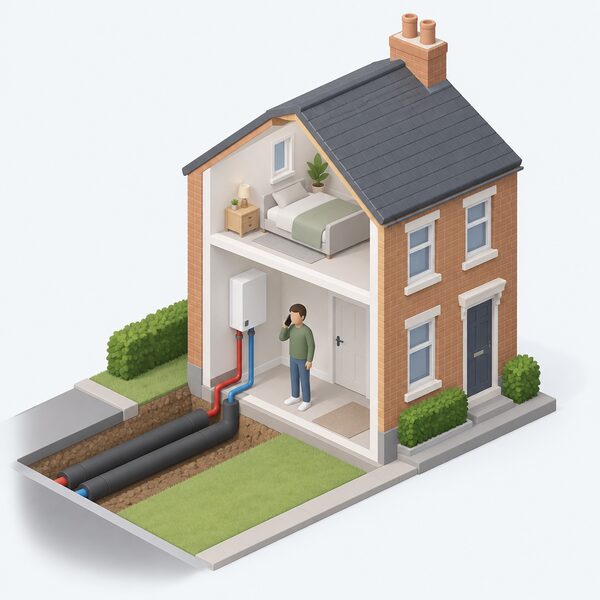
The scheme's scope is wider than household supply. The Ombudsman describes itself as an independent service, separate to Ofgem, for problems with an energy supplier, an energy broker, a network operator or a heat network supplier20. Its general help page lists the same categories: energy supplier, energy broker, network operator, green deal or heat network supplier2.
That breadth matters for households whose complaint is not about a bill. A Green Deal complaint in England and Wales can be referred to Energy Ombudsman services if it has not been resolved within eight weeks21. A Feed-in Tariff generator can escalate an unresolved complaint after eight weeks22. A flexibility service provider, such as a company running a demand-shifting tariff, has eight weeks to resolve a complaint unless it issues a deadlock letter9.
Heat networks are the newest addition. Ofgem's decision guidance states that consumers should first notify their heat supplier and work with it before contacting the Energy Ombudsman, and that the heat supplier has eight weeks to resolve the complaint8. The draft guidance published alongside it uses the same eight-week figure23. The Ombudsman's heat network case pages apply the standard eligibility test: at least eight weeks since the issue was first raised with the supplier, or a deadlock letter, plus sufficient evidence including the date the complaint was raised and a supplier name matching the account holder's bill24.
Where a heat network operator is not listed on the scheme, Citizens Advice publishes guidance on problems with a heat network for consumers in England and Wales25.
What happens after escalation: evidence, decisions and outcomes
Once a complaint is escalated, the Ombudsman asks for information and evidence, reviews evidence from both the consumer and the energy company, informs the consumer of its decision within six weeks, and gives the energy company a set of actions to resolve the problem20. The six-week decision commitment appears in Ofgem's consumer guidance as well27.
The evidence window is short. The Ombudsman allows up to 14 days to upload evidence to support a case3. Cases are accepted only where the complainant has sufficient evidence, including the date the complaint was raised with the supplier, and where the supplier name matches the name on the bill16.
In practice, most disputes are resolved within six weeks of the Ombudsman receiving evidence from both parties4. That is the Ombudsman's own average, and it runs from the point evidence is complete rather than from the date of escalation, so the total elapsed time from first complaint is usually longer.
What the Ombudsman can and cannot do: awards up to £10,000, but no fines
The Ombudsman can require a company to take a set of actions to resolve a problem, and it can offer financial awards. The maximum depends on the sector and the consumer.
| Sector | Maximum award |
|---|---|
| Energy brokers | Up to £10,0004 |
| Energy networks | Up to £10,000 for domestic disputes, up to £20,000 for small business disputes4 |
| Flexibility service providers | Up to £10,000 for domestic disputes, up to £20,000 for micro business consumers4 |
The headline maximum is rarely approached. The Ombudsman states that its average award is around £501. Independent guidance from the Centre for Sustainable Energy puts typical compensation at £50 to £7512.
What the Ombudsman cannot do is stated as plainly as what it can. It cannot punish companies, dictate how companies operate, or issue fines4. A household expecting a regulator's penalty should look instead to Ofgem, which handles licensing and enforcement. The Ombudsman's role is to settle the individual dispute and require the company to put it right.
"Punish companies Dictate how companies operate Issue fines"
Contacting the Ombudsman and the limits of the scheme

The Ombudsman publishes an email address for enquiries, enquiry@energyombudsman.org27. Two telephone numbers appear in the material available, 0845 055 0760 and 0330 440 1624, and the two figures conflict, so the current number should be checked on the Ombudsman's own site before calling. Complaints are raised through the online dispute form.
The scheme's limits are worth stating. It is free to the consumer, but it is not a regulator and it does not set policy. It cannot compel a supplier to change its tariffs or its business model. It works on the individual dispute in front of it, and its decisions bind the company for that case.
For a household's energy independence, the Ombudsman is a backstop rather than a tool of control. It does not reduce reliance on the grid, on a supplier or on gas. What it does is give a household a free, independent route to a decision when a supplier has failed to resolve a complaint within eight weeks, or has issued a deadlock letter. The dependence on the supplier remains; the remedy for a supplier that will not act is what the scheme provides.
Sources28 cited
- We may be able to help resolve your energy dispute, Energy Ombudsman, 2026-09-20
- How we can help, Energy Ombudsman, 2026-09-19
- FAQs, Energy Ombudsman, 2026-09-19
- What to expect, Energy Ombudsman, 2026-09-19
- Complain about your energy supplier or network operator, Ofgem, 2026
- Worried about your energy bills, Energy Ombudsman, 2026-03-24
- Energy suppliers, Energy Ombudsman, 2026-09-20
- Heat networks regulation: consumer protection guidance decision, Ofgem, 2026-01-13
- Information for disputes with flexibility service providers, Energy Ombudsman, 2026-09-20
- Dispute resolution, Ofgem, 2026-09-17
- Energy bills: why you should know about the back billing rules, Which?, 2026-09-20
- How do I make a complaint to my energy supplier?, Centre for Sustainable Energy, 2025-07
- Problems with services, Anglesey Council, 2025-10
- Energy Ombudsman H1 data 2026, Energy Ombudsman, 2026-08-24
- Fairer, faster redress in the energy market, GOV.UK, 2025-10-23
- Cynon Taf Community Housing 2007 Ltd, Energy Ombudsman, 2026-09-19
- Sanctuary Housing Association, Energy Ombudsman, 2026-09-19
- Creating a case with the Energy Ombudsman, Energy Ombudsman, 2026-09-20
- Essential Living, Energy Ombudsman, 2026-09-19
- Complain about your energy supplier or network operator, Ofgem, 2026
- How to complain about your Green Deal energy efficient home improvements, Citizens Advice Scotland, 2026-05-13
- Guidance for FIT Generators V18, Ofgem, 2026-04-01
- Heat networks consumer protections draft guidance, Ofgem, 2025-09-05
- ESP Heat Ltd, Energy Ombudsman, 2026-09-19
- If there's a problem with your heat network, Citizens Advice, 2026-09-17
- If there's a problem with your heat network, Citizens Advice Wales, 2026-09-17
- Complain about your energy supplier, Ofgem, 2026
- British Gas Trading, Energy Ombudsman, 2026-09-19
 Complaining About a SupplierHow do you complain about your energy supplier, and how long should it take?
 Complain About Energy SupplierThe order of a complaint: the supplier's own procedure, the eight-week point or deadlock, and referral to the Energy Ombudsman in Great Britain or the Consumer Council in Northern Ireland.
 Report a Faulty MeterWhat to do when a meter over-records, stops recording or produces impossible readings: the evidence to gather, how to raise it with the supplier, the 5 working day and 8 week deadlines, and how the Energy Ombudsman handles meter disputes.
 Energy Complaints and RedressMaps the routes a householder has when an energy supplier, network operator, broker or heat network gets something wrong, which body handles which dispute, and what the Energy Ombudsman can and cannot do.
 Switching SupplierHow long does switching energy supplier actually take, and what happens if you owe money?
 Final Bills and Credit RefundsHow final bills and credit refunds work when you leave an energy supplier: the six-week deadline for the final bill, the ten-working-day deadline for refunding credit, the twelve-month back billing limit, and the automatic compensation that applies when suppliers miss these standards.