
In this guide
Heating controls are made by three distinct kinds of company in the UK: boiler and heat pump manufacturers that supply matched thermostats and timers for their own appliances, independent controls specialists that build room thermostats, programmers, radiator valves and wiring centres for any system, and technology and energy brands that sell app-driven smart thermostats. The regulatory floor is the same whoever made the device. Approved Document L guidance is that each room should be provided with thermostatic room controls, both in new dwellings and where a heat generator such as a boiler is replaced in an existing home1.
What counts as a complete control package is well defined. A full set of heating controls includes a programmer, thermostatic radiator valves and a room thermostat2, with a cylinder thermostat added where the system stores hot water3. A smart thermostat sits on top of that architecture rather than replacing it, and independent guidance puts the cost of one at around £100 to £250, with installation and VAT treatment depending on how it is bought4. Retail prices for individual models range from £62 for the Habi Wireless Smart Thermostat to £199 for the Google Nest Smart Thermostat E5.
For a household thinking about energy independence, controls are the cheapest lever in the heating system and also the one that creates new dependencies. A dumb programmer and a set of radiator valves depend on nobody. A connected thermostat depends on a manufacturer's servers, a broadband connection and a security support period that the maker itself defines in its PSTI statement of compliance.
Who makes thermostats and heating controls in the UK
The control aisle in a UK merchant is filled by companies with quite different business models. Appliance manufacturers treat controls as an accessory line that locks a system together: Ideal Heating supplies thermostats, timers and accessories for the full range of Ideal boilers and heat pumps8. That approach gives a single point of technical support and a single warranty conversation, at the cost of a package designed around one brand's appliances.
Independent controls makers sell into every system. Drayton states that its Wiser 2nd Generation Radiator Thermostat is manufactured in Britain at the company's Plymouth factory and is available in merchants nationwide9. Domestic manufacturing of this kind is unusual in the sector and matters for spare parts and lead times, though it is a maker's own claim about its own product.
Electric heating manufacturers make their own integral controls, because there is no boiler to interface with. Trust Electric Heating Ltd describes itself as a British manufacturer delivering in the UK, and offers a selection of thermostatic controls with its neos electric radiator, which it states is a UK and internationally patented product10. Emitter manufacturers matter too, because the valve body on a radiator sets what a smart TRV head can fit: Stelrad describes itself as the UK's number one radiator brand11.
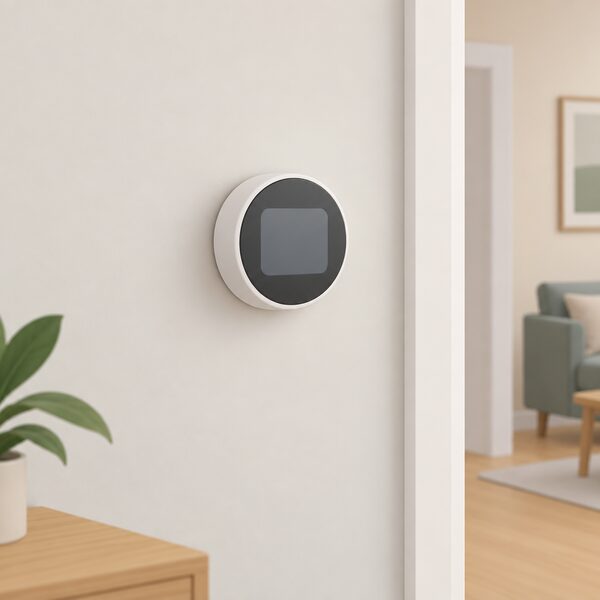
Energy suppliers and technology firms form the third group. British Gas sells smart products from its Hive brands, including smart thermostats, smart plugs and smart light bulbs12. Here the manufacturer relationship, the retail relationship and sometimes the energy supply relationship sit inside one company, which is convenient and also concentrates dependence.
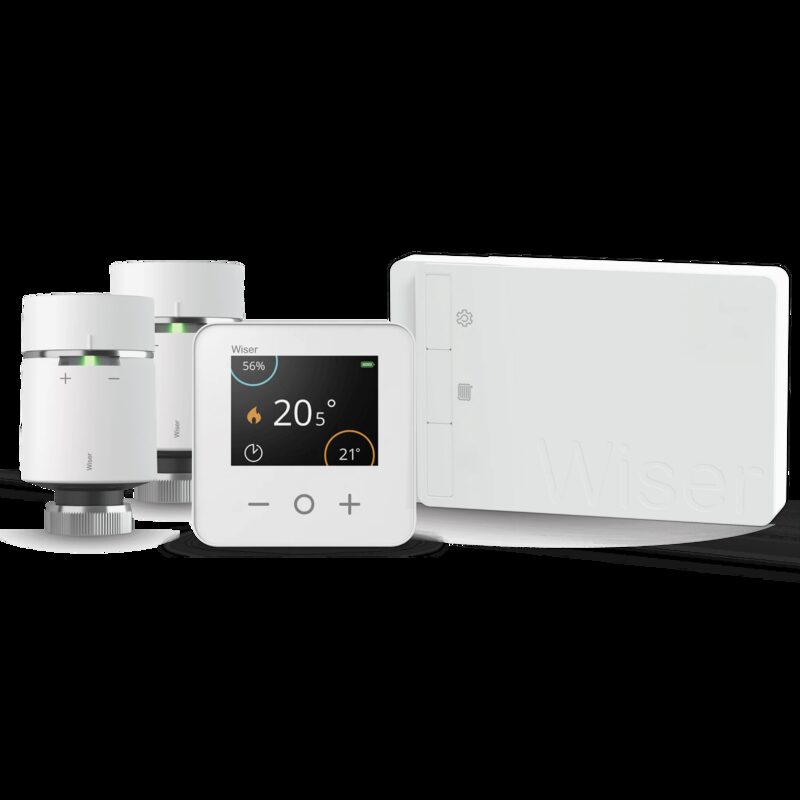
The main manufacturers and what each is known for
| Company | Known for | Key figure |
|---|---|---|
| Ideal Heating | Thermostats, timers and accessories for the full Ideal boiler and heat pump range8 | Controls matched to one appliance brand |
| Drayton | Wiser 2nd Generation Radiator Thermostat, made in Britain at the Plymouth factory9 | Available in merchants nationwide9 |
| Trust Electric Heating | Thermostatic controls supplied with the neos electric radiator10 | British manufacturer delivering in the UK10 |
| British Gas (Hive) | Smart thermostats, smart plugs and smart light bulbs12 | Supplier-owned smart brand |
| Nest Smart Thermostat E5 | £1995 | |
| Worcester Bosch | EasyControl smart thermostat5 | £1705 |
| Habi | Wireless smart thermostat, heating and hot water5 | £625 |
| Stelrad | Radiators, and the valve bodies smart TRV heads fit11 | UK's number one radiator brand11 |
Because most controls are sold with an appliance, the shape of the appliance market shapes the controls market. There are at least 33 manufacturers supplying air source heat pumps in the UK, with Mitsubishi Electric, Vaillant, Daikin and Samsung accounting for nearly two-thirds of total annual UK sales, and Kensa holds 41% of the ground source market as the only UK manufacturer of ground source systems13. The Heat Pump Association's membership covers around 90% of the volume of heat pumps currently sold in the UK market, according to its 2025 supply chain report14, while an earlier statement put the figure at over 85%15; the documents give different figures for different dates. Around 33.5% of hydronic heat pumps sold in the UK are manufactured here on the baseline scenario, against 80% for fossil fuel heating appliances16. A control bought with an imported appliance still depends on an importer's support arrangements in the UK.
Smart controls: what the new ranges offer
A smart thermostat is a device that can be programmed, or remotely controlled, to manage a home's temperature, and most allow multiple routines to be programmed so the home is at the intended temperature through the day17. Most smart heating controls link to a phone and can be operated by smartphone, tablet or laptop, or by a smart speaker18. Smart TRV heads extend the same logic to individual radiators, which is how a single-zone system can be made to behave like several.
The functional gain over a good programmable thermostat is mostly scheduling flexibility, remote override and, in some ranges, geolocation. The gain is real but bounded: setting a thermostat between 18°C and 21°C for comfort and efficiency is the underlying behaviour that drives the bill6, and no app changes the physics of the building fabric.
Smart thermostats have also entered the grant landscape. The ECO4 measures table lists a smart thermostat as a recognised measure type19, meaning the device can appear inside a funded package rather than only as a retail purchase.
Security is the area where smart controls differ most from conventional ones. Which? states that all thermostats in its testing programme go through tests to check how well they protect users from hacking attacks and keep data private, and that concerns are raised with manufacturers5.
Controls for heat pumps: what changes at low flow temperatures

Heat pumps generally operate at a lower temperature than boiler systems20, and the heat produced is generally at a lower temperature than a traditional heating system21. That single fact changes the control problem. A boiler can recover a cold house quickly; a heat pump recovers slowly, so the strategy shifts from short bursts to longer, steadier operation, and controls have to support that.
Heat pump systems are typically controlled by the end user via weather compensation or internal temperature control, such as a room thermostat, together with a timer or programmer to control space heating21. Put another way, the controller adjusts heating schedules, flow temperatures and hot water settings, while the thermostat signals when heating is needed, and the two may be built into the unit or separate22. Many heat pumps also have a heating boost setting that gives a little extra energy when the outside temperature is particularly low, using a little more electricity23.
Building regulations guidance requires that a heat pump system has adequate controls, and that heat pumps and dedicated ancillary products such as integrated hot water storage vessels are commissioned in accordance with both the manufacturer's instructions and the appropriate system design parameters24. Commissioning is where control settings are actually fixed, and getting it wrong has consequences: a poor control system can force even the best heat pump to underperform25.
Appliance makers provide matched controls for this reason. Ideal Heating states that, just like a boiler, heat pumps can be controlled through accessories such as thermostats and timers8. Heat pumps are technically suitable for most UK homes if installed appropriately, and are currently installed in 1% of UK homes26. Nesta's analysis advises against blanket mandates for low-temperature systems, citing enforcement challenges and fraud risk, and notes that requiring low-temperature radiators and pipework at boiler replacement risks adding unnecessary cost if high-temperature heat pumps become the norm27. For controls, the practical reading is that a household replacing a boiler is not obliged to buy heat pump control architecture in advance, though a weather-compensating control and correctly sized emitters will transfer.
Compliance: PSTI statements and what they cover
Any connectable thermostat sold in the UK falls under the Product Security and Telecommunications Infrastructure regime. The statement of compliance is the document that carries this. All information required under PSTI must be included in the statement, a physical copy provided with the product suffices and can be in the packaging or instructions, a digital statement must accompany the product, and use of a summary statement is currently not permitted28.
Responsibility is not a single company's. Government guidance is explicit:
"the manufacturer, importer and distributor must ultimately ensure that the SoC accompanies the product and meets the necessary legal requirements"
Other marks and schemes sit alongside PSTI and cover different things. Heating products sold on the GB market are subject to a mandate to display the UKCA mark30. BSI Kitemark certification in the EV charging space is assessed against the UK Smart Charge Regulation and ETSI EN 303 64531, the latter being the consumer IoT security standard that also underpins thinking on connected home devices. For performance rather than security, the Heat Pump KEYMARK involves checks conducted to determine whether the values indicated by the manufacturer are compliant with the relevant product standards32. NAPIT, commenting on plug-in solar, frames the general expectation that products comply with an approved UK product specification33. More detail sits on our pages covering manufacturer certification and approvals and how energy products are tested.
Matching controls to your heating system
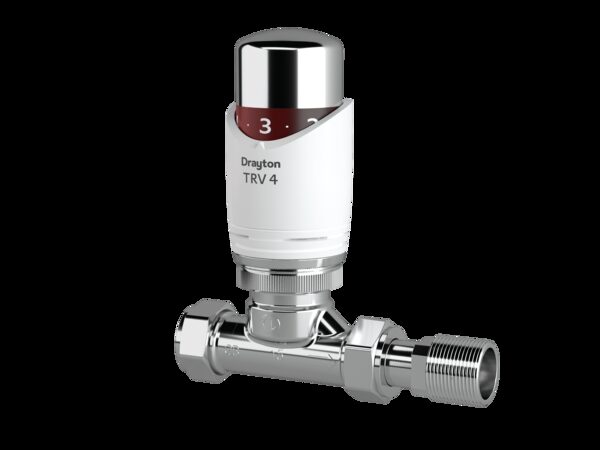
The control package follows the heat source and the distribution system, not the other way round. Cadent's guidance describes a full set of heating controls as a programmer, thermostatic radiator valves and a room thermostat2. Home Energy Scotland's recommended set is a time-controlled programmer, at least one room thermostat, thermostatic radiator valves if the home has radiators, and a cylinder thermostat if the system has a hot water cylinder3.
- Combi boiler with radiators: programmer plus room thermostat plus TRVs; no cylinder thermostat, as there is no stored water3.
- System or regular boiler with a cylinder: the same, plus a cylinder thermostat and usually two-channel time control3.
- Heat pump with radiators or underfloor: weather compensation or room thermostat with timer or programmer, commissioned to the manufacturer's instructions and design parameters21.
- Direct electric heating: control is built into the appliance, as with the thermostatic controls supplied with the neos electric radiator10.
Appliance-brand controls are the simplest route where the appliance is new, because a maker such as Ideal Heating supplies thermostats, timers and accessories across its full boiler and heat pump range8. Independent controls are the route where the appliance stays and the controls are being upgraded. Either way the wiring centre and the valve arrangement determine what is physically possible, which is why the decision is normally made with the installer rather than at the till.
Retrofit: fitting controls to buildings that were not designed for them
Retrofit changes the control question because the fabric is variable and the pipework is inherited. The Retrofit Revisit work at CIBSE, whose key funding partner is Innovate UK34, and the evidence base behind the Welsh Part F review, derived from 75 case studies from the Retrofit for the Future programme and the AECB's Low Energy Buildings database35, both sit on studies of real dwellings rather than modelled ones. That distinction matters: control settings that work in a modelled house frequently do not survive contact with cold bridges and leaky fabric.
Independent research is starting to test control products in that setting. The Centre for Sustainable Energy was commissioned by Passiv UK to research the Passiv Smart Thermostat36, an example of a controls maker putting a product in front of an independent research body rather than relying on in-house figures.
Controls also interact with fabric measures. Insulating render and plaster products such as ProofTherm, listed as available in the UK37, change the response time of a wall and therefore the heating curve a control should follow. A home that has been insulated after its controls were commissioned will usually be running a schedule that no longer matches the building.
Installer skills are the binding constraint on retrofit control quality. Heating manufacturers including Baxi, NIBE, Panasonic, Vaillant, Ideal Heating and Worcester Bosch were expected to offer additional discounts and offers to trainees participating in the heat training grant scheme38, an indication of how closely manufacturer training and installed control quality are linked. Our page on manufacturer installer networks covers how those schemes work.
Room-by-room control and how many zones a home needs
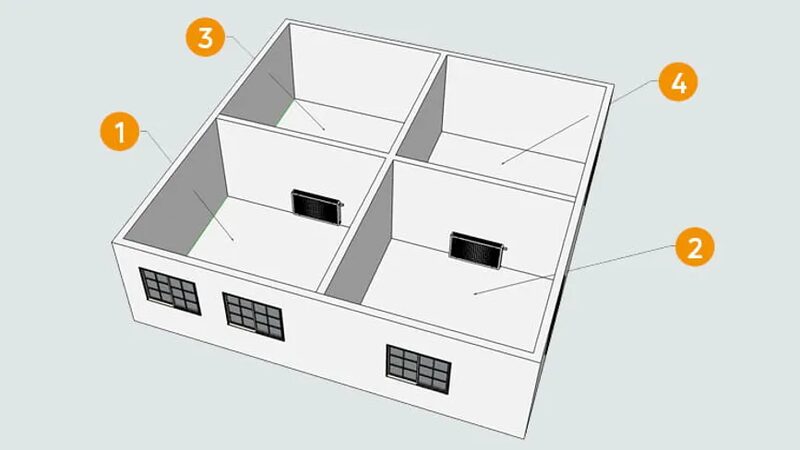
The regulatory answer is clear: each room should be provided with thermostatic room controls, applying to heating systems in new dwellings and when a heat generator such as a boiler is replaced in an existing dwelling1. In a radiator system that normally means a TRV on every radiator except the one in the room containing the room thermostat, so the two controls do not fight each other.
Zoning is a separate question from room control. A zone has its own time and temperature schedule and its own call for heat; a TRV only limits output in one room. The recommended package therefore pairs at least one room thermostat with TRVs throughout, plus a cylinder thermostat where hot water is stored3. Smart TRV heads blur the line by giving each radiator a schedule, which is the main practical reason households fit them.
Temperature setting is the other half of the calculation. Guidance for UK households is to set the thermostat between 18°C and 21°C for comfort and efficiency6. Rooms used differently can sit at different points in that band, which is exactly what per-room control makes possible, and it is where the savings from a well-configured system come from rather than from the device itself.
What tighter heating rules mean for control choices

Control requirements have already tightened. New thermostatic control measures were introduced in 2022 in all the GB regions, applying when a heating appliance, meaning a boiler, electric heating or heat pump, is installed39. Northern Ireland's building regulations discussion document records this, and the position there is set through a separate process, so households in Northern Ireland should check the requirement applying to their own installation.
The direction of travel is set by low-carbon heating policy. All new homes built in England will be required to use low-carbon heating systems, with heat pumps anticipated to be the primary route to compliance for the vast majority of new homes40. Government targets an aim of 450,000 annual installations per year by 2030, with 70% targeted to be manufactured in the UK by 2035; a record 125,000 heat pumps were sold in 2025, a 27% increase over 2024, with approximately 45,000 manufactured in the UK41. Reforms to England's permitted development rights have removed the one-metre boundary rule, increased size limits for units and added flexibility for detached homes42.
Barriers remain. A lack of qualified heat pump installers is a potential barrier to rollout, as are constraints imposed by planning rules and the need for electricity infrastructure upgrades26. Currently 8.6% of UK homes are heated by electricity, generated by traditional storage heaters or modern heat pumps7, so for most households the control decision is still being made around a gas appliance.
One installation rule cuts across brands. The Heat Pump Association's statement on flammable refrigerants explains that manufacturers' manuals may advise different approaches to mitigating possible risks from residential outdoor air-to-water heat pumps containing higher flammability refrigerants, and that installers, specifiers, designers and system owners or operators must follow manufacturer guidance43. Where controls, siting and safety zones interact, the appliance manual takes precedence over any general rule of thumb.
Warranty, registration and who to contact
Controls warranties are administered by the manufacturer, and registration terms are the maker's own. Where a control is supplied as part of an appliance package, as with the Ideal Heating range of thermostats, timers and accessories for its boilers and heat pumps8, the appliance maker is usually the single point of contact for both. Our pages on manufacturer warranties and registering a warranty set out what typically keeps cover valid.
Scheme complaints follow different routes from product faults. For the Boiler Upgrade Scheme, complaints about scheme administration go to Ofgem at feedback@ofgem.gov.uk, and scheme policy complaints go to DESNZ at boilerupgradescheme@energysecurity.gov.uk44. Suspected fraud or misuse of the scheme can be reported to Ofgem at counterfraud@ofgem.gov.uk45. On product standards policy, the government consultation on raising minimum energy performance standards for heat pumps gives spaceheatingstandards@energysecurity.gov.uk as its contact30.
The independence point is worth stating plainly. A programmer, a room thermostat and a set of radiator valves are repairable, replaceable from multiple suppliers and dependent on nobody once fitted. A connected control adds capability and adds a manufacturer, a server and an app to the list of things a warm house depends on. Neither is wrong, but the trade is real, and the declared PSTI support period is the number that tells a household how long the second option will keep receiving attention.
Sources45 cited
- Approved Document L, Volume 1: Dwellings, 2021 edition incorporating 2023 amendments, UK Government
- Energy efficiency advice, Cadent Gas, 2026-09-20
- Thermostats and heating controls, Home Energy Scotland, 2026-09-20
- Boiler prices: how much does a new boiler cost, Which?, 2025-09-17
- How to buy the best smart thermostat, Which?, 2026-09-17
- Energy saving tips for UK households, British Gas Energy Trust, 2026-04-21
- Decarbonisation of heat guide, Energy Systems Catapult, 2025-06-27
- Heating controls, Ideal Heating, 2026-09-17
- Upgraded smart radiator thermostat expands the Wiser 2nd Generation range, Drayton Controls, 2026-09-08
- Trust Electric Heating Ltd, Which? Trusted Traders, 2026-09-17
- Stelrad profile, CIPHE, 2023-03-16
- How to choose the best energy company, Which?, 2026-01-19
- EINAS 2025: heat and buildings, UK Government, 2024
- Heat pump supply chain readiness to deliver net zero homes, Heat Pump Association UK, 2025-02
- HPA reacts to proposal to delay the Clean Heat Market Mechanism, Heat Pump Association UK, 2024-03-14
- From carbon to competitiveness, Heat Pump Association UK, 2026-01
- How a smart thermostat can save you money this winter, Ivie, 2025-11-18
- Smart homes and a lower carbon footprint, Energy Saving Trust, 2026-01-21
- ECO4 measures table v4.0, Ofgem, 2025-07-29
- Heat pumps, Association for Renewable Energy and Clean Technology, 2026-09-17
- Your home guide to heat pumps, OFTEC, 2026-09-17
- Does turning off the heat pump affect heating, Nesta, 2025-01-21
- Heat pump fact check, Energy Saving Trust, 2026-07-01
- Approved Document L, Volume 1: Dwellings, UK Government, 2026
- Why heat pump installations must be done right, Flexi-Orb, 2025-02-11
- Heat pumps research briefing, Parliamentary Office of Science and Technology, 2026-09-19
- Should we be making homes heat pump ready: conclusions, Nesta, 2026-02-12
- Energy and rating labels, Electrical Safety First, 2026-09-19
- Regulations: consumer connectable product security, UK Government, 2024-01-08
- Raising minimum standards for heat pumps: options assessment, UK Government, 2024-11-27
- Kitemark certification for EV charging, BSI, 2026-09-17
- Heat Pump KEYMARK benefits for consumers, Heat Pump KEYMARK, 2026-09-17
- NAPIT responds to the plug-in solar consultation, NAPIT, 2026-07-16
- Retrofit Revisit 2024, CIBSE, 2024-07
- Building Regulations Part L and F review, stage 2A consultation, Welsh Government, 2020-11-25
- Passiv smart thermostat research, Centre for Sustainable Energy, 2025-05-29
- Insulating render and plaster, UK Green Building Council, 2024-04-25
- £5 million heat training grant, CIPHE, 2023-03-02
- Building regulations discussion document and pre-consultation, Department of Finance Northern Ireland, 2023-10-11
- What the Future Homes Standard means for homeowners, NICEIC, 2026-04-22
- Carbon Budget and Growth Delivery Plan: heat and buildings factsheet, UK Government
- How to get homes more ready for heat pumps, Nesta, 2026-02-12
- Statement on R290 safety zone and flammable refrigerants training, Heat Pump Association UK, 2026-05-12
- Boiler Upgrade Scheme guidance for property owners, draft v5, Ofgem, 2026-03-25
- Boiler Upgrade Scheme guidance for property owners v5, Ofgem, 2026-04
 Smart Thermostats ExplainedWhat does a smart thermostat actually do, and is it worth it?
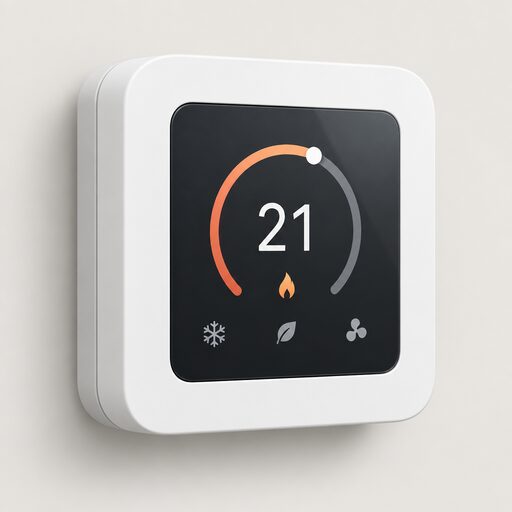 Heating Controls CostA smart thermostat usually costs between about a hundred and two hundred and fifty pounds, but fitting can push that higher.
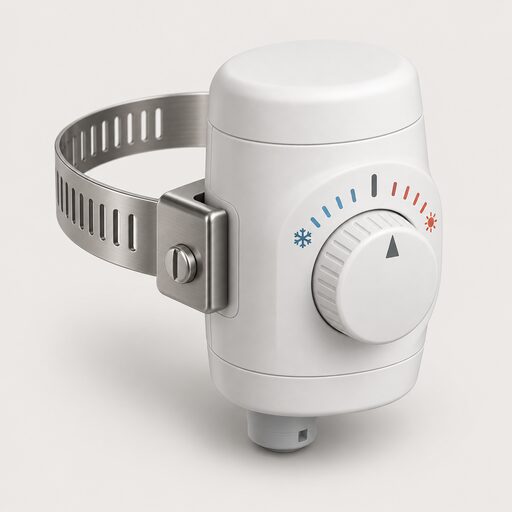 Hot Water Cylinder ControlsWhat temperature should a hot water cylinder thermostat be set to, and does it need its own timer apart from the heating?
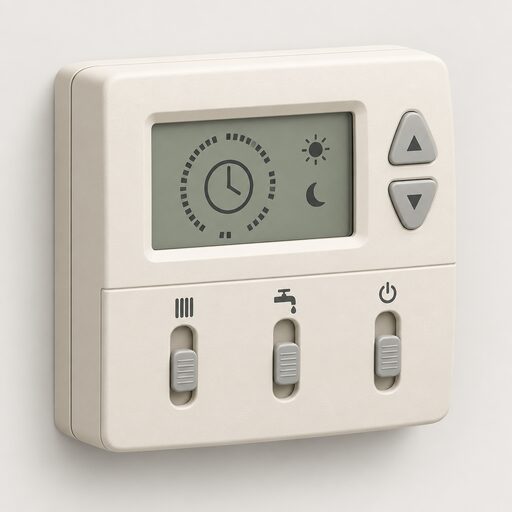 Controls, Thermostats and TRVsWhich heating controls actually cut your bills, and what does each one do?
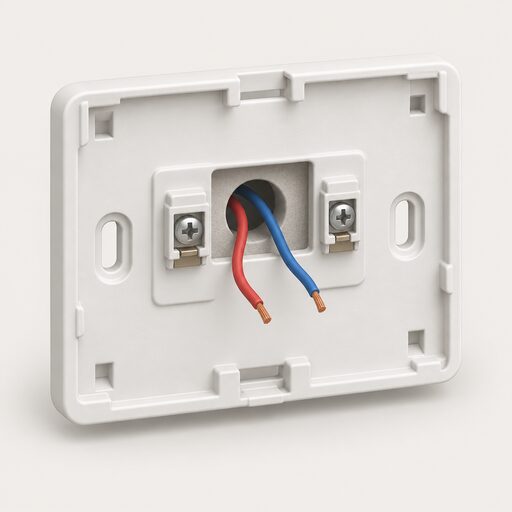 Installing Heating ControlsSwapping a thermostat or programmer looks simple, but which jobs can you safely do yourself and which need a registered installer?
 The Full Heating Controls GuideA room thermostat, a programmer and valves on your radiators are the basics.