
In this guide
Kensa is the only manufacturer of ground source heat pumps in the UK, and the government's own statistics put it at 41% of the UK ground source market as of June 20251. The company makes British-built ground source heat pumps for homes, from a 3kW Shoebox unit to larger Evo and Compact models, and describes them as combining lower lifetime costs with a fit-and-forget experience2.
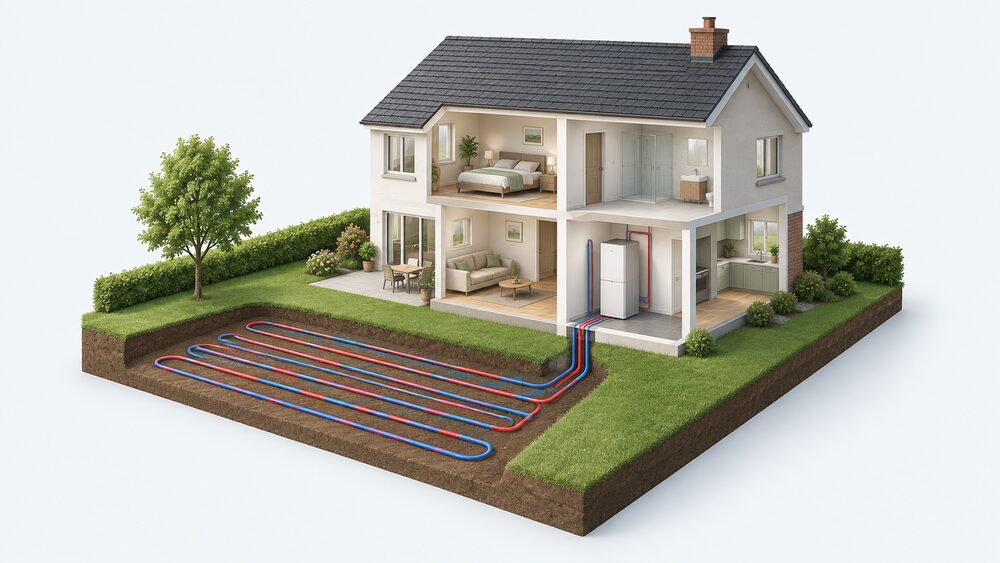
The proposition is different from an air source heat pump. A ground source unit draws heat from the ground or a water source through buried pipework, so there is no outdoor fan unit and no defrost cycle. Kensa's range carries ErP system ratings up to A+++, a design life the company states as 25 years, and warranties that run from a 1 year out-of-the-box term to an 8 year extended term3. The company is MCS approved, TrustMark accredited and a RECC member3.
What a Kensa system does for a household's independence is real but partial. It removes the gas or oil supply from the heating system and replaces it with electricity and a ground array on or under the property. It does not remove the electricity supply, the distribution network, or the need for a contractor to design, install and service the system. Networked schemes, where one shared ground array serves a heat pump in each dwelling, add a shared asset and a management arrangement to that picture.
Kensa at a glance: Cornwall's ground source specialist
Kensa manufactures in the UK and sells through installers rather than direct to householders6. Its product range is built around ground source only, which distinguishes it from the large boiler and air source manufacturers that added a ground source line to an existing catalogue. The company contributed to the formation of the MCS Heat Pump Standard, MIS 3005, and states that its products are tested on an MCS accredited test rig at an ISO 9001 manufacturing plant3.
That manufacturing position matters for a household weighing energy independence. A ground array is a UK-sited asset that cannot be moved offshore, and the heat pump itself is made domestically, which shortens the parts and service chain. The dependence that remains is on the electricity grid for the compressor and pump, on a supplier for that electricity, and on the manufacturer for spares and technical support over a design life the company puts at 25 years2.
Kensa's own guidance describes a management system based on, but not limited to, the requirements of BS EN ISO 9001:20153. The company is a member of the RECC and states that it abides by the standards set to protect consumers interested in renewable systems3. For a buyer, those are the credentials that sit behind the product rather than in front of it.
The range: Shoebox, Evo and Compact models
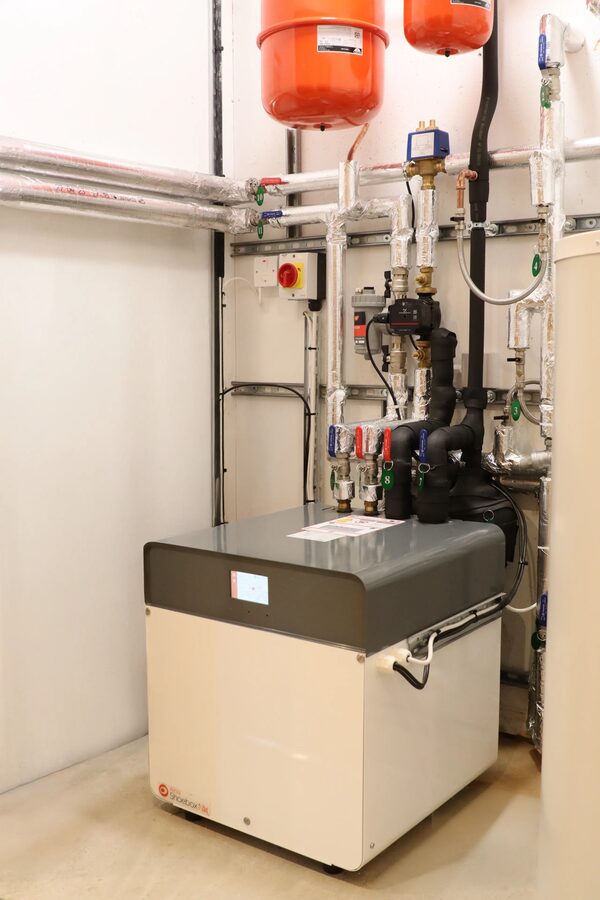
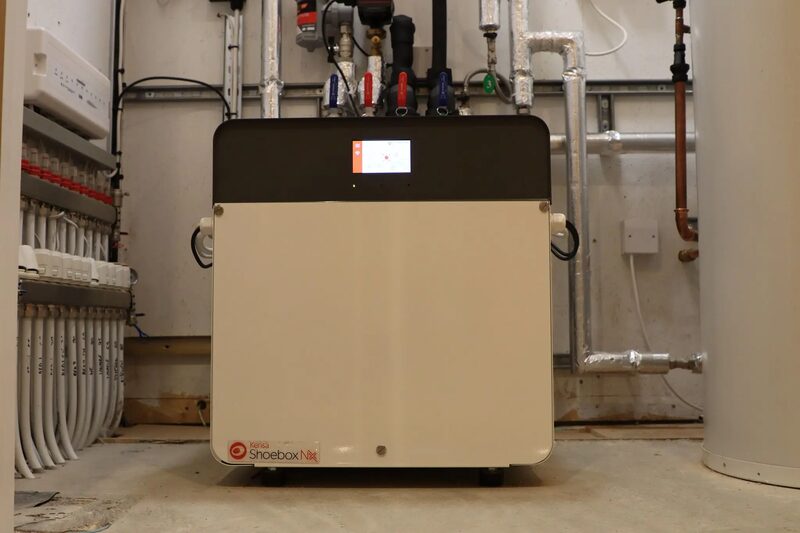
Kensa's domestic range spans small, low-output units through to larger models for bigger properties. The Shoebox comes in 3kW and 6kW versions, and the newer Shoebox NX in 3kW and 5kW versions4. The Shoebox is aimed at flats, apartments and Passivhaus developments, where its low heat and aural outputs and high efficiencies suit a fabric-first build3. The Evo and Compact families cover the larger outputs, and the range as a whole is described as accommodating new build and retrofit projects of all shapes and sizes4.
| Model family | Outputs | Notes |
|---|---|---|
| Shoebox | 3kW and 6kW4 | Suited to flats and Passivhaus; can be configured for passive cooling3 |
| Shoebox NX | 3kW and 5kW4 | Newer generation of the small unit4 |
| Evo | Larger domestic outputs | Used in retrofit and off-gas conversions7 |
| Compact | Larger domestic outputs | Used in high-temperature and networked schemes8 |
The plan's headline figure of 3kW to 24kW spans the domestic catalogue, with the smallest units at 3kW and the largest domestic models well above the Shoebox outputs. Above the domestic range, the same families appear in communal and networked schemes, where a single ground array is sized for many dwellings rather than one.
A household choosing between these units is really choosing an output that matches the heat loss of the property. Kensa offers a heat loss survey to establish how much heat a home needs, and describes a comprehensive survey as the basis for deciding what is best9. That survey, not the model name, determines which unit is specified.
Specifications: 65°C flow, A+++ ErP and a 25-year design life
Kensa states that its ground source heat pumps have ErP system ratings up to A+++3. The company also states an industry-leading design life of 25 years with low maintenance requirements2. Those two figures are the headline specification claims, and both come from the maker rather than from an independent test body.
Flow temperature is where ground source and air source diverge in practice. The Product Characteristics Database records heat pump values at 35°C, 45°C and 55°C, and the low-temperature heating thresholds used in official guidance are 45°C or 35°C design flow water temperature as stated on the commissioning certificate, rounded to the nearest whole number10. A high-temperature Kensa unit can run hotter than that where a property needs it: the 8.5kW High Temperature Single Compact model provides 100% of heating and domestic hot water at a converted church in Powys8.
"Some of Kensa's ground source heat pumps, including the Shoebox, can be configured to deliver passive cooling which is a relatively 'un-mechanical' means to remove excess heat as it only uses a circulation pump"
The warranty position is a ladder rather than a single term. Kensa's product pages list a 1 year out-of-the-box warranty, a 4 year standard warranty and an 8 year extended warranty4. The 1 year and 4 year terms sit alongside each other in the published material, so both are given here. A household should read the warranty schedule attached to its own quotation rather than rely on a headline term.
Networked heat pumps: one ground array, a heat pump per dwelling
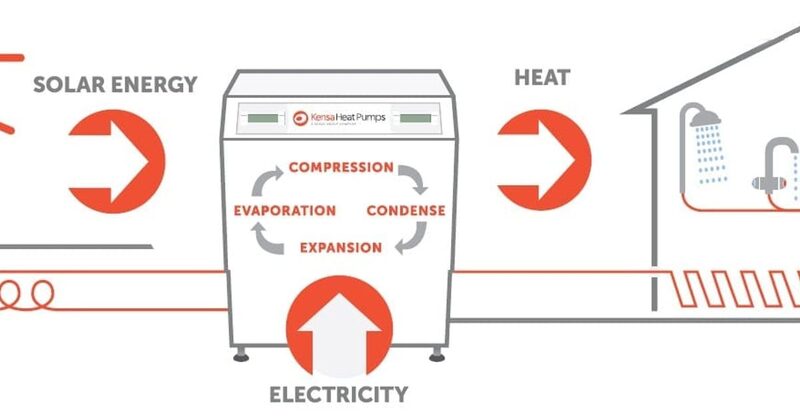
Kensa's shared ground loop design places a ground source heat pump in each dwelling, with every unit connected to a fifth generation district heating ambient loop11. The loop circulates water at near-ground temperature around a neighbourhood, and each dwelling's heat pump lifts that heat to the temperature its heating and hot water need. There is no central plant room and no heat meter in the conventional sense, because each home runs its own unit.
The largest documented example is Chadwell St Mary in Thurrock, where 273 flats across three high-rise tower blocks had old night storage heaters replaced with networked ground source heat pumps connected to 109 boreholes5. The scheme was completed in November 20235. Nesta records the same project as replacing inefficient night storage heaters across 273 flats in three tower blocks5.
The model has been applied at other scales. Kensa completed networked ground source installations serving 14 Lar Housing Trust homes in Edinburgh in July 2024, and work began in August 2025 on a Renfrewshire Council project replacing gas heating in two Paisley tower blocks, with completion targeted for summer 202612. Kensa is also credited with carrying out the UK's first in-road, networked heat pump installation12.
For a household, the networked model changes the independence picture. The ground array is a shared asset, so the home depends on the loop being maintained and on the arrangement that governs it, whether that is a landlord, a management company or an energy service company. What the household gains is a heat source that is not gas and not delivered by tanker, and a unit it controls inside its own walls.
Costs and savings: the claims and the independent figures

Kensa states that its ground source heat pumps deliver savings up to £1,000 per year versus air source, and that they have the lowest lifetime costs over 30 years2. Both are maker claims. The independent figures sit lower and vary by comparison.
| Source | Comparison | Figure |
|---|---|---|
| Kensa (maker) | Ground source vs air source | up to £1,000 a year2 |
| Energy Saving Trust, via MCS | Ground source vs old gas boiler | £490 a year13 |
| Which? | Ground source vs gas boiler, worked example | £162 a year14 |
| Home Energy Scotland | Well-designed heat pump vs gas boiler | around £80 to £170 a year15 |
| Centre for Sustainable Energy | Heat pumps, running cost | £800 to £1,050 a year16 |
| Croydon Council | Air source heat pump, cost | £10,000 or more17 |
The spread reflects different baselines. A ground source heat pump compared with an old gas boiler shows a larger saving than the same heat pump compared with a modern condensing boiler, because the starting point is worse. The £490 figure is explicitly a comparison against an old gas boiler13. The Which? example compares a ground source heat pump with a gas boiler and finds it cheaper to run by £162 a year on average14. Home Energy Scotland's range of around £80 to £170 a year applies to a well-designed heat pump generally15.
There is no published Kensa list price for a supplied and fitted system, so prices are installer-quoted. The figures that exist for ground source generally are broad: Croydon Council lists air source heat pump costs at £10,000 or more, which is a different technology and a different cost base17. The Centre for Sustainable Energy puts heat pump running costs at around £800 to £1,050 a year, making them one of the cheapest electric heating options16. Wider cost context is at ground source heat pump cost and heat pump running costs.
Certification and consumer protection: MCS, TrustMark and RECC
Kensa is an MCS approved installer and states that the majority of its products are MCS certified3. The company is TrustMark accredited, which it describes as a commitment to good customer service and technical competence, and it is a member of the RECC, abiding by the standards set to protect consumers interested in renewable systems3.
MCS itself certifies, quality assures and provides consumer protection for microgeneration installations and installers, covering small-scale renewable technologies including heat pumps18. Heat pumps fall under the MCS 007 certification code19. MCS certified installers use MCS certified ground and water source heat pumps, tested for quality, reliability and performance13. The Energy Saving Trust's moving-house checklist includes a step to check whether a heat pump has an MCS certificate20.
Certification is not decorative. The Boiler Upgrade Scheme guidance for installers states that installers must be MCS certified and be certified to install heat pumps and/or biomass boilers21. A household claiming a grant therefore needs the installation to sit within the scheme, and the MCS route is how that is evidenced.
The CEN Heat Pump Keymark provides certification for heat pump products as a separate European scheme19. For a UK household, the MCS certificate is the one that matters for grant eligibility and for the consumer protection that comes with it.
Surveys, quotes and how a Kensa project runs
A Kensa project starts with a heat loss survey. The company states that it can survey a home to establish how much heat is needed, and that a comprehensive survey helps decide what is best9. That survey determines the output of the unit, the size of the ground array, and whether the existing emitters and cylinder are adequate.
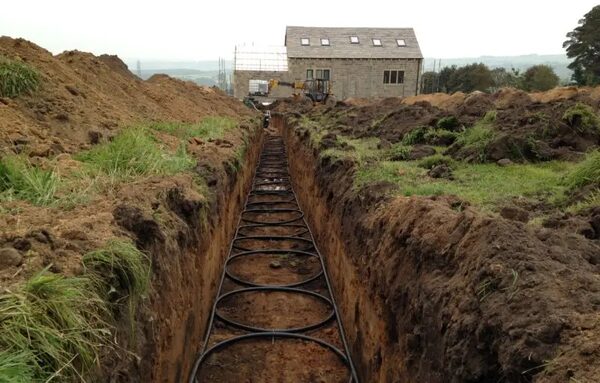
The ground array is the part of the project that most distinguishes a Kensa installation. Kensa supplies both slinkies and straight pipes, the two types of horizontal ground array that collect heat for a ground source heat pump9. Once buried in trenches, they connect to the heat pump through a manifold and header pipe, with sand sometimes used initially to protect the pipes9. Where a water source is available, Kensa makes ready-made pond mats for use with all its ground source heat pumps6.
- Heat loss survey to establish the heat demand of the property9.
- Ground array design and installation, using slinkies, straight pipes or pond mats9.
- Connection of the array to the heat pump through a manifold and header pipe9.
- Commissioning, with the design flow temperature recorded on the commissioning certificate10.
Kensa's involvement in the Heat Pump Ready programme shows the company working inside government-funded innovation projects. In the Bridgend project, Kensa was listed as a project subcontractor alongside Nuvision and Challoch22. A separate Heat Pump Ready stream lists a project led by Guru Systems with no project partners23. The programme was a time-limited innovation scheme rather than a standing offer of free feasibility work.
Noise assessment is part of the wider installation process. The MCS 020 calculator requires the heat pump make and model and the installation location for a single heat pump assessment, with project details optional24. Ground source units have an advantage here, because the compressor sits indoors and there is no outdoor fan. Research on installer and customer conversations found that interview case studies were conducted with participants and with three heating engineers installing heat pumps on behalf of the project25.
What Kensa installations have delivered across the UK
The documented record is concentrated in social housing, new build and off-gas retrofit. Kensa's units are all manufactured in the UK6, and the company carried out the UK's first in-road, networked heat pump installation12.
| Project | Location | Scale | Date |
|---|---|---|---|
| Chadwell St Mary | Thurrock | 273 flats, 109 boreholes5 | November 20235 |
| Fountainbridge | Edinburgh | 14 Lar Housing Trust homes12 | July 202412 |
| Renfrewshire tower blocks | Paisley | Two tower blocks, gas heating replaced12 | Started August 2025, completion targeted summer 202612 |
| Felindre converted church | Powys, Wales | 8.5kW High Temperature Single Compact8 | Not stated |
The Felindre case is a converted church in Powys where a Kensa 8.5kW High Temperature Single Compact heat pump provides 100% of heating and domestic hot water8. A domestic water source installation in Cirencester used a 13kW Kensa Evo water source heat pump with three pond mat collectors, fitted and commissioned in December 20227.
The wider UK context is that heat pump installations remain a small share of the heating market. From January to July 2024, more than 30,000 heat pumps were installed in homes and small businesses across the UK26. Which? has argued that government must do more to tackle cost and other barriers discouraging consumers from switching to heat pumps26.
For a household, the case studies show what the technology does at scale rather than what it will do in one property. A networked scheme in a tower block and a single unit in a converted church are different projects with different ground arrays, different emitters and different commissioning. The common thread is that the ground array is designed for the site, and the heat pump output is matched to the heat loss of the building.
Where Kensa fits a household's energy independence
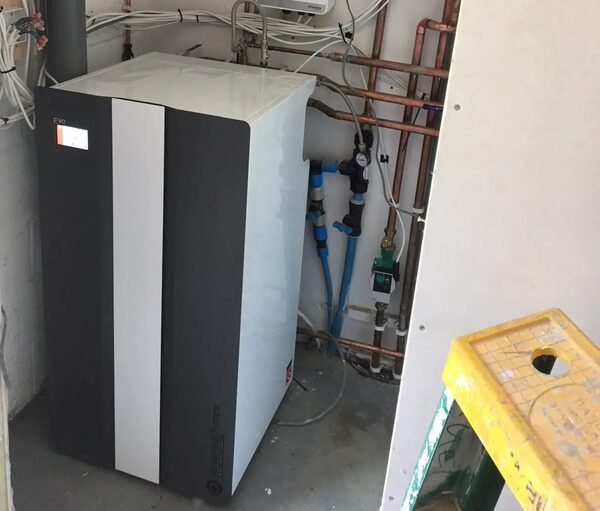
A Kensa ground source heat pump removes gas or oil from the heating system and replaces it with electricity and a ground array. The array is a UK-sited asset with a stated 25 year design life, and the units are manufactured in the UK2. That is a genuine reduction in exposure to imported fuel and to a gas supplier.
The dependence that remains is on the electricity grid and an electricity supplier, because the compressor and circulation pumps run on mains power. A networked scheme adds a shared ground loop and the arrangement that governs it. The warranty ladder depends on the terms attached to the installation, and the longest term is an extended warranty rather than a standard one4. Servicing and spares depend on the manufacturer over the life of the unit.
For homes where a ground array is feasible, the technology offers a heat source that is not delivered by pipe or tanker and does not depend on the weather at the outdoor unit. Where ground or water space is not available, the alternatives are covered at ground source heat pumps, water source heat pumps and shared ground loop networks. The wider picture is at heat pumps and household energy independence.
Sources26 cited
- Energy innovation needs assessment: heat and buildings, UK Government, 2025
- Kensa heat pumps for homes, Kensa Heat Pumps, 2026
- Compliance and standards, Kensa Heat Pumps, 2026
- Hot water secondary return pump, Kensa Heat Pumps, 2026
- Clean heat neighbourhoods: Kensa's Essex retrofit, Nesta, 2026
- Pond mats, Kensa Heat Pumps, 2026
- Domestic water sourced heat pump case study, Renewables First, 2026
- Felindre converted church, Powys, Kensa Heat Pumps, 2026
- Slinky pipe ground source heat pump, Kensa Heat Pumps, 2026
- Low temperature heating, NCM Product Characteristics Database, 2026
- Kensa Thurrock Council Chadwell St Mary, Heat Pumping Technologies, 2026
- A networked approach to low carbon heat, Nesta, 2026
- Ground and water source heat pumps, MCS Certified, 2026
- Ground source heat pump costs and savings, Which?, 2026
- Heat pumps, Home Energy Scotland, 2026
- Electric heating advice, Centre for Sustainable Energy, 2026
- Air and ground source heat pumps, Croydon Council, 2026
- ECO4 Flex and GBIS Flex information, Ceredigion Council, 2025
- Product scheme equivalency, MCS Certified, 2026
- Moving house energy checklist, Energy Saving Trust, 2026
- Boiler Upgrade Scheme guidance for installers, Ofgem, 2026
- Heat Pump Ready Programme stream 1 phase 1 projects, UK Government, 2026
- Heat Pump Ready Programme stream 2 projects, UK Government, 2026
- MCS 020 noise assessment calculator, MCS Certified, 2025
- Electrification of heat: effective conversations, Energy Systems Catapult, 2024
- Government must do more to tackle cost barriers, Which?, 2024
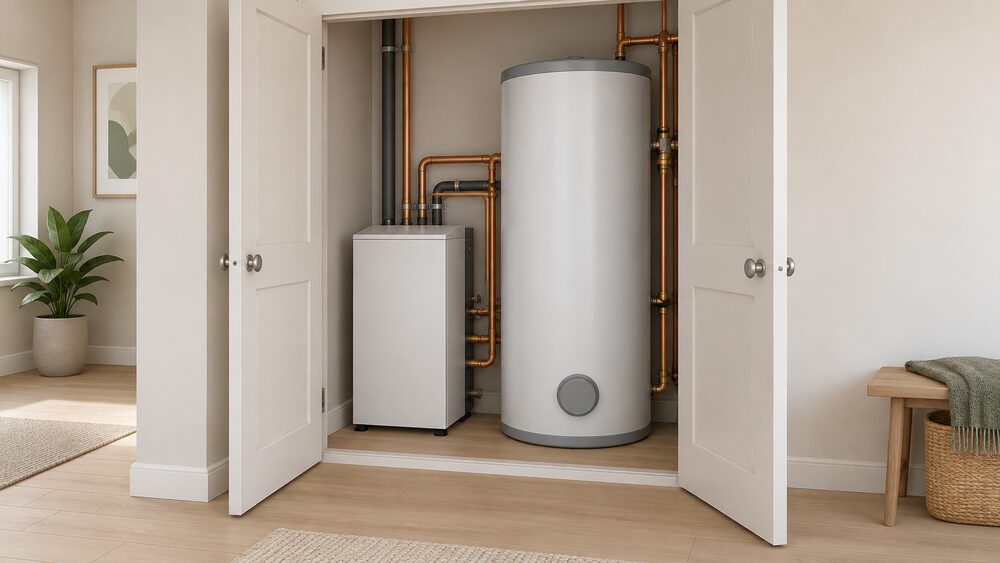 Kensa Shoebox ground source heat pumpCan the Kensa Shoebox really heat a flat with no garden?