
In this answer
Short answer
The smart requirement for new domestic heat pumps is not yet law, but its shape and timing are visible. Independent guidance states that flexible operation will become compulsory for new heat pumps in 2026/2027 if the smart mandate is brought in as intended1. For electrical heating appliances, the first phase of the Energy Smart Appliances Regulations has an implementation date of 31 October 2028 or two years after the regulations are made, whichever is later2.
The direction of travel is set. Government has signalled standards ensuring all new electric heating systems are "smart ready"3, and industry guidance assumes a smart heat pump control system will have to meet, as a minimum, the criteria for Smart Readiness Level 34. What that means in practice is a heat pump able to receive an external signal and shift when it runs, rather than one that simply heats on a fixed schedule.
For a household, the practical question is what changes at the point of installation, and what does not. An existing heat pump is not caught. A new one bought after the rules take effect will be expected to carry the interfaces and controls that let a supplier, a flexibility provider or a home energy management system adjust its operation. The sections below set out the scope, the technical requirements, the legislative route and what it all means for grant-funded installations.
What the smart requirement covers
The scope runs wider than heat pumps alone. The first phase of the Energy Smart Appliances Regulations covers electrical heating appliances, and the implementation date for those appliances is 31 October 2028 or two years after the regulations are made, whichever is later2. That places storage heaters and heat batteries in the same regulatory family as hydronic heat pumps, rather than treating them as a separate category.
For heat pumps funded through the Boiler Upgrade Scheme, the capacity ceiling is 45kWth5. That figure matters because it defines the size of appliance the scheme will support, and by extension the size of appliance most commonly installed in homes. Above that threshold, installations sit outside the grant framework.
Electric storage heaters already carry control obligations under building standards. Approved Document L requires automatic control of input charge, and an adjustable heat release rate7. Those requirements predate the smart appliance regulations and show the direction: a heater that can respond to a signal rather than simply charging on a fixed overnight window.
Heat batteries appear in the funding landscape as well as the regulatory one. The Boiler Upgrade Scheme funds heat pumps, biomass boilers and heat batteries in homes and non-domestic buildings8, and independent guidance describes the scheme as funding the installation of a heat pump, biomass boiler or heat battery9. The Warm Homes: Local Grant lists high heat retention storage heaters among its eligible measures10, and for retrofit and packaged hybrids it requires that the heat pump is sized to provide a minimum of 55% of the calculated heat load11.
The practical effect is that a household replacing an old storage heater or adding a heat battery is buying into the same smart-readiness trajectory as a household installing an air source or ground source heat pump. The appliance types differ; the expectation that they can be controlled externally does not.
Smart-ready: what a new heat pump must be able to do
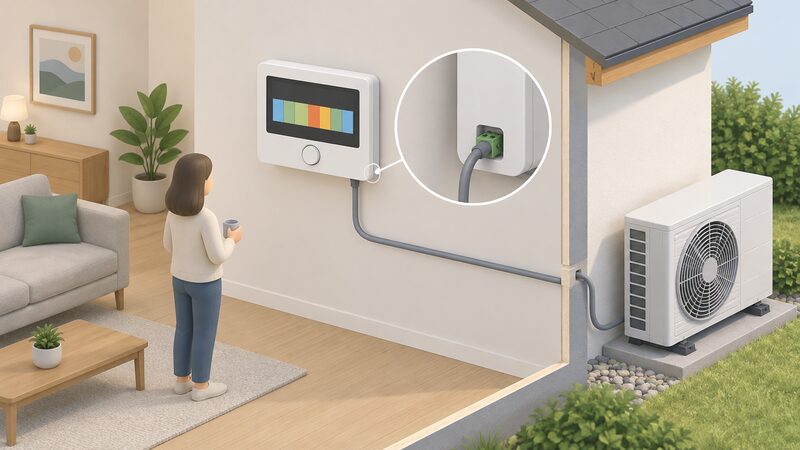
Smart readiness is a capability standard, not a performance guarantee. Industry guidance assumes a smart heat pump control system will have to meet, as a minimum, the criteria for Smart Readiness Level 34. That is a threshold for how much the appliance can sense, communicate and respond, not a statement about how efficiently it will run in a given house.
The technical requirements for a heat pump with photovoltaic integration give a clearer picture of what the interfaces must support. They include a Smart Grid Ready input or another external control interface; the ability to accept boost or surplus-use signals; available thermal storage; enough flexibility to avoid too much switching; and consideration of whether the compressor is variable-speed or on/off12. Each of those points bears on whether an external signal can actually be acted on without harming the appliance.
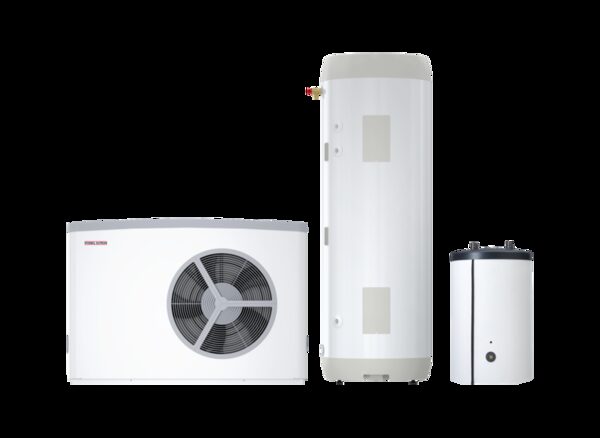
Thermal storage is the constraint that catches people out. A heat pump with nowhere to put surplus heat cannot absorb a boost signal usefully, which is why buffer tanks and hot water cylinders matter to smart operation. The buffer tanks and volumisers page covers how that storage is configured, and the hot water cylinders page covers the domestic hot water side.
Compressor type matters too. A variable-speed compressor can modulate output across a range, while an on/off compressor cycles. The guidance treats this as a factor in how much flexibility the appliance can offer12, which is why two heat pumps with the same nominal output can behave very differently under a smart tariff.
Manufacturers have already shipped products with these interfaces. The Daikin Altherma 3 H HT Heat Pump is listed with Smart Grid compatibility and upgraded software for improved performance13. That is a maker's description of its own product, and it shows the capability exists in the current market rather than being a future specification.
Smart Grid Ready inputs and accepting boost or surplus-use signals
Smart Grid Ready is a common interface used in Europe for external heat pump control12. It is the physical and logical route by which an outside signal reaches the appliance, and it is one of the ways a heat pump can satisfy the external control interface requirement.
The signals that interface carries are of two broad kinds. A boost signal tells the heat pump to run harder or pre-charge thermal storage while conditions are favourable. A surplus-use signal tells it to absorb generation that would otherwise be exported. Both depend on the appliance having somewhere to put the heat and enough modulation to act on the instruction without excessive switching12.
Solar is the clearest domestic case. Solar panels can power a heat pump, which can lower both electricity and heating bills14. A smart-ready heat pump with the right interface can take surplus generation directly, rather than exporting it and buying it back later. The solar panels and a battery with a heat pump page covers the system design question, and the time-of-use tariff savings page covers the tariff side.
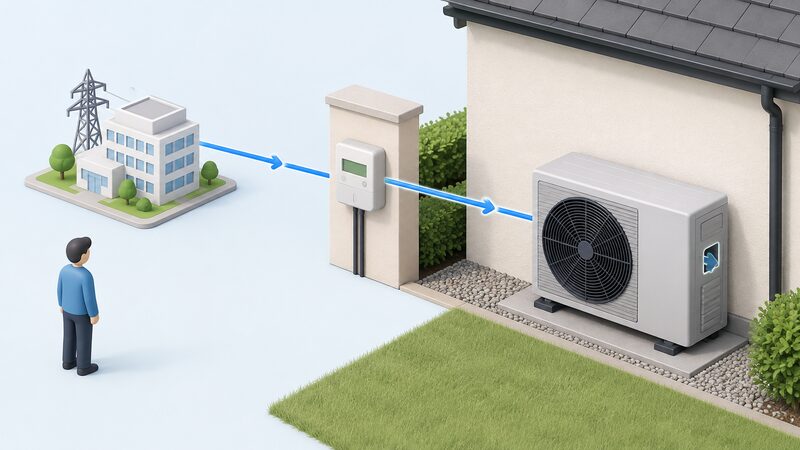
There is a grid connection dimension as well. "Apply to connect" applies to premises with a new Maximum Demand between 60A and 100A inclusive, and the application is made prior to installation using the heat pump connection form15. A heat pump that shifts its load can change the demand profile a network operator sees, which is part of why the flexibility agenda and the connection process sit alongside each other.
Independent work has identified the administrative side as a barrier in its own right. Streamlining processes such as Distribution Network Operator approval, electricity supply upgrades and the Energy Performance Certificate requirement for BUS funding is described as crucial to making homes administratively ready for a heat pump16. The same work notes that as heat pump uptake accelerates, ensuring both households and the grid are ready will determine whether low-carbon heating can be the default, particularly at moments of boiler breakdown16.
"Smart Grid Ready is a common interface used in Europe for external heat pump control."
How the ESA Regulations fit in and when they are intended to open
The Energy Smart Appliances Regulations are the legislative vehicle. The Energy Bill would allow regulations to be created for energy smart appliances and require load controllers to have a licence17. That is the enabling power; the detailed rules follow in secondary legislation.
The enforcement reach is broad. The ESA regulations could apply to "any person making, supplying, importing or distributing energy smart appliances or carrying out load control"18. That captures manufacturers, importers, distributors and flexibility providers, not just installers.
The first phase covers electrical heating appliances, with the implementation date set at 31 October 2028 or two years after the regulations are made, whichever is later2. The two-part formulation matters: if the regulations are made late, the date moves with them, so the earliest realistic opening is 31 October 2028.
Not every proposed requirement has settled support. BEAMA disagrees with the proposed tamper protection requirement in regulation 17 for heat manufacturers, describing it as carried over from EVSCP regulations and not appropriate for electrical heating appliances19. That is a live point of contention between industry and government, and it shows the regulations are still being shaped rather than fixed.
The relationship between the ESA Regulations and the smart mandate for heat pumps is one of overlap rather than identity. The mandate for new heat pumps is described as arriving in 2026/2027 if brought in as intended1, which is earlier than the electrical heating appliance implementation date2. A household installing a heat pump in the interim is buying into a market that is already moving toward smart readiness, ahead of the regulations that will make it compulsory for the wider appliance category.
What this means for households under the Boiler Upgrade Scheme

The Boiler Upgrade Scheme provides upfront grants to help reduce the cost of installing heat pumps and biomass boilers in homes and non-domestic buildings20. It is the main funding route for domestic heat pump installation in England and Wales, and its rules sit alongside the smart agenda rather than being changed by it.
Eligibility is framed around what is being replaced. The scheme is primarily for properties replacing a fossil fuel heating system such as gas, oil or LPG, or an electric heating system excluding existing heat pumps21. New-build properties are generally not eligible, except for certain self-build properties that meet specific criteria22.
The technical conditions are specific. A BUS-funded heat pump system must provide 100% of the space heating needs of the eligible property23, and the appliance must have a maximum capacity of 45kWth5. Where a supplementary heating appliance is present, the heat pump can still qualify so long as it can provide the full space heating demands of the property24.
Timing is the condition most likely to catch a household out. Your installer must commission and install the heat pump within 120 days of applying for the grant or it will not be eligible6. That window is fixed by the scheme rules and does not move for supply delays or scheduling.
The scheme funds heat pumps, biomass boilers and heat batteries in homes and non-domestic buildings8, and independent guidance describes the same three categories9. Ground source heat pumps are an eligible technology5. For households in Wales, the heat pump grant in Wales page covers the devolved picture, and the heat pump grants page covers the UK-wide funding landscape.
Smart-ready versus fully smart: what owners can expect in practice
Smart-ready and fully smart are different things, and the gap between them is where most household confusion sits. A smart-ready heat pump has the interfaces and controls to accept external signals. A fully smart installation is one where those signals are actually connected to something: a tariff, a flexibility service, a home energy management system or a solar array.
The long-run picture from independent work is that by 2035 a large proportion of heat pumps in the stock will be smart-enabled, and the power to the heat pump will be accessed and controlled by either the heat pump manufacturer, the energy supplier or a different flexibility provider1. That is a modelled future state, not a current guarantee, and it describes who holds the control rather than what the household saves.
The tariff side already has a hard requirement. You will need a smart meter to get a heat pump or electric vehicle tariff25. Without one, the time-of-use products that make smart operation worthwhile are not available, which is why the smart meter rollout and the heat pump rollout are linked.
The scale of that link is significant. An estimated 80% of homes will need a smart meter upgrade to get a heat pump, according to a CCC estimate26. The same work estimates that around 240,000 homes a year would become electrically heat-pump-ready through smart-meter visits26. Those are estimates, and they describe a potential rather than an achieved rate.
Modelling of running costs gives a sense of what smart operation is worth. Government modelling uses a standard 3-bedroom detached house with good insulation, a heat pump with typical efficiency, a smart electricity tariff enabled by a smart meter, gas standing charges removed in the heat pump scenario, and a fully electric setup with no gas used for cooking in both scenarios27. Those assumptions define the comparison, and a household whose circumstances differ will see different figures.
Installation standards already point toward commissioning as the point where smart functions would be set up. Installers are expected to install and commission the system to the standards set out in the approved document28, and a competent person scheme should be used when undertaking a heat pump or mechanical ventilation installation29. The heat pump controls page covers weather compensation and smart operation in more detail, and the heat pump installation page covers the process from survey to handover.
What remains dependent is the control layer. A smart-ready heat pump still needs a supplier, a flexibility provider or a manufacturer's platform to send it signals, and that means an ongoing relationship with a third party. The appliance reduces reliance on gas and on a boiler, but it does not remove reliance on the electricity grid, on a tariff, or on the company operating the control service. That is the trade a household makes: less dependence on imported fuel, more dependence on the systems that manage when power is used.
Sources29 cited
- Summary of findings from heat pump flexibility expert workshop, CREDS, 2026
- Energy Smart Appliances Regulations interim response, GOV.UK, 2026
- Heat pumps could have potential to halve UK heating bills, E3G, 2025
- Electrification of heat, BEAMA, 2021
- Boiler Upgrade Scheme: installers, Ofgem, 2026
- Check if you're eligible for the Boiler Upgrade Scheme, GOV.UK, 2026
- Approved Document L Volume 1 Dwellings, GOV.UK, 2023
- Reforming consumer protection for home upgrade schemes, GOV.UK, 2026
- Grants and loans, Energy Saving Trust, 2026
- Green Homes Wales loan standard terms and conditions, Development Bank of Wales, 2026
- Warm Homes: Local Grant policy guidance, GOV.UK, 2026
- Photovoltaic integration, iDM Energiesysteme, 2026
- Daikin Altherma 3 H HT Heat Pump, Quiet Mark, 2026
- Solar photovoltaic, MCS Certified, 2026
- Building regulations renewables guidance, Bedford Borough Council, 2026
- Should we be making homes heat pump ready, Nesta, 2026
- Research briefing CBP-9865, House of Commons Library, 2026
- Research briefing CBP-9865 PDF, House of Commons Library, 2023
- BEAMA response to Energy Smart Appliances Regulations consultation, BEAMA, 2026
- Boiler Upgrade Scheme, Ofgem, 2026
- BUS guidance for property owners draft, Ofgem, 2026
- BUS guidance for property owners V5, Ofgem, 2026
- BUS guidance for installers V5, Ofgem, 2026
- BUS guidance for installers V5.1, Ofgem, 2026
- Deciding if a heat pump is right for you, Citizens Advice, 2025
- How to get homes more ready for heat pumps, Nesta, 2026
- Heat pump, GOV.UK, 2026
- Approved Document L Volume 1 Dwellings, GOV.UK, 2026
- Future Homes and Buildings Standards consultation response, GOV.UK, 2026
 Future Homes StandardWill your new build still have a gas boiler, and when do the new rules actually start?
 Heat Pump Electricity TariffsA heat pump tariff gives you cheaper electricity for part of the day, so running your heating costs less than on a standard rate.
 Smart Thermostats ExplainedWhat does a smart thermostat actually do, and is it worth it?
 Controls and Smart OperationWhy does a heat pump need different controls from a boiler, and what does weather compensation actually do?
 Smart Heating Security and DataHow safe is your smart thermostat from hackers, and who sees the data it collects about your heating?
 Controls and Time-of-Use TariffsCheaper electricity at night only saves money if your heating actually uses it then.