

In this answer
Short answer
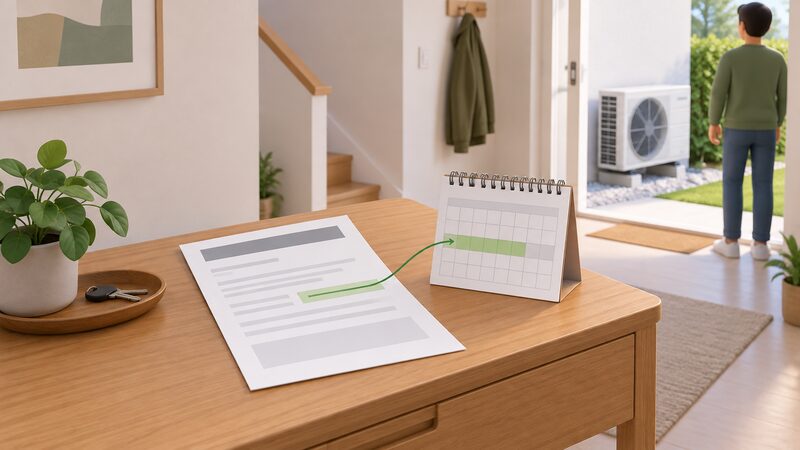
The Boiler Upgrade Scheme voucher is a time-limited promise, not an open-ended entitlement. Ofgem guidance states that vouchers are valid within 3 months for air-to-water heat pumps, air-to-air heat pumps and biomass boilers, and within 6 months for ground source heat pumps1. Separately, the application must be properly made within 120 days of the commissioning date1. Those two clocks run alongside each other, and the shorter one governs.
The scheme is installer-led. An MCS certified installer applies for the grant on the property owner's behalf, discounts the grant from the invoice, applies to Ofgem for a voucher, and redeems that voucher after the installation has been commissioned2. Ofgem then pays the installer, and the household's benefit arrives as a reduced upfront cost rather than a payment3. The household's practical job is to know the dates and to give consent promptly when Ofgem asks.
What the voucher is, and who redeems it
A Boiler Upgrade Scheme voucher is Ofgem's confirmation that a specific property and a specific installation have met the eligibility requirements, and that a stated grant value is reserved for that job. It is issued to the installer, not to the householder. The scheme is installer-led: installers who are MCS certified can apply for and redeem Boiler Upgrade Scheme vouchers on behalf of property owners7. The application is installer-led, with the installer applying for the grant on the property owner's behalf2.
That structure explains why the deadlines sit with the installer. The installer submits the voucher application, Ofgem issues the voucher, the installer submits a voucher redemption application after commissioning, and the installer receives the grant payment4. Ofgem pays the installer when the installer redeems the voucher, with the owner benefiting through the reduced upfront cost3.
The household still has a role. Ofgem contacts the property owner, and consent must be given within 14 days of that contact3. Where a voucher is revoked, Ofgem notifies the installer within 14 days of the decision8. Installers can request a review of a decision, and that request must be received within 28 days of the date of the notice of the decision being reviewed9.
For a household weighing the scheme against supplier-funded work, the Boiler Upgrade Scheme and ECO4 routes are separate, and the application process is where the dates are set.
The two-stage application: voucher issue and redemption
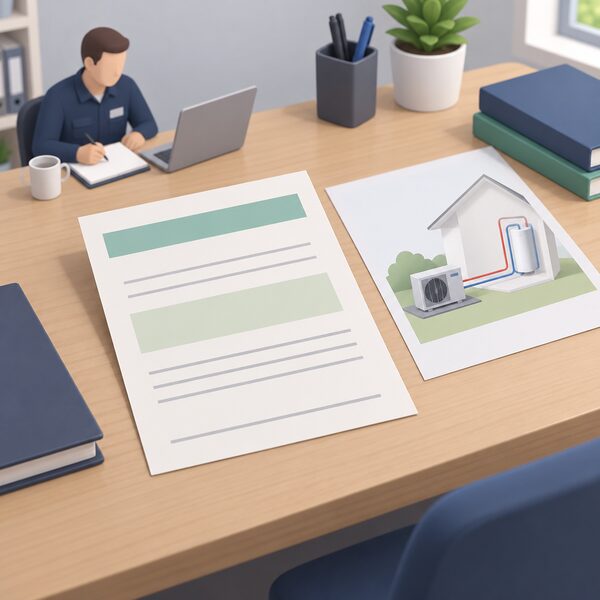
The grant application is a two-stage process4. Stage one is the voucher application: the installer submits it, and Ofgem issues a voucher if the property and technology qualify. Stage two is redemption. Following commissioning of an installation the installer can submit a voucher redemption application (stage 2a), and once Ofgem has established that the remaining eligibility requirements have been met, the grant payment is made (stage 2b)5.
Redemption is not a formality, but it is quick once the paperwork is in order. Across Scheme Year 3, Ofgem processed and paid 96% of applications for voucher redemptions within 10 working days of the request6. Payments run on a weekly schedule, with a maximum gap of five working days between approving a redemption application and sending payment for most applications; payments move to the following working day after a public holiday10.
The volume gives a sense of scale. In the quarter from August 2025 to October 2025 there were 8,233 voucher redemption applications4. Total voucher applications reached 102,7354. Between May 2022 and March 2026 the scheme paid just over 80,000 grants worth £560 million11.
A voucher that has been issued keeps its value. Any vouchers that have been issued will receive the grant value stated on the voucher when they are submitted for redemption, and remain redeemable before and after 23 October 202310. That matters where grant levels change mid-project: the voucher, not the current published rate, is the figure that gets paid.
Voucher validity: 3 months for air source, 6 months for ground source
The validity period depends on the technology, and the reason is practical. Air source heat pump, air-to-air heat pump and biomass boiler vouchers run for 3 months1. Ground source heat pump vouchers run for 6 months1. Ofgem's own summary of the position is blunt: vouchers for ground source heat pumps are valid for 6 months1. The quarterly reporting states the same split, that vouchers for air source heat pumps and biomass boilers are valid for 3 months4.
Ground source work takes longer because it involves ground loops or boreholes, excavation and, often, planning or access arrangements. The extra three months reflects that, not a difference in the grant itself.
| Technology | Voucher validity | Grant value |
|---|---|---|
| Air source heat pump | 3 months1 | £7,5004 |
| Air-to-air heat pump | 3 months1 | £7,5004 |
| Biomass boiler | 3 months1 | £7,5004 |
| Ground source heat pump | 6 months1 | £7,5004 |
| Ground source heat pump, off-gas grid, replacing oil or LPG | 6 months1 | £9,0004 |
Validity periods are fixed. Ofgem states that it cannot extend validity periods under any circumstances9. A household that has not had the installation commissioned before the voucher lapses has no route to an extension, and the grant is lost.
The 120-day commissioning application deadline
The 120-day rule is the second clock, and it works in both directions. The application must be properly made within 120 days of the commissioning date1. Read the other way, the heating system must be commissioned no more than 120 days prior to the voucher application being properly made7. Independent guidance puts it plainly: heating systems commissioned up to 120 days before the application is submitted are entitled to support under the scheme12.
This is what allows a retrospective application. Installers may apply for a Boiler Upgrade Scheme voucher after the installation has been commissioned, provided the application is properly made within 120 days of commissioning13. A household that had a heat pump fitted without a grant application in place is not automatically excluded, provided the dates fall inside the window.
There is a floor as well as a ceiling. Heating systems must be commissioned on or after 1 April 2022 to be eligible10. Vouchers were issued from 23 May 2022 on eligible technologies installed from 1 April 202214.
Ofgem has tightened the language around this rule over time. A 2024 update to the property owner guidance promised greater clarity to the 120-day commissioning rule15. The practical effect for a household is that the commissioning date on the certificate is the anchor for everything: it sets the outer limit for the application, and it is the date an installer will be asked to evidence.
Scheme dates: when applications open and close

The scheme opened for applications on 23 May 202216. It has run in scheme years since, with Scheme Year 2 covering 1 April 2023 to 31 March 202417. It remains open for grants towards heat pump installations across England and Wales18.
The closing date is published. The scheme is scheduled to close at 11:59pm (Midnight) on 30 December 20296. That is the deadline for new applications, not for redemptions of vouchers already issued.
The grant rate changed during the scheme's life. The higher grant only applies to new applications submitted from 21 July 202619. Applications submitted before that date sit on the earlier rate, and the voucher issued at the time records the value that will be paid10.
| Date | What it marks |
|---|---|
| 1 April 2022 | Earliest eligible commissioning date10 |
| 23 May 2022 | Scheme opened for applications16 |
| 1 April 2023 to 31 March 2024 | Scheme Year 217 |
| 21 July 2026 | Higher grant rate applies to new applications from this date19 |
| 30 December 2029, 11:59pm | Scheme closes to new applications6 |
What happens if the voucher expires or the budget runs out
Vouchers are issued on a first come, first served basis, to applicants who meet the eligibility requirements, until the budget cap for the financial year is reached20. That is the mechanism behind the scheme's occasional pauses: the constraint is the annual budget, not the number of qualifying homes.
Expiry is common enough to be measured. In Scheme Year 3, a further 3,638 vouchers expired before they were redeemed21. In Scheme Year 2, a further 2,128 expired before they were redeemed17. Earlier reporting found around 10% of air source heat pump and biomass boiler vouchers expiring for the November 2023 to January 2024 cohort, in line with previous quarters22.
The pattern is consistent: a meaningful minority of vouchers are never redeemed, usually because the installation slipped past the validity window or the household changed its plans. Because validity cannot be extended9, an expired voucher means a fresh application, a fresh eligibility check and whatever grant rate applies at that point.
Eligibility conditions that sit alongside the deadline
The deadline is only one of the conditions, and a voucher that is redeemed still has to satisfy the rest. Properties are no longer required to have a valid Energy Performance Certificate to apply for the Boiler Upgrade Scheme from 28 April 2026, but where an EPC exists, the certificate number must be provided9. The government had already set out its intention to amend eligibility criteria to relax the EPC requirement from 2026/27 onwards, adopting a hybrid model23.
The grant limit is one per property5. A second heat pump at the same address does not attract a second voucher.
Funding cannot be stacked. Funding from the Boiler Upgrade Scheme and ECO cannot be blended for the same measure or be included within an ECO4 project24. ECO4 funding must not be blended with funding from other government schemes or grants, including the Warm Home Discount, the Boiler Upgrade Scheme, the Social Housing Decarbonisation Fund and the Home Upgrade Grant25. A household choosing between the two routes is choosing, not combining. The ECO4 and other grants page sets out how that separation works in practice.

Where the deadline leaves the household
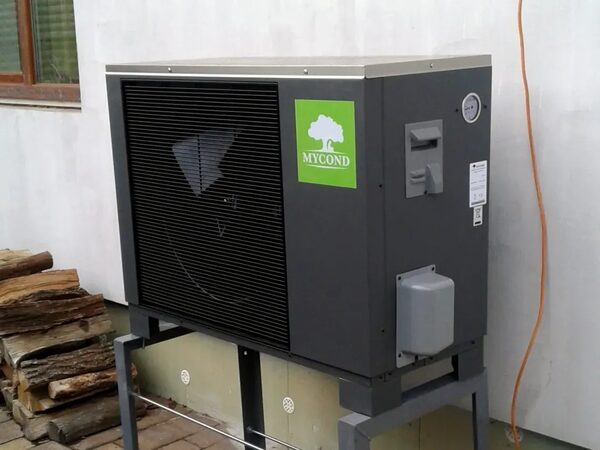
The scheme does real work for energy independence: it moves a home off a fossil fuel boiler and onto a heat pump, cutting the gas connection's share of the household's heating. What it does not do is remove dependence. The heat pump runs on electricity from the grid, bought from a supplier, and the grant itself depends on an installer staying within Ofgem's windows and on an annual budget that can be exhausted. The household's exposure is to the installer's administrative timing as much as to the technology.
The dates are therefore worth tracking directly. The voucher validity period, 3 months or 6 months depending on technology1, and the 120-day commissioning window1 are the two figures that decide whether a grant is paid. Both are fixed, neither can be extended9, and both are measured from dates the installer records. A household that knows its commissioning date and its voucher issue date can see the deadline coming.
Where a query arises, complaints about Ofgem's administration of the scheme can be sent to feedback@ofgem.gov.uk7. The wider picture of how grants fit into a home's energy position is set out in grants and energy independence.
Sources25 cited
- Boiler Upgrade Scheme guidance for installers v5.1, Ofgem, 2026-07-02
- Boiler Upgrade Scheme guidance for property owners v5 draft, Ofgem, 2026-03-25
- Boiler Upgrade Scheme guidance for property owners V5, Ofgem, 2026-04
- Boiler Upgrade Scheme quarterly report, Issue 15, Ofgem, 2026-02-27
- Boiler Upgrade Scheme quarterly report, Issue 14, Ofgem, 2025-11-26
- Boiler Upgrade Scheme quarterly report, Issue 13, Ofgem, 2025-08-29
- BUS Annual Report 2024 to 2025, Ofgem, 2025-07
- Boiler Upgrade Scheme guidance for installers V5, Ofgem, 2026-04-28
- Summary of updates to BUS guidance for installers V5, Ofgem, 2026-04
- BUS property owner guidance V2.3, Ofgem, 2023-09-25
- Summary of updates for BUS guidance for property owners V4.1, Ofgem, 2024-11-11
- Boiler Upgrade Scheme quarterly report, Issue 7, Ofgem, 2024-02-29
- BUS Quarterly Report, Issue 8, Ofgem, 2024-05-31
- Boiler Upgrade Scheme installer guidance, Ofgem, 2022-07-21
- BUS Annual Report April 2024 to March 2025, Ofgem, 2025-07-31
- BUS Annual Report April 2023 to March 2024, Ofgem, 2024-07-31
- Boiler Upgrade Scheme installers page, Ofgem, 2026-09-17
- Boiler Upgrade Scheme, RECC, 2026-09-17
- Boiler Upgrade Scheme, MCS Certified, 2026-09-17
- What you can get, GOV.UK, 2026-09-17
- Notice of approved grant categories and values, GOV.UK, 2026-07-21
- Boiler Upgrade Scheme, Find Government Grants, 2026-09-18
- Heat pump applications surge after increase in government grant, GOV.UK, 2023-11-30
- Decision: administration of the Boiler Upgrade Scheme, Ofgem, 2022-04-07
- Boiler Upgrade Scheme statistics, July 2026, Department for Energy Security and Net Zero, 2026-08-27
 Manufacturer WarrantiesHow long does a boiler, heat pump or solar panel warranty actually last, and what do you have to do to keep it valid?
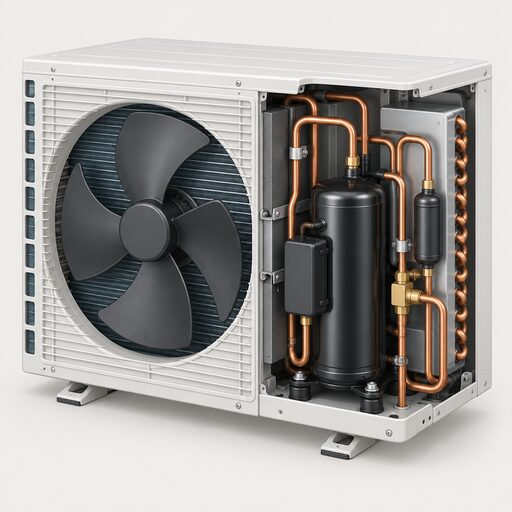 Air Source Heat PumpsHow an air source heat pump takes heat from outdoor air, the difference between air-to-air and air-to-water systems, typical efficiency, the £7,500 Boiler Upgrade Scheme grant, noise and planning limits, and what ownership means for a household's energy independence.
 Ground Source Heat Pump CostWhat a ground source heat pump costs in the UK, splitting groundworks and drilling from the heat pump and internal works, and how the £7,500 Boiler Upgrade Scheme grant and the £9,000 off-gas-grid uplift change the figure.
 How Much Does a Heat Pump CostA heat pump usually costs around eleven thousand pounds installed, though quotes vary a lot depending on your home.
 Getting Installation QuotesHow householders obtain quotes for boilers, heat pumps and solar PV, how many quotes are usually recommended, what a survey should involve, and the difference between an estimate, a quotation and a fixed price.
 Boiler WarrantiesHow long does a boiler warranty actually last, and what do you have to do to keep it?