
In this answer
Short answer
An ECO4 boiler replacement is not a single appointment. It is a project with several stages, and the time it takes depends on which stage a household is at. The physical installation itself is short: a like-for-like boiler replacement often takes only a few days, while a heat pump is likely to take a few weeks1. A new boiler with new pipework, floorboards lifted and other system upgrades can take longer, depending on property size2.
The scheme's own deadlines shape the outer limit. ECO4 was extended by 9 months to 31 December 2026, confirmed in a government consultation published on 23 January 20263. Measures installed from 1 April 2022 are covered4. Within a project, the installation of a measure is deemed complete at handover, and handover is expected within four calendar weeks of the installer finishing work on each measure5.
What follows sets out each stage, what adds time, how the order of works affects the schedule, and what happens when a project slips.
How long an ECO4 boiler replacement takes, end to end
There is no published end-to-end figure for an ECO4 boiler replacement, because the scheme sets deadlines for stages rather than a single clock. What can be said is that the works themselves are short and the administration around them is what stretches the calendar.
The installation window is the clearest part. Independent guidance puts a like-for-like boiler replacement at a few days, and a heat pump at a few weeks1. General boiler fitting guidance gives a wider band: anywhere from 4 to 6 hours to 3 to 4 days, depending on whether the job is a like-for-like swap or a switch to a different type of boiler or heating system2. Changing from a conventional boiler to a system boiler is given as 2 to 3 days2. A new boiler with new pipework around the house, floorboards removed and other system upgrades can take longer again, depending on the size of the property2.
After the installer finishes, handover is expected within four calendar weeks of the work on each measure being completed5. That is the point at which the installation of a measure is deemed complete5.
The scheme itself runs to 31 December 2026, after a 9 month extension confirmed on 23 January 20263. Earlier delivery guidance set a completion deadline of 31 March 2026, so the extension moved the outer boundary6. For a household, the practical reading is that the works are days, the paperwork is weeks, and the scheme deadline is the backstop.

The stages from application to installation, and what each one adds

The first step is to reach out to an approved ECO4 supplier to express interest7. From there the supplier assesses the property and the household against the scheme rules, and if the household qualifies and is happy with the proposed improvements, the supplier books the installation at a convenient time7.
The measures that can be installed are set out in the ECO4 measures table. They include boiler upgrade to a non-renewable heating system, boiler upgrade to a renewable heating system, repair of a broken heating system, replacement of a broken efficient heating system, first time central heating, electric storage heater upgrades and repairs or replacement, connection to a district heating system, heating controls, solar PV, wall, roof, floor and loft insulation, draught proofing, window glazing and higher performance external doors8.
Each stage adds its own time. The eligibility check depends on evidence, and evidence supporting Help to Heat Group eligibility must be dated no more than 12 months before the beginning of a project9. The survey and specification stage determines which measures are proposed. The installation booking follows agreement. Then the works, then handover within four calendar weeks5.
For comparison, the Boiler Upgrade Scheme runs a two-stage process in which the installer submits a voucher application, Ofgem issues the voucher, the installer submits a voucher redemption application, and the installer receives the grant payment11. ECO4 does not follow that voucher model, but it shares the pattern of an application stage, a works stage and a verification stage.
What holds up an ECO4 application: the survey, evidence and eligibility checks
The delays that matter most are evidentiary. Eligibility evidence must be dated no more than 12 months before the beginning of a project9, so a household relying on an older document may need to obtain a fresher one before the project can begin.
Where a property has no valid EPC, alternative evidence can include a utility bill dated within three months, the most recent fuel receipt, photographs of the existing heating system, and an expired EPC where one is available12. Each of those takes time to assemble.
Occupancy rules also bite. Premises must be used by the occupants for living in on more than a short-term basis, defined as more than three months8. Private landlords can only access ECO to replace an old heating system with a renewable heating system where the existing EPC is band E, F or G13. That narrows what can be proposed for rented homes and can change the specification after the survey.
Local authority delivery adds another layer. Under ECO4 Flex, examples of measures that can be installed include solid wall insulation, cavity wall insulation, room in roof insulation, loft insulation, flat roof insulation, electric storage heater upgrade, first time central heating to air source heat pump, boiler upgrade from oil, LPG and solid fuel to air source heat pump, and solar photovoltaic panels10. Evidence of eligibility is expected to be retained for up to 3 years following the end of the scheme6.
Some councils do not accept ECO requests at all. One council states that it will not be accepting any ECO related requests, and that residents assessed as potentially eligible are referred on to the relevant funding scheme provider or an approved installation company14. Where that applies, the first approach is to a supplier rather than the council, and the clock starts later.
Boiler first or whole-house first: how the ECO4 order of works affects timing
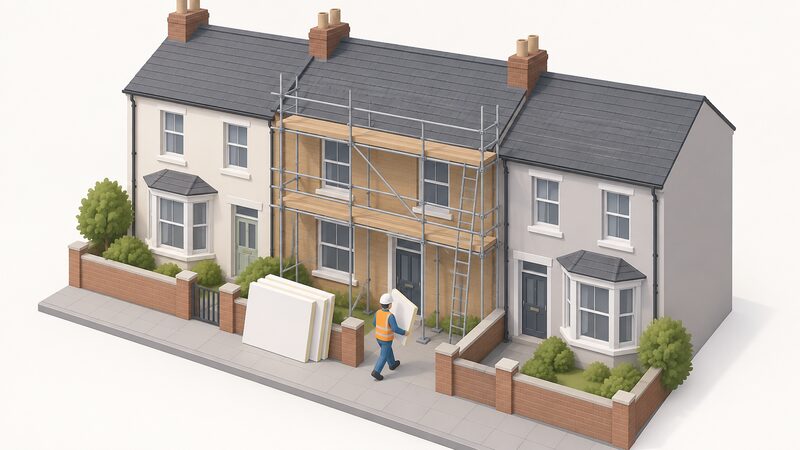
ECO4 focuses on whole house retrofits15, and the order of works is deliberate. The scheme prioritises the installation of insulation before considering other measures16, and describes a shift to a fabric-first multi-measure whole-house retrofit approach16.
That sequencing has a direct effect on the calendar. A household expecting a boiler in the first week may find insulation scheduled first, with the heating work following. The reason is that fabric measures reduce the heat demand the new heating system has to meet, so the specification of the boiler depends on what the insulation achieves.
There is also a hard deadline attached to multi-measure projects. Where an in-fill measure is used, it needs to be finalised within three months from the installation of the last of the three associated ECO4 measures6.
"ECO4 focuses on whole house retrofits"
The practical consequence is that a boiler-only project and a whole-house project have different timelines. A boiler-only job is measured in days of work1. A whole-house project is measured in the sequence of measures, and the boiler may not be first.
What happens after installation: notification, sign-off and when you can use the boiler
The installation of a measure is deemed complete at handover, and handover is expected within four calendar weeks of the installer finishing work on each measure5. That is the formal completion point, and it is the stage at which the household can expect the paperwork to catch up with the physical work.
One requirement has been removed. The requirement for a full set of heating controls in the property following a boiler installation was removed under ECO4 Delivery Guidance version 3.0, dated 7 August 202517. That removal is recorded in the summary of updates to the delivery guidance and measures table18.
Notification deadlines sit with suppliers rather than households. Supplier notification deadlines for domestic customer numbers and supply were set at 1 February 2023, 1 February 2024 and 1 February 2025 across successive phases5. Settlement data is available from 22 January of the year after the relevant qualification year5.
For the household, the usable point is handover. The boiler is installed and commissioned before that, but the measure is not complete until handover takes place5.
If the installation is delayed or goes wrong: who to contact and your options
Where delays occur for reasons that could not reasonably have been foreseen at the start of the project, an installation extension of three months will be permitted6. An extension may be requested at any time before the deadline of five months after the date of completion of installation of the first measure in that project5.
Safety issues have their own rule. Where health or safety risks are identified, installers are required to make them safe within 24 hours19.
On the consumer protection side, the Boiler Upgrade Scheme guidance shows the shape of Ofgem's oversight of installers: within 14 days of deciding to withhold a payment, Ofgem will send a notice to the installer, and will notify the installer and any other person affected by a decision of the result within 21 days of concluding the review20. That is BUS procedure rather than ECO4 procedure, but it illustrates the escalation route through the regulator.
Where an application is refused, measures may be rejected9. Some councils refer residents assessed as potentially eligible to a funding scheme provider or an approved installation company rather than handling the request themselves14.
What ECO4 covers, and what it does not

The measures table is the definitive list of what can be funded. It covers boiler upgrade to a non-renewable heating system, boiler upgrade to a renewable heating system, repair of a broken heating system, replacement of a broken efficient heating system, first time central heating, electric storage heater upgrades and repairs or replacement, connection to a district heating system, heating controls, solar PV, wall, roof, floor and loft insulation, draught proofing, window glazing and higher performance external doors8.
Repair sits alongside replacement. Where an existing heating system is intact and under its lifespan, the ECO4 scheme encourages homeowners to repair rather than replace it22. That is a timing issue as much as a funding one: a repair is a shorter job than a replacement, and a household told its boiler can be repaired rather than swapped should expect a different schedule.
| Measure | What it covers | Timing implication |
|---|---|---|
| Boiler upgrade, non-renewable | Replacement with a non-renewable heating system | Days of work for a like-for-like swap1 |
| Boiler upgrade, renewable | Replacement with a renewable heating system | A few weeks for a heat pump1 |
| Boiler repair | Repair of a broken heating system | Shorter than replacement8 |
| Broken efficient heating replacement | Replacement of a broken efficient heating system | Days, subject to specification8 |
| First time central heating | Installing central heating where none exists | Longer, as pipework and radiators are added2 |
| Insulation | Wall, roof, floor and loft insulation | Prioritised before other measures16 |
Installations under ECO include a free 10 year service package under Innovation Measure 01223. That is a scheme term attached to that measure, not a general warranty across all ECO4 work.
Where the timeline is uncertain
Two things are genuinely unresolved. The first is the eligibility check itself: no published figure gives its duration, and the evidence rules only say that supporting documents must be dated no more than 12 months before the beginning of a project9. The second is the interaction between the scheme end date and project deadlines. ECO4 runs to 31 December 2026 after the 9 month extension3, while earlier delivery guidance set completion no later than 31 March 20266. A household starting a project late in the scheme's life is working against both.
Scotland differs on heating policy. The Heat in Buildings Strategy set out phasing out the need to install new or replacement fossil fuel boilers in off-gas grid areas from 2025, and in on-gas areas later24. That is a Scottish policy direction rather than an ECO4 rule, and it affects what can be proposed north of the border.
For a household, the honest summary is that the boiler is fitted in days, the project completes at handover within about four weeks of the installer finishing5, and the total elapsed time from first contact to a working boiler depends on evidence, survey, specification and the order in which measures are scheduled.
Sources24 cited
- Planning for your boiler's replacement, Which?, 2026-02-27
- How long does it take to fit a boiler?, Uswitch, 2026-09-16
- Extending the ECO4 end date, GOV.UK, 2026-01-23
- Energy Company Obligation (ECO), Ofgem, 2026-09-17
- ECO4 supplier administration guidance, Ofgem, 2026-07-06
- ECO4 delivery guidance version 3.2, Ofgem, 2025-12-08
- Consumer grants and incentives: ECO4, MCS Certified, 2026-09-07
- ECO4 delivery guidance version 4.0, Ofgem, 2026-03-26
- ECO4 summary updates document, Ofgem, 2026-09-17
- ECO4 Flexibility Funding, Ceredigion County Council, 2026-09-17
- Boiler Upgrade Scheme quarterly report, issue 14, Ofgem, 2025-11-26
- BUS guidance for property owners, Ofgem, 2026-03-25
- Energy Company Obligation (ECO4) scheme, Derbyshire County Council, 2026-09-17
- Home energy efficiency, Bridgend County Borough Council, 2026-09-17
- ECO4 Flex and GBIS Flex information document, Ceredigion County Council, 2025-11
- Energy saving grants and funding, Tameside Council, 2026-09-17
- ECO4 delivery guidance v3.2 and measures table: summary of updates, Ofgem, 2025-08-07
- Summary of updates to ECO4 delivery guidance and measures table, Ofgem, 2025-08-07
- Retrofit measures: ECO4 and GBIS, Hansard, 2025-10-13
- Boiler Upgrade Scheme guidance for installers V5, Ofgem, 2026-04-28
- ECO 4 vs ECO 3: what installers need to know, Wolseley, 2026-09-17
- ECO4, Elmhurst Energy, 2026-09-20
- ECO4 Innovation Approved Innovation Measures v1.10, Ofgem, 2024-07
- Heat in Buildings Strategy: island communities impact assessment, Scottish Government, 2021-11-11
 New Boiler Cost in the UKWhat a replacement boiler costs in the UK by type and fuel, and what drives the installation element: conversions, relocations, flue work and system upgrades.
 Switching SupplierHow long does switching energy supplier actually take, and what happens if you owe money?
 Boiler WarrantiesHow long does a boiler warranty actually last, and what do you have to do to keep it?
 The Full Boilers and Heating GuideWhich boiler suits your home, and when is it worth swapping the old one?
 Boiler InstallationGetting a new boiler means following building rules, and the person fitting it must be registered to sign the work off.
 New Electricity ConnectionWho do you contact for a new or upgraded electricity connection, and what will it cost?