
In this answer
Short answer
A condemned boiler is one an engineer has judged unsafe or beyond economic repair, and it is one of the few situations where a household can realistically end up with a replacement heating system at no cost. The main route is ECO4, the Energy Company Obligation, which lists both the repair of a broken heating system and the replacement of a broken efficient heating system among its eligible measures1. The scheme is funded by energy suppliers and administered by Ofgem, and it closes to new applicants on 31 December 20262.
The catch is eligibility. ECO4 is built around qualifying benefits, the Warm Homes: Local Grant uses income limits, and the Boiler Upgrade Scheme pays a fixed £5,000 grant towards a heat pump or biomass boiler rather than a like-for-like gas swap3. A condemned boiler does not by itself unlock funding; it establishes that work is needed, and the scheme rules then decide who pays.
Where a grant does apply, the household's exposure is usually limited to whatever falls outside the funded scope. Where none applies, a conventional boiler alone is quoted at around £1,500 without installation, before any labour, controls or remedial work5.
What 'condemned' means, and why it opens the door to funding
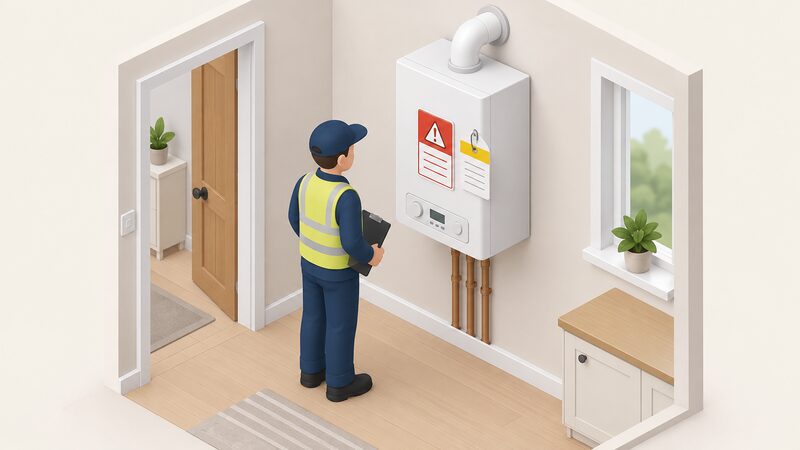
A condemned boiler is not a legal category in the grant rules. It is an engineer's judgement that the appliance is unsafe to keep in service, and it matters because every funding route is built around replacing or repairing heating that has failed, is inefficient, or cannot be made safe. ECO4 explicitly encourages homeowners to repair rather than replace where an existing heating system is intact and under its lifespan, and separately lists repair of a broken heating system and replacement of a broken efficient heating system as eligible measures1. A condemned appliance sits at the replacement end of that spectrum.
Building regulations shape what can go in its place. The replacement of a gas boiler will probably have to be a condensing boiler unless there is sufficient reason why one cannot be installed, with an assessment carried out by a registered installer9. Off the gas grid, non-condensing boilers can only be fitted if the building qualifies for an exemption based on an assessment of the technical difficulty and cost associated with installing a condensing model11.
Independent guidance draws the line differently again. Which? advises that replacing a non-condensing boiler bought before 2005 could be worth it, but does not recommend replacing an old condensing boiler unless it is broken, functioning poorly or condemned12. That is the practical test most households face: a condemned appliance is one of the three conditions under which replacement is treated as sensible rather than optional.
For a household's energy independence, a condemned boiler is a forced decision rather than a chosen one. The replacement determines whether the home stays on gas, moves to a heat pump, or switches to a different fuel entirely, and the grant rules largely decide which of those is affordable.
ECO4: the main route to a free boiler replacement
ECO4 is the scheme most households mean when they ask about a free boiler. It funds insulation, boilers and central heating, and solar and renewable energy technologies, delivered by installers working for obligated energy suppliers13. The eligible measures table is broad: boiler upgrade to a non-renewable heating system, boiler upgrade to a renewable heating system, repair of a broken heating system, replacement of a broken efficient heating system, first time central heating, electric storage heater upgrades and repairs or replacement, connection to a district heating system, heating controls, solar PV, wall, roof, floor and loft insulation, draught proofing, window glazing and higher performance external doors1.
Two rules matter for a condemned boiler. First, boiler replacement measures that are not first time central heating are delivered under the broken heating system cap and its associated uplift, which limits how much of a project can be spent on the boiler itself14. Second, the scheme has been moving towards greener replacements: it encourages homeowners to replace existing boilers with alternatives such as heat pumps2.
The scheme has also been simplified. The requirement for a full set of heating controls in the property following a boiler installation was removed from the delivery guidance in August 202515. That reduces the scope of work an installer must complete alongside the boiler, though controls remain an eligible measure in their own right.
Funding cannot be stacked. Funding from the Boiler Upgrade Scheme and ECO cannot be blended for the same measure or be included within an ECO4 project3. A household choosing between a supplier-funded boiler replacement and a heat pump grant is choosing between two separate routes, not combining them.
Other schemes that can cover a condemned boiler
The Boiler Upgrade Scheme is the main alternative, and it works on entirely different principles. It provides a grant to cover part of the cost of replacing fossil fuel heating systems with a heat pump or biomass boiler, and it supports homes and small and medium non-domestic buildings in England and Wales17. The grant is £5,0004. It is not means tested, so a condemned boiler in a household on any income can qualify, but it funds low carbon heating rather than a like-for-like replacement.
Biomass has its own conditions. A grant is available where the property is off the gas grid, is in a rural location, and the boiler has an emissions certificate showing that polluting emissions are kept to a minimum19. Biomass boilers cannot be grant funded in a self build property19.
In Northern Ireland, the Affordable Warmth Scheme is the boiler replacement route, aimed at householders who are over 65, or have a child in receipt of Child Benefit or Kinship payments, or receive Disability Living Allowance, Personal Independence Payment, Attendance Allowance or Industrial Injuries Benefit20. The Northern Ireland Housing Executive also offers a Renovation Grant for homes that have been inspected and found to be unfit to live in21. A previous Northern Ireland Boiler Replacement Scheme helped owner occupiers with a gross annual income under £40,000 to replace boilers over 15 years old22.
In London, the Warm Homes: Local Grant states that tenants should not pay for upgrade costs, which matters where a condemned boiler sits in a rented home23.
Who qualifies: benefits, income and property rules

ECO4 eligibility turns on the household rather than the boiler. The scheme operates through qualifying benefits and through ECO4 Flex, the local authority route for households on a low income or vulnerable to cold who do not receive a qualifying benefit. Under ECO4 Flex, local authorities are not liable for any claims a customer makes should they be dissatisfied with the standard of work; liability is held with the installer24. That is a meaningful distinction for anyone referred through a council: the council is the gateway, not the guarantor.
The Boiler Upgrade Scheme has no benefit test but does have property rules. Social housing is not eligible25. Self builds can qualify where the property is not part of an excluded property development25. Applicants must own the property they are applying for, including a business, a second home, or a property rented out to tenants26.
Tenure rules cut both ways for renters. Under the domestic private rented property minimum standard, landlords must not unreasonably refuse tenant requests for energy efficiency improvements funded at no cost to the landlord, for example through grants or third-party funding27. That gives a private tenant a route to ask, though the request depends on funding being available at no cost to the landlord.
Where a household does not qualify, the fallback is a loan or a grant from a council's housing financial assistance budget. Cornwall's Home Improvement loan, for example, excludes new conservatories and porches, furniture and soft furnishings, house deposits, secondary heating, demolition and rebuilding of the whole property, and conversion of a house into flats28. Boiler replacement is not on that exclusion list, but the terms are set locally.
How to apply, and what the survey involves
The Boiler Upgrade Scheme is installer-led, with the installer applying for the grant on the property owner's behalf. The installer discounts the grant from the invoice, applies to Ofgem for a grant voucher, and redeems the voucher after installation and commissioning29. The household does not receive the money directly; the grant is applied upfront as a discount to the cost of the installation and is paid to the installer6.
ECO4 works through obligated suppliers and their installer networks, with the survey establishing what the property needs and what the scheme will fund. The survey is also where the scope is fixed: a condemned boiler may be accompanied by findings on insulation, ventilation or the flue route that change the work required.
Ofgem can ask for evidence after the event. For the Boiler Upgrade Scheme, that may include valid ID, proof of address, proof of property ownership, copies of MCS certificates, evidence of supplementary heating, copies of EPCs and EPC site notes, utility bills or fuel delivery receipts, photographs of the previous and installed heating systems, purchase receipts or a quote, total building heat loss calculations, and an emissions certificate for biomass boilers6. The list is not exhaustive30.
Installation itself is quick once work starts. A like-for-like swap can take four to six hours, converting from a system or conventional boiler to a combi can take up to two days, changing from a conventional boiler to a system boiler takes two to three days, and a system boiler with a cylinder takes two to three days because the cylinder needs fitting8. A conventional boiler installation is likely to take one to three days8.

If you do not qualify: what a replacement actually costs
Where no grant applies, the household pays the full cost. A conventional boiler is quoted at around £1,500 without installation, so the appliance alone is a starting point rather than a total5. Labour, controls, flue work, any cylinder, and remedial work found at installation sit on top, and prices are installer-quoted rather than published.
The cost of a refused application is not only financial. Under the Boiler Upgrade Scheme, 2,295 applications were rejected in Scheme Year 3 for failing eligibility checks7. Common reasons include a property or heating system that is not eligible, fossil fuel appliances retained or installed, a system not fully commissioned, consent not provided or falsified, or the property having previously received public funding for a low carbon heating system at the same address13. Only the installer may request a review of a decision, and the right of review does not apply to decisions to withhold payment13. Ofgem's compliance actions against installers can include withholding payments, revoking vouchers, offsetting payments due, or seeking repayment31.
For a household's independence, the outcome is mixed. A grant-funded replacement removes the immediate capital cost and, in the case of a heat pump, reduces reliance on gas, but it does not remove reliance on the grid, on a supplier, or on the installer's warranty and aftercare. A like-for-like replacement under ECO4 leaves the home on gas, dependent on the same network and the same supplier relationships as before. The scheme changes who pays for the boiler, not who supplies the heat.
Sources31 cited
- ECO4 delivery guidance version 4.0, Ofgem, 2026-03-26
- ECO4, Elmhurst Energy, 2026-09-20
- ECO4 delivery guidance v3.2, Ofgem, 2025-12-08
- Notice of approved grant categories and values for the Boiler Upgrade Scheme, GOV.UK, 2026-07-21
- Best boilers, Confused.com, 2025-11-03
- Boiler Upgrade Scheme guidance for property owners V5, Ofgem, 2026-04-28
- Boiler Upgrade Scheme annual report April 2024 to March 2025, Ofgem, 2025-07-31
- How long does it take to fit a boiler?, Uswitch, 2026-09-16
- Boilers and heating: building regulations, Planning Portal, 2026-09-17
- Building regulations: boilers and heating, Welsh Government, 2026-09-17
- Your home guide to liquid fuel heating, OFTEC, 2026-09-20
- Boiler energy efficiency, Which?, 2025-09-19
- Boiler Upgrade Scheme guidance for installers v5.1, Ofgem, 2026-07
- First time central heating checklist, Ofgem, 2020-10-16
- Summary of updates to ECO4 delivery guidance and measures table, Ofgem, 2025-08-07
- ECO4 delivery guidance v3.2 and measures table: summary of updates, Ofgem, 2025-08-07
- Funding schemes, OFTEC, 2026-09-20
- Boiler Upgrade Scheme, GOV.UK, 2026-09-17
- Check if you're eligible for the Boiler Upgrade Scheme, GOV.UK, 2026-09-17
- Affordable Warmth Scheme, Northern Ireland Housing Executive, 2026-09-17
- Grants we offer, Northern Ireland Housing Executive, 2026-09-17
- Northern Ireland housing statistics 2023-24, Northern Ireland Statistics and Research Agency, 2024-09-25
- Warmer Homes, Greater London Authority, 2026-09-17
- ECO flexibility funding, Ceredigion County Council, 2026-09-17
- Boiler Upgrade Scheme: installers, Ofgem, 2026-09-17
- Boiler Upgrade Scheme, MCS Certified, 2026-07-21
- Trading standards guidance: other consumer problems, Isle of Anglesey County Council, 2026-05
- Eligible and non-eligible works, Cornwall Council, 2025-10-01
- Boiler Upgrade Scheme, Find government grants service, 2026-09-18
- BUS guidance for property owners v5 draft, Ofgem, 2026-03-25
- BUS PO guidance V2.3, Ofgem, 2023-09-25
 The Full Boilers and Heating GuideWhich boiler suits your home, and when is it worth swapping the old one?
 New Boiler Cost in the UKWhat a replacement boiler costs in the UK by type and fuel, and what drives the installation element: conversions, relocations, flue work and system upgrades.
 Controls in Rented HomesCan you change the heating controls in a rented home, and who pays if they break?
 Building RegulationsReplacing a boiler or heating system usually needs building regulations approval, and the rules differ across England, Scotland, Wales and Northern Ireland.
 Financing an InstallationPaying monthly for a boiler, solar panels, battery or heat pump sounds simple, but who actually lends you the money and what happens if the work goes wrong?
 Replacing a Gas or Oil BoilerSwapping a gas, oil or LPG boiler for a heat pump changes how your home is heated and how much it costs.