
In this answer
Short answer
The boiler scrappage schemes that once paid households to swap an old, inefficient boiler are closed. The Boiler Replacement Scheme in Northern Ireland is now closed1, and the Warm Home Discount Scheme that ran alongside support for low-income households has also closed2. No scrappage voucher can be claimed today, and any site offering one should be treated with caution.
What exists instead is the Boiler Upgrade Scheme, which covers England and Wales and pays upfront grants of up to £7,500, or £9,000 for homes heated by oil and LPG, towards a heat pump or, in limited circumstances, a biomass boiler3. The scheme has been extended to 20304, and it is the main route by which a household with an old G-rated boiler can now get help to replace it.
The schemes that paid for old boilers, and why they are gone
Scrappage-style schemes shared a simple idea: pay households something towards a new, efficient boiler when they scrapped an old one. The Northern Ireland Boiler Replacement Scheme worked this way, providing owner occupiers whose gross annual income was less than £40,000 with help for the cost of replacing boilers over 15 years old7. That scheme is now closed1.
The Warm Home Discount Scheme, which sat alongside boiler support for low-income households, has likewise closed2. The reason for the shift is policy as much as money: government support has moved away from paying for new fossil fuel boilers and towards paying for low-carbon heating. The Renewable Heat Incentive that preceded today's scheme has itself been replaced with the Boiler Upgrade Scheme8.
For a household's energy independence this is a real change of direction. The old schemes helped you buy a more efficient version of the same gas-dependent appliance. The current scheme pays you to leave fossil heating behind altogether, which reduces dependence on the gas grid or on delivered oil and LPG, though it leaves you dependent on electricity and on the scheme's own rules and budget.
The Boiler Upgrade Scheme: grants, technologies and how to apply
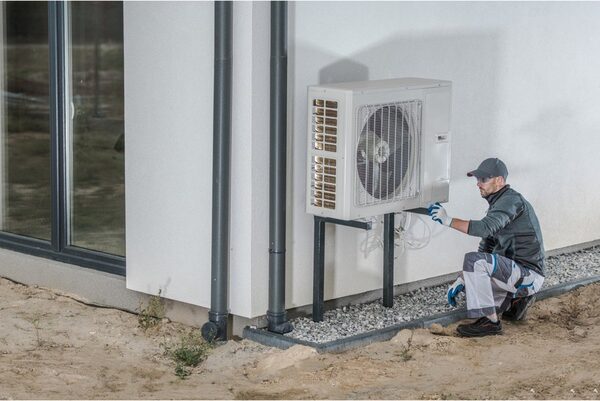
The Boiler Upgrade Scheme provides upfront grants to help reduce the cost of installing a low-carbon heating system, such as a heat pump or, in limited circumstances, a biomass boiler, in properties in England and Wales9. The standard grant is up to £7,5003, confirmed in the official notice of approved grant categories and values10, with £9,000 for owners of properties heated by oil and liquid petroleum gas11. Biomass boilers are an eligible technology12, with an approved category for a biomass boiler in an off-gas grid property replacing an oil heating system10.
The application is installer-led, with the installer applying for the grant on the property owner's behalf: the installer discounts the grant from the invoice, applies to Ofgem for a grant voucher, and redeems the voucher after installation and commissioning13. You cannot apply yourself9. To be eligible, the property must have a fossil fuel heating system, such as gas, oil or LPG, or an electric heating system, excluding existing heat pumps9.
The scheme's closing date is 30 December 2029, 11:59pm13, and it has been extended to 20304. A £2,500 grant for heat batteries will also be available once the legislation and appropriate product standards are in place14, and independent guidance confirms heat batteries will be eligible for a £2,500 grant through the scheme15.
What the scheme has delivered so far
Uptake has grown steadily. By the end of March 2026 the scheme had supported 80,098 low-carbon heating systems since it started5, up from 49,136 a year earlier16. Scheme Year 3 alone supported 25,331 installations16. Vouchers issued across the scheme total £504,994,500 in value, against 68,605 voucher redemption applications17. Around 76.3% of grants paid since the start of the scheme were for the replacement of fossil fuelled heating systems, like gas boilers5, which is exactly the job the old scrappage schemes once did, but with a low-carbon result.
The scheme's carbon ambition is substantial: it is expected to deliver up to 1.1MtCO2e of carbon savings over Carbon Budgets 4 and 5, and 2.6MtCO2e over its lifetime6.

When gas boilers are phased out
There is no ban on keeping or using a gas boiler. The government's stated ambition is to end the installation of gas boilers by 2035 at the latest18, and the Heat and Building Strategy plans to phase out the installation of new natural gas boilers beyond 203519. Independent reporting likewise describes plans to phase out new gas boilers from 203520.
On new homes, the direction is faster. Earlier policy set a nationwide ban on installing gas boilers in all new-build properties by 2025 and for all households by 20356, and the consultation on England's Future Homes Standard proposes banning gas boilers, following Scotland's lead21. The detail of our gas boiler ban page sets out what is actually law and what remains ambition.
For households, the practical reading is that a gas boiler bought today remains usable, but the policy direction is fixed: new installations are intended to stop from 2035, and grant support is already aimed at the alternatives.
Still running an old G-rated boiler
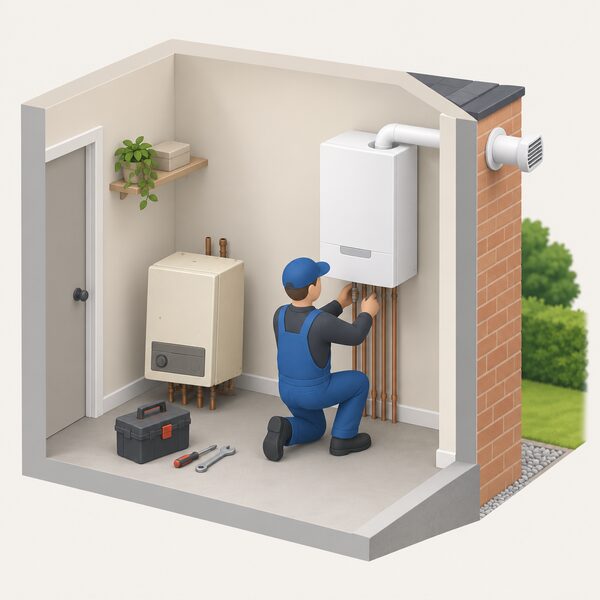
A G-rated boiler is the least efficient class still found in UK homes, and the running-cost penalty is well documented. Independent guidance puts the saving from upgrading a G-rated boiler to an A-rated one at around £320 a year for a semi-detached house22, with a matching figure of around £320 each year for a semi-detached home on mains gas upgrading to an A-rated condensing boiler with full heating controls, based on energy prices in July 202623. A separate estimate for Great Britain puts the saving at £42024. The figures differ because they assume different home types and price bases, but both point the same way: an old G-rated boiler is expensive to run.
Options today fall into two groups. A Boiler Upgrade Scheme grant pays towards a heat pump or biomass boiler if the property has a fossil fuel or eligible electric heating system9. Alternatively, a straight boiler replacement remains possible, and the installing engineer can often take the old boiler away at no extra cost, with old boilers or their parts sometimes recycled25. Our pages on boiler efficiency and ErP ratings, new boiler cost and heating grants in each nation cover the practical next steps.
Sources25 sources
- Apply for the Boiler Upgrade Scheme, GOV.UK
- The Warm Home Discount Scheme, GOV.UK
- Boiler Upgrade Scheme grant finder, Find Government Grants
- Boiler Upgrade Scheme guidance for installers v5, Ofgem, 2026-04-24
- Boiler Upgrade Scheme annual report, April 2025 to March 2026, Ofgem, 2026-07-31
- Boiler statistics, Uswitch, 2024-01-04
- Northern Ireland housing statistics 2023-24, NISRA, 2024-09-25
- Russell and Kate: solar panels and a heat pump, Energy Saving Trust, 2026-08-13
- Boiler Upgrade Scheme guidance for property owners v5, Ofgem, 2026-04-24
- Notice of approved grant categories and values for the Boiler Upgrade Scheme, GOV.UK, 2026-07-21
- Parliamentary research briefing CBP-9585, UK Parliament, 2026-05-13
- Boiler Upgrade Scheme: installers, Ofgem, 2026-09-17
- Boiler Upgrade Scheme guidance for installers v5.1, Ofgem, 2026-07-01
- Carbon Budget and Growth Delivery Plan: heat and buildings factsheet, GOV.UK, 2026-06-23
- Electric heating advice, Centre for Sustainable Energy, 2026-06
- Boiler Upgrade Scheme annual report, April 2024 to March 2025, Ofgem, 2025-07-31
- Boiler Upgrade Scheme quarterly report, issue 14, Ofgem, 2025-11-26
- British Energy Security Strategy, UK Government, 2022
- Heat and Building Strategy: gas boilers phase-out, International Energy Agency, 2026-04-11
- RECC autumn newsletter 2024, Renewable Energy Consumer Code, 2026-09-17
- Will Scotland's future homes generate energy?, Solar Energy UK, 2026-09-17
- Make your home more energy efficient, Confused.com, 2026-07-06
- Upgrading and replacing your boiler, Centre for Sustainable Energy, 2026
- Renewable heat right for your home, Energy Saving Trust, 2026-05-19
- How long does it take to fit a boiler?, Uswitch, 2026-09-16