In this guide
A hot water cylinder is the one piece of household plant that stores energy as heat rather than buying it at the moment of use, and the UK market for them is substantial: around 500,000 hot water cylinders are installed, new and replaced, every year1. The makers fall into three groups. Dedicated cylinder manufacturers such as UK Cylinders, Telford, McDonald Water Storage and Newark Cylinders build vented, unvented and heat pump cylinders, often to order. Boiler and heat pump manufacturers such as Vaillant and Ideal Heating supply matched or pre-plumbed cylinders alongside their appliances. And a smaller group, led by Mixergy, sells connected cylinders that heat only part of the volume and report back through an app.
UK Cylinders is described as the UK's largest manufacturer of heat pump cylinders and a leading supplier of unvented hot water solutions, working from three Yorkshire facilities under ISO 9001 quality standards2. Telford states it manufactures in the UK and offers the widest range of copper and stainless steel cylinders available, sold through plumbing and builders merchants3. McDonald Water Storage states it is the only company in the UK that manufactures all its vented cylinders to BS1566 standards, and the only cylinder company specialising in exact like for like replacements for copper thermal stores4.
For a household, the independence argument is straightforward and limited. A cylinder decouples the moment heat is generated from the moment hot water is drawn, so it can be charged by a heat pump, a solar thermal panel, an immersion heater running on cheap or self-generated electricity, or a boiler. It does not generate anything. It remains dependent on whatever heat source fills it, on the mains cold supply for an unvented model, and, for smart models, on a manufacturer's cloud service and a company that has to stay in business for the life of a warranty that can run to 25 years.
Who makes hot water cylinders in the UK
The domestic cylinder market is unusual in that a large share of it is still made in Britain. Telford states its cylinders are manufactured in the UK using premium quality materials, that its stainless steel and copper storage range supplies the plumbing and heating industry nationally through local merchants, and that next day delivery is available on some lines3. UK Cylinders manufactures unvented cylinders for both traditional and renewable systems, supplying social housing providers among others, with nationwide coverage2. McDonald Water Storage supplies vented and unvented cylinders across the UK and Ireland, and offers replacements described as covering any make, any model, any shape, any size, any capacity9.
Materials divide the market. Cylinders are manufactured from copper or stainless steel, with mild steel solutions that in a domestic application are glass lined, predominantly used outside the UK11. Bespoke makers extend that choice to the grade, meaning thickness, of the copper or stainless steel used12.
Heat pump cylinder supply overlaps with the heat pump industry itself. There are at least 33 manufacturers supplying air source heat pumps in the UK, with Mitsubishi Electric, Vaillant, Daikin and Samsung accounting for nearly two-thirds of total annual UK sales; the main companies manufacturing air source heat pumps in the UK in 2024 were Mitsubishi Electric, Vaillant, Ideal and Octopus Energy, with a total market share of 34%13. Industry modelling puts the UK-manufactured share of hydronic heat pump sales at 33.5% in a baseline scenario, against a scenario raising it to 59%14. The Heat Pump Association represents manufacturers accounting for around 90% of the volume of heat pumps currently sold in the UK market, and its membership includes manufacturers of heat pumps, components and associated equipment as well as energy companies, certification bodies, installers and training providers15.
Further brand detail sits on the heat pump manufacturers and boiler manufacturers pages, and ownership questions on who owns which energy brand.
UK Cylinders and the heat pump cylinder segment
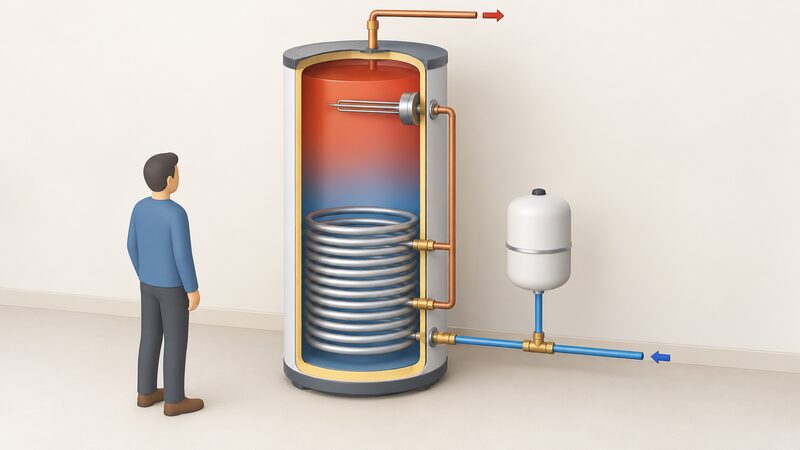
Heat pump cylinders are a distinct product rather than a conventional cylinder relabelled. A heat pump delivers water at a lower flow temperature than a boiler, so the internal coil has to be larger to transfer the same heat, and the cylinder is normally a mains pressure unvented design17. That is the segment UK Cylinders is described as leading, and its output covers both traditional and renewable systems from the same Yorkshire plants2.
Integrated heat pump cylinders, where the heat pump and the store are supplied as one unit, are quickly increasing in popularity in the UK18. Exhaust air heat pumps, which draw heat from air leaving the building, can also heat water stored in a cylinder for hot taps, showers and baths19. Ideal Heating pairs its Logic Air range with what it describes as its best in class pre-plumbed hot water cylinder, and states that its customer service and warranty team is based in the UK and open 364 days a year, with the range designed for the UK climate20.
In practice the household consequence of a heat pump cylinder is a larger box and a longer reheat. The store has to reach temperatures that satisfy the legionella guidance: UK building regulations advise that water cylinders, but not thermal stores, need to regularly reach temperatures of more than 60°C8. That last step is usually done by an immersion heater, which means a period of direct electric heating in every cycle. Grid flexibility can be earned from a cylinder but only in one direction: a Mixergy cylinder, and hot water cylinders in general, can only provide certain services to the National Grid operators, because the electrical energy is converted to hot water and cannot be converted back to electricity1.
Telford, Ideal Heating and the connected cylinder makers: where each fits
| Maker | What it states about its range | Source type |
|---|---|---|
| UK Cylinders | UK's largest manufacturer of heat pump cylinders; unvented cylinders for traditional and renewable systems; three Yorkshire facilities, ISO 9001, nationwide supply2 | Distributor page |
| Telford | Widest range of copper and stainless steel cylinders available; manufactured in the UK; superior corrosion resistance; lifetime warranties on some lines; next day delivery available on some lines3 | Maker |
| McDonald Water Storage | Only UK company manufacturing all vented cylinders to BS1566; like for like replacements for any copper thermal store; vented and unvented across the UK and Ireland4 | Maker |
| Newark Cylinders | Bespoke solutions from 8 litres to 2,000 litres, vertical and horizontal, variable coil quantities, sizes and positions, upgradeable insulation thicknesses6 | Maker |
| Ideal Heating | Pre-plumbed cylinder partnered with the Logic Air heat pump range; UK-based customer service and warranty team open 364 days a year20 | Independent product listing |
| Mixergy | Patented top-down heating design giving control over how much hot water is heated22 | Maker |
| Kensa | Mains pressure hot water cylinders for heat pumps17 | Maker |
| World Heat | Manufactured in the UK, 25-year guarantee23 | Supplier listing |
Maker claims of this kind are promotional and should be read as such. What distinguishes the groups practically is how the cylinder is bought: Telford sells through merchants for an installer to specify, Ideal Heating supplies a cylinder matched to its own heat pump, bespoke makers build to a measured space, and Mixergy sells a controlled appliance with a subscription option attached. Brand-level detail on Mixergy cylinders, Heatrae Sadia and Megaflo, Vaillant and Ideal Heating is held separately.
Unvented or vented: which cylinder suits which home
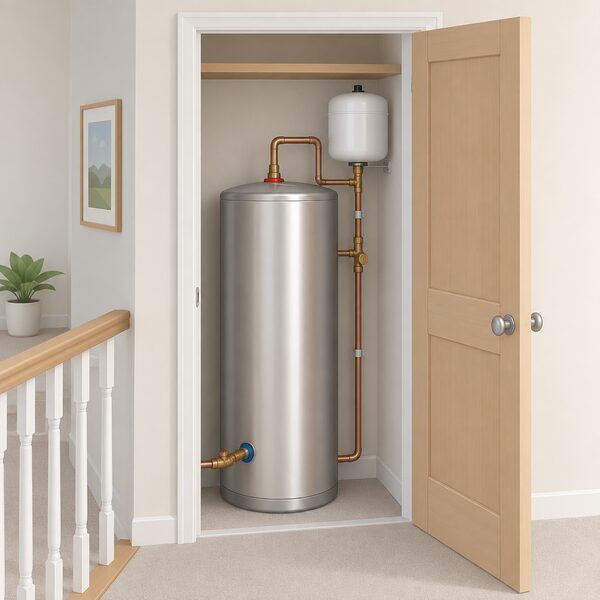
An unvented cylinder stores hot water and delivers it directly from the mains water supply, with no separate cold water storage tank in the loft24. It delivers mains pressure hot water throughout the property and is described as suited to modern homes, renovations, or properties wanting mains pressure hot water throughout25. The trade-off is regulatory and financial: an unvented installation requires Building Control notification, and vented cylinders tend to be cheaper than unvented because they are relatively simple in construction and operate at lower pressure24.
- Unvented: mains pressure at every outlet, no cold water storage tank, no loft space needed for a feed cistern, but Part G3 installation and notification apply24
- Vented: gravity fed from a cistern, simpler construction, lower operating pressure, generally cheaper26
- Thermal store: in SAP treatment, a separate thermal store, hot-water only or integrated, is treated as if it were a cylinder28
For independence, the distinction matters in a power cut and a mains failure. A vented system will still deliver stored hot water under gravity from its cistern; an unvented one depends on mains pressure being present. Both depend on the heat source, not on the cylinder, for the energy in the tank. Newer cylinders can hold heat for up to 48 hours, which sets the practical limit of how long a household coasts on a charge29.
Sizing: capacity, height and lagging add up to the space you need
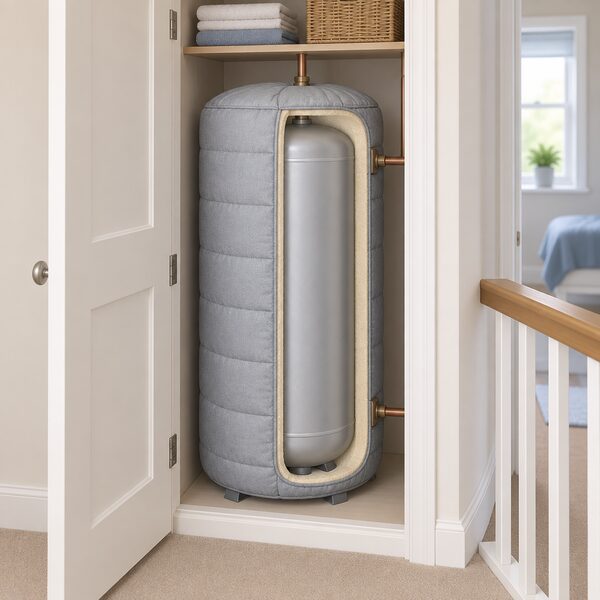
The size of cylinder needed depends on the water demand, the number of occupants and the frequency of baths and showers30, and more broadly on the amount of hot water a household typically uses31. For larger properties, a direct hot water cylinder of 300 litres or more is indicated30. RdSAP's reference table gives a normal hot-water cylinder size of 110 litres, with an indicative size up to 130 litres28. Bespoke manufacture spans a far wider band, from 8 litres to 2,000 litres in various heights, diameters and orientations, vertical and horizontal6.
Physical fit is decided by more than litres. A published domestic sizing guide records a 40 litre cylinder at a shell diameter of 280 mm; its two listings of the height for that capacity, 720 and 645, disagree, and the discrepancy is unresolved32. Bespoke options include variable coil quantities, sizes and positions as well as upgradeable insulation thicknesses, and insulation thickness adds to the external dimension even where the stored volume does not change12.
Two things push a cylinder larger than a household expects. Solar water heating needs a larger cylinder, which will take up extra room33. Heat pump systems need the larger coil described above. Where the cylinder replaces a combi, the space has to be found from scratch: one recorded case saw a household replace direct combi boiler supply with a new hot water system with a cylinder34.
Insulation standards apply to the finished installation as well as the product. In England and Wales, the cylinder should at least meet the minimum requirements of Approved Document L35. For an older uninsulated cylinder, a jacket costs about £30 in Great Britain and £30 in Northern Ireland36, with a separate estimate of about £2037; both are consumer guidance figures rather than quoted prices.
Water quality limits: chloride below 300 ppm, hardness and the softener condition
Stainless steel cylinders are sensitive to water chemistry, and manufacturers write that sensitivity into the warranty rather than the specification. Mixergy's terms dated 2 June 2026 require water chemistry to remain within recommended limits, including chloride below 300 ppm, and state that in areas where hardness exceeds 200 ppm CaCO3 a water softener must be installed for the warranty to remain valid7. The earlier terms, for cylinders fitted before 3 June 2026, required that the water supply does not have a chloride content greater than 300 ppm and that water hardness is not greater than 270 ppm38. The two documents therefore set different hardness thresholds, 200 ppm and 270 ppm, and which applies depends on the installation date.
| Condition | Terms before 3 June 2026 | Terms from 3 June 2026 |
|---|---|---|
| Chloride | not greater than 300 ppm38 | below 300 ppm7 |
| Hardness | not greater than 270 ppm38 | softener required above 200 ppm CaCO37 |
| Transferability | not transferable, rests with the original householder38 | transferable if service history is passed on7 |
Where a plate heat exchanger is supplied with the cylinder for use with heat pumps, the property must be in a soft water area or the plumbing system deployed with a water softener38. Another maker sets anode inspection intervals by hardness: for water with hardness at or below 250 mg/L CaCO3, two years after installation; above 250 mg/L CaCO3, or in critical or aggressive water, one year after installation, with subsequent inspections annually39. In commercial installations where constant usage or reheat is required, titanium immersion heaters must be fitted to comply with the Mixergy warranty38.
The practical point for a household is that the water supplied to the property, which is outside the household's control, can decide whether a 25-year warranty survives. A hardness test before purchase is the only way to know which side of the threshold a postcode falls.
Warranty and registration: the 60-day deadline and what keeps cover alive
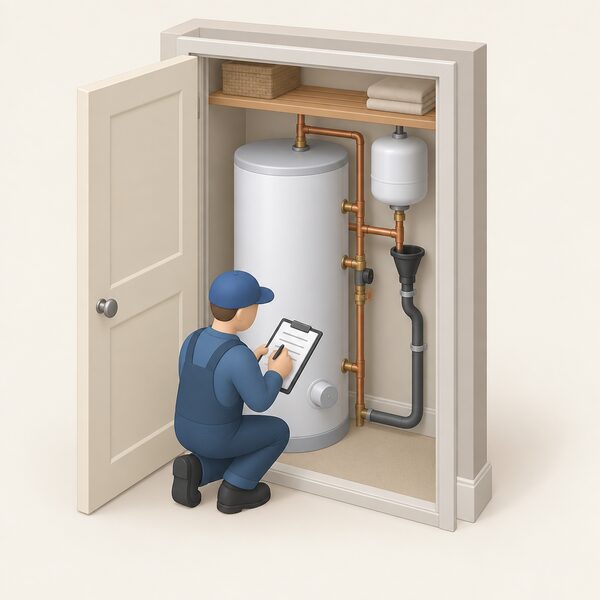
Cylinder warranty periods are long and the conditions are strict. Mixergy warrants the stainless steel cylinder, the inner vessel including the sensor strip, for 25 years with registration via its warranty registration form, excluding labour; registration must be completed within 60 days of commissioning or of first legal completion of the property7. Under the earlier terms the cylinder carried 25 years from installation and the components 3 years from the date of installation38. The homeowner guide states Mixergy X and Mixergy Solar X cylinders carry 25 years on the cylinder and 3 years on the components22, and the iHP X heat pump unit an initial 5-year warranty18.
| Product | Cover stated | Registration deadline |
|---|---|---|
| Mixergy iHP X stainless steel cylinder | 25 years with registration, excluding labour7 | 60 days7 |
| Mixergy components | 3 years from installation38 | 60 days7 |
| Mixergy iHP X heat pump unit | initial 5 years, fully serviceable18 | as above |
| Vaillant domestic cylinder (indirect) | contact Vaillant UK Service on 0330 100 3143 within the guarantee period40 | 30 days40 |
| Vaillant direct cylinder | 2 years parts and labour against manufacturing defects; reverts to 12 months if not registered41 | 30 days41 |
| Rointe domestic cylinder tank | 3 years, plus 2 years; electronics 2 years, plus 1 year, plus 1 year39 | not stated |
| Typical unvented cylinder | 25 years on the body against material defects and manufacturing faults, 2 years on all components26 | not stated |
| World Heat cylinder | 25-year guarantee, manufactured in the UK23 | not stated |
| Telford | lifetime warranties on some lines3 | not stated |
The conditions matter more than the headline number. Mixergy's current terms require installation by a competent person in accordance with current UK Building Regulations and Mixergy's instructions, a completed and retained Benchmark commissioning checklist, an annual service carried out and documented either in the installation manual or supported by proof of payment from the servicing installer, and a servicing engineer registered with an appropriate competent person scheme such as Gas Safe Register where applicable7. Cover applies to products installed in the United Kingdom; products installed outside the UK and installations not carried out to the instructions are excluded, as are consequential losses including property damage or loss of earnings7. Vaillant requires installation and commissioning by a Building Regulations Approved Document G(3) qualified installer within 6 months of despatch of the cylinder from its warehouse, and its guarantee is subject to the laws of England and Wales with disputes heard before a court or tribunal in England40.
"Replacing any component, or replacing the whole appliance, does not restart the warranty period."
The earlier Mixergy terms invalidate cover if the cylinder has been subject to frost damage, misused, tampered with, subjected to neglect, or modified in any way other than by Mixergy38. Nothing on the warranty page affects statutory rights7. General guidance on this sits on manufacturer warranties and registering a warranty.
Making a claim: what to have ready
Mixergy Ltd takes warranty claims on 01865 595 875, weekdays 09:00 to 17:00, and asks for the product MX number, proof of installation and service history, and photographs with a description of the issue7. A valid claim is settled by a like-for-like replacement cylinder, or by replacement of the covered components as applicable, and the warranty covers replacement only: labour costs associated with replacing the cylinder or its components are not covered, and only replacement items are offered, not the cost of installing them38. The defects covered are corrosion, material defects and manufacturing faults7.
The paperwork that supports a claim is created at handover, not afterwards. An installer should provide a commissioning checklist and hand over all documentation including the manufacturer's installation manual, warranty registration details, and a record of the safety valve settings27. Homeowners are advised to keep proof of annual maintenance42. Where that paperwork is missing, the building control notification made at installation, or the competent person scheme record where the engineer was registered, may be the only surviving evidence of the date27.
Regulations and servicing: G3, Benchmark and the annual visit
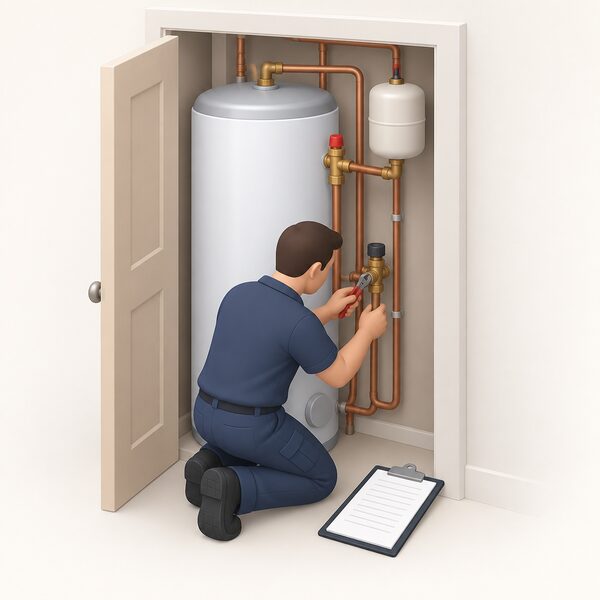
Two regimes bear on a stored hot water system. Building Regulations Part G3 governs unvented installation and competence, as set out above. Benchmark governs the record: it is the nationally-recognised scheme that places responsibilities on both manufacturers and engineers to ensure best practice in the installation, commissioning and servicing of domestic heating and hot water products43, and its purpose is to ensure that customers are provided with the correct products for their needs and that those products are installed, commissioned and serviced in accordance with the manufacturer's instructions by competent persons, safely, at optimum efficiency and meeting the appropriate Building Regulations44. It is described elsewhere as a scheme promoting best practice in installation, commissioning and servicing of domestic heating and hot water systems45.
Annual servicing is close to universal as a warranty condition. Unvented cylinder servicing validates the manufacturer's warranty and, in the maker's words, guarantees the cylinder operates efficiently in compliance with industry guidance and Building Regulations11. One service checklist states plainly that to validate the warranty the cylinder must be serviced annually by a suitably qualified service engineer42. Making annual servicing a condition of the hot water cylinder warranty has been described as going some way to addressing the problem of unserviced stored water systems46. Where a hybrid system is installed, manufacturers recommend annual servicing of hybrid units, which require both gas and electrical skill47.
The industry itself considers the regulation dated. The Heating and Hotwater Industry Council has said it believes heat pumps should have a mandatory annual service, and has recommended a review of Part G3 of the Building Regulations, which it believes to be out of date and not reflective of the requirements for heat pump systems47. It also argues the Benchmark service record is a means of maintaining high quality installation standards which would help maintain necessary noise requirements of heat pump installations47. Separately, a heat pump installation must be notified to the distribution network operator within 28 days48. Cylinder settings should be set by a boiler engineer and kept hot enough to avoid the build-up of bacteria in the storage tank49.
Service cover for cylinders is also sold as a maintenance plan: published plans cover an unvented hot water cylinder and installation pipework in a heat-pump system, or an air-source heat pump plus unvented cylinder and the pipework for both50. Plumbing firms list unvented cylinder installation and maintenance as a service line46. More on this sits under manufacturer service plans.
The Hot Water Association and the case for stored water
The Hot Water Association is a trade organisation whose membership accounts for nearly 100% of hot water storage devices sold in the UK46. It is the body behind much of the servicing guidance the manufacturers point to, and it has worked with the Chartered Institute of Plumbing and Heating Engineering on a webinar providing information and guidance on energy storage potential, grid enabled hot water stores and other thermal energy storage mediums51. That framing, the cylinder as a thermal battery, is the industry's principal argument against instantaneous combi supply.
The argument has substance for a self-sustaining household. A cylinder can be charged when electricity is cheapest or when a solar array is exporting, and newer cylinders can hold that heat for up to 48 hours29, so the draw at the tap is separated from the draw on the grid. A cylinder can take heat from a heat pump, a solar thermal collector or an immersion heater, and some makers control how much of the volume is heated: Mixergy's patented top-down heating design is described as giving complete control over how much hot water is used22. Kensa states that heat pump cylinders deliver hot water whenever it is needed17.
The limits are equally real. A cylinder holds heat, not electricity, and cannot return energy to the grid1. It takes floor space, more so with solar33. It has to be raised above 60°C regularly for legionella control8, which costs energy that instantaneous heating does not. It carries a servicing obligation every year for the life of the warranty. And the smart models add a dependence on the manufacturer's platform: Mixergy's annual service condition can be evidenced by a Benchmark service record or by subscription to the Mixergy Care Plan or Care Plan Plus with annual monitoring via the online analytics platform38. That is a commercial relationship lasting as long as the cover, which is an aspect of independence a household should weigh alongside the energy case. The wider question is set out on manufacturers and household energy independence.
Sources51 cited
- Mixergy and grid flexibility, Mixergy, 2023-11-10
- UK Cylinders feature, Marlec, 2026-06-10
- Telford hot water cylinders, Telford Group, 2026-09-17
- Vented cylinders, McDonald Water Storage, 2025-06-02
- Replacement thermal stores, McDonald Water Storage, 2024-03-21
- Bespoke cylinder solutions, Newark Cylinders, 2026-08-26
- Mixergy product warranty terms, from 3 June 2026, Mixergy, 2026-06-02
- How to ensure a heat pump runs efficiently, Energy Saving Trust, 2026-05-19
- Replacement hot water cylinder guide, McDonald Water Storage, 2026-09-17
- Vented vs unvented hot water cylinder, McDonald Water Storage, 2024-08-14
- Unvented cylinders, McDonald Water Storage, 2024-08-14
- Bespoke vs standard cylinders, Newark Cylinders, 2025-02-25
- Energy Innovation Needs Assessment: heat and buildings, UK Government, 2024
- From Carbon to Competitiveness, Heat Pump Association UK, 2026-01
- Heat pump supply chain readiness, Heat Pump Association UK, 2025-02
- HPA UK response to CCC adaptation report, Heat Pump Association UK, 2026-05-20
- Hot water cylinders for heat pumps, Kensa, 2026-09-17
- Mixergy iHP X myth busters, Mixergy, 2024-04-29
- Exhaust air heat pumps, Energy Saving Trust, 2025-06-05
- Ideal Logic Air 10kW heat pump, Quiet Mark, 2026-09-17
- Ideal Logic Air 8kW heat pump, Quiet Mark, 2026-09-17
- Mixergy homeowner guide, Mixergy, 2025-09-19
- Worcester Bosch heat pump and cylinder, E.ON Next, 2026-09-17
- What is an unvented cylinder, Newark Cylinders, 2026-07-24
- Vented vs unvented hot water cylinders, Newark Cylinders, 2026-09-04
- Vented vs unvented comparison, McDonald Water Storage, 2024-08-14
- Who can install an unvented cylinder, OSO Hotwater, 2026-06-02
- RdSAP 10 documentation, BRE Group, 2024-02-12
- Hot water guide, Uswitch, 2025-01-31
- Unvented cylinder sizing guide, Newark Cylinders, 2026-07-13
- Is now a good time to get a heat pump, Energy Saving Trust, 2025-12-12
- Domestic cylinder sizing guide, McDonald Water Storage, 2026-09-17
- Your home guide to solar water heating, OFTEC, 2026-09-20
- Vanessa and Patryk's air source heat pump, Energy Saving Trust, 2022-07-20
- Heating and heat pump factsheets, CIBSE, 2026-09-17
- Insulating tanks and radiators, Energy Saving Trust, 2025-11-03
- Energy saving tips for winter, Centre for Sustainable Energy, 2025-12-10
- Mixergy product warranty terms, before 3 June 2026, Mixergy, 2026-06-02
- Warranty terms and conditions, Rointe, 2026-08-03
- Cylinder guarantee terms and conditions, Vaillant UK, 2026
- Direct cylinder guarantee terms, Vaillant UK, 2026
- Unvented cylinders service checklist, Joule UK, 2026-09-17
- Using a Gas Safe engineer, Liquid Gas UK, 2026-09-20
- Benchmark scheme guidance, HHIC, 2026-09-17
- MID Benchmark online integration, MCS, 2023-11-22
- Unvented hot water storage cylinder servicing guide, McDonald Water Storage, 2018
- Hybrid heat pump guidance, HHIC, 2026-09-17
- Heat pump cost, time and what's involved, UK Power Networks, 2026-09-17
- Make your home more energy efficient in one weekend, Which?, 2026-08-28
- HomeServe boiler cover guide, Uswitch, 2026-09-17
- CIPHE TechTalk: Connected Cylinders, CIPHE, 2026-09-17
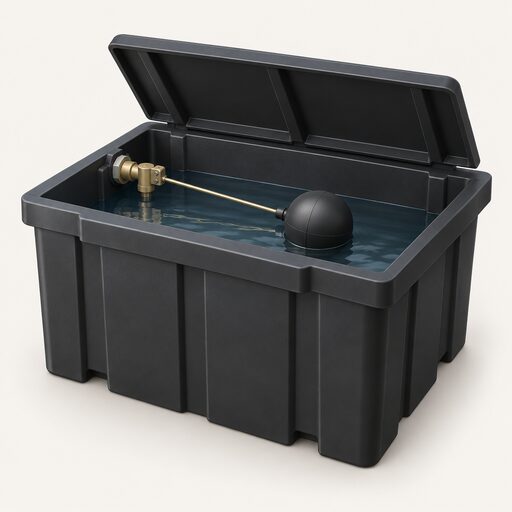 Hot Water CylindersWhich hot water cylinder suits your home, and what is the real difference between a vented one, an unvented one and a thermal store?
 Which Homes Suit a Heat PumpMost UK homes can have a heat pump fitted, so the real question is whether yours makes it easy or expensive.
 The Full Brands GuideWhich boiler, heat pump or solar brand can you trust, and who actually owns it?
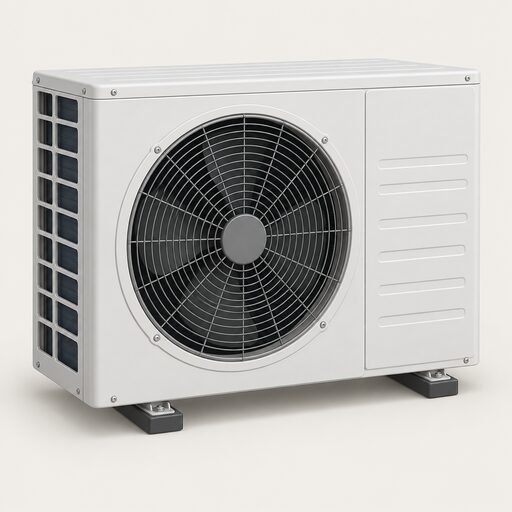 Heat Pump ManufacturersWhich heat pump brands can you actually buy in the UK, and who makes them?
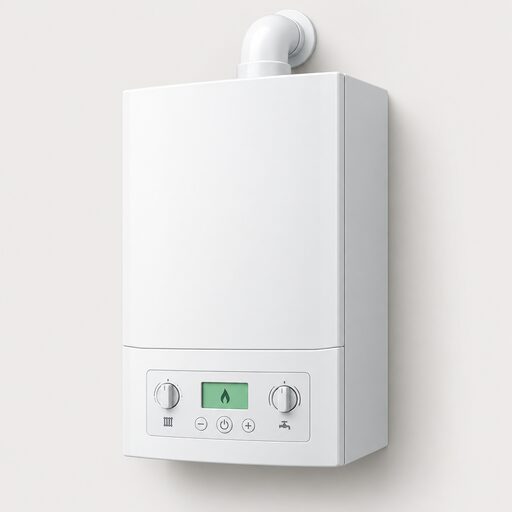 Boiler Manufacturers in the UKCovers the manufacturers supplying gas, oil, LPG and electric boilers to UK homes, their main ranges and where they are made.
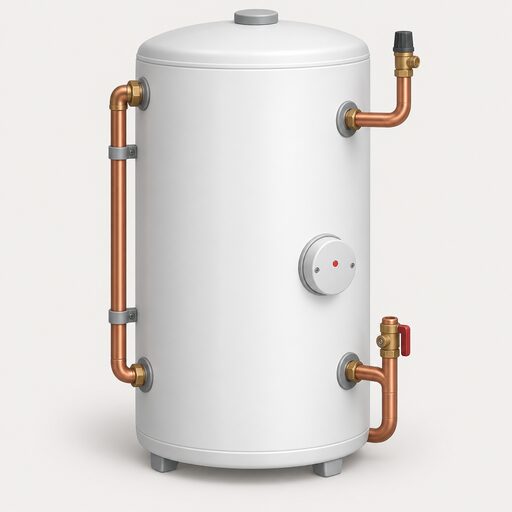 Air-to-Water Wet SystemsAir-to-water heat pumps feed radiators, underfloor heating and a hot water cylinder, and are the most common domestic heat pump in the UK.