
In this guide
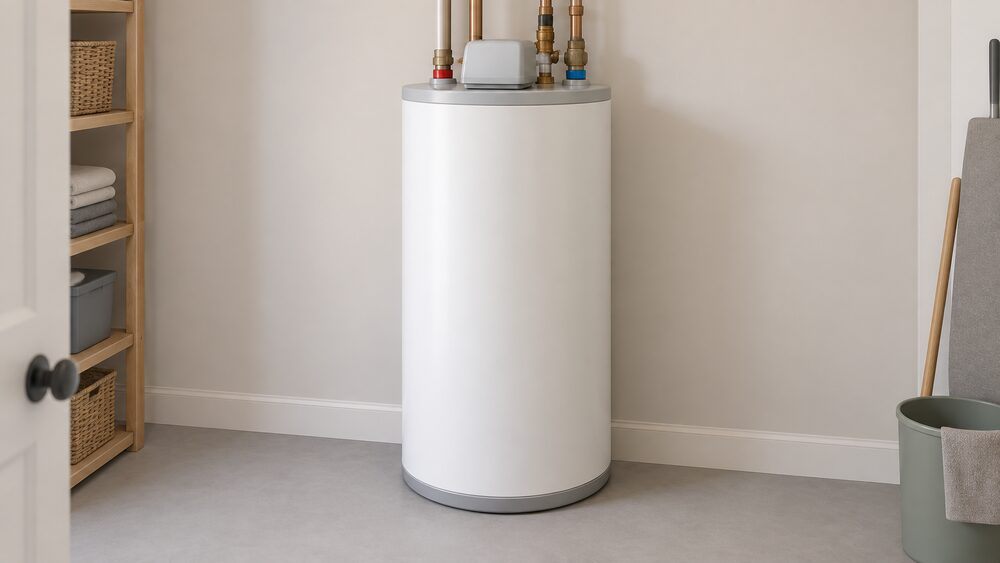
A Mixergy cylinder is a hot water store that heats from the top down rather than from the bottom up. The maker calls this patented top-down heating, and it means the cylinder heats only the water a household actually needs, leaving the rest of the tank cool until demand arrives1. The company describes the technology as patented stratified heating, and states that it delivers up to 40% hot water energy savings2.
The headline performance claims are speed and usable volume. Mixergy states that its cylinders deliver usable hot water up to ten times faster than conventional cylinders, that Boost mode delivers usable hot water in under 30 minutes, and that the design provides up to a third more usable hot water than a traditional cylinder1. On energy, the maker claims up to 40% off hot water bills and up to 21% gas boiler savings verified by the Energy Saving Trust3.
The warranty is the other figure that matters. Every Mixergy cylinder carries a standard 2 year warranty including parts and labour, rising to 25 years on the stainless steel inner vessel when registered, excluding labour5. Registration must happen within 60 days of purchase5.
What a Mixergy cylinder is and how it differs from a conventional tank
A conventional cylinder heats its whole volume from a coil at the bottom, so the store sits at one temperature and the household pays to keep it there. A Mixergy cylinder works the other way. It exploits thermal stratification, heating the tank from the top down, and the maker states this is unlike anyone else9. The practical consequence is that a household can heat a small volume of water at the top of the tank for a morning shower rather than bringing 200 litres up to temperature.
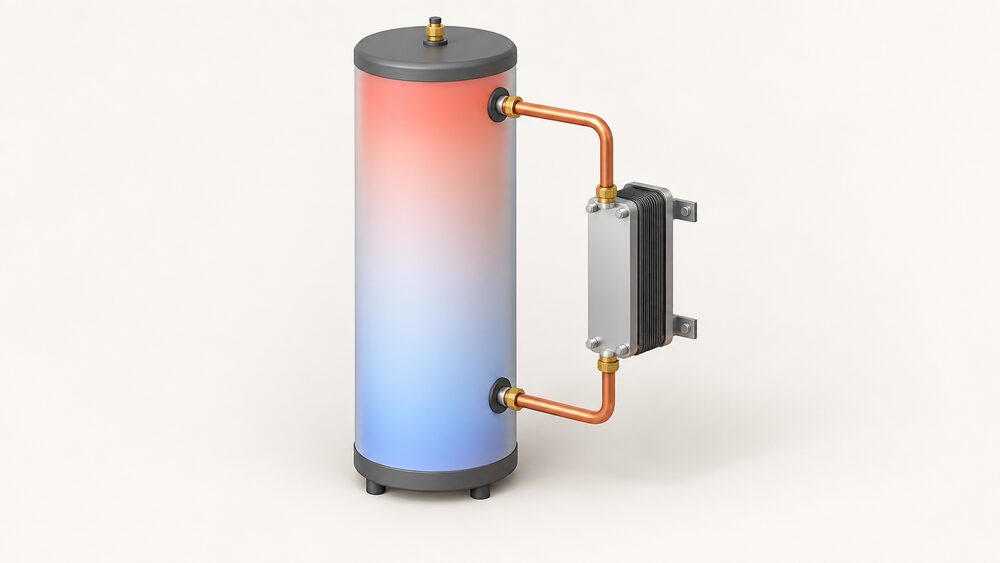
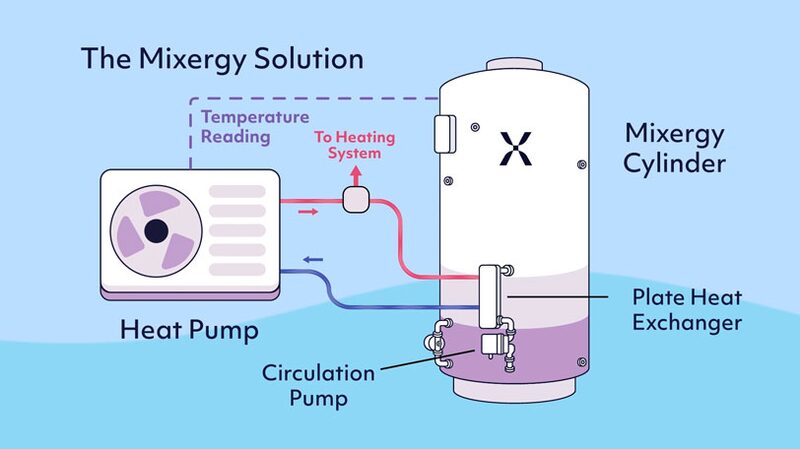
The hardware difference is the heat exchanger. A Mixergy cylinder has an external plate heat exchanger rather than an internal coil, which the maker says generates hot water more efficiently than a cylinder with an internal coil10. Because the plate exchanger sits outside the vessel, the cylinder itself can be smaller: Mixergy states that its cylinders are typically 40% smaller than conventional equivalents, with a slimline option available3.
The range covers both indirect and direct models, which matters because it determines what can heat the water. Indirect cylinders take heat from a boiler or heat pump through the plate exchanger; direct models use an electric immersion. Mixergy describes the range as built for the energy transition, and the tanks are listed in the SAP Appendix Q product database, including versions with an integrated solar PV diverter3.
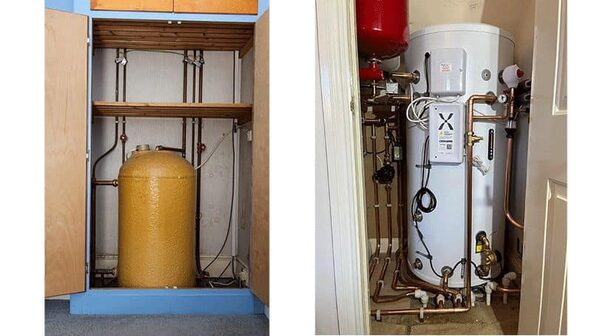
For a household, the independence question is straightforward. A Mixergy cylinder does not change the fuel a home runs on. It changes how much of that fuel is spent on hot water, and it keeps the option of changing fuel later open. That is a smaller claim than a heat pump or a solar array, but it is a real one, and it is the reason the cylinder is often specified before the heat source is decided.
How stratified heating works: top-down heating and the plate heat exchanger
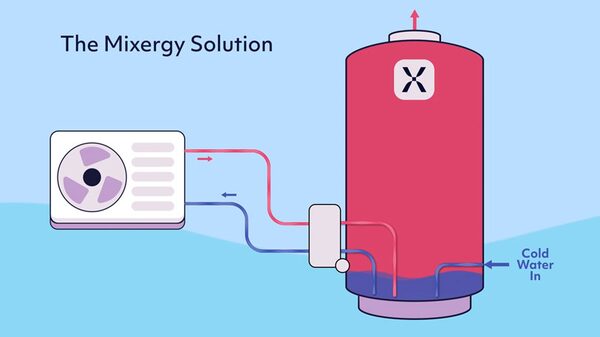
The mechanism is worth understanding because it explains both the savings and the speed. Mixergy states that it always exchanges thermal energy with the coldest part of the cylinder at all times via a plate heat exchanger, irrespective of state of charge12. That is the opposite of a conventional coil, which sits in a fixed position and heats whatever surrounds it.
Because the heat exchanger is external and the cylinder is stratified, the top of the tank holds hot water while the bottom stays cold. The cylinder heats from the top down, so the first water drawn is hot even when the store is only partly charged. Mixergy describes the system as heating only what the home needs when connected with gas and electric13.
The plate exchanger also does work for heat pumps specifically. Mixergy states that for heat pumps, the externally mounted plate heat exchanger enhances system performance and improves overall efficiency1. In a pilot of six homes in North Devon, three of the cylinders were connected to air source heat pumps using the externally mounted plate heat exchanger14.
"we always exchange thermal energy with the coldest part of the cylinder at all times via a plate heat exchanger"
The iHP X takes the same principle and integrates it. Mixergy describes the iHP X as the only integrated heat pump cylinder which uses patented top-down heating technology15. That is a maker claim about its own product rather than an independent finding, but it identifies the design lineage clearly: the same stratification logic, with the heat pump head unit mounted on the cylinder rather than beside it.
Speed and usable hot water: up to 10x faster and 30% more usable water
The speed claim is the one most often quoted, and it appears consistently across Mixergy's own material. The maker states that the cylinder delivers usable hot water up to ten times faster than conventional cylinders, and repeats the figure in a press release covering the Mixergy X3. A case study on the Barcud project in Welsh social housing puts it as reaching a useful temperature up to ten times faster than a conventional tank11.
Boost mode is the practical version of that claim. Mixergy states that Boost mode delivers usable hot water in under 30 minutes, and describes it as outperforming competitor units2. The iHP X product page repeats the under 30 minute figure and calls it suited to peak demand16. A case study on a major renovation project describes usable hot water being delivered in under 30 minutes simply by pressing the boost button15.
The usable volume claim is separate and slightly different. Mixergy states that its cylinders provide up to a third more usable hot water than traditional cylinders1, and elsewhere puts the figure at 30% more usable hot water11. With an externally mounted plate heat exchanger, the maker claims 20% more useable hot water compared to conventional heat pump cylinders3.
| Claim | Figure | Applies to |
|---|---|---|
| Heat-up speed | up to 10 times faster2 | Mixergy smart cylinders |
| Boost mode | usable hot water in under 30 minutes2 | Mixergy smart cylinders |
| Usable hot water | up to a third more1 | Mixergy cylinders |
| Usable hot water, heat pump | 20% more3 | With external plate heat exchanger |
These are maker figures, and they compare against a conventional cylinder rather than against a measured baseline in the household's own home. The direction of the claim is consistent across every document, which is worth something, but the multiplier depends on how the conventional cylinder was sized and run.
Smart controls, state of charge and the app
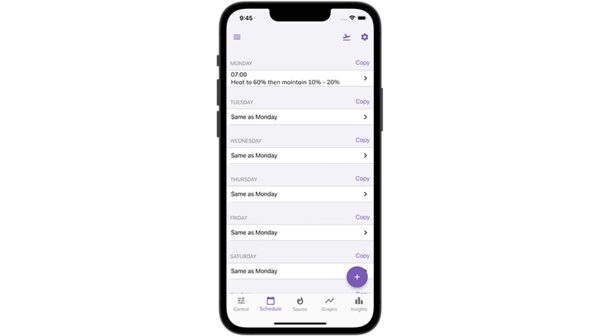
The control layer is what turns the cylinder into a scheduling device. Mixergy states that its cylinders are built to stay connected, linking to the app, syncing with smart tariffs and giving full remote control1. The Mixergy User App ships with every Mixergy cylinder and allows a household to track use, compare with others and set schedules that integrate with smart tariffs to run at the optimal time17.
State of charge monitoring is the feature that makes stratification usable. Mixergy describes it as knowing whether there is enough heat to cover the day12. Without it, a partly charged stratified cylinder would be hard to manage; with it, the household can see how much hot water is available before deciding to heat more.
The controller measures more than temperature. Mixergy states that its smart controller measures frequency in Hz, voltage in V and power in kW, and can communicate these data points via an API at cloud level3. That is the mechanism behind grid flexibility services and the reason the cylinder can respond to tariff signals rather than a fixed timer.
This is the clearest dependence the product creates. A household gains control over when hot water is heated, which is genuine independence from peak pricing, but it gains it through a manufacturer's app and servers. If Mixergy stopped supporting the platform, the cylinder would still heat water, and the scheduling intelligence would be lost. That trade-off is common to connected heating equipment and is covered in more detail in firmware updates and product support life.
Which heat sources it works with: boiler, direct electric, solar PV or heat pump
Mixergy cylinders are designed to accept more than one heat source over their life. The maker states that they can connect with any heat source at any time in their lifetime13, and lists gas boilers, direct electric heating, heat pumps and solar PV as the options they can be installed with19.
The Mixergy X is the general purpose model. Mixergy states that it connects seamlessly to gas, direct electric or heat pump systems, and that if a household is using an external energy source such as a heat pump, gas boiler or solar PV, the X is the unit specified1. The Solar X is the variant for homes with panels: it can be specified with direct electric, solar PV, gas or heat pump systems, and it heats only what is needed for faster delivery and less waste7.
The iHP X is different again. It is an integrated heat pump cylinder, described as SAP-optimised and designed for modern developments using direct electric heating16. That makes it a specification for new build and retrofit projects where direct electric is the base heating, rather than a like-for-like replacement for a gas heated cylinder.
| Model | Heat sources | Solar handling |
|---|---|---|
| Mixergy X | Gas, direct electric, heat pump18 | Optional diverter, PV compatible2 |
| Mixergy Solar X | Direct electric, solar PV, gas, heat pump7 | Integrated solar diverter18 |
| Mixergy iHP X | Integrated heat pump, direct electric developments16 | Not stated |
For a household, the value of this is that the cylinder is not tied to the fuel it was first installed with. A home that starts on a gas boiler and later adds a heat pump keeps the same tank. That is a genuine reduction in the risk of a stranded asset, and it is the strongest independence argument the product has.
Heat pump readiness and retrofitting later without changing the tank
Mixergy states that all its cylinders are heat pump ready, and that households can start their journey to a heat pump with Mixergy regardless of what they run now8. The mechanism is the plate heat exchanger: because the cylinder exchanges heat with the coldest part of the store through an external plate, it can be retrofitted to a heat pump at any time in the cylinder's lifetime8.
The maker puts the timescale plainly: a household can come back in 10 years' time to add a heat pump without needing to change the tank20. Mixergy X and Solar X are described as built to be heat pump ready1, and the cylinders can be upgraded with a heat pump module or a solar PV module, repurposing the unit as a heat pump cylinder or a smart solar PV hot water store3.
Independent work on heat pump readiness supports the logic of doing this in stages, though not the product claim. Nesta states that installing a heat pump often requires additional steps beyond simply fitting the unit, which adds complexity and cost and can deter homeowners when a quick gas boiler swap is easier21. Nesta's recommendation is that major changes such as resizing radiators or creating space for a hot water cylinder are best done when disruption is already planned, for example during renovations, and that any such adjustments done in advance need to offer a clear benefit to homeowners and eliminate rather than add hassle21.
That is the case for specifying a heat pump ready cylinder early: the cylinder space and the pipework are dealt with once. It is not a case for buying a heat pump before the fabric and radiators are ready. On the heat pump side itself, official guidance from the Welsh Government's development bank notes that heat pumps can work efficiently without much retrofit and insulation, but that installers must choose the appropriate heat pump to match the property's characteristics22. The Energy Saving Trust covers what makes a heat pump run efficiently in more detail.
Efficiency and savings: up to 21% on gas, up to 40% on hot water bills
The savings claims come in two sizes and it is worth keeping them apart. The larger figure is up to 40% off hot water bills compared to conventional cylinders, which Mixergy states on its product pages and repeats in its guidance on gas free homes2. The smaller figure is up to 21% gas boiler savings, which the maker describes as Energy Saving Trust verified3. A distributor listing for the 210 litre direct unvented cylinder carries both figures, describing independent verification that Mixergy tanks significantly reduce gas consumption, saving up to 21% on hot water bills, alongside the 40% hot water bill saving4.
The gap between 21% and 40% is not a contradiction so much as a difference in scope. The 21% figure is tied to gas boiler savings and carries a verification claim; the 40% figure is a hot water bill saving and is stated more broadly. A household should read the 21% figure as the more conservative and better evidenced of the two, and the 40% figure as the upper end of the maker's own range.
The mechanism behind both is the same: heating only the water needed rather than the whole tank. Mixergy states that all its smart hot water cylinders help save energy by reducing gas consumption8, and that the top-down design reduces energy wastage3. The standing heat loss figures show the floor that savings work against: the 180 litre Mixergy X Direct Standard cylinder loses 0.96 kWh per day and the 210 litre version 1.01 kWh per day7. The integrated heat pump models lose more, at 1.63 kWh per day for the 180 litre iHP X and 1.70 kWh per day for the 210 litre16.
The savings also depend on how the cylinder is run. A stratified cylinder that is heated to full every morning behaves more like a conventional one. The savings come from using state of charge and the app to heat only what the day needs, which is why the control layer and the efficiency claim are really the same claim.
Sizes, vented and unvented options and the stainless steel build
Mixergy's own range is built around stainless steel. The warranty documents name the stainless steel cylinder and the inner vessel including the sensor strip as the covered component5, and the Mixergy X, Solar X and iHP X all share that construction5. The published standing heat loss figures cover 180 litre and 210 litre models in both the X Direct and iHP X ranges7.
The wider UK cylinder market gives the context for materials and sizing. Vented cylinders are available in copper and stainless steel across a wide variety of sizes, types and capacities23, and unvented cylinders are offered in a choice of stainless steel 316L or copper construction24. One manufacturer describes unvented cylinders manufactured from high quality duplex stainless steel23, and another notes that stainless steel cylinders use a convoluted tube with a larger coil to match the surface area of the copper counterpart, because the stainless tube does not have as high a surface area24.
Sizing is not fixed either. Cylinders can be manufactured to order across a wide range of capacities, from compact units through to large commercial vessels24, and bespoke units exist well beyond domestic scale: one production run included a 2000 litre unvented stainless steel cylinder with two input coils of 9.0m² and 6.0m² to handle the demand25. Customisation extends to coil positions, connections, insulation and whether the unit is vented or unvented26.
For a household, the practical point is that a Mixergy cylinder is a specified product rather than a catalogue size. The unvented kit supplied with the 210 litre direct unvented cylinder includes a pressure reducing valve, check valve, pressure and temperature relief valve, expansion relief valve, tundish and expansion vessel with mounting bracket and adapters4. That is the standard unvented safety package, and it is the reason installation is a competent person's job rather than a DIY one.
Warranty: 25 years as standard
The warranty is the strongest number on the page, and it comes with conditions that decide whether a household actually gets it. Every Mixergy cylinder comes with a standard 2 year warranty from the start, including parts and labour5. Registration changes that: Mixergy X, Solar X and iHP X cylinders carry 25 years on the cylinder and 3 years on the components when registered1, and the warranty document states that Mixergy warrants the hot water cylinder will be free from manufacturing defects for 25 years from installation27.
The registration deadline is 60 days from purchase to qualify for extended cover5. Without registration, the stainless steel cylinder, inner vessel and sensor strip carry 2 years including parts and labour6. With registration, the same component carries 25 years excluding labour6. The iHP X adds a separate term for the head unit: 25 years on the cylinder, 5 years on the head unit and 3 years on the components1.
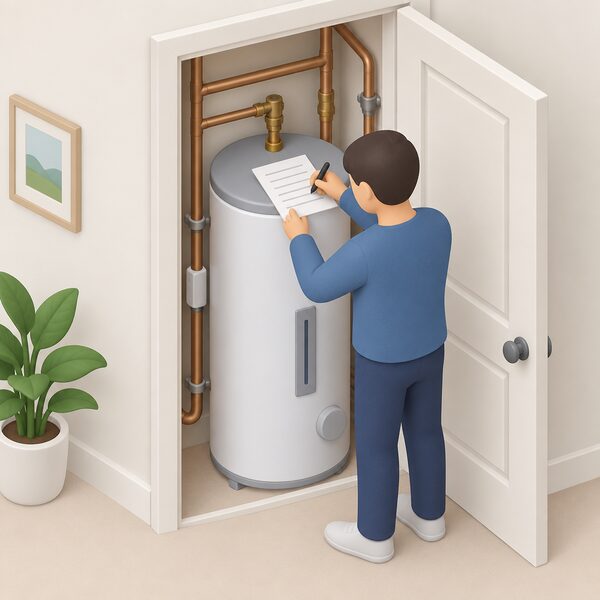
The terms changed on 3 June 2026, and Mixergy publishes two documents because of it. One applies where the cylinder was fitted, or the home's legal completion date was, before 3 June 202627. The other applies from that date onwards6. A household checking its cover needs the document that matches its installation date, not the current one by default. The general mechanics of keeping a manufacturer warranty valid are covered in registering a warranty and keeping it valid.
Installation, connectivity requirements and UK availability
Installation is described as comparable to a standard cylinder, and Mixergy states that its cylinder is as simple to install as a conventional one10. The iHP X product page repeats that installation is comparable to a standard cylinder and notes that the detachable head unit design simplifies servicing16. The Solar X installs like a standard unvented cylinder but with an embedded diverter, and Mixergy states that no specialist installation or maintenance is required and that it removes the need for additional PV diverter hardware7.
The installer qualification depends on where in the UK the work happens. In England and Wales the installer must hold a G3 qualification; in Scotland a P3 qualification is required; in Northern Ireland a P5 qualification is required1. That is the unvented cylinder competence requirement, and it applies to the cylinder type rather than to the brand.
On solar, there are two routes. A household can connect directly to solar panels with a Solar X, or go through a third party diverter by adding a PV Switch to a Mixergy X1. The Mixergy X lists PV integration as an optional diverter and is described as PV compatible2, while the Solar X comes with an integrated solar diverter18. Mixergy's guidance is to use free solar first2.
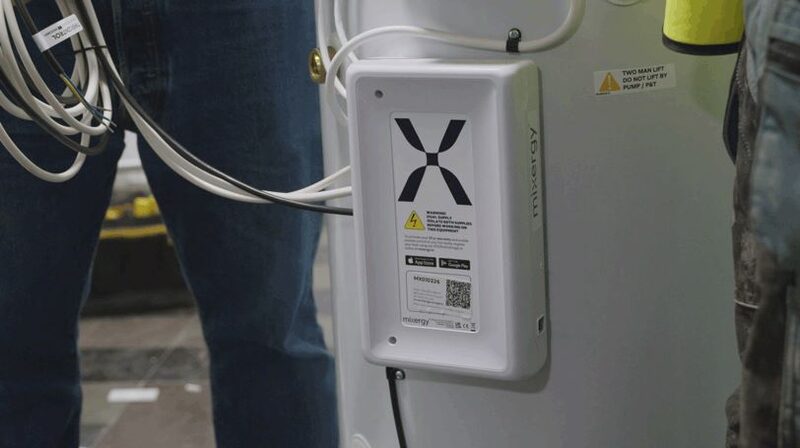
Connectivity is the remaining requirement. Mixergy lists grid connectivity as part of the system18, and the app ships with every cylinder17. The commercial range adds full Modbus connectivity for integration into building management systems19, which is a different market but shows the same design assumption: the cylinder is expected to be part of a connected system rather than a standalone tank.
On availability, Mixergy cylinders are sold through installers and distributors rather than as a retail product, and the 210 litre direct unvented cylinder appears on a distributor listing4. Prices are installer-quoted and no published list price is given here. The wider UK cylinder market, including the manufacturers behind the brands, is covered in hot water cylinder manufacturers in the UK.
Where the Mixergy cylinder sits on Welsh schemes and certification

Mixergy cylinders are recognised in SAP Appendix Q and the Home Energy Model, and the maker states they are officially recognised to meet SAP and RdSAP compliance19. That recognition matters for new build and retrofit specification, because it means the cylinder's performance can be entered into the standard assessment models rather than estimated.
The Welsh Government's Nest scheme is a separate matter. Nest is a Welsh Government scheme, delivered under the Welsh Government Warm Homes Nest scheme, which makes Welsh homes warmer and more energy efficient places to live28. The published guidance describes what is funded as replacement of a boiler or electric storage heaters to ensure a safe and reliable heating system30. Nothing in the published scheme material names Mixergy cylinders as an approved product, so a household should not read the SAP recognition as a grant approval.
The distinction is worth stating plainly because the two are often conflated. SAP Appendix Q listing is a modelling recognition that lets a product's measured performance be used in compliance calculations. Grant funding under Nest is a decision about which measures and products a scheme will pay for. A product can hold the first without qualifying for the second.
Sources30 cited
- Homeowner guide, Mixergy, 2025
- Hot water solutions, Mixergy, 2026
- Making the transition to a gas free home, Mixergy, 2023
- Mixergy 210 litre direct unvented smart cylinder, Kiasa, 2026
- Warranty and care plan, Mixergy, 2026
- Warranty information, after 3 June 2026, Mixergy, 2026
- Solar X, Mixergy, 2026
- How Mixergy cylinders work with a heat pump, Mixergy, 2024
- Why new build developers choose Mixergy, Mixergy, 2022
- What you need to know about COP and hot water, Mixergy, 2024
- Smarter hot water, lower tenant bills: the Barcud project, Mixergy, 2026
- Real world performance of Mixergy and heat pumps, Mixergy, 2023
- Mixergy electric heating company partnership, Mixergy, 2024
- Mixergy helps North Devon homes improve efficiency, Mixergy, 2025
- Mixergy iHP X installed in major renovation project, Mixergy, 2024
- iHP X, Mixergy, 2026
- Mixergy app, Mixergy, 2025
- SAP solutions, Mixergy, 2026
- Mixergy news feed, Mixergy, 2026
- What about decarbonisation of water, Mixergy, 2021
- Should we be making homes heat pump ready, Nesta, 2026
- Specialist heat pumps for homeowners, Development Bank of Wales, 2024
- Products, Range Cylinders, 2026
- Unvented cylinders, Newark Cylinders, 2026
- February 2026 update newsletter, Newark Cylinders, 2026
- SlimFit cylinders, Newark Cylinders, 2026
- Warranty information, before 3 June 2026, Mixergy, 2026
- Get help with energy efficiency in your home: Nest, Welsh Government, 2026
- Home energy efficiency, Bridgend County Borough Council, 2026
- Get help with unexpected costs such as food and heating, Welsh Government, 2026
 MixergyA Mixergy cylinder is a hot water tank that heats from the top down, so it only warms the water you actually need.