
In this guide
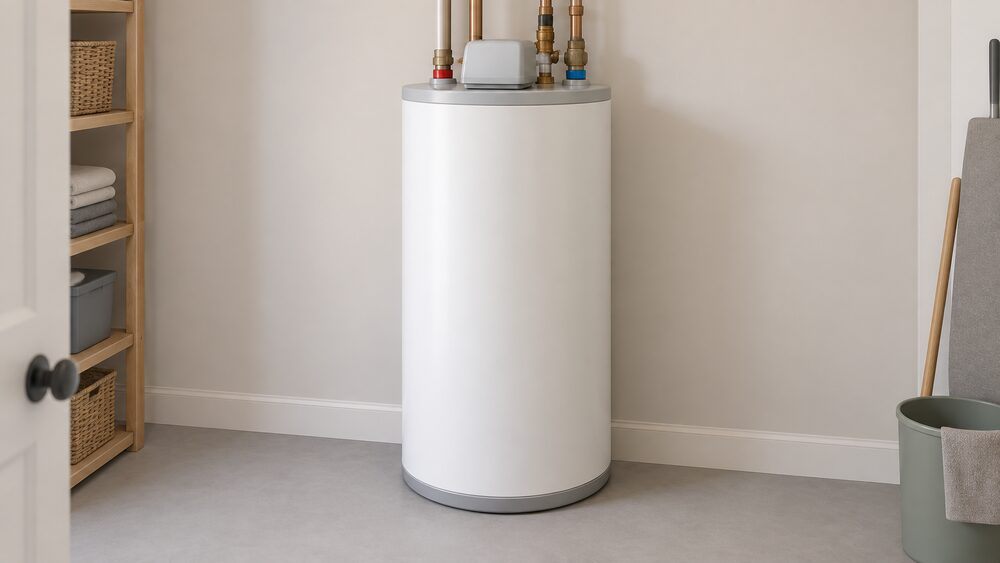
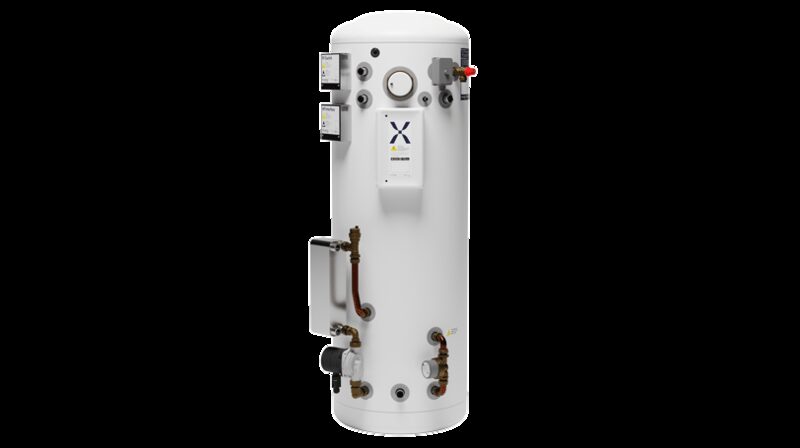
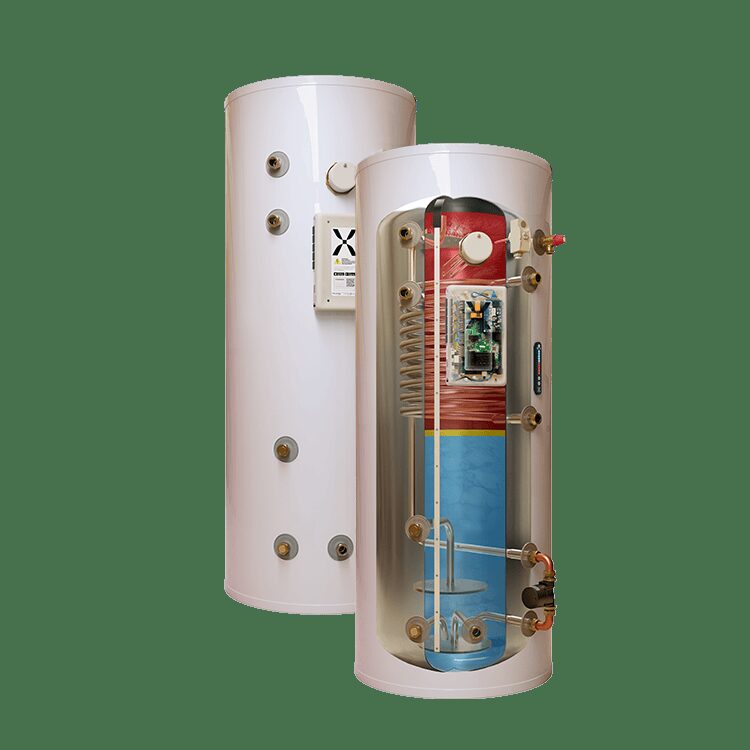
A Mixergy cylinder is a hot water tank that heats from the top down rather than from the bottom up. The maker describes it as top-down heating, and states that the patented method heats only the water a household needs1. In domestic new build and social housing projects, Mixergy reports savings of up to 40% on hot water energy use, and independent trade reporting in March 2025 put the claim at up to 60% on hot water bills2.
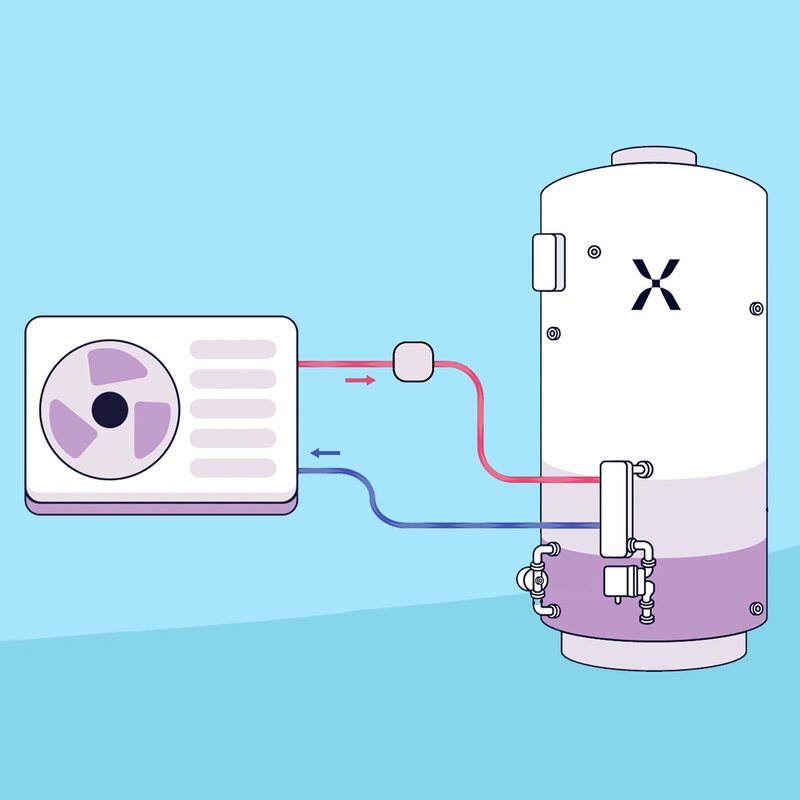
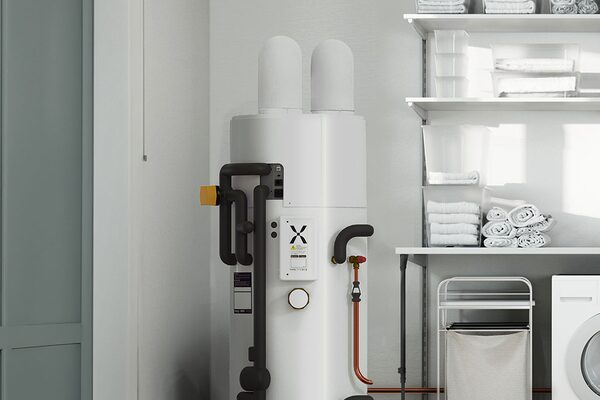
The cylinder is heat-source agnostic. Mixergy X connects to gas, direct electric or heat pump systems, and the Mixergy Solar X is listed for compatibility across gas, electric and heat pump systems1. There is also an all-in-one heat pump cylinder, the Mixergy iHP X1. That matters for independence: the same tank can sit on a gas boiler now and a heat pump later, so the cylinder is not the part of the system that locks a household into a fuel.
What it does not remove is the dependence on a heat source, a supplier and, for the smart functions, a manufacturer's controls. The savings figures come from the maker and from trade reporting of the maker's claims, not from a government field trial, and the largest number applies to hot water rather than to the whole heating bill.
Top-down heating: what the cylinder actually does
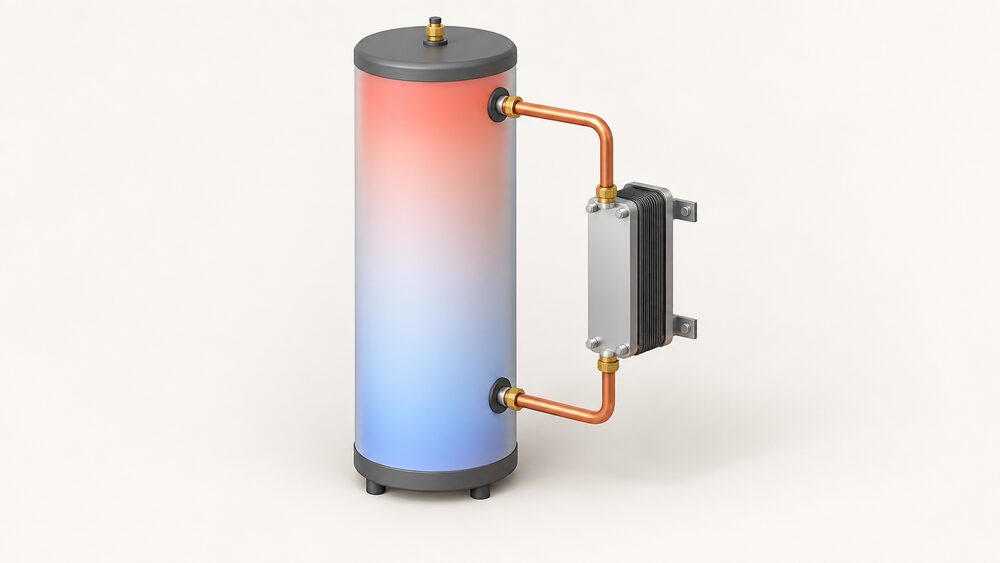
A conventional cylinder is stratified by temperature in the opposite way to what a household wants. The boiler or immersion coil sits at the bottom, so the whole tank has to reach temperature before the top of it is hot enough to use. Mixergy reverses the useful part of that: the cylinder heats the top of the tank first, so a small volume of usable hot water is available quickly and the rest of the tank is only heated when it is needed1.
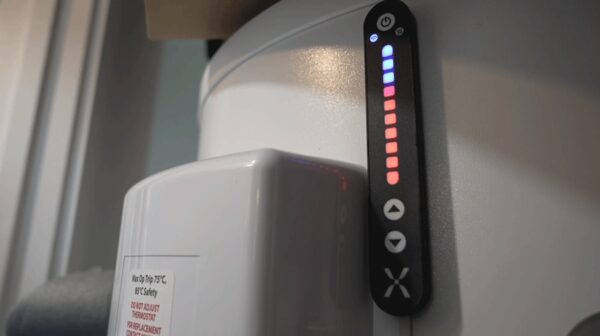
The practical effect is that a household draws hot water from a small hot layer rather than waiting for a full tank. The maker states the method heats only the water a household needs, and reports that this is where the up to 40% domestic saving comes from2. The cylinder also carries built-in machine learning, which is the mechanism by which it learns a household's pattern and decides how much of the tank to heat and when1.
The commercial range extends the same idea to larger buildings. It is direct electric, solar ready and heat pump ready, with up to three immersion heater power options available, and it carries full Modbus connectivity for integration into building management systems2. The commercial cylinders connect to commercial heat pumps, VRF systems and solar PV, with BMS integration via Modbus TCP2.
| Feature | Domestic range | Commercial range |
|---|---|---|
| Heat sources | Gas, direct electric or heat pump1 | Commercial heat pumps, VRF, solar PV2 |
| Immersion options | Not stated | Up to three power options2 |
| Controls | Built-in machine learning1 | Full Modbus connectivity, BMS via Modbus TCP2 |
| Solar | Solar X listed for gas, electric and heat pump1 | Solar ready2 |
Savings: up to 60% on hot water bills, and how that figure is reached
Two figures circulate for Mixergy, and they are not the same measurement. The maker's own news reporting states that Mixergy is already saving up to 40% on hot water energy use across domestic new build and social housing projects2. Independent trade reporting in March 2025, covering the company's funding round, describes the product as helping homes today save up to 60% on their hot water bills3.
The gap between 40% and 60% is the gap between energy use and bills. A cylinder that shifts when it heats, rather than only how much it heats, can cut the unit cost of the electricity it uses by running in cheaper periods, on top of the energy it saves by not heating a full tank. The 40% figure is the energy figure the maker reports from installed projects; the 60% figure is a bill figure reported in trade coverage. Neither is a government field trial result, and both are specific to hot water rather than to total household heating.
The scope matters as much as the number. Hot water is a smaller share of a gas-heated home's bill than of an electrically heated one, so a percentage saving on hot water translates into a larger absolute saving where hot water is a bigger part of the total. The Energy Saving Trust notes that boilers are usually fuelled by gas or oil, but sometimes liquid petroleum gas (LPG) or biomass, which is the range of heat sources a cylinder may be sitting behind4.
Smart tariffs and grid flexibility: the cylinder as a virtual battery
A hot water cylinder is a store of energy that can be filled at any time and drawn from later, which is what makes it useful to a grid with cheap and expensive hours. Independent guidance on heat batteries states that they can help balance the electricity grid5. The same logic applies to a cylinder: it can absorb electricity when supply is abundant and release the heat when the household needs it.
The tariff mechanism is the same one used for batteries. Independent guidance describes setting a battery to charge up when electricity is cheap, and to discharge when electricity is expensive6. A cylinder does this in heat rather than in electrons, and the commercial Mixergy range carries full Modbus connectivity for integration into building management systems, with BMS integration via Modbus TCP, which is the technical route by which that scheduling is done at scale2.
For a household, the dependence this creates is worth naming. Time-of-use operation depends on a tariff that offers cheap periods, on a supplier that provides one, and on controls that can act on a price signal. The cylinder itself is a store, not a generator, so it shifts cost rather than removing the need for a supply. Where a household already has a smart tariff, the cylinder is one more flexible load on it; where it does not, the flexibility is unused.
Heat pump compatibility: where the efficiency advantage is lost
Mixergy X connects to gas, direct electric or heat pump systems, and the Solar X is listed for compatibility across gas, electric and heat pump systems1. The all-in-one option, the Mixergy iHP X, is described as an all-in-one heat pump cylinder1. So the answer to whether a Mixergy cylinder works with a heat pump is yes, in more than one configuration.
The efficiency question is separate from the compatibility question. Official guidance states that heat pumps operate more efficiently when the source temperature is higher and/or the sink temperature is lower7. Independent guidance puts it more bluntly: heat pumps operate efficiently at lower temperatures, and the higher the flow temperature, the harder they have to work8. A cylinder that asks a heat pump for a high temperature is asking it to run outside its best range.
The size of that penalty is documented. Independent guidance states that a heat pump system designed for a 55 degrees C flow temperature will reduce the efficiency of the whole system by about 15% compared with a 45 degrees C whole-system design9. High-temperature heat pumps are generally less efficient than low-temperature heat pumps10, and heat pump efficiency can drop in extremely cold conditions11. One official consultation uses an illustrative running cost example at 300% efficiency12.
The anti-legionella cycle is where this bites hardest. Independent guidance states that a heat pump usually has a legionella protection function that runs daily, weekly or permanently13. A pasteurisation cycle to a higher temperature is exactly the high-flow-temperature operation that costs efficiency, so a cylinder paired with a heat pump has to balance the two.
"heat pumps operate efficiently at lower temperatures, and the higher the flow temperature, the harder they have to work"
Best use cases: gas boiler, immersion and transitional setups

The strongest case for a Mixergy cylinder is a home that is not ready to change its heat source. The cylinder works on gas, direct electric or heat pump systems, so it can be fitted behind an existing boiler and left in place when the boiler is eventually replaced1. That is a transitional role rather than an end state.
Independent guidance supports the interim logic. IGEM IG/1 states that systems running on electric along with natural gas, LPG, or oil are an effective and immediate interim solution that could be seen as a boiler plus measure, helping to accelerate the transition to low-carbon heating14. A cylinder that improves hot water performance on the existing fuel, and is ready for a different one later, fits that description.
The immersion route is the other clear case. The commercial range is direct electric, solar ready and heat pump ready, with up to three immersion heater power options available2. Immersion heaters are a standard service offered by heating firms, and one independent company listing includes immersion heaters among its services15. For a household with solar PV, an immersion-fed cylinder is a way to store surplus generation as heat.
The comparison with a straight boiler replacement is a timing one. Independent guidance puts a gas boiler installation at one day11. A cylinder change is a separate piece of work, and the case for doing it is strongest where hot water demand is high, where a smart tariff is available, or where a heat pump is planned within the life of the cylinder.
Recognition and standards: SAP, Appendix Q and the Home Energy Model
Mixergy states that its cylinders are recognised in SAP Appendix Q and the Home Energy Model, and that Mixergy X is officially listed in SAP and the Home Energy Model1. It also states that the product is officially recognised to meet SAP compliance and recognised in Appendix Q1. This is the part of the proposition that matters to new build and retrofit under building regulations, because it determines whether the cylinder can be counted in a compliance calculation.
The framework it sits in is changing. Approved Document L names the Home Energy Model (HEM) and the government's Standard Assessment Procedure for the Energy Rating of Dwellings as the approved calculation methodologies for new dwellings16. Independent reporting states that products that were in SAP Appendix Q are being included in the main model17. The Standard Assessment Procedure covers the energy rating of dwellings and the production of EPCs, and supports the Green Deal and Energy Companies Obligation schemes18.
The transition is staged rather than immediate. Official guidance states that the Future Homes Standard will launch with only SAP 10.3 being available, and that HEM will be approved for use as an alternative to SAP 10.3 once it meets the full criteria required of an approved calculation methodology19. The approved version for energy performance of new dwellings in England is SAP version 10.3, under a notice of approval dated 24 March 202620. Scottish assessment work has covered SAP 10.2, HEM v0.33 with the Future Homes Standard Wrapper v0.24, and PHPP v10.621. Thermal bridging and airtightness are incorporated within SAP, RdSAP and SBEM and recognised as integral parts of the energy modelling process22.
The company: Oxford spin-out, funding and the King's Award
Mixergy is an Oxford spin-out. Its case study work includes a property renovation in Oxford23, and Oxford has a citywide smoke control area24. The company raised £12 million in funding, reported by CIPHE in March 2025, and the same report covers the appointment of David Tuohy as Executive Chair3. Mixergy received the King's Award for Enterprise in Innovation for 20251.
The company has moved into the professional and commercial side of the industry. In March 2026 it joined the CIBSE Patrons, the group of businesses that provide financial, technical and practical backing to CIBSE2. It leads the Making Efficient Systems around Heat Pumps (MESH) project, with Centrica PLC and Vaillant Group UK Ltd as project partners23. That places it alongside a major energy supplier and a major boiler manufacturer in a heat pump project rather than in competition with them.
Public funding records show a University of Oxford transaction with a £58,966.18 vendor payment dated 17 July 2024, under a net zero innovation heading25. That is a research-linked payment rather than a company grant, and it is recorded against the university rather than Mixergy.
Ownership and partnerships: investors, licensing model and UK availability
Mixergy Ltd is an independent UK company rather than a division of a boiler maker. Its ownership sits with its founders and its investors, and its most visible commercial relationships are project partnerships rather than parent companies. It leads the MESH project with Centrica PLC and Vaillant Group UK Ltd as partners23, and it has joined the CIBSE Patrons group2.
The licensing question is worth separating from the ownership question. Mixergy's commercial range is sold into building services work, with Modbus connectivity and BMS integration, which is a route into commercial and multi-occupancy buildings rather than a domestic retail channel2. The domestic product line is the Mixergy X, the Solar X and the iHP X1. Availability in the UK is therefore through the company and its installation partners rather than through a national merchant network.
Ownership structures in heating are not always simple, and the wider market shows why the question gets asked. Third-party ownership contracts have been reviewed with industry, the FCA, HM Treasury and other key stakeholders26. In Scotland, under the Tenement (Scotland) Act 2004, owners in mixed tenure blocks are liable for their share of common repair costs27. Where a heat technology is installed under a funded scheme, tenure rules apply: insulation schemes fully funded by NISEP list owner occupier as a tenure category28. Those are the kinds of arrangement a household may meet when a cylinder is installed as part of a wider retrofit rather than bought outright.
For a household weighing independence, the position is this. A Mixergy cylinder improves the efficiency of hot water on whatever heat source is already in place, and it can be carried across to a heat pump later, which reduces the risk of a stranded asset. It does not remove the need for a heat source, a fuel supplier or, for the smart functions, the manufacturer's controls and a working internet connection. The savings figures are the maker's and trade reporting of the maker's claims, and they apply to hot water rather than to the whole bill.
Sources28 cited
- Mixergy SAP solutions, Mixergy, 2026
- Mixergy news, Mixergy, 2026
- Mixergy secures £12 million in funding, CIPHE, 2025
- Heating your home, Energy Saving Trust, 2026
- No home left behind: supporting lower income homes in the heat transition, Association for Decentralised Energy, 2026
- Tariffs for renewable technology, Energy Saving Trust, 2026
- Home Energy Model: heat pump methodology, Department for Energy Security and Net Zero, 2026
- Avoiding costly mistakes: why heat pump installations must be done right, Flexi-Orb, 2025
- Domestic Heat Pump Guide, MCS Certified, 2024
- Will I need bigger radiators or underfloor heating, Nesta, 2025
- Heat pumps vs boilers, CPA, 2025
- Building regulations discussion document, Northern Ireland Department of Finance, 2023
- How to ensure a heat pump runs efficiently, Energy Saving Trust, 2026
- IGEM IG/1 guidance, HHIC, 2026
- BPI Boiler Plumbing Installations, Which? Trusted Traders, 2026
- Approved Document L, Volume 1: Dwellings, HM Government, 2026
- HEM consultation government response published, Future Homes Hub, 2025
- National Calculation Method, NCM, 2026
- Future Homes and Buildings Standards consultation response, HM Government, 2026
- Notice of approval of the methodologies of calculation, HM Government, 2026
- Identification and assessment of improvements to energy standards, Scottish Government, 2026
- Conversion of traditional buildings: guidance, Scottish Government, 2026
- Heat Pump Ready Programme: Stream 2 projects, HM Government, 2026
- Smoke control area changes, HETAS, 2026
- DESNZ grants to private sector, HM Government, 2024
- Amendments to the Boiler Upgrade Scheme: government response, HM Government, 2025
- High Rise Retrofit and Upgrade Programme Phase 1, City of Edinburgh Council, 2026
- NISEP list of schemes 2024-25, Utility Regulator Northern Ireland, 2024
 Mixergy smart hot water cylindersMixergy cylinders heat water from the top down, so you get hot water faster and waste less energy.