
In this answer
Short answer
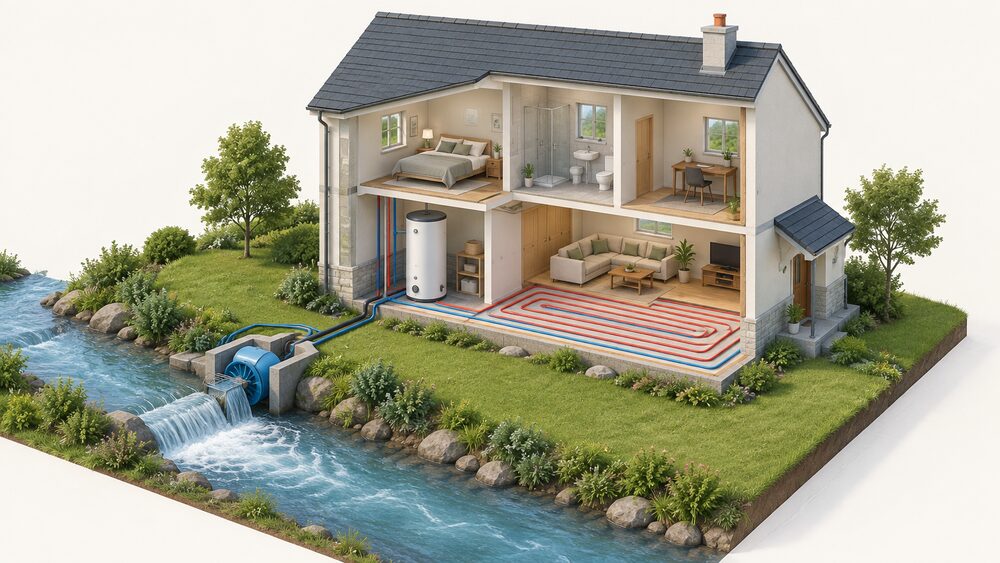
Micro hydro can supply space and water heating, but only under one condition: the available power has to exceed demand at the moment the heat is wanted. The Planning Portal states the position directly: "space and water heating can be supplied when available power exceeds demand"1. That is a narrower claim than it first appears. A hydro turbine on a stream produces whatever the water gives it, and a household's heat demand peaks in the coldest weeks of the year, when run-of-river flows are often at their lowest.
The capacity bands matter for how the question is framed. Systems with a capacity of less than 100 kilowatts are sometimes referred to as micro-hydro, and very small systems with a capacity of less than five kilowatts are also known as pico-hydro2. A pico-hydro machine of a few kilowatts is an electrical generator first and a heat source second. Turning its output into useful heat means either an electric heating element or a heat pump, and both bring their own conditions.
What follows sets out what micro hydro can and cannot heat, the sizing rules that apply to any wet heating system it feeds, where off-grid sites get the most from it, and what remains dependent on the grid, a supplier or a manufacturer.
What micro hydro can and cannot heat
Micro hydro is an electricity generator. Everything it heats, it heats by converting that electricity into heat, or by driving a heat pump that does the same job more efficiently. The distinction matters because the heating facts that govern electric heat sources are written for heat generators generally, not for hydro specifically, and they set the terms on which any electric heat source operates in a dwelling. Direct electric heating and hot water products have fewer restrictions than fossil fuel alternatives, and greater controllability7, and most products need only a connection to the electric circuit7.
The Domestic Renewable Heat Incentive's eligible heating systems give a useful map of what counts as a legitimate heat generator. Biomass only boilers are eligible for space heating only, or both space and domestic hot water heating7. That is the shape of the question: a single plant can serve both loads, but the scheme rules treat space heating and domestic hot water as separate services that must be accounted for.
Solar thermal, the closest analogue to a weather-driven heat source, carries an explicit limit. It cannot be used to replace a traditional liquid fuel or gas-fired central heating installation8. A household looking at hydro should read that as a warning about what a variable renewable source can be asked to do: it can work alongside a conventional heater, not stand in for one outright.
There are also hard physical constraints on where certain appliances may sit. A flueless instantaneous water heater should not be installed in a room or space having a volume of less than 5 m³9. Scotland's New Build Heat Standard is drawn tightly too: it only extends to the provision of space heating, cooling and hot water, with other heat or hot water processes out of scope10. Permitted development for air source heat pumps carries a similar boundary, allowing a heating only unit or a combined heating and cooling unit, but not a cooling only one11.
For a hydro household, the practical reading is that micro hydro can drive space heating and domestic hot water through an electric or heat pump circuit, but it cannot be presented as a like-for-like replacement for a gas or oil boiler without a backup.
When available power exceeds demand: the key condition
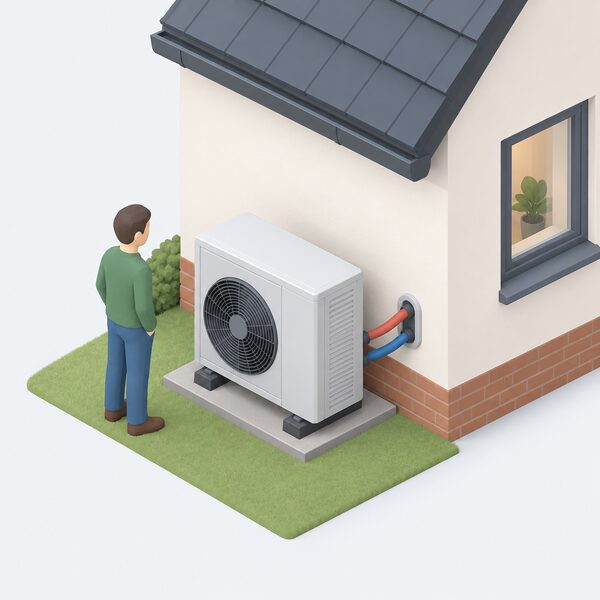
The whole case for hydro heating rests on a timing match. The Planning Portal's formulation is that space and water heating can be supplied when available power exceeds demand1. That is a statement about instantaneous balance, not annual totals. A scheme can generate more kilowatt hours over a year than the house consumes and still fail to heat the house on a still, cold January evening.
The heat pump methodology used in government modelling recognises the same problem from the other direction. A backup energy source is required when the required flow temperature is above the maximum flow temperature limit of the heat pump5. In other words, the design has to assume that there will be moments when the primary source cannot deliver the temperature the emitters need, and something else has to step in.
Two thresholds sit alongside this. Extending or expanding the capacity of a space heating, comfort cooling or ventilation system by over 25% of its previous capacity counts as work that may alter energy performance or CO2 emissions performance12. And under heat network authorisation conditions, there is a condition about conduct if payments relating to the supply of heating, cooling or hot water are not made, including restricting when premises may be disconnected13. Neither is about hydro directly, but both show how tightly regulated domestic heat supply has become.
For a household, the condition translates into a design question: what is the peak heat demand, and what is the minimum power the turbine can be relied on to deliver at that moment? No flow or head figures for heating duty are published, so the answer has to come from a site-specific assessment. What is established is that the match is the test, and that a backup is not an admission of failure but a design requirement: a secondary heat source is required when the required flow temperature is above the maximum flow temperature limit of the heat pump8.
Sizing a system for space and water heating
Sizing starts with heat loss, not with the turbine. Approved Document L Volume 1 requires that the size of space heating systems should be designed using the heat loss calculation in BS EN 12831-1 for the dwelling and a sizing methodology that takes account of the properties of the dwelling, and that systems should not be oversized3. The same document sets the flow temperature ceiling: all parts of the system, including pipework and emitters, should be sized to allow the space heating system to operate at a maximum flow temperature of 45°C or lower4.
That 45°C figure is the Welsh position. The English guidance in the 2021 edition incorporating 2023 amendments states a maximum flow temperature of 55°C for a newly installed or fully replaced wet heating system where feasible14. The two documents disagree on the number, and the disagreement is unresolved: a scheme designed to 55°C will not satisfy a 45°C requirement, and one designed to 45°C will need larger emitters or more of them.
Low flow temperatures are what make renewable and electric heat sources workable. Water-based underfloor heating can be run at lower boiler or heat pump flow temperatures than radiators, saving money on energy bills15. That is the emitter choice that most easily meets a 45°C or 55°C ceiling, and it is why underfloor heating recurs in hydro and heat pump designs.
There is a control requirement that bears directly on a combined system. Controls must be installed that ensure the heat generator does not supply hot water services and space heating service simultaneously16. Controls limiting flow temperature at the heat generator must also be installed and commissioned in accordance with the design, and cannot be overridden by the householder16. A hydro system feeding both loads therefore needs a control strategy, not just a turbine and a tank.
| Parameter | Requirement | Source |
|---|---|---|
| Space heating sizing | Heat loss calculation in BS EN 12831-1 plus a sizing methodology | 3 |
| Maximum flow temperature (Wales) | 45°C or lower | 4 |
| Maximum flow temperature (England) | 55°C where feasible | 14 |
| Simultaneous service | Controls must prevent hot water and space heating at once | 16 |
| Flow temperature control | Must not be overridable by the householder | 16 |
Do I need a hot water cylinder with micro hydro heating?
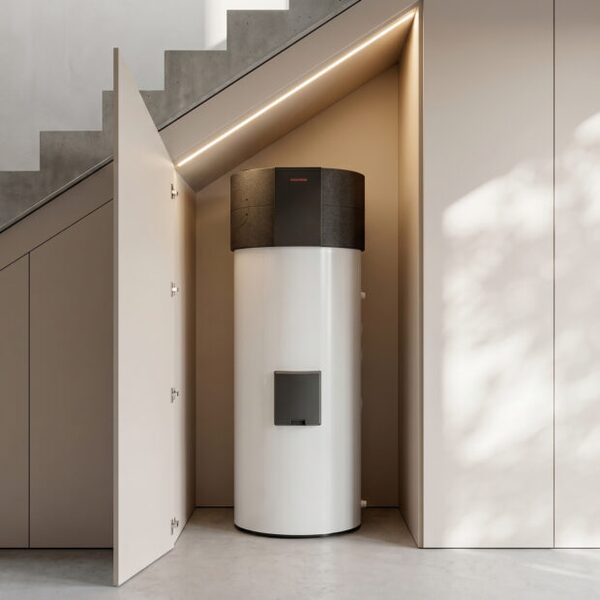
In most cases, yes. Low-temperature, low-carbon solutions such as heat pumps generally require a hot water cylinder17. A larger hot water cylinder is likely to be needed and this will take up extra room8. The cylinder is not an optional extra in a low-flow-temperature system: it is where the heat is stored so that the generator can run when it can and the house can draw when it needs.
The exception is a combi boiler or instantaneous water heater, where you would not need to install a hot water cylinder alongside the heat pump19. But that exception sits awkwardly with a hydro scheme, because a combi needs a high-temperature source and a hydro-driven heat pump does not produce one. Electric heating systems need to be paired with a hot water solution, such as a hot water only heat pump or an electric water cylinder20. Electric wallpaper carries the same condition: you'll need a way of producing and storing hot water, such as immersion heaters in a hot water cylinder21.
Where solar thermal is combined with a conventional boiler, the cylinder has to be a twin-coil type. Solar water heating systems can be combined with a liquid fuel or gas-fired boiler via a compatible hot water cylinder having two heating coils18. A hydro scheme feeding the same cylinder would need its own coil or its own immersion, and the cylinder sizing has to account for both.
The independence point is straightforward. A cylinder gives a household a buffer of stored heat that survives a lull in flow, a power cut or a maintenance stop. Without one, the house is only as warm as the stream is powerful at that minute.
Off-grid applications: where micro hydro heating fits best
Off-grid is where the arithmetic works best, because the alternative is a generator or a delivered fuel rather than a mains supply. The Planning Portal's condition, that space and water heating can be supplied when available power exceeds demand1, is easiest to satisfy on a site with a steady head and flow and a modest, well-insulated heat load.
The emitter choice follows the same logic. Wet underfloor heating systems are best suited for large rooms or whole floors22, and water underfloor heating is ideal for larger zones over 25m²23. Electric underfloor heating systems are best suited for small areas where wet systems would be prohibitive to install, like toilets or ensuites22. On an off-grid site, the wet system is the one that can be fed from a stored cylinder; the electric one is a direct load that competes with everything else on the circuit.
Water underfloor heating also has a storage advantage. It stays warmer for longer than electric heating systems, as the hot water remains in the pipes even after the system switches off24. For a hydro household, that thermal inertia smooths the gap between what the turbine produces and what the rooms need.
Direct electric heating has its own place in the mix. Traditionally, the direct electric heating systems category has been defined as a combination of storage and direct acting heating, either specified together or separately, supported by a separate hot water system20. A typical existing-home layout is storage heating in the main living areas and hall, and direct acting heating in bedrooms, kitchen and bathrooms25. Direct acting systems generally use less energy than storage-based systems, and consequently produce lower carbon emissions25.
Electric water heating products also have fewer restrictions than fossil fuel alternatives, and greater controllability26, and electric space heaters can last an average of 50% longer than a conventional fossil fuel heat source26. Those are arguments for the electrical route generally, not for hydro specifically, but they explain why an off-grid hydro scheme feeding electric heat is a coherent design rather than a compromise.
Grid connection versus direct heating use
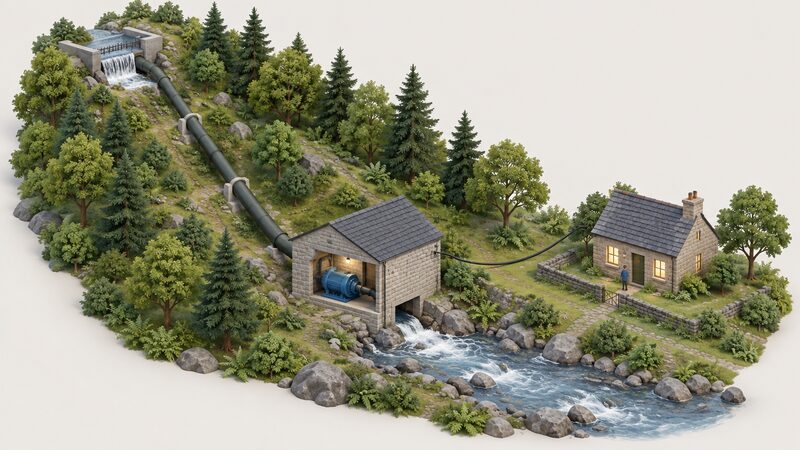
A grid connection changes the economics and the compliance picture. With the decarbonisation of the electric grid, electric water heating can provide hot water in dwellings and commercial premises in an increasingly sustainable, efficient and reliable way27. That is the case for using hydro output electrically and letting the grid absorb the timing mismatch, rather than trying to match generation to heat demand directly.
Connection brings its own rules. In Northern Ireland, G99/NI Fast Track parameters changed on 1 May 2026: applications can be up to 60A per phase, previously 16A per phase, with the export limit remaining at 16A per phase28. That is a material change for anyone sizing a hydro generator against a single-phase supply, and it is specific to Northern Ireland; the position differs across the four nations.
Direct heating use, without export, avoids the connection agreement but accepts the timing problem in full. The choice between the two is really a choice about what the household wants to be independent of. A grid-connected hydro scheme reduces imported units but still depends on the network for backup, for the moments when flow is low and heat demand is high, and for the compliance regime that governs the connection.
An off-grid scheme depends on nothing external for its heat, but it depends entirely on its own storage, its own backup and its own maintenance. Direct electric heating and hot water products can last an average of 50% longer than a conventional fossil fuel heat source7, and direct acting electric space heating generally uses less energy than storage-based systems, and consequently produces lower carbon emissions9. No cost figures are published for either route, so prices are installer-quoted.
Permissions, consents and what remains dependent
Various consents and licences are required for a hydro project6. Building regulations will normally apply to aspects of the work such as electrical installation29. Permitted development rights for agricultural or forestry land buildings extend to house hydro-turbines, biomass boilers and anaerobic digestion systems30, which is a narrow route and not a general household permission.
The dependence that remains is worth stating plainly. A hydro household still depends on a watercourse with adequate head and flow, on a manufacturer for the turbine and its spares, on a control system that cannot be overridden, and on a backup heat source for the moments the flow temperature requirement exceeds what the primary source can deliver5. Where the scheme is grid-connected, it depends on the network and on a supplier. Where it is off-grid, it depends on its own cylinder, its own batteries and its own maintenance schedule.
Micro hydro can supply space and water heating. It does so when available power exceeds demand, through low-temperature emitters, a stored cylinder and a control strategy that keeps hot water and space heating apart. Everything beyond that is site-specific, and the figures that decide it are the ones a survey produces, not the ones a brochure quotes.
Sources30 cited
- Hydroelectricity, Planning Portal, 2026
- Consumer Code, RECC, 2026
- Approved Document L Volume 1: Dwellings, MHCLG, 2026
- Building Regulations Approved Document L Volume 1 2026, Welsh Government, 2026
- Heat pump methodology, DESNZ, 2026
- Hydropower, nidirect, 2026
- Eligible heating systems, Ofgem, 2026
- Your home guide to solar water heating, OFTEC, 2026
- Building Regulations guidance Part J: heat producing appliances, Welsh Government, 2025
- New Build Heat Standard part two, Scottish Government, 2026
- Air source heat pumps, Bracknell Forest Council, 2025
- Approved Document L Volume 1 consultation version, Welsh Government, 2025
- The Warm Homes Social Housing Fund wave 3 scheme guidance addendum, MHCLG, 2026
- Approved Document L Volume 1: Dwellings, 2021 edition incorporating 2023 amendments, MHCLG, 2023
- Underfloor heating, Energy Saving Trust, 2025
- Low temperature heating, NCM PCDB, 2026
- Heating and heat pump factsheets, CIBSE, 2026
- Your home guide to solar water heating, OFTEC, 2026
- Hybrid heat pumps, Energy Saving Trust, 2026
- What is direct electric space heating, BEAMA, 2025
- Electric wallpaper explained, Energy Saving Trust, 2026
- Underfloor heating systems, NICEIC, 2026
- Underfloor heating cost, Warmup, 2026
- Warm water underfloor heating, BEAMA, 2025
- Electric space heating, BEAMA, 2026
- Benefits of electric heating and hot water, BEAMA, 2025
- Electric hot water, BEAMA, 2026
- The Electricity and Gas (Heat Networks etc.) Regulations 2025, legislation.gov.uk, 2025
- Building regulations: hydro electricity, Welsh Government, 2026
- The Town and Country Planning (General Permitted Development) (Amendment) (Wales) Order 2012, legislation.gov.uk, 2012
 Micro Hydro Power for HomesA stream on your land that flows all year can make steady electricity, day and night, even when there is no sun or wind.
 Using a Heat Pump for CoolingCan a heat pump cool your home in summer as well as heat it in winter?
 Hot Water Heat PumpsA hot water heat pump heats only the water in your cylinder, using air instead of a boiler flame.
 Water Source Heat PumpsYour home sits near a river, lake or the sea.
 Domestic Wind TurbinesCan a wind turbine really power a home, and is your site windy enough?
 Micro Hydro CostHow much does a micro hydro scheme cost to build and run, and what makes one worth it?