
In this answer
Short answer
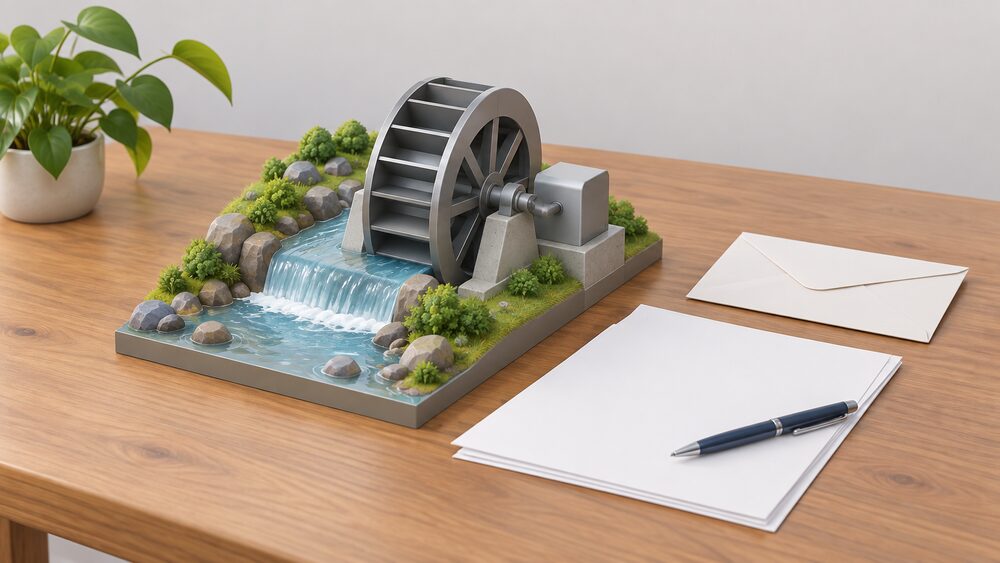
Yes, a small hydro turbine can connect to a single-phase supply. The ceiling is 17kW: NIE Networks states that it is possible to connect up to 17kW maximum to a single phase supply, and that above this capacity a three phase supply is required1. Within that ceiling, the connection route splits at 3.68kW per phase. Installations at or below that figure follow the simpler G98 notification process; larger installations up to the 17kW single-phase maximum need a G99 application2.
The practical question for most sites is not whether a single-phase connection is possible but which regime the turbine falls into. A micro hydro scheme is defined by capacity, not by connection type: systems with a capacity of less than 100 kilowatts, the size typically used for small-scale generation, are sometimes referred to as micro-hydro3. That definition sits well above the single-phase ceiling, so a scheme can be a micro-hydro scheme in name and still need a three-phase supply or an export limitation device to connect.
What a single-phase connection buys a household is the ability to run the turbine alongside the grid rather than instead of it. A grid connection is not mandatory for a behind-the-meter system, but it enhances value by enabling export of surplus electricity4. What it does not buy is independence from the network: the connection remains the household's route to export payments, to backup when the turbine is not running, and to the distribution network operator's protection requirements.
G99 connection rules: what applies to a single-phase hydro scheme
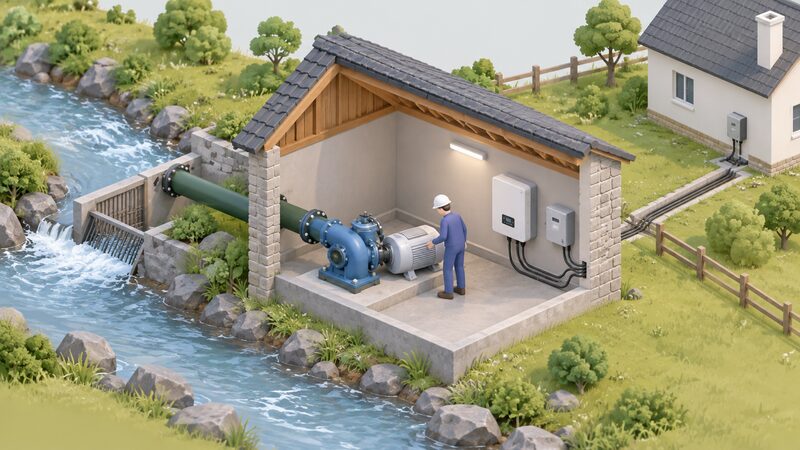
Engineering Recommendation G98 covers projects connected at low voltage, 230V single phase or 400V three phase7. It is a simple connection procedure for fully type tested installations under 16A per phase, installed on a fit and notify basis8. The 16A per phase figure is the origin of the familiar 3.68kW threshold: SSEN describes small-scale distributed generation equipment under 3.68kW at one property as following its small-scale process9.
Above that, G99 applies. The G99 Fast Track Process is available for installations onto a single-phase connection where inverter capacity is 3.68kW generation and 3.68kW storage per phase, with total export limited by a G100 device to 3.68kW9. Where the total of all generation, fixed storage and the power export capacity of vehicle-to-grid is below 50 kW three-phase or 17 kW single-phase, the simplified application form A1-1 applies10. That 17kW single-phase figure matches the NIE Networks ceiling, and it is the practical upper bound for a single-phase hydro connection.
In Northern Ireland the same architecture applies under different names. G98/NI covers generation equal to or below 3.68kW single phase; G99/NI covers generation over 3.68kW single phase or 11.04kW three phase3. NIE Networks classes a microgenerator at limits of 3.68kW single phase and 11.04kW three phase, and small scale renewable generation as greater than 3.68kW and up to 17kW single phase, and greater than 11.04kW and up to 2MW three phase4.
The distinction matters for a hydro scheme because hydro output is steady rather than intermittent. A turbine that runs near its rated output for much of the year sits close to the connection limit far more often than a solar array of the same nameplate capacity, which spends most of its time well below it.
Sizing the turbine to stay within single-phase limits
Sizing a hydro turbine for a single-phase connection means working backwards from the connection threshold, not forwards from the resource. The two thresholds that matter are 3.68kW per phase, below which the fit and notify route applies, and 17kW single phase, above which a three-phase supply is required1.
Between those figures the scheme needs a G99 application and, in the Fast Track case, an export limitation device. The G99 Fast Track Process for a single-phase connection allows 3.68kW generation and 3.68kW storage per phase with total export limited by a G100 device to 3.68kW9. A larger turbine can therefore be installed behind a single-phase connection provided its export is capped, though the generation capacity itself still has to be declared.
Northern Ireland adds a further layer of terminology. NIE Networks distinguishes a microgenerator at 3.68kW single phase from small scale renewable generation at greater than 3.68kW and up to 17kW single phase4. The older G83 limit was based on the certified continuous steady state operating rating of the inverter, subject to a 4kW single phase figure4. That inverter-based approach is the one to carry forward: it is the certified continuous rating of the generating equipment, not a peak or momentary figure, that determines which regime applies.
For a household, the sizing decision has a direct independence consequence. A turbine sized to the single-phase ceiling can meet a large share of a home's demand and export the rest, but it cannot exceed the connection without either a three-phase upgrade or an export limitation device that curtails output. Curtailment is lost generation, and it is the price of staying on a single-phase supply.
Grid connection versus off-grid: which route suits your site
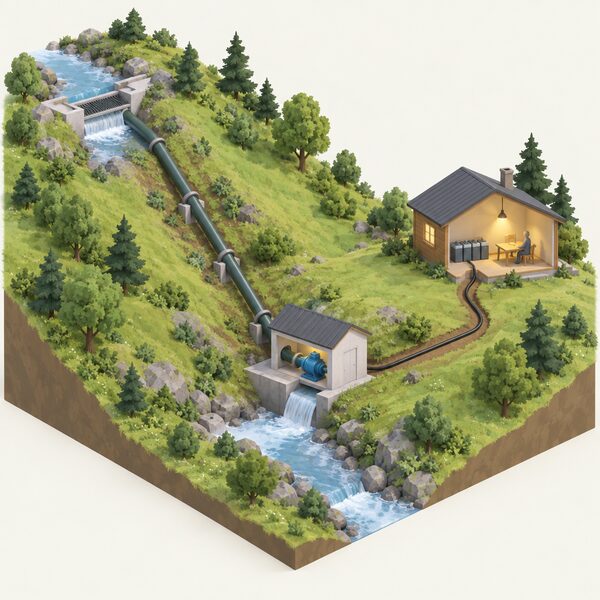
For houses with no mains connection but with access to a micro hydro site, a good hydro system can generate a steady, more reliable electricity supply than other renewable technologies at a lower cost11. Hydroelectricity schemes are one of the most reliable alternatives to mains supply for isolated properties12. The Consumer Council notes that hydropower might be a cheaper option if your home is off the electricity grid13.
That reliability is the core of the off-grid case. In off-grid applications the power is used for lighting and electrical appliances, and space and water heating can be supplied when available power exceeds demand11. Micro-hydro systems generate power from running water and are ideal for off-grid homes, offering long-term savings despite high initial costs14. Small hydroelectricity systems, also called hydropower systems, can produce enough electricity for all electrical appliances and lighting in your home15.
The trade-off is that off-grid operation removes the export route entirely. A grid connection is not mandatory, but it enhances value by enabling export of surplus electricity4. An off-grid household therefore depends on its own battery bank and diversion load rather than on a supplier, and it carries the full capital cost of storage. A grid-connected household depends on the network for backup and on a supplier for payment, but avoids the cost of storing every kilowatt hour it generates.
For a site with a mains connection already in place, the grid route is usually the simpler one: the turbine runs alongside the supply, surplus is exported, and the household retains the grid as its winter backup. For a genuinely isolated property, the off-grid route turns the hydro scheme into the primary supply, with all the reliability that implies and all the storage cost that comes with it.
Export, metering and payment for hydro electricity
Export payments for hydro depend on which scheme the installation sits under. The Feed-in Tariff remains the framework for accredited generators: a FIT Export Payment is a fixed payment made by the FIT Licensee to the FIT Generator or Nominated Recipient for every kWh exported to the National Grid16. Eligibility requires that you must be able to measure the electricity generated, and exported if applicable, by the installation separately from all other sources to receive generation payments, and export payments if metered17.
For installations not on the Feed-in Tariff, the Smart Export Guarantee is the route. As of June 2026, SEG payments can reach up to 25 pence per kWh, which is comparable to the unit rate of electricity18. Individual suppliers set their own rates and terms: Solar Energy UK's list of export tariffs includes EDF's Export Exclusive 12m V3 and Export 12m, and So Energy's So Export Flex19. Rates and availability change, and the tariff a household can access depends on the supplier and the metering in place.
Metering is the practical constraint. Separate measurement of generation, and of export where export payments are claimed, is a condition of the Feed-in Tariff17. A hydro scheme sharing a meter with the rest of the property cannot demonstrate what it exported. The same principle applies to SEG tariffs, which are paid on metered export.
The independence picture here is mixed. Export payments turn the turbine into an income stream and improve the economics of a scheme that would otherwise only offset consumption. But they also tie the household to a supplier, a meter and a tariff that can change. A household that wants payment for exported hydro electricity is choosing a relationship with the electricity market, not independence from it.
Consents and approvals before you connect
Connection approval is only one of several consents a hydro scheme needs. On the electrical side, the trigger for prior approval rather than notification is set out plainly: you must apply before you connect if there is more than one generator at a single property9. A hydro turbine installed alongside an existing solar array therefore moves out of the notify route even if it is small.
Planning consent is separate. Permitted development for stand alone wind turbines requires that the installation complies with the Microgeneration Certification Scheme Planning Standard (MCS 020) or equivalent standards, and only the first installation of any wind turbine would be permitted development, and only if there is no existing air source heat pump at the property20. Additional wind turbines or air source heat pumps at the same property require an application for planning permission21. Building-mounted turbines follow the same first-installation logic22. These rules are written for wind, but they show the pattern a hydro scheme also faces: permitted development is narrow, conditional and limited to a single installation.
Water abstraction and environmental consents sit outside the electrical connection and are covered separately in water abstraction licences and permits for home hydro and fish passage, screening and environmental requirements. The connection application itself goes to the distribution network operator: SSEN publishes a micro generation connections process for installations up to 3.68kW per phase at one property9, and NIE Networks handles the equivalent process in Northern Ireland3.
What happens if hydro output exceeds the single-phase limit
Above 17kW on a single-phase supply, a three-phase supply is required1. That is the hard ceiling. Below it, a separate constraint applies to the supply itself: SSEN requires that the supply capacity must be confirmed with SSEN where the maximum demand is greater than the cut-out rating, or where the new maximum demand is greater than 60A (13.8kVA single phase) for residential properties23. A hydro scheme that pushes household demand past the existing cut-out therefore triggers a supply capacity check independently of the generation connection.
Installing any three phase electrical equipment, such as water pumps, is itself listed as a trigger for a supply upgrade24. Hydro schemes often involve pumps and other three-phase plant, so the upgrade question can arise from the mechanical side of the scheme as much as from the generator.
Off-grid, exceeding demand is not a connection problem but a storage and diversion problem. Space and water heating can be supplied when available power exceeds demand11. That is the standard off-grid answer to surplus: rather than curtailing, the scheme diverts excess output to heat. On a grid-connected single-phase scheme, the equivalent answer is an export limitation device, as in the G99 Fast Track arrangement where total export is limited by a G100 device to 3.68kW9.
The choice between the two is a choice about dependence. A three-phase upgrade keeps the full output available for export but ties the household to a larger connection and its costs. An export limitation device keeps the single-phase connection but discards output at the top of the range. Neither is free.
What inverter or protection settings apply to a single-phase hydro connection
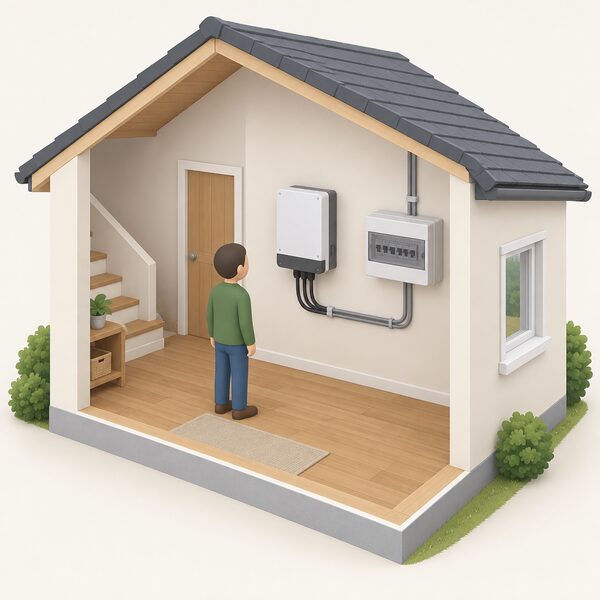
Protection settings follow the connection standard, not the prime mover. G98 applies to fully type tested installations under 16A per phase, installed on a fit and notify basis8. Type testing is what allows the notify route: the equipment's protection behaviour has already been demonstrated, so the network operator does not need to assess it case by case.
For the AC side, maker datasheets give the shape of the requirement. The Enphase IQ7HS microinverter specifies a 1 x 1 ungrounded array configuration, no additional DC side protection required, and AC side protection requiring a maximum of 20 A per branch circuit25. That is a solar microinverter rather than a hydro controller, and it is given here only to show how a type tested unit states its protection envelope. A hydro installation uses its own controller and inverter, and the settings that apply are those the equipment was certified with under the relevant standard.
The practical point for a household is that protection settings are not a matter of preference. They are part of the type test that makes the fit and notify route available, and they are what the network operator relies on when it accepts a G98 notification. Where a scheme needs a G99 application, the settings are assessed as part of that application.
For the wider standards picture, MCS certification for wind and hydro installations and G98 and G99: connecting a wind, hydro or CHP generator to the grid cover the certification and application detail. Northern Ireland readers should also see connecting a generator in Northern Ireland.
Sources25 cited
- Connections FAQs, NIE Networks
- Generation connections FAQs, NIE Networks
- Help to select, NIE Networks
- Generation connections, NIE Networks
- Micro, small scale and large scale renewable generation, NIE Networks
- What is G98/NI, NIE Networks
- G98 Single Premises Summary Guide, Energy Networks Association
- Micro generation connection procedure, Sell2Wales
- Micro generation connections, SSEN
- G98 Single Premises, Energy Networks Association
- Hydro electricity, Planning Portal
- Hydroelectricity, Home Energy Scotland
- Renewable energy, Consumer Council
- Sustainable home energy solutions, Planning Portal
- Hydroelectricity, Energy Saving Trust
- Guidance for FIT Generators V18, Ofgem
- Feed-in Tariffs: FIT generators, Ofgem
- POST note 771, Parliamentary Office of Science and Technology
- Smart Export Guarantee, Solar Energy UK
- Planning permission: stand alone wind turbines, Planning Portal
- Planning permission: wind turbines, Welsh Government
- Planning permission: building-mounted wind turbines, Planning Portal
- Heat pump connections, SSEN
- Building regulations renewables guidance, Bedford Borough Council
- IQ7HS microinverter data sheet, Enphase
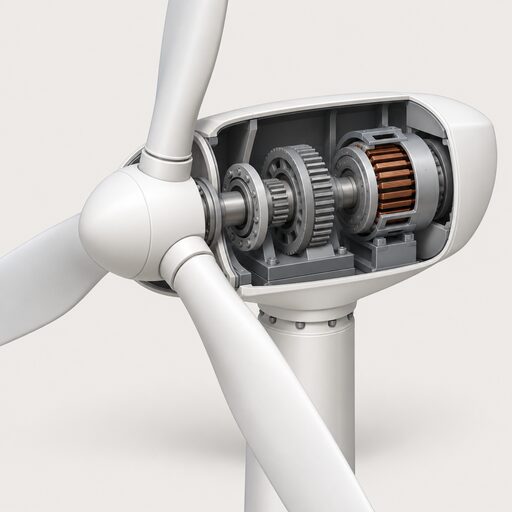 Domestic Wind TurbinesCan a wind turbine really power a home, and is your site windy enough?
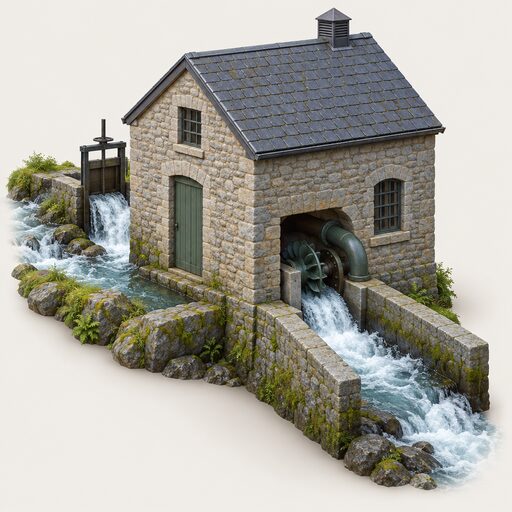 Micro Hydro Power for HomesA stream on your land that flows all year can make steady electricity, day and night, even when there is no sun or wind.
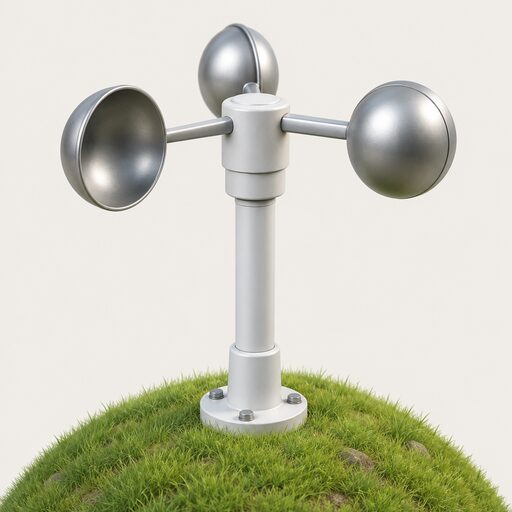 Wind Turbine Output and SizingHow much electricity a home wind turbine makes depends far more on your wind than on its size.
 Micro Hydro CostHow much does a micro hydro scheme cost to build and run, and what makes one worth it?
 Microgeneration and IndependenceWhat can you use when solar cannot cover winter evenings, and does it really make you independent?
 The Full Wind, Hydro and Micro-CHP GuideCould a small wind turbine or water wheel work at your home, and what about boilers that make their own electricity?