
In this answer
Short answer
Yes, a behind-the-meter system can export surplus electricity, but only through an export arrangement. The generation itself is not the constraint: official Welsh Government guidance states plainly that "Surplus energy can often be exported"1. What turns that surplus into a payment is a connection, a meter that records what leaves the property, and a supplier or scheme willing to buy it.
The distinction matters because behind-the-meter describes where the equipment sits, not what it is allowed to do. A grid connection is not mandatory for a behind-the-meter system, but the same guidance notes that it "enhances the value of BTM systems by enabling the export of surplus electricity"1. A household that never connects can still generate and store, but it has no route to sell the excess.
For most homes the practical route is the Smart Export Guarantee, which pays for exported electricity as recorded by a smart meter2. The size of the surplus depends on the household: a medium electricity consumer uses 2,700kWh a year, the figure used for bill values3, and anything generated above that and above what is used at the moment of generation is what becomes available to export.
What 'behind the meter' means and where the meter boundary sits
Behind the meter is a location, not a technology. It describes generation, storage and control equipment installed on the household's side of the metering point, so that the electricity it produces is consumed on site before any of it crosses the boundary. Welsh Government guidance covers behind-the-meter energy systems in "both domestic and commercial buildings"1, which is why the term appears in domestic solar, battery and heat discussions alike.
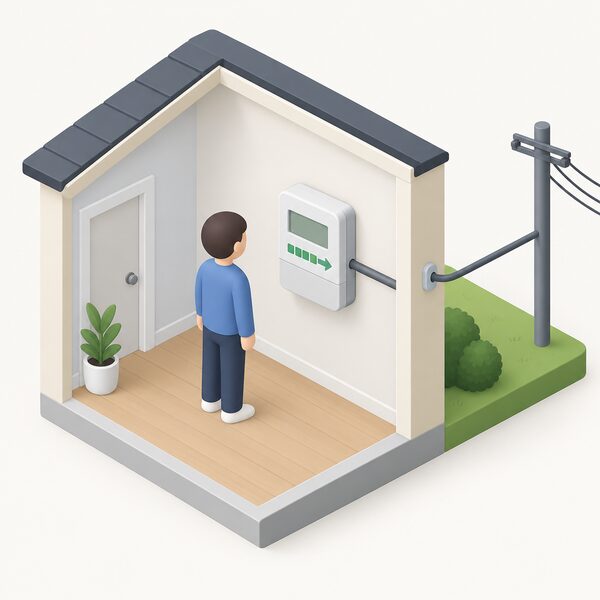
The boundary itself is the meter. Everything upstream of it belongs to the network and the supplier; everything downstream belongs to the household. That is why the meter's capabilities decide what can be claimed. On an Economy 7 import/export meter, the default reading without pressing any buttons is the export reading, shown as a small "5" followed by five numbers9. On an import/export meter without a blue button, "R" shows the total amount of exported units for about ten seconds10. These are the physical readings a household can take, and they are distinct from the import register that the supplier bills from.
The meter also carries an identity that ties readings to an account. The meter serial number is often found below the barcode on the meter, and the same number appears on bills, in the online account or in an app11. For a household trying to establish what its system is exporting, that number is the link between the hardware on the wall and the records held by the supplier.
It is worth being precise about what sits on each side, because the phrase is often used loosely. A battery, an inverter, a solar array and a diverter are all behind the meter. The distribution network, the supplier's systems and the settlement arrangements that pay for exports are all in front of it. The meter is the only place where the two meet, and it is the only place where export can be measured for payment.
Can a behind-the-meter system export surplus electricity? Yes, but only through an export arrangement
The answer is yes, with conditions. Surplus energy can often be exported1, and a grid connection, while not mandatory, is what enables it and enhances the value of the system1. Without a connection there is no route to the grid, and without an arrangement there is no payment even where the connection exists.
The arrangement is what most households mean by an export tariff: "the rate paid to households or businesses for the electricity they export back to the grid"12. The Smart Export Guarantee is the main scheme, described by MCS as a way to "sell surplus solar electricity to the grid"13. Local authority guidance in England puts it the same way: a household can "sell any surplus energy you don't use back to the grid"14, and parliamentary research confirms that "Any excess electricity generated by the panels can be exported to the grid"15.
The conditions are where households come unstuck. Generators must have a smart meter to monitor exports in order to qualify for the SEG4, and the meter must be a registered one that records exported electricity, even where no smart tariff is taken2. For Feed-in Tariff installations that add storage or electric vehicle charging, the meter must be able to measure the amount generated or exported from the installation separately from any other source, unless pro-rating is allowable16. Where pro-rating is available and the shared meter is an export meter, the electricity exported can be accurately measured, but deemed export payments are not available in that case16.
There is also a technical requirement on the meter itself. Export meters must be capable of taking measurements at half-hourly intervals in relation to the exported electricity volumes for which payment is sought17. That is the metering standard behind the settlement arrangements, and it is why a smart meter, rather than a simple totalising register, is the instrument the scheme expects.
"Surplus energy can often be exported."
Self-consumption first: how much surplus a household typically has left over
Surplus is what remains after the home has used what it generated. The starting point is the household's own consumption, and the official figure used for bill values is 2,700kWh of electricity a year for a medium consumer, alongside 11,500kWh of gas and 3,900kWh for multi-register meters3. A system sized around that consumption will have less to export than one sized well above it.
Consumption varies widely between households, and that variation drives how much surplus exists. There is a typical energy consumption gap of around 30% between households in the bottom and top equivalised income deciles18. Two homes with identical arrays can therefore have very different export volumes, because one uses far more of its generation on site.
Standby load is a small but persistent part of the picture. The Energy Saving Trust estimates that UK households waste around eight per cent of their electricity bill on standby19, and standby accounts for 8% of household energy consumption on average20. That is consumption that happens whether or not the sun is shining, and it reduces the surplus available at the times generation peaks.
The wider context is that domestic energy costs form 6% of total household expenditure on average, but 10% for the lowest income decile21. Export income is therefore a modest line for most households and a more meaningful one for those spending a larger share of income on energy. The economics of surplus are covered in more detail in self-consumption and self-sufficiency ratio.
| Household figure | Value | Source |
|---|---|---|
| Medium electricity consumption | 2,700kWh a year | 3 |
| Medium gas consumption | 11,500kWh a year | 3 |
| Multi-register meters | 3,900kWh a year | 3 |
| Consumption gap, bottom to top income decile | around 30% | 18 |
| Electricity bill wasted on standby | around 8% | 19 |
| Standby share of household energy consumption | 8% | 20 |
| Domestic energy as share of household expenditure | 6% average, 10% lowest decile | 21 |
Export tariffs and smart meter data: who measures what you send out
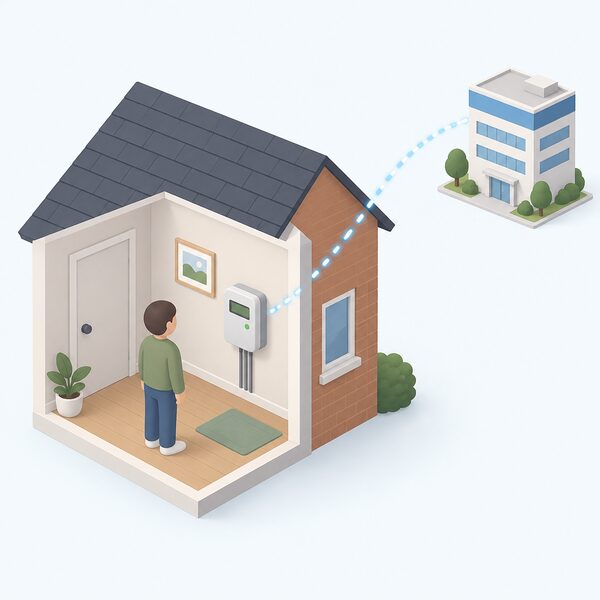
The Smart Export Guarantee pays on export alone. Payments are "exclusively an export tariff, based solely on how much electricity you export back to the grid, as recorded by your smart meter"5. That is a clean separation from import billing: the household is paid for what leaves, and billed for what arrives, and the two are calculated from different registers.
Smart meter data does several jobs at once. It is used to bill for the energy used, to offer new products and services such as new tariffs where permission has been given, and to help make the energy system more efficient by recording demand more accurately22. Independent guidance adds that data sent by a smart meter is used by the energy supplier to bill and by the network operator to carry out essential tasks23. Export tariffs are one of the products built on that data: tariffs are being offered that pay for exporting renewable energy to the smart energy system, obtainable by getting a smart meter installed24.
The shift from estimated to measured export is the important change for older installations. Where a household currently receives deemed export payments, those stop and are replaced by export payments for the amount of electricity recorded by the meter as exported to the grid25. Metered export is defined as export payments made based on export meter readings, as opposed to deemed export26. The Feed-in Tariff deemed rate estimated that a household exported 50% of the energy it generated6, and once a smart meter is fitted, a household with a deemed or estimated Feed-in Tariff export rate cannot go back to it6.
Batteries, plug-in solar and virtual power plants: how storage changes the export picture
Storage changes the arithmetic of export in a way that is easy to misread. Installing battery storage lowers the amount of electricity exported to the grid, which means less money from export payments, but the independent guidance is that overall savings are greater than relying on export payments7. The household is trading a small export income for a larger reduction in imported electricity.
That is the intended design. Independent guidance on buying a house with solar panels suggests considering battery storage if the system does not already have it, so that surplus electricity is stored rather than exported27. Official guidance on a low-carbon housing development in Corby describes the same principle: householder use of solar generated electricity is maximised by battery storage and exported to the grid28. The battery serves self-consumption first and export second.
The scale of the prize is significant where smart tariffs are combined with export. Rooftop solar paired with battery storage is reported to cut energy bills by up to 80% when factoring in smart tariffs and exporting excess energy back to the grid29. That figure is a reported outcome, not a guarantee, and it depends on the tariff and the household's pattern of use.
Plug-in solar is the exception that proves the rule. Plug-in panels became legal across Great Britain from 27 August 2026, with savings of up to £100 a year30, but the maker guidance is explicit: a household cannot export extra electricity or earn money through Smart Export tariffs with them8. They are a self-consumption product, and the export route remains with fixed, registered installations.
Virtual power plants sit at the edge of what the evidence supports. They aggregate home storage and pay for flexibility, but no UK household payment terms are available here, so no figure can be given. What can be said is that a VPP does not remove the need for a meter that records export; it changes who pays and when. The trade-offs between storing and exporting are set out in home battery vs hot water tank and solar diverter vs battery.
| Route | Can it export? | Basis |
|---|---|---|
| Fixed solar PV with SEG | Yes | Paid for exact export as recorded by smart meter5 |
| Solar plus battery | Yes, but less volume | Storage lowers exports; overall savings greater7 |
| Plug-in solar | No | Cannot export or earn through Smart Export tariffs8 |
| Small wind, grid-connected | Yes | Unused or excess electricity can be exported and sold31 |
Community energy and the grid edge: where household export fits in the wider system
Household export is one small part of a system that is being rebuilt around the meter. Behind-the-meter systems apply to domestic and commercial buildings alike1, and the same export logic runs through other technologies: for grid-connected small wind, any unused or excess electricity can be exported to the grid and sold to the local electricity supply company31. The principle is not specific to solar.
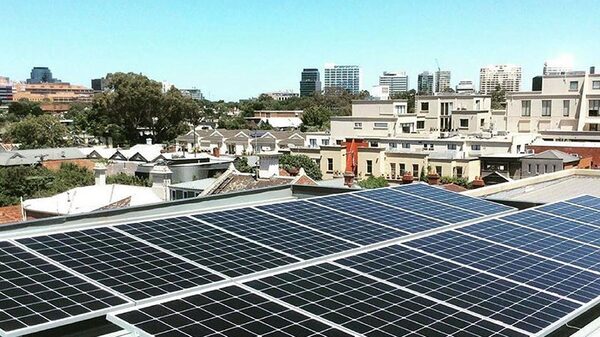
The wider context is that the surplus from a solar PV system, where generation exceeds need, is put onto the grid13. That is the physical fact behind every export tariff. What varies is who pays for it and how it is measured, and that is where community energy and local supply arrangements come in. Community energy groups in England, Scotland and Wales became eligible for the Main Fund, around 75% of Energy Redress Scheme funding, from 23 July 202632, which widens the routes by which local generation and local supply can be supported.
Official statistics also track the delivery side of household energy efficiency. The Household Energy Efficiency Statistics headline release includes further analysis and geographical breakdowns of ECO measures, ECO delivery costs, estimated carbon and energy savings from measures installed, and the supply chain33. That is the national picture against which household export sits: individual systems, aggregated into a system-wide effect.
For a household, the independence question is straightforward. Export does not make a home independent of the grid; it makes the grid a customer for part of what the home generates. The dependence that remains is on the connection, the meter, the supplier or scheme that pays, and the settlement arrangements behind them. A home that wants to reduce that dependence further is looking at storage and self-consumption rather than export, which is the subject of behind-the-meter systems and community energy.
Sources33 cited
- Behind-the-meter energy systems guidance, Welsh Government, 2026-06-29
- Smart Export Guarantee, Energy Saving Trust, 2026-05-20
- Summary of changes to the energy price cap, 1 October to 31 December 2025, Ofgem, 2025-08-27
- Smart Export Guarantee and metering, Parliamentary Office of Science and Technology, 2026-06-25
- Can I switch energy supplier if I have solar panels?, Uswitch, 2026-06-04
- Feed-in Tariff guide, Uswitch, 2026-07-13
- Battery storage, Home Energy Scotland, 2026-09-20
- Plug-in solar panels explained, EDF Energy, 2026-09-17
- How to read your electric meter: import/export meters, NIE Networks, 2026-09-19
- Import and export meters, NIE Networks, 2026-09-20
- Reading your gas or electricity meter, Centre for Sustainable Energy, 2026-08
- Solar photovoltaic (PV), MCS Certified, 2026-07-30
- Smart Export Guarantee, Solar Energy UK, 2026-05-12
- How do I retrofit my home: solar panels, Oxfordshire County Council, 2026-09-17
- Research briefing on solar, House of Commons Library, 2026-09-17
- Guidance for FIT generators, Ofgem, 2026-04-01
- Draft licence conditions, Department for Business, Energy and Industrial Strategy, 2026-09-17
- Energy affordability: how to reduce bills for the majority of households, Joseph Rowntree Foundation, 2025-11-18
- Energy efficiency tips, nidirect, 2026-09-17
- Home and business grants, schemes and advice, East Herts Council, 2026-09-17
- Electricity prices in Great Britain, House of Lords Library, 2026-06
- Get help with your smart meter, Ofgem, 2026-09-17
- How to use your smart meter data, Which?, 2026-07-14
- Myth-busting smart meter problems, Smart Energy GB, 2026-09-17
- Feed-in Tariffs: generators, Ofgem, 2026-09-17
- Key terms explained: Feed-in Tariffs, Ofgem, 2026-09-17
- Buying a house with solar panels, Energy Saving Trust, 2026-08-13
- Building for 2050: low cost, low carbon homes, UK Government, 2022-12-05
- Dear Prime Minister, the sunlit uplands are this way, Solar Energy UK, 2026-07-16
- Plug-in solar panels now available, Energy Saving Trust, 2026-08-27
- Wind, nidirect, 2026-05-18
- Energy industry voluntary redress scheme, Community Energy England, 2026-07-23
- Household Energy Efficiency Statistics, headline release June 2026, UK Government, 2026-06-25
 Export Metering and LimitationYour solar panels are capped so they cannot send much power back to the grid.
 Behind-the-Meter SystemsWhere does your meter sit, and what does that mean for the solar panels or battery you put in at home?
 Prepayment Meter DebtHow debt repayment is set on a prepayment meter, the limits on the share of a top-up that can be taken, and how to have a rate reviewed.
 Grid Connection Rules for V2GCan your charger send power back to the grid?
 Exporting From a Home BatteryCan you actually get paid for electricity your home battery sends to the grid?
 Prepayment Meters and DebtCan your energy supplier force you onto a prepayment meter because you owe them money?