In this guide
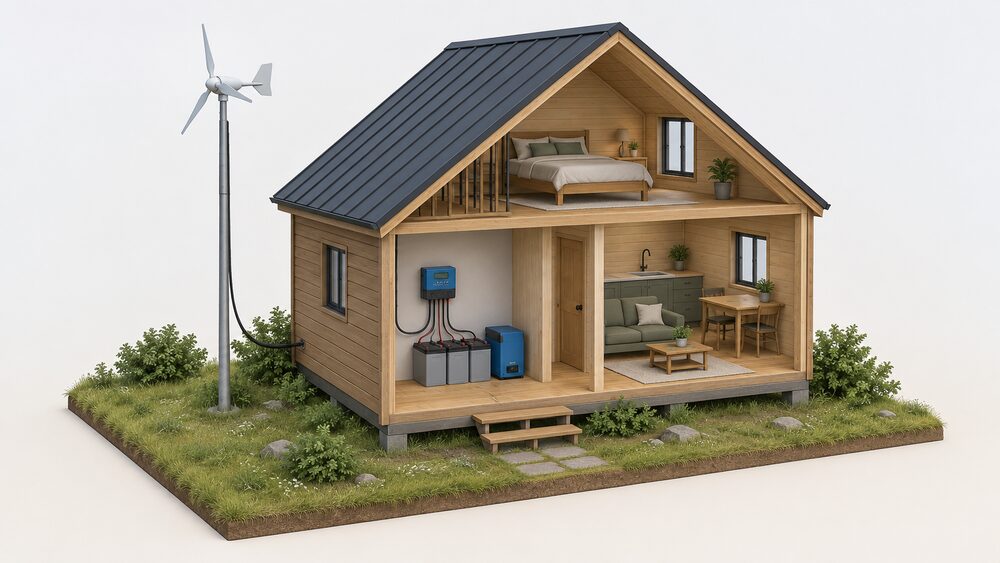
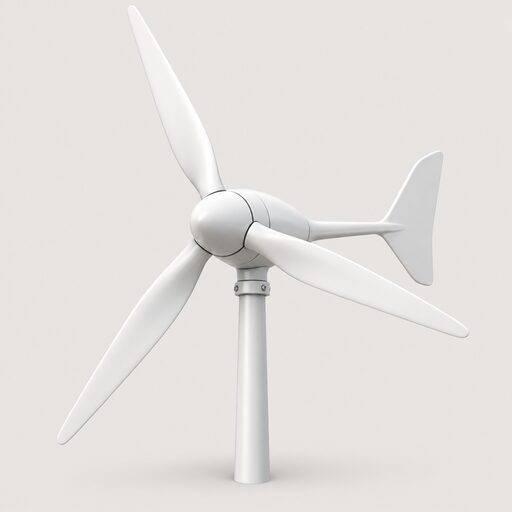
An off-grid windcharger is a small wind turbine whose whole job is to push current into a battery bank rather than into the grid. It generates electricity by using wind to turn blades connected to a generator, and in an off-grid setting that electricity is stored rather than exported1. The machines sold for this work are small: the UK companies Marlec and Leading Edge make small turbines that can generate a few hundred watts of power in a strong wind, sized for off-grid setups like boats or remote cottages2.
The figure that decides whether a site is worth pursuing is the annual average wind speed. Energy Saving Trust guidance says a turbine should be considered where the local annual average wind speed is five metres per second or more3. That is an average across the year, not a gust, and it is the single most common reason a proposed installation turns out to be a poor fit.
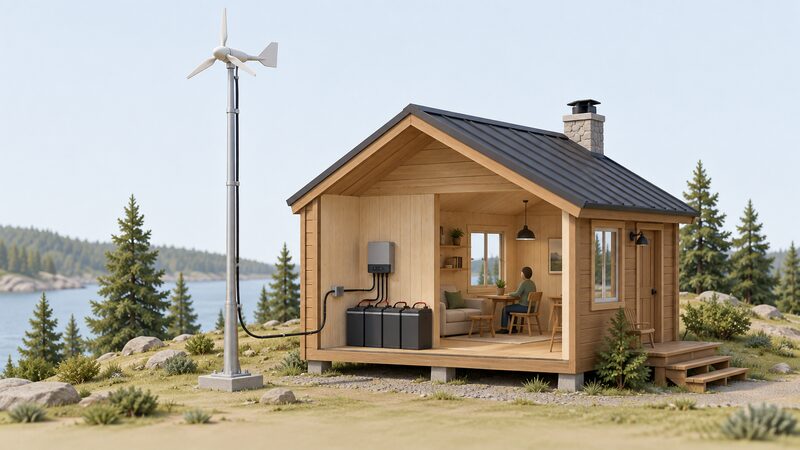
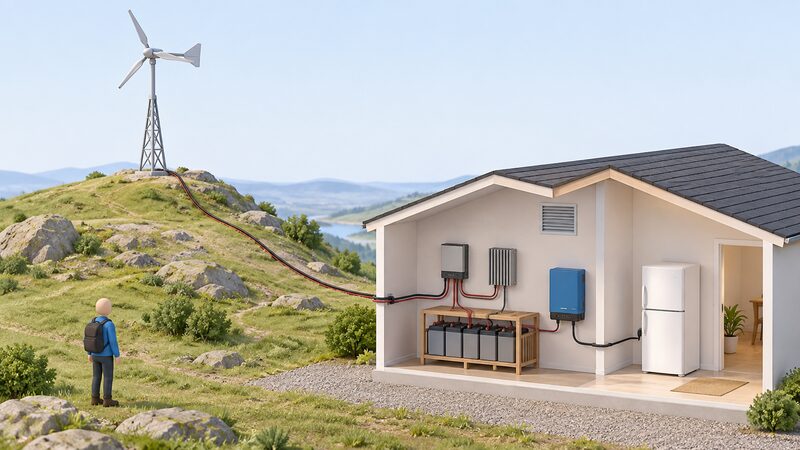
Where the site qualifies, the system is a chain rather than a single product: turbine, controller, battery bank, and an inverter that produces 230 Vac 50Hz electricity enabling common appliances to be run from a battery4. Each link has its own limits, and the battery bank is the part that wears out and must be replaced5.
What an off-grid windcharger actually does
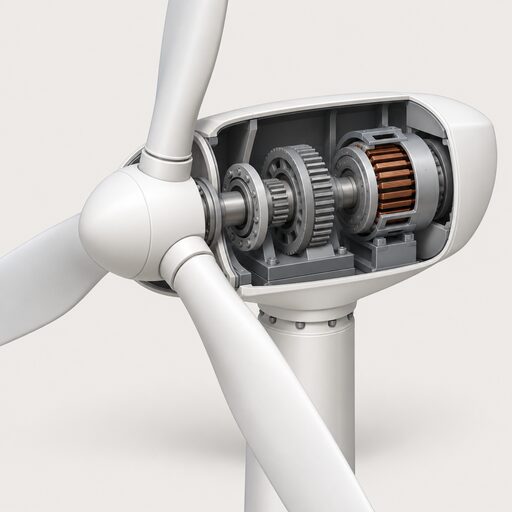
A windcharger converts moving air into direct current and hands that current to a battery. The turbine itself is only the first stage. Energy Saving Trust describes the mechanism plainly: wind turbines generate electricity by using wind to turn blades connected to a generator1. In a grid-connected system the destination for that electricity is the network, and any unused or excess electricity can be exported to the grid and sold to the local electricity supply company7. An off-grid windcharger has no such destination, so everything it makes must either be used immediately, stored, or dissipated.
That changes the design brief. A grid-tied turbine can be sized for average output and let the grid absorb the peaks and troughs. An off-grid machine has to be sized against the battery bank and the load, because surplus current with nowhere to go will overcharge the batteries. This is why off-grid wind systems are sold as a package with a controller, and why the controller is not an optional accessory.
The scale is modest and should be understood as such. A few hundred watts in a strong wind is the realistic band for this class of machine2. That is enough to keep a boat's batteries topped up, run lights and a fridge in a cabin, or supplement a larger off-grid house. It is not a substitute for a mains supply in a conventionally equipped home.
For a household's energy independence, the gain is real but partial. The turbine removes the fuel supply from the equation entirely: no deliveries, no tank, no connection. What remains is dependence on the weather, on a battery bank that degrades, and on the manufacturer for spares and support. A windcharger makes a site independent of the grid, not independent of maintenance.
Rutland 1200: output, cut-in and voltages at a glance
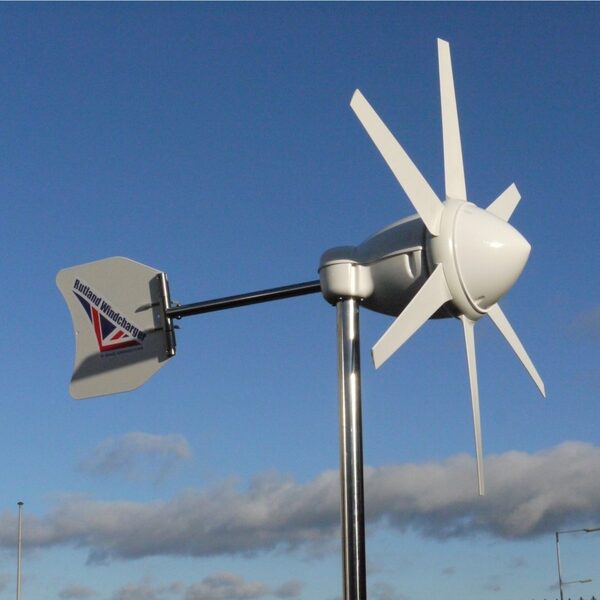
The Rutland 1200 Terrain is the machine with the fullest published specification in this class. The maker quotes 290W at 11m/s (21 knots) wind speeds, and a peak power of 483W at 15m/s6. At the lower end, the same page quotes 40W at 5m/s, expressed as 1.45A on the 24V machine and 0.75A on the 48V machine6.
The shape of that curve is the important part. Output does not rise in a straight line with wind speed: it climbs steeply, so a site with occasional strong winds and long calm spells behaves very differently from a site with a steady moderate breeze, even where the annual average is identical. The 290W figure is reached at 11m/s, which is a fresh to strong breeze, not a gale.
| Specification | Rutland 1200 Terrain |
|---|---|
| Output at 11m/s (21 knots) | 290W6 |
| Peak power | 483W at 15m/s6 |
| Output at 5m/s, 24V machine | 40W (1.45A)6 |
| Output at 5m/s, 48V machine | 40W (0.75A)6 |
| Yaw rotation | Slipring and brush gear for 360 degree free rotation6 |
The voltage options matter because they set the rest of the system. A 12V bank is the traditional choice for boats and small cabins, where loads are light and cable runs short. A 48V bank carries the same power at lower current, which reduces losses and suits a larger house. Off-grid inverters are made to convert battery voltage at 12V, 24V or 48V DC to mains voltage at 230V AC to run appliances4, so the bank voltage chosen at the start constrains the inverter bought later.
Marine, Terrain or standard: which Rutland 1200 fits which setting
The Rutland 1200 is offered in variants aimed at different exposures, and the differences are about how the machine handles wind direction and salt rather than about raw output. The Terrain version is quoted with slipring and brush gear for 360 degree free rotation6. That continuous rotation matters on a land site where the wind veers through the day, because the machine can follow it without the cable twisting to its limit.
The Marine version is quoted at 290W at 11m/s (21 knots) and also at 250W at 10m/s (23mph)6. Both figures come from the maker, and the documents do not resolve which applies, so a buyer comparing the two should ask for the current datasheet rather than rely on either number alone.
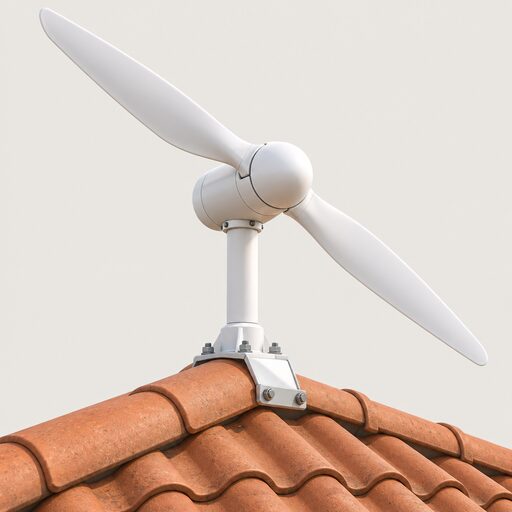
Beyond the Rutland range, the choice of turbine type follows the site. Domestic wind turbines in the UK come in two main types: the freestanding or pole-mounted wind turbine, and roof-mounted wind turbine8. Pole mounting is the usual answer for an off-grid installation because it lifts the machine clear of the turbulence that surrounds buildings, and small turbines should ideally be located on a hilltop or raised structure, away from obstructions like trees or other buildings5. Building-mounted turbines can be installed on rooftops or building sides5, but the turbulent airflow over a roof reduces output and increases wear.
Horizontal axis machines dominate for a reason: horizontal turbines tend to be the default design because they are the most efficient1. Vertical axis turbines take up less space than horizontal turbines1, which can matter on a tight site, but the efficiency penalty is the trade.
For a household, the variant choice is a durability decision rather than a performance one. A marine machine on a coastal site, and a terrain machine on an exposed inland site, are both about surviving the conditions long enough for the output figures to mean anything. The independence the system delivers depends on the machine still turning in year ten.
The controller: why the turbine ships with its own
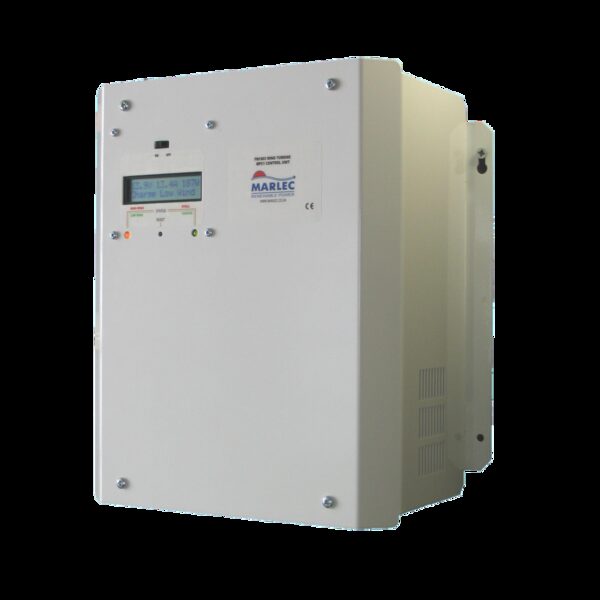
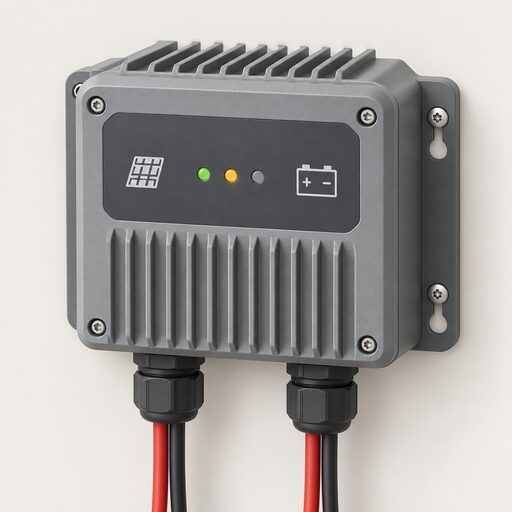
A battery-charging turbine cannot be connected straight to a battery bank. The controller sits between them, rectifying the turbine's variable output, regulating the charge, and disposing of surplus current once the batteries are full. This is why the Rutland 1200 ships with its own controller rather than leaving the buyer to source one.
The technical reason is that a wind turbine's output is not a steady voltage. The installer competence standards for small wind recognise this directly, listing non-conventional AC output, meaning variable voltage, variable current and variable frequencies, as a distinct underpinning knowledge area for wind turbine work9. A controller designed for a solar array, which produces a comparatively steady direct current, is not interchangeable with one designed for a windcharger.
The surplus problem is the other half of the controller's job. A turbine in a strong wind can produce more current than the batteries will accept, and that energy has to go somewhere. The controller diverts it, which is why off-grid wind systems are specified with a dump load or diversion arrangement rather than left to rely on the batteries alone.
Where a system is bought as a package, the controller is matched to the turbine by the maker. Where it is assembled from mixed parts, the match has to be checked deliberately, and any additional charges for the controller or its installation should be confirmed in writing before work begins11.
Batteries and inverters: how the power reaches your appliances
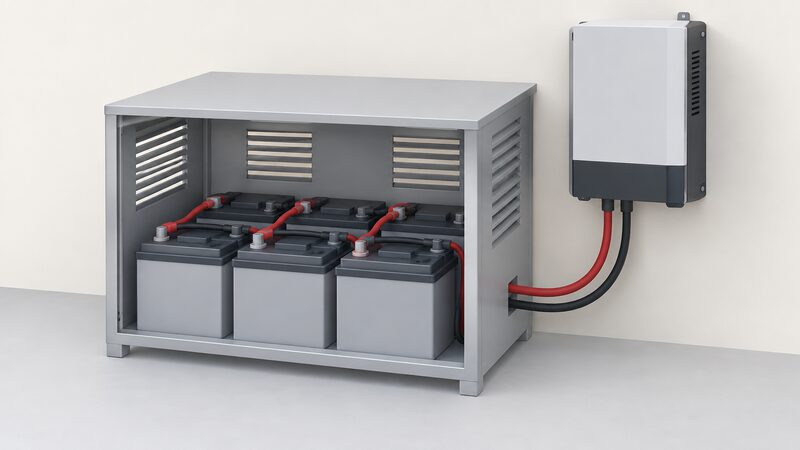
The battery bank is the heart of an off-grid wind system and the part that determines how much of the turbine's output a household can actually use. Battery storage lets excess electricity from wind turbines and solar panels be stored for later use1, which is what turns an intermittent supply into something a house can run on.
The inverter is the next link. Off-grid inverters produce 230 Vac 50Hz electricity enabling common appliances to be run from a battery4, and they can provide power up to the rating of the inverter whilst there is enough energy in the battery4. That second condition is the one that catches people out: the inverter's rating is a ceiling, not a guarantee, and it is the battery state that decides whether the ceiling can be reached.
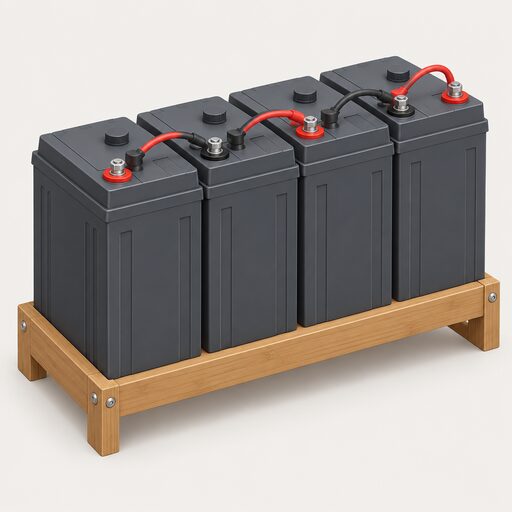
Battery banks are consumable. If a system is off-grid, the batteries will also need to be replaced8. The inverter is the other significant replacement item, and for a larger system that replacement usually costs between £1,000 and £2,0005. These are the running costs that sit behind the turbine's headline output, and they recur.
There is a design choice in how the battery is coupled to the rest of the system. A DC-coupled arrangement, where the generation and the battery are connected on the direct current side, is typically more efficient and tends to be cheaper, though such a system might not be able to charge from the grid12. For a genuinely off-grid site that last limitation is irrelevant, since there is no grid to charge from.
For energy independence, the battery bank is where the independence is actually stored. A turbine without a bank delivers power only when the wind blows. A turbine with a bank delivers power when the household needs it, which is the difference between a supplementary generator and a supply.
Monitoring your system: the Rutland 1200 Remote Display
An off-grid system gives no utility bill to tell a household how it is performing, so the display is the only routine feedback on whether the turbine, the batteries and the load are in balance. The Rutland 1200 Remote Display connects to the controller through the supplied 3m serial cable, with 5m and 10m replacement cables available6.
The display is offered in two physical formats. The surface mount version measures 125 x 75 x 50mm and weighs 203g, and the recess mount version measures 125 x 75 x 9mm and weighs 132g, with a cut out of 100 x 62mm6. The recess version is the one that sits flush into a panel, which suits a boat's instrument panel or a cabin wall where a protruding box would be in the way. Packed, the unit measures 155 x 145 x 60 and weighs 320g6.
Remote monitoring is now a normal expectation in small-scale generation. A newly certified small wind turbine was noted for its remote data-logging and control features13, and remote monitoring appears in other domestic energy schemes over periods as long as 12 years14. The value of monitoring in an off-grid setting is diagnostic rather than decorative: a falling daily yield with an unchanged wind pattern points to a battery reaching the end of its life, and a rising battery temperature points to a charge problem.
What the display does not do is remove dependence on the maker. It is a proprietary unit matched to a proprietary controller, so spares and support come from one company. That is a normal arrangement for this class of equipment, and it is worth weighing alongside the independence the system delivers.
Cabling and installation: minimising voltage drop on long runs
Off-grid wind installations tend to have long cable runs, because the turbine has to be sited away from obstructions while the batteries need to be somewhere accessible and ventilated. Small wind is especially practical for remote areas where connecting to the grid may be costly or challenging5, and those are exactly the sites where the distance between turbine and battery store is greatest.
Distance costs voltage. The longer the run and the lower the system voltage, the more of the turbine's output is lost as heat in the cable before it reaches the batteries. This is the practical argument for a 48V bank on a site with a long run: the same power moves at lower current, and lower current means lower loss for a given conductor size. It is also why the remote display's cable length is quoted in the specification, since the display run is a separate consideration from the power run.
Siting decisions drive the installation. Small wind turbines should ideally be located on a hilltop or raised structure, away from obstructions like trees or other buildings5, and systems work best in exposed, windy locations and are less suitable for built-up or sheltered areas1. A site that meets those conditions is usually a site where the cable run is long.
The competence of the installer is a separate question from the equipment. The scheme rules for small wind installation list non-conventional AC output, meaning variable voltage, variable current and variable frequencies, as a distinct knowledge area9, which reflects the fact that a windcharger's electrical behaviour differs from the steady output of a solar array. A household commissioning an off-grid system is commissioning that competence as much as the hardware.
Cost: what a Rutland 1200 system runs to
Published prices for the Rutland 1200 itself are installer-quoted, and no figure for the turbine is given here. What the sources do provide is the surrounding cost structure, which is where the money actually goes over the life of a system.
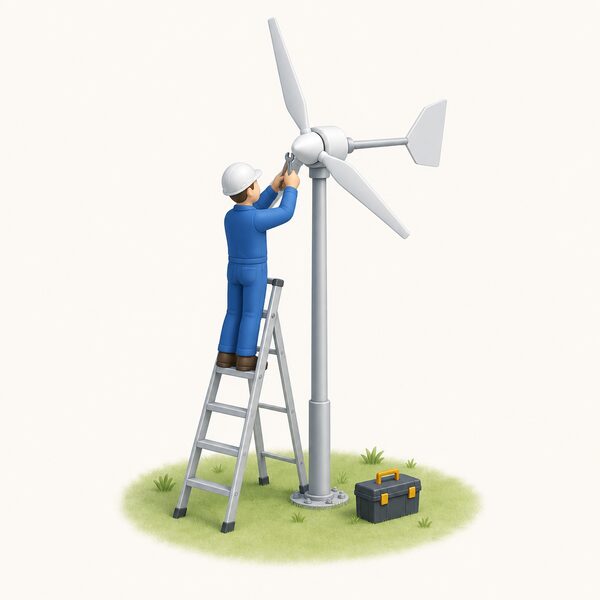
Maintenance is the recurring item. Small wind turbine maintenance typically costs between £100 and £200, depending on the size of your system5, and maintenance checks are necessary every few years, generally costing around £100 to £200 per year depending on the turbine16. Those two statements describe the same order of cost from different angles, and both point to a modest but unavoidable annual commitment.
Replacement of the power electronics is the larger occasional cost. For a larger system, replacing the inverter usually costs between £1,000 and £2,0005. Batteries are the other replacement item on an off-grid system8, and their cost scales with the size of the bank rather than with the turbine.
For comparison, a small 1kW off-grid battery charging system's basic equipment might cost £5,000 to £6,000, plus installation costs17, and a hydropower system is expected to cost around £5,000 to £6,000 for a small, 1kW off-grid generator, plus installation costs7. Those figures are for hydro rather than wind, but they set the order of magnitude for a small off-grid generating system with a battery bank.
| Cost item | Figure | Source basis |
|---|---|---|
| Maintenance | £100 to £200, depending on system size | Small wind guidance5 |
| Maintenance checks | Around £100 to £200 per year, every few years | Home Energy Scotland16 |
| Inverter replacement, larger system | £1,000 to £2,000 | Small wind guidance5 |
| 1kW off-grid battery charging system, basic equipment | £5,000 to £6,000 plus installation | Micro hydro guidance17 |
The independence question sits alongside the cost. A grid connection is not mandatory for a behind-the-meter system, but it enhances the value of the system by enabling the export of surplus electricity10. An off-grid windcharger gives up that export value in exchange for not needing the connection at all, which is the trade a remote site is usually making.
Where windchargers fall short, and where solar or hydro fits better
The limits of a windcharger follow from its fuel. Wind is intermittent, and a small machine's output is concentrated in the stronger hours. Systems work best in exposed, windy locations and are less suitable for built-up or sheltered areas1, which rules out most suburban sites before any other consideration applies. The 5m/s annual average threshold is the test, and a site that fails it will not be rescued by a larger turbine.
Solar is the natural partner rather than the rival. A wind solar hybrid system means that the site is covered in low light and wind conditions5, because the two sources peak at different times of year and in different weather. Battery storage lets excess electricity from wind turbines and solar panels be stored for later use1, so the two share the bank. Solar thermal panels can work even in cloudy or overcast conditions18, and solar panels can be installed on an outbuilding provided the building roof is strong enough19, which gives an off-grid site a second generation option without a second battery bank.
Hydro is the stronger answer where the site allows it. For houses with no mains connection but with access to a micro hydro site, a good hydro system can generate a steady, more reliable electricity supply than other renewable technologies at a lower cost11. Micro-hydro systems generate power from running water and are ideal for off-grid homes, offering long-term savings despite high initial costs20. The reason is that a stream flows through the year, while wind and sun do not.
"For houses with no mains connection but with access to a micro hydro site, a good hydro system can generate a steady, more reliable electricity supply than other renewable technologies at a lower cost."
The wider context is that small-scale wind is a small part of a large sector. Onshore wind is described as the quickest and cheapest generation21, and onshore wind carried a 39% lower global average lifetime cost of electricity generation than the alternative in 202122. Those figures are about utility-scale wind, not a 290W windcharger, and the economics do not transfer down to a single battery-charging machine. What transfers is the principle: the resource at the site decides the outcome, and for a small off-grid system the resource is measured in metres per second at the hub height, not in megawatts on a national grid.
For a household, the honest summary is that a windcharger delivers genuine independence from the grid and from fuel supply, at a scale that suits a cabin, a boat or a supplementary role in a larger off-grid house. It does not remove dependence on the weather, on a battery bank that must be replaced, or on a single manufacturer for a proprietary controller and display. Where a stream is available, hydro is the more reliable route to the same independence.
Sources22 cited
- Wind turbines, Energy Saving Trust, 2026-05-20
- Domestic wind power, Centre for Alternative Technology, 2023-10-01
- Wind, nidirect, 2026-05-18
- Off-grid battery inverters, Wind & Sun, 2026-09-20
- Small wind turbines, MCS Certified, 2026-08-18
- Rutland 1200 Terrain Windcharger, Marlec Engineering, 2026-08-19
- Hydroelectricity, Energy Saving Trust, 2025-11-06
- Wind turbines, Uswitch, 2026-01-06
- MIS 3003 Issue 3.0 Installer Requirements: Wind Turbines, MCS Certified, 2011-03-11
- Behind-the-meter energy systems guidance, Welsh Government, 2026-06-29
- Hydro electricity, Planning Portal, 2026
- Battery storage, Centre for Sustainable Energy, 2025-10
- Milestone for small wind sector as new wind turbine product achieves MCS certification, MCS Certified, 2025-01-23
- ECO4 innovation approved innovation measures, Ofgem, 2026-02
- EV charger and heat pump connections, NIE Networks, 2026-09-19
- Wind turbines, Home Energy Scotland, 2026-09-20
- Micro hydro, Centre for Alternative Technology, 2025-07-01
- Solar thermal panels, nidirect, 2024-10-22
- Solar panels, Energy Saving Trust, 2026-08-27
- Sustainable home energy solutions, Planning Portal, 2024-09-02
- Our response to EAC call for evidence into reducing UK reliance on fossil fuels, Energy Saving Trust, 2025-10-07
- The link between energy bills and fossil fuels, End Fuel Poverty Coalition, 2025-09-09
 Off-Grid Battery SystemsHow many days of power do you need when there is no sun?
 Off-Grid SolarOff-grid solar means your home, cabin or boat runs on its own power, with no connection to the grid.
 Domestic Wind TurbinesCan a wind turbine really power a home, and is your site windy enough?
 The Full Wind, Hydro and Micro-CHP GuideCould a small wind turbine or water wheel work at your home, and what about boilers that make their own electricity?
 Wind Power on the UK GridOffshore wind now supplies a big share of Britain's electricity, and it keeps growing.
 Building-Mounted Wind TurbinesWill a wind turbine on your roof actually make enough electricity to be worth it?