
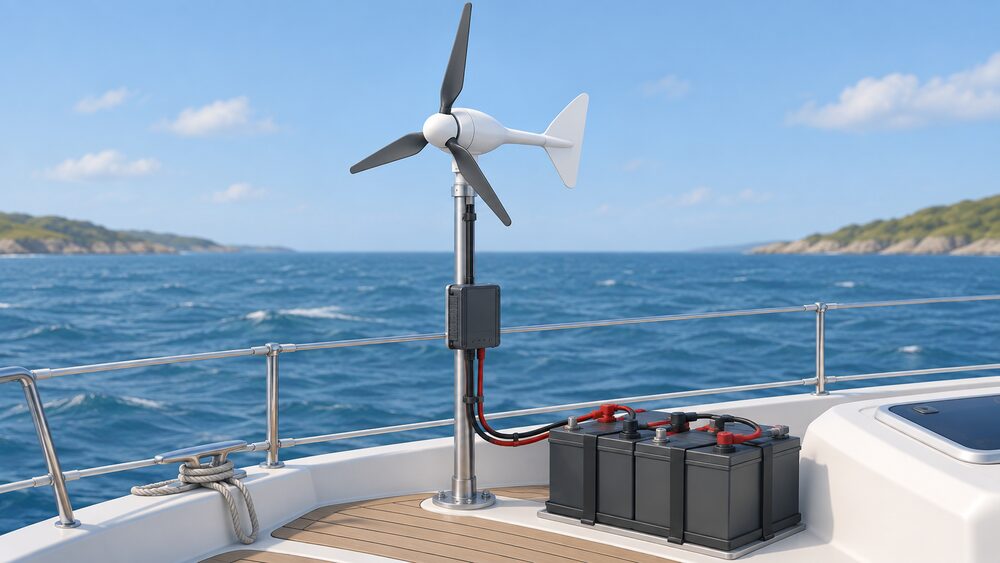
In this guide
Marlec Engineering is a British manufacturer of small wind turbines and off-grid power equipment, founded in 1978 in Rutland and now based in Corby, Northamptonshire. It describes itself as the UK's longest-established renewable energy manufacturer, and it is the company behind the Rutland Windcharger range, which it has designed, developed and manufactured in the UK for over 45 years1.
The scale is unusual for a British microgeneration maker. Marlec states that over 100,000 Rutland windchargers have been sold worldwide, in their various versions, and that the company has delivered 100,000+ installations globally2. The product line has widened well beyond wind: Marlec now designs the Solar iBoost+ solar diverter, the iBoost Buddy and a Heat Pump Interface, alongside batteries and controllers for off-grid systems1.
For a household, the significance is straightforward. Marlec is a UK manufacturer with a UK support base, a two year warranty on its products, and a design service that builds a system around a specific site rather than a catalogue part3. What it does not do is remove dependence: a Rutland windcharger charges a battery bank, and the household still depends on that battery, on a controller, and on whatever the turbine cannot supply in a still week.
Marlec Engineering: the UK's longest-established renewable energy manufacturer
Marlec was founded in 1978 in Rutland and describes itself as the UK's longest-established renewable energy manufacturer1. That claim is the company's own, and it is repeated across its product literature, including on the Solar iBoost+ pages, where it calls itself the UK's longest-established renewable energy company6. The distinction matters less than the substance behind it: a British firm that has stayed in the same field for nearly five decades, through the rise and fall of several government support schemes for small wind.
The company's own account of its history is that it pioneered the Rutland Windcharger and has supported solar PV since the 1980s, delivering 100,000+ installations worldwide1. Its off-grid guidance describes it as a developer and manufacturer of micro wind turbines in the UK for over 45 years, and separately cites over 30 years of experience in off-grid and grid connected solar installations2. Those two figures are not inconsistent: the wind business predates the solar work by roughly a decade.
The wider context is a UK renewable sector that has grown substantially. Official statistics record renewables electricity generation by Major Power Producers up 25% in the three month period from September 2025 to November 2025 compared with the same period a year earlier8. Solar panels are described in independent guidance as the most common domestic renewable energy source in the UK9. Marlec sits in the smaller, older corner of that market: micro wind and off-grid power, where the customer is often a boat owner, a remote property or a site with no mains connection at all.
What this means for independence is that Marlec is a manufacturer a household can deal with directly, in the UK, for a product category where most alternatives are imported. The company's support and engineering teams are in Corby, and its windchargers are designed, developed and manufactured in the UK3. That shortens the supply chain for spares and service, though it does not change the fundamental physics of a small turbine.
From Rutland in 1978: over 45 years of windcharger development
The Rutland name comes from the county where the company was founded, and it has outlasted the location. Marlec's manufacturing is now at Corby in Northamptonshire, where the company states its windchargers are designed, developed and manufactured, and where its sales and engineering teams are based3. The FM910-4 Furlmatic page refers to precision worked materials in the company's UK factory4.
The product range has been through several generations. The Rutland 504 and 505 are the small 12V machines, the 1200 Marine is the larger marine unit available in 12V and 24V versions, the FM910-4 Furlmatic is the furling machine aimed at isolated sites, and the VertX 360 is the current vertical axis design3. Marlec's controllers have moved with them: the SMR1 is the charge controller supplied with the VertX 360 and the 505, and the controller range includes automatic voltage detection for 12V or 24V systems, pulse width modulation charging control and a built-in blocking diode3.
"We pioneered the Rutland Windcharger and have supported solar PV since the 1980's, delivering 100,000+ installations worldwide"
The engineering choices reflect the off-grid duty cycle rather than domestic generation. A windcharger on a boat or a remote site spends most of its life trickle charging a battery, with occasional high output in strong wind. That is why furling, blocking diodes and voltage detection matter more than peak rated output: the controller has to protect the battery from overcharge and from reverse current at night, and the turbine has to survive gusts it cannot use.
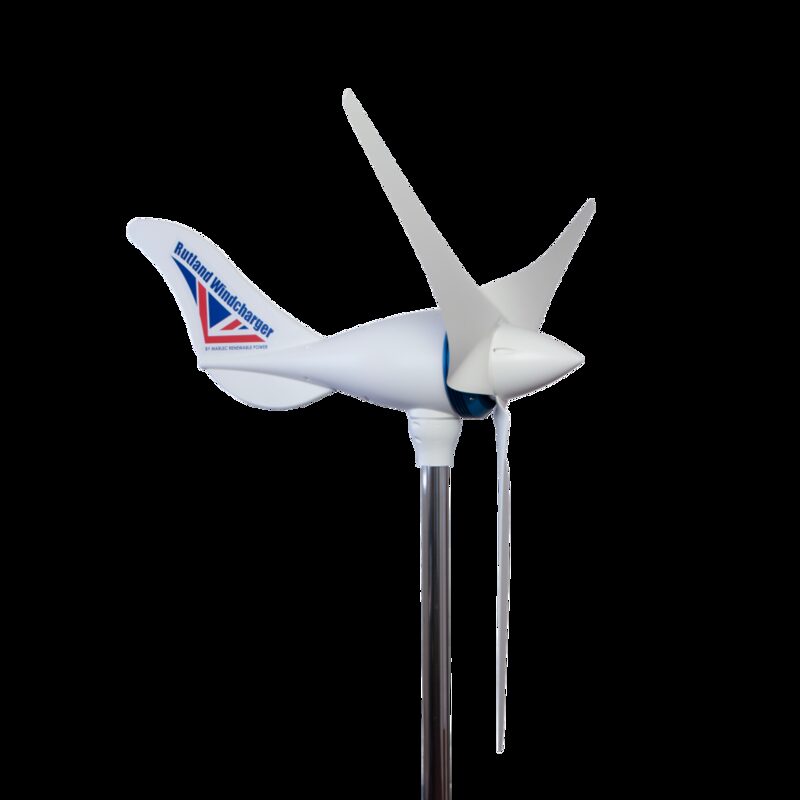
Rutland Windchargers: over 100,000 installations worldwide
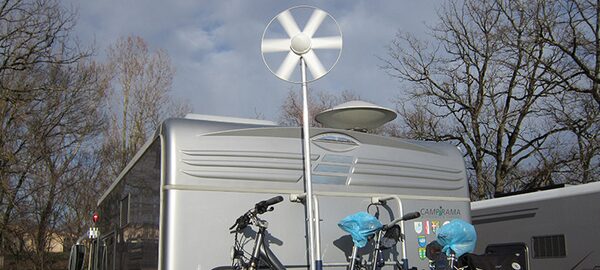
The installation count is the clearest measure of the range's reach. Marlec states over 100,000 wind chargers sold worldwide, and separately describes 100,000+ installations worldwide1. The Rutland 504 page puts it as in excess of 100,000 units sold, in its versions, worldwide5. These are the maker's figures and they are consistent across pages, which is the most that can be said: there is no independent register of Rutland installations to check them against.
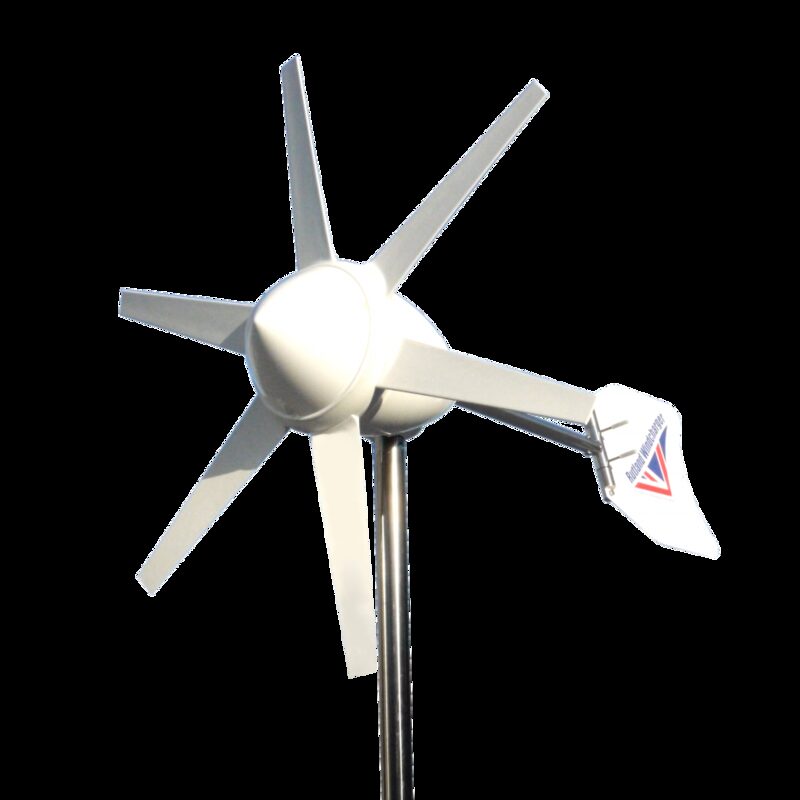
Where those units have gone is visible in the suitability lists on each product page. The FM910-4 Furlmatic is listed for low energy isolated sites, wind power for street lighting and wind power for static caravans4. The 12V Rutland 504 is listed for boats and marine use5. The VertX 360 is listed for off-grid, road signs and equipment, and car park lighting3. The 1200 Marine is the larger marine machine, available in 12V and 24V7.
| Product | Listed applications | Voltage | Warranty |
|---|---|---|---|
| Rutland VertX 360 | Off-grid, road signs and equipment, car park lighting3 | 12V, with SMR1 controller3 | 2 years3 |
| Rutland FM910-4 Furlmatic | Low energy isolated sites, street lighting, static caravans4 | Not stated | 2 years4 |
| 12V Rutland 504 | Boats and marine5 | 12V5 | 2 years5 |
| Rutland 505 | Marine and off-grid, with SMR1 12V controller6 | 12V6 | 2 years6 |
| Rutland 1200 Marine | Marine, 12V and 24V versions7 | 12V or 24V7 | 2 years7 |
The pattern is telling. These are not machines sold to houses on the gas grid looking to shave a few pounds off a bill. They are sold to sites where there is no mains supply, or where running a cable would cost more than the turbine. That is the market Marlec has served since 1978, and it is a market where reliability over years matters more than a headline output figure.
Wind, solar or hybrid: how Marlec designs a system for the application
Marlec does not sell a windcharger as a standalone answer. Its off-grid guidance states that its solutions may be single technology based or a hybrid of wind power and solar power, and that they are designed specifically for the application2. That is a design service as much as a product line, and it is the reason the company asks for site information before quoting.
The five inputs Marlec states it will consider are average power consumption, duty cycle, geographical location, quality of site, and operating voltage2. Each one changes the answer. Average consumption and duty cycle set the daily energy requirement in watt hours, which sets the battery bank. Geographical location and site quality set how much wind can be expected, which sets the turbine. Operating voltage decides whether the system runs at 12V or 24V, which in turn decides the controller and the wiring.
Independent guidance supports the hybrid approach. MCS describes a wind solar hybrid system as one where you are covered in low light and wind conditions, which is the practical argument for pairing a turbine with a panel rather than relying on either alone10. Marlec's own solar experience is long: it cites over 25 years of solar panel applications, and over 30 years in off-grid and grid connected solar installations2.
For a household, this is the point where independence is either real or nominal. A well specified hybrid with an adequate battery bank can carry a remote property through still, dark periods. An undersized battery bank cannot, whatever the turbine's rating. The design inputs Marlec lists are the same ones any off-grid system needs, and they are worth gathering before making contact.
Where Rutland windchargers fit: marine and land-based off-grid power
The Rutland range divides broadly into marine machines and land-based machines, though the two overlap. The 12V Rutland 504 is listed for boats and marine use, and the 1200 Marine is the larger marine unit in 12V or 24V5. The FM910-4 Furlmatic and the VertX 360 are aimed at land-based off-grid work: isolated sites, street lighting, static caravans, road signs and car park lighting3.
That spread reflects what a small windcharger is actually good at. It produces power day and night, in winter as well as summer, and it does so without a fuel supply. For a boat on a mooring, a remote agricultural building, a telecoms cabinet or a sign that has no cable run, that is a better fit than solar alone, particularly in the UK winter when a panel's output falls sharply. Independent guidance on off-grid alternatives notes that hydroelectric schemes are among the most reliable alternatives to a mains supply for isolated properties, which sets the bar that wind and solar are being measured against11.
The limits are equally clear. A Rutland windcharger is a battery charging device, not a grid-connected generator. It does not reduce a household's dependence on a supplier unless the household is genuinely off grid, and even then the dependence simply moves: to the battery bank, to the controller, and to the wind itself. Marlec's own battery range illustrates the point, with gel and AGM batteries from 36Ah to 135Ah at 12V12.
For a home that is already on the mains, the more relevant Marlec products are the solar diverters rather than the turbines. For a home that is not, the windcharger is one part of a system whose weakest link is usually storage. More on how these machines compare with other off-grid options is at micro wind vs solar PV for an off-grid home and off-grid wind power.
Beyond windchargers: Solar iBoost+, the iBoost Buddy and Heat Pump Interface
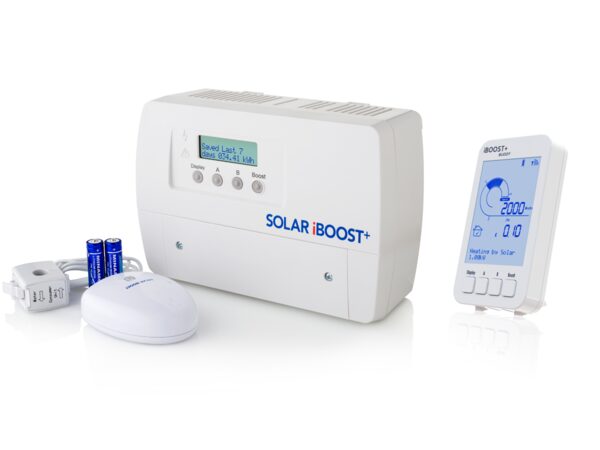
Marlec's product line now extends well past wind. The company states that it designs smart energy solutions such as the Solar iBoost+, which turns surplus solar energy into hot water1. The Solar iBoost+ automatically heats up to two immersions, uses wireless communication between the clamp and the unit as standard, and has a built-in Boost button for an instant boost of hot water13.
The Heat Pump Interface, abbreviated HPI, extends the same idea to homes with a heat pump. Marlec states that it enables solar diversion when using an air source heat pump for hot water, and that it allows the heat pump and Solar iBoost+ to work independently while safely sharing the immersion, with smart switching for seamless control1. That is a specific engineering problem: a heat pump and a solar diverter both want to control the same immersion heater, and the interface arbitrates between them.
| Product | Function | Key detail |
|---|---|---|
| Solar iBoost+ | Diverts surplus solar to hot water1 | Heats up to 2 immersions; wireless clamp13 |
| iBoost Buddy | Companion unit in the iBoost family1 | Listed alongside Solar iBoost+1 |
| Heat Pump Interface (HPI) | Shares the immersion between heat pump and diverter1 | Smart switching for seamless control1 |
The logic of these products is different from the windchargers. A solar diverter does not make a household independent of the grid; it makes better use of generation the household already has, by putting surplus electricity into a cylinder rather than exporting it. Official guidance on behind-the-meter systems describes the same principle, noting that these systems use smart energy management to prioritise on-site use of generated electricity, and that while a grid connection is not mandatory, it enhances the value of such systems by enabling export of surplus electricity14.
That is the honest position on Marlec's diverter range: it improves self-consumption, and it leaves the household connected. The windcharger range is the part of the business aimed at genuine independence, and it is the older part.
Warranty: 2 years from date of purchase
Marlec's warranty term is stated identically across its product pages: the company warrants its products for 2 years from date of purchase3. That applies to the Rutland VertX 360, the FM910-4 Furlmatic, the 12V Rutland 504, the Rutland 505 and the Rutland 1200 Marine3. It is a maker's warranty on the product, and it runs from purchase rather than from commissioning.
Two years is short by the standards of some installed renewable work. TrustMark guidance refers to a minimum two-year warranty for work, and a minimum 25-year guarantee for certain measures installed under the ECO15. OFTEC's workmanship warranty lasts six years from the date of installation where the job notification is received on time16. Independent guidance on solar installation suggests the installer's workmanship should have a guarantee for 2 years17. Marlec's term sits at the lower end of that range, which is unsurprising for a product sold as goods rather than as an installed measure.
The practical consequence for a household is that the warranty covers the early failure period, and everything after that is a maintenance question. Marlec's controllers are built with protection features that reduce the chance of avoidable failure: automatic voltage detection for 12V or 24V systems, pulse width modulation charging control and a built-in blocking diode8. Those are the components most likely to fail in a badly matched system, and they are the ones the controller is designed to protect.
Buying, servicing and owning a Marlec product in the UK
Marlec sells direct and supports direct. The company's contact details are published on its solar pages: by phone on +44 (0)1536 201 588 and by email7. For off-grid systems, the route is a conversation: Marlec asks households to call or email to discuss the system and obtain a quotation, and it will consider average power consumption, duty cycle, geographical location, quality of site and operating voltage2.
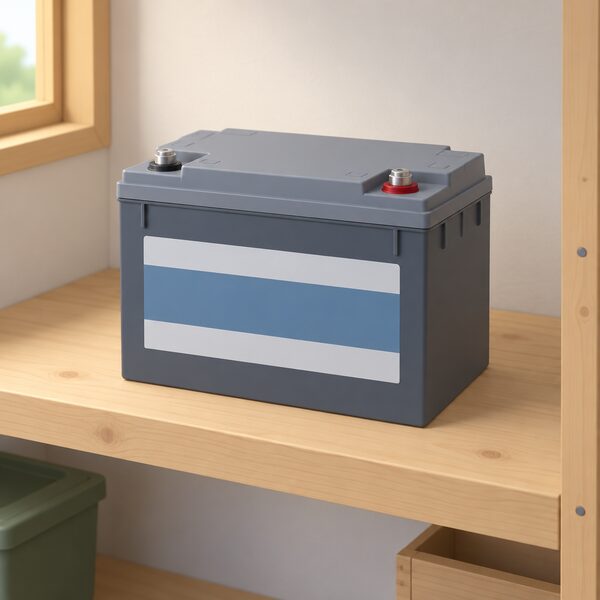
Prices are the least transparent part of the picture. Marlec publishes battery prices in GBP, including a 36Ah 12V gel battery at £133.78, a 60Ah 12V gel battery at £226.04, a 38Ah 12V AGM battery at £132.14, a 135Ah 12V AGM battery at £376.69, a 119Ah 12V gel battery at £377.28 and a 122Ah 12V gel battery at £393.5412. Those figures carry no stated VAT or delivery position, so they should be read as quoted rather than as confirmed totals. No list prices are published for the windchargers or controllers, which are quoted on enquiry.
| Battery | Type | Price |
|---|---|---|
| 36Ah, 12V | Gel | £133.7812 |
| 38Ah, 12V | AGM | £132.1412 |
| 60Ah, 12V | Gel | £226.0412 |
| 119Ah, 12V | Gel | £377.2812 |
| 122Ah, 12V | Gel | £393.5412 |
| 135Ah, 12V | AGM | £376.6912 |
On servicing, Marlec supports its products through sales and engineering teams in Corby, and its controllers are designed for long unattended operation3. No published routine inspection interval for windchargers appears in the company's material. For comparison, official guidance on domestic oil tanks suggests inspecting tanks, pipes and other equipment for leaks, damage and interference once a month, with any problems fixed promptly18. A windcharger on a mast has different failure modes, but the principle of periodic physical inspection applies.
On product regulation, energy related products carrying the CE mark can currently be sold in Great Britain if they comply with GB ecodesign standards, without also needing a UK Conformity Assessment marking19. That is the regime Marlec's products sit within. For a household, the practical points are the two year warranty, the UK support base, and the fact that the system design, not the badge, determines whether an off-grid installation works.
Sources19 cited
- Marlec company and product overview, Marlec Engineering, 10 June 2026
- Remote power supply and off-grid design, Marlec Engineering, 29 January 2026
- Rutland VertX 360 Windcharger, Marlec Engineering, 16 December 2025
- Rutland FM910-4 Furlmatic Windcharger, Marlec Engineering, 7 August 2026
- 12V Rutland 504 Windcharger, Marlec Engineering, 26 August 2026
- Rutland 505 Windcharger, Marlec Engineering, 6 August 2025
- Rutland 1200 Marine Windcharger, Marlec Engineering, 22 August 2026
- Marlec windcharger controllers, Marlec Engineering, 25 December 2023
- Solar iBoost+ and PV self-consumption, Marlec Engineering, 22 May 2024
- Marlec solar power, Marlec Engineering, 18 September 2026
- Marlec batteries, Marlec Engineering, 2 July 2025
- Small wind turbines, MCS Certified, 18 August 2026
- Behind-meter energy systems guidance, Welsh Government, 29 June 2026
- Hydroelectricity, Energy Saving Trust, 6 November 2025
- Energy trends and prices, Department for Energy Security and Net Zero, 29 January 2026
- Domestic renewable energy sources, Energy Saving Trust, 11 December 2025
- TrustMark and ECO warranty requirements, House of Commons Library, 13 May 2026
- OFTEC workmanship warranty, OFTEC, 20 September 2026
- How to choose a good solar installer, Low Carbon Hub, 20 October 2025
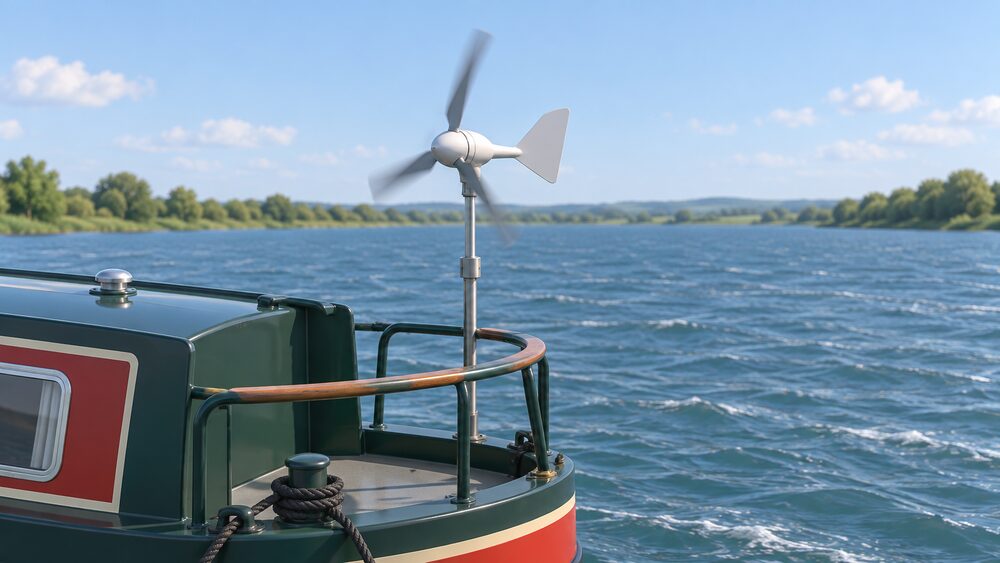 Rutland 914i WindchargerHow much power does a Rutland 914i actually make in real wind, and is it worth fitting on a boat or off-grid setup?
 Rutland WindchargersRutland wind turbines charge batteries rather than feed the grid, so they suit boats, off-grid homes and places where mains power is hard to reach.