
In this guide
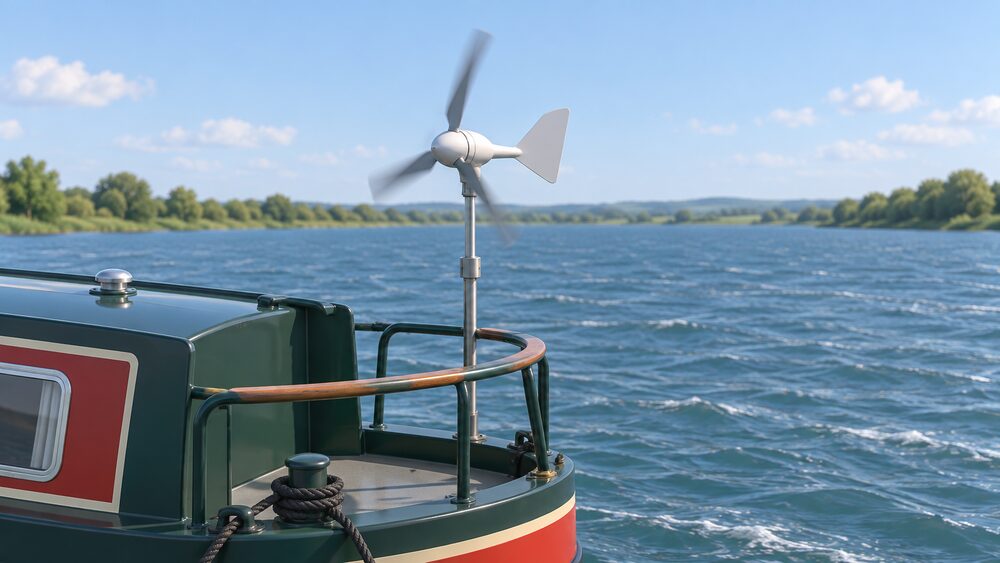
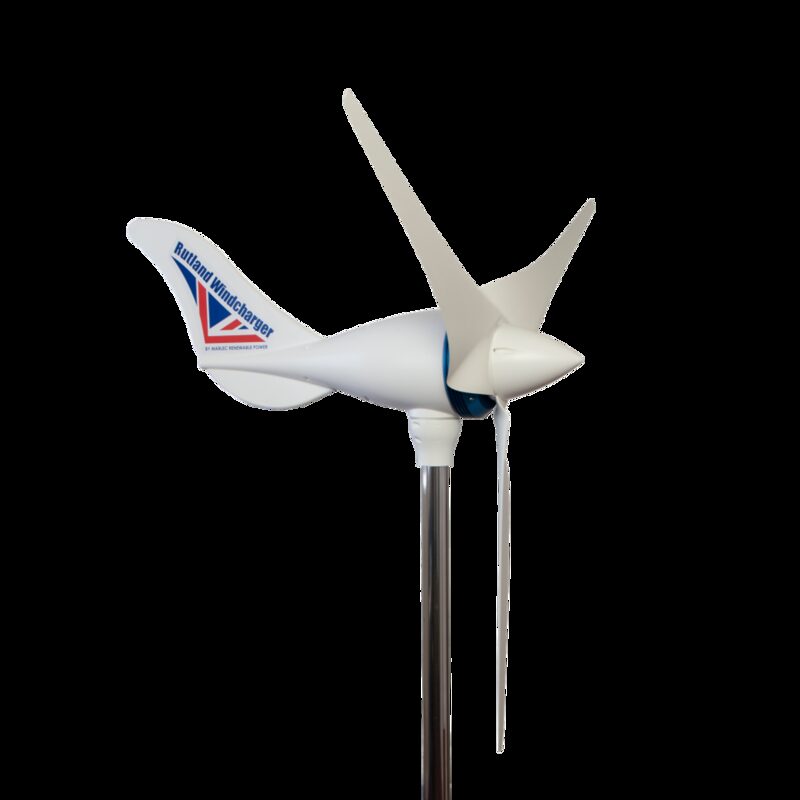
The Rutland 914i is a small UK-made windcharger rated at 140 W in an 11 m/s (24.6 mph) wind, sold in 12V and 24V variants and designed for marine use and for narrowboats1. It is the model Marlec positions as the successor to the Rutland 913, and the maker states it is capable of capturing up to 30% more energy than that older machine2.
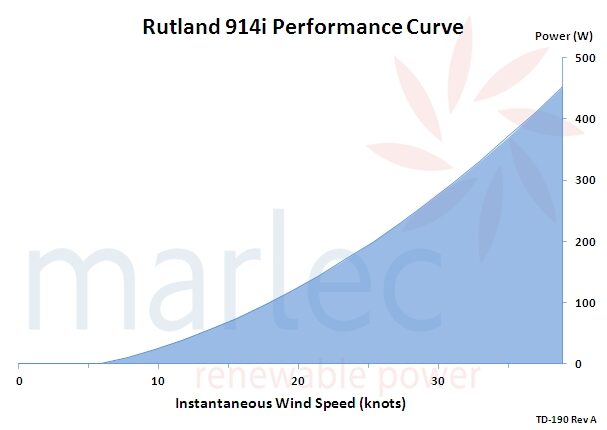
Output climbs steeply with wind speed. The published curve gives 24W (1.7A) at 5 m/s and 262W (18.9A) at 15 m/s on the 12V model, with 143W (10.3A) at 11 m/s1. Cut-in is 3.1 m/s (6.9 mph), and the turbine carries built-in MPPT electronics rather than relying on an external maximum power point tracker2.
For a household, the 914i is an off-grid device, not a grid-tied generator. It charges a battery bank directly, which means it serves boats, remote sites and static caravans rather than a mains-connected home. The dependence it leaves in place is on wind, on a battery bank, and on a charge controller sized to absorb whatever the turbine produces.
What the Rutland 914i is and where it fits
The 914i sits in Marlec's windcharger line as the mid-sized machine between the small 504 and the larger 1200. It is designed, developed and manufactured in the UK by Marlec, and the maker lists two models, the 12V and the 24V1. Marlec describes it as designed for marine use and for use on narrowboats, which places it firmly in the off-grid and mobile market rather than the domestic rooftop one2.
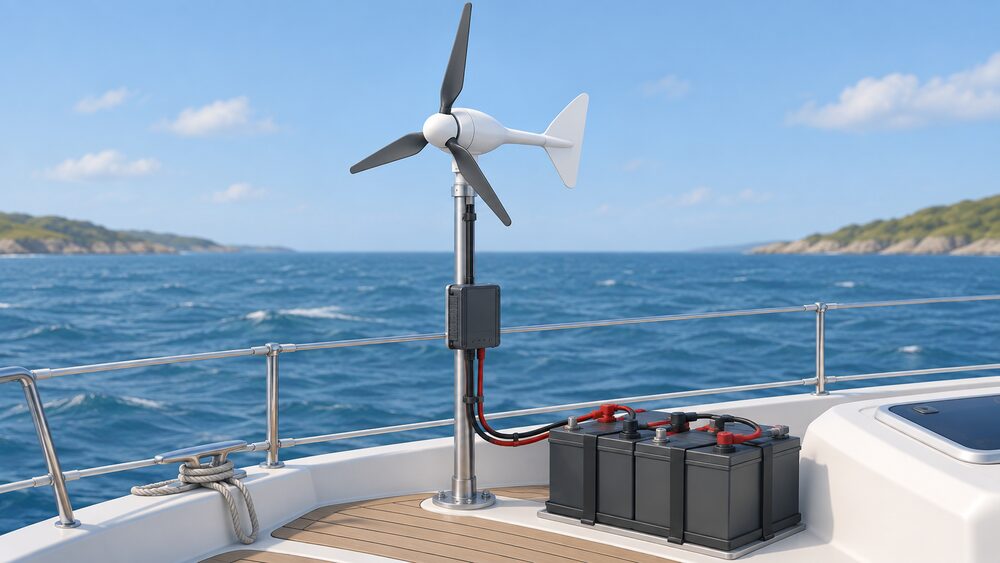
That positioning matters for a householder. A windcharger of this class charges a battery bank at 12 or 24 volts DC; it does not synchronise to the mains and does not export. The sites it suits are those already living on stored DC power: a narrowboat, a sailing yacht, a static caravan, a remote shed or an off-grid cabin. Marlec's own wider range is marketed across boats and marine, low energy isolated sites, off-grid street lighting and remote homes, and the 914i is the marine-oriented member of that family3.
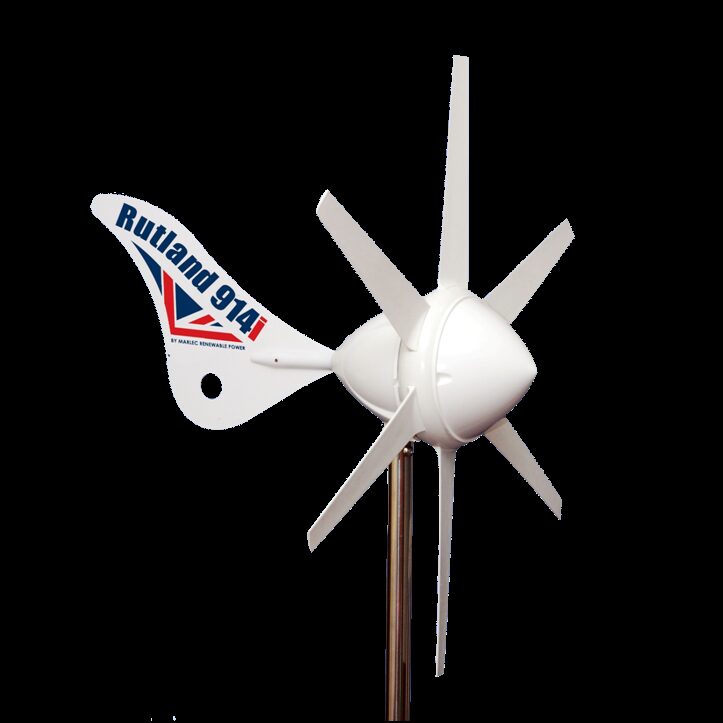
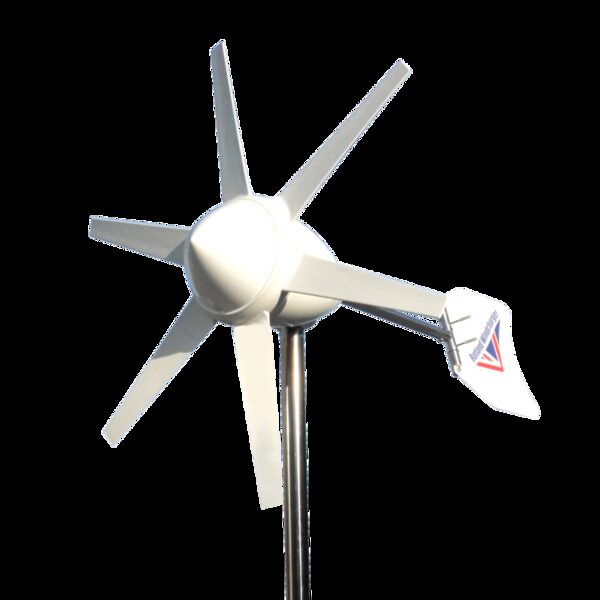
The turbine is a three-phase brushless generator with a slipring for 360 degree free rotation and low brush wear, which is what allows it to sit on a mast and yaw continuously without a cable winding up1. Spares support is unusually deep for a small turbine: Marlec lists separate 12V and 24V stators, hub assemblies, MPPT circuit boards, tail fins, bearings and brush kits for the 913 and 914i, so a failed component can be replaced rather than the whole machine5.
For energy independence, the 914i reduces reliance on a marina shore supply or a generator for battery charging, and it does so without fuel. What it does not do is remove the need for a battery bank, a controller, or a fallback charging source in a still week. A household weighing this against other options can compare it with micro wind versus solar PV for an off-grid home and with the wider picture in off-grid wind power.
Output: 140W rated, from 24W at 5 m/s to 262W at 15 m/s
The headline rating is 140 W in an 11 m/s (24.6 mph) wind, and that figure appears consistently across Marlec's own product pages and the distributor listings1. It is a rating at one wind speed, not a continuous output, and the published power curve shows how far output moves either side of it.
| Wind speed | 12V model | 24V model |
|---|---|---|
| 5 m/s | 24W (1.7A)1 | Not stated |
| 11 m/s | 143W (10.3A)1 | 143W (5.1A)1 |
| 15 m/s | 262W (18.9A)1 | 262W (9.4A)1 |
Two things stand out. First, the jump from 24W at 5 m/s to 143W at 11 m/s is roughly a sixfold increase for a doubling of wind speed, which reflects the cubic relationship between wind power and output. Second, the 12V and 24V models reach the same wattage at 15 m/s but at very different currents: 18.9A on 12V against 9.4A on 24V1. That current difference drives cable sizing and controller choice more than the wattage does.
The rated 140 W is reached at 11 m/s, which is a fresh to strong breeze, not a gale. Below cut-in the turbine produces nothing, and in the 3 to 5 m/s band it trickles. A household or boat relying on this machine should expect useful charging in exposed, windy locations and long idle periods in sheltered ones. The general principles of matching output to site are set out in wind turbine output and sizing and wind speed and siting.
Cut-in at 3.1 m/s and how the built-in MPPT works
Marlec gives the cut-in wind speed as 3.1 m/s (6.9 mph), the point at which the turbine begins to charge2. A second Marlec page for the same product states 3 m/s, so the two published figures differ slightly1. Either way, this is a low cut-in by small wind standards, and it is one of the reasons the 914i is marketed for sites where wind is modest or intermittent. The turbine uses Maximum Power Point Tracking (MPPT) technology to match generator performance to turbine speed, achieving higher efficiency and more power generation6.
The more consequential piece of engineering is the built-in MPPT. Maximum Power Point Tracking matches the generator's performance to the turbine speed, which Marlec states achieves higher efficiency and therefore more power generation2. In plain terms, a fixed-load turbine is only optimally loaded at one wind speed; an MPPT stage continuously adjusts the electrical load so the rotor keeps turning near its best tip speed ratio across a wider range. Marlec credits this electronics with letting the 914i rival the claimed outputs of larger turbines7.
The MPPT board is a serviceable part rather than a sealed black box: Marlec lists separate 12V and 24V MPPT PCBs among the 913 and 914i spares5. That is a practical point for an owner, because the electronics are the component most likely to fail and the one that determines whether the turbine performs to its curve.
MPPT is not unique to this machine. It is standard across small wind and solar charge equipment, and the term is defined in the industry's own jargon guidance8. What matters for the 914i is that the tracking is inside the nacelle, so the external controller's job is regulation and battery management rather than maximum power point tracking. The controller question is covered in more detail in Marlec HRDi versus HRSi charge regulators.
12V or 24V: which variant matches which battery bank
The 914i is sold as two models, a 12V and a 24V, and the choice is dictated by the battery bank already installed rather than by preference1. Marlec lists the voltage as 12 or 24 volts DC and describes two models available2.
The practical difference is current. At 15 m/s the 12V model delivers 262W at 18.9A while the 24V model delivers the same 262W at 9.4A1. Halving the current halves the resistive losses in the cable run from masthead to battery, and it allows thinner, cheaper cable for the same distance. On a boat with a long cable route from a stern-mounted turbine to a battery box, that is a real installation advantage.
The trade-off is that a 24V bank is less common on small craft. A 12V system matches the majority of narrowboat and yacht electrical installations, where lighting, pumps and navigation equipment are all 12V. A 24V bank suits larger vessels and some off-grid properties, and it pairs with 24V inverters and 24V charge controllers.
The turbine does not convert between the two. A 12V 914i cannot be re-strapped to charge a 24V bank, and the spares list confirms the split at component level, with separate 12V and 24V stators, hub assemblies and MPPT boards5. Getting the voltage right at the point of order is therefore essential, and it is the single most common specification decision on this model. The wider context of battery bank design is covered in off-grid wind power.
Specifications at a glance: rotor, weight and dimensions
The 914i is a compact machine by the standards of its output. The turning radius is 557 mm, which sets the clearance the rotor needs from any mast fitting, guy or structure behind it1. Packed, it measures 370 x 300 x 450 mm and weighs 13.1 kg, light enough to be carried to a mast by one person2.
| Specification | Figure |
|---|---|
| Rated output | 140 W in an 11 m/s (24.6 mph) wind1 |
| Maximum output | 262W at 15 m/s1 |
| Cut-in wind speed | 3.1 m/s (6.9 mph)2 |
| Voltage | 12 or 24 volts DC2 |
| Generator | Low friction 3 phase, brushless1 |
| Turbine diameter | 910 mm1 |
| Turning radius | 557 mm1 |
| Net weight | 11.58 kg1 |
| Packed weight and dimensions | 13.1 kg, 370 x 300 x 450mm1 |
| Governing devices | None1 |
| Yaw | Slipring for 360 degree free rotation, low brush wear1 |
| Warranty | 2 years from date of purchase1 |
The net weight of 11.58 kg and packed weight of 13.1 kg put the machine at the upper end of what one person can handle on a ladder, and the packed carton at 370 x 300 x 450mm is small enough for standard courier delivery to a boatyard or remote site1. The 910 mm rotor is small enough to mount on a pushpit, a short mast or a gable, though the swept area limits how much energy it can intercept compared with larger machines.
The absence of governing devices is a specification line worth reading carefully. Marlec lists governing devices as none, and its troubleshooting guidance states that the Rutland 500 series and the 914i models do not have any self limiting features1. There is no furling mechanism and no mechanical brake. In a storm the turbine relies on the electrical load and the battery to hold it back, which is why the controller and the state of the battery bank matter to the machine's survival, not just to charging performance.
Price, bundles and the HRDi controller options

The turbine alone is listed at £724.14 on one Marlec page, while a second Marlec page for the same product shows £869.18, so the two published figures disagree and neither is ruled out2. Both are quoted without a stated VAT position. Beyond the bare turbine, Marlec sells complete kits that bundle the machine with mounting hardware and a regulator.
| Item | Price |
|---|---|
| Rutland 914i turbine | £724.14, with a second page showing £869.182 |
| Rutland 914i Solo Kit | £1,482.311 |
| Rutland 914i Duo Kit | £1,612.311 |
| Rutland 914i Duo Expert Kit | £1,746.581 |
| HRDi Charge Controller | £134.27 to £234.788 |
| Rutland 914 Marine Mounting Kit | From £153.926 |
| Rutland 913 and 914i spares | £0.34 to £360.795 |
The Solo Kit pairs the turbine with a marine mounting kit, a marine stays kit and an HRSi Regulator for a single battery bank1. The Duo and Duo Expert kits step up to the HRDi Charge Controller, which Marlec states is designed for use with the Rutland 504, 914i or FM910-4 windchargers8. The Duo Expert adds an HRDi Remote Display, and Marlec notes that cable is not included in that kit1.
The HRDi controller is also sold on its own at £134.27 to £234.78, and it appears in several bundle options that pair it with either the 12V or 24V turbine and a choice of mounting kits8. A separate bundle pairs the 12V 914i with the HRDi and a remote display at £1,612.3111. For a smaller machine, the equivalent 504 bundle with HRDi is £1,084.11, which gives a sense of how the kit price scales with turbine size12.
Because the 914i has no governing device, the controller is not an optional accessory. It regulates charging and, in a dump load arrangement, absorbs surplus output once the battery is full. The choice between the HRSi and HRDi regulators is set out in Marlec HRDi versus HRSi charge regulators, and the general principle in dump loads and diversion controllers.
Warranty: 2 years, UK-made
Marlec warrants its products for 2 years from date of purchase, and that term is stated identically across the Rutland range, including the 914i, the FM910-4 Furlmatic, the FM1803, the 1200 Marine and the 5041. There is no longer extended term published for the 914i, and no registration step that unlocks one.
The warranty is a maker's term, and it sits alongside the fact that the machine is designed, developed and manufactured in the UK by Marlec1. UK manufacture shortens the supply chain for spares, and the depth of the spares list supports that: stators, MPPT boards, bearings, brushes, tail fins and hub assemblies are all sold separately for the 913 and 914i5. An owner out of warranty can therefore repair rather than replace, which is unusual in small wind and materially affects the long-run cost of ownership.
Two limits are worth stating plainly. The 2 year term is short relative to the working life a turbine of this type might see, and it is a warranty against manufacturing defect rather than a performance guarantee: it does not promise the published output curve will be met at a given site. And because the 914i has no self limiting features, damage from overspeed in a storm may fall outside a defect claim9. The general position on small wind warranties and certification is covered in small wind turbine standards and certification.
Compared with the Rutland 913: up to 30% more energy

The 914i is the successor to the Rutland 913, and Marlec states it builds on that model's success and is capable of capturing up to 30% more energy2. A second Marlec page puts it more directly, describing the 914i as delivering 30% more power than the 9133. The two phrasings describe the same claim, one in terms of energy captured and one in terms of power.
The gain is attributed largely to the built-in MPPT electronics, which Marlec says match generator performance to turbine speed for higher efficiency and more power generation2. A 913 without that tracking would be loaded sub-optimally across much of its wind range, so the improvement is plausible on the maker's own account, though it is a maker's claim rather than an independently measured comparison.
The two models share a parts lineage. Marlec sells a combined 913 and 914i spares range that includes components common to both, such as the front disc, brush holder and brush kit, post adaptor assembly, lower yaw ball bearing and blade screws, alongside parts specific to each, including separate 913 and 914 stators and the 914i MPPT boards5. That overlap means some service parts remain available for the older machine.
For a buyer choosing between them, the 914i is the current model with the MPPT electronics and the higher claimed yield, while the 913 is the older design. Both carry the same 2 year warranty term1. The wider Rutland range, including the 504, 505, 1200 and VertX models, is set out in Rutland windchargers, and the maker behind them in Marlec Engineering.
Where the 914i leaves a household dependent
The 914i reduces dependence on fuel and on shore power for battery charging, and it does so with a machine made and supported in the UK. What it does not do is make a home self-sufficient in electricity. It is a battery charger, not a grid-connected generator, and its output is intermittent by nature.
The dependencies that remain are specific. The turbine needs a battery bank to charge, and a bank large enough to carry the load through calm spells. It needs a charge controller, because Marlec states the 914i has no self limiting features and lists no governing device1. It needs wind: below the 3.1 m/s cut-in it produces nothing, and the rated 140 W arrives only at 11 m/s2. And it needs a fallback charging source, whether a second turbine, solar, a shore supply or an engine alternator, for the weeks when the wind does not blow.
There is also a maintenance dependence, though a shallow one. The slipring and brushes wear, the bearings eventually need replacing, and the MPPT board can fail, all of which are serviceable with parts from the maker1. The 2 year warranty covers manufacturing defects only1. For a household or boat weighing this machine against alternatives, the honest position is that the 914i is a well-supported, repairable, UK-made charger for a site that already has a battery system and a windy exposure, and a poor fit for anyone expecting it to carry a load on its own.
Sources16 cited
- Rutland 914i Windcharger, Marlec
- Rutland 914i Windcharger, Wind and Sun
- Wind Power, Marlec
- Rutland 505 Windcharger, Marlec
- Rutland 913 and 914i Spares, Marlec
- Marlec Windchargers, Wind and Sun
- Bundle Option 7 914i 24V with HRDi and Remote Display, Marlec
- Rutland FM910-4 Furlmatic Windcharger, Marlec
- Troubleshoot a Windcharger System, Marlec
- Bundle Option 5 914i 24V with HRDi, Marlec
- Bundle Option 4 914i 12V with HRDi, Marlec
- Bundle Option 15 504 with HRDi, Marlec
- Off-Grid Wind Turbines, Wind and Sun
- Off-Grid Wind Turbines, Wind and Sun
- Rutland 1200 Windcharger, Marlec
- Rutland 1200 Terrain Windcharger, Marlec
 Marlec EngineeringMarlec Engineering has built Rutland Windchargers in the UK since 1978, with over 100,000 units sold worldwide and a 2 year warranty.
 Rutland WindchargersRutland wind turbines charge batteries rather than feed the grid, so they suit boats, off-grid homes and places where mains power is hard to reach.