In this guide
The Solar iBoost+ is a solar immersion controller made by Marlec. It watches how much electricity a home is exporting and, instead of letting that surplus go to the grid, sends it to the immersion heater in the hot water cylinder. The maker describes it as a device that can "simply divert excess energy to your hot water tank, allowing you to heat your water and make the most of your solar power"1. It connects to the existing electricity meter and water cylinder, and the maker states there is no strict limit on the size of the PV system it can handle1.
The unit is factory pre-set to start heating once exports exceed 100W, and that threshold can be raised in 50W steps to a maximum of 500W2. It carries a 2 year warranty as standard from the date of purchase2. Independent guidance puts the device itself at around £300 to £500, plus installation3, while the maker puts the initial installation cost at usually around £350 to £5001.
What it does for a household is convert an export that earns little into hot water that would otherwise be bought as gas or electricity. What it does not do is take the home off the grid: the immersion still draws grid power when boosted, the cylinder still needs a boiler or heat pump in winter, and the savings depend on how much hot water the household actually uses.
What the Solar iBoost+ is and what it does
The Solar iBoost+ is a diverter, one of a family of devices that sit between a PV system and the hot water cylinder. The maker sets out the choice plainly: surplus electricity can go to a battery, or "a PV immersion controller, like the Solar iBoost+, can simply divert excess energy to your hot water tank"1. Home Energy Scotland describes the same function in independent terms: "Instead of sending surplus electricity to the grid, a PV diverter switch can power your hot water tank's immersion heater, storing hot water for later use"4.
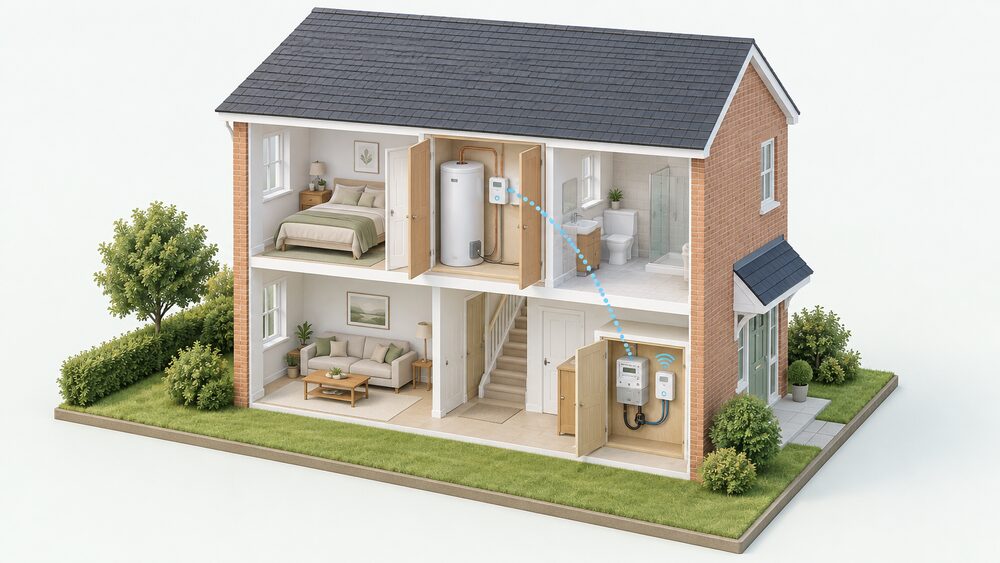
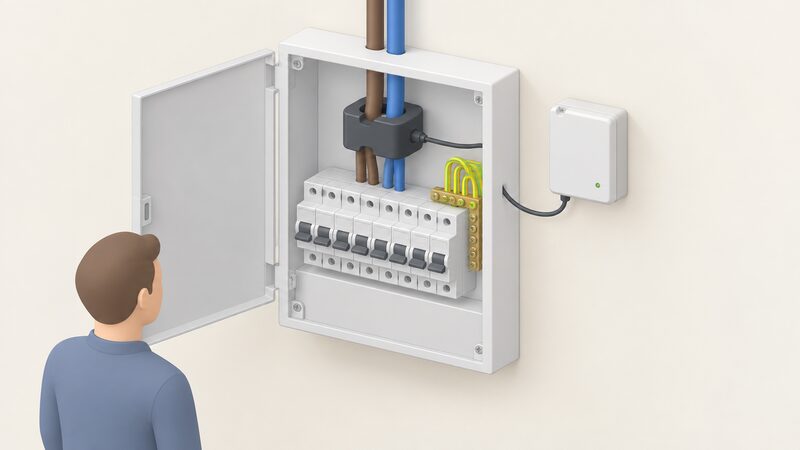
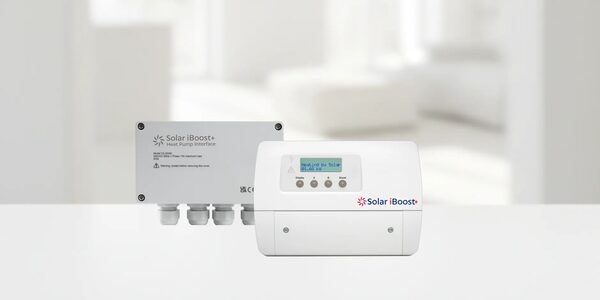
The device is made up of two parts. The sender unit sits at the meter position and "monitors how much of your energy is being exported to the grid"1. The Solar iBoost+ control unit is installed next to the hot water tank and "receives messages from the Sender"2. Between them they decide, second by second, how much power to send to the immersion.
That is the whole proposition: no battery, no change to the PV system, no change to the tariff. The cylinder becomes a thermal store for electricity that would otherwise be exported. The trade-off is that hot water is a lower-value use of a kilowatt hour than running an appliance, and a cylinder can only absorb so much before it is up to temperature.
How it works: the sender, clamp and immersion controller
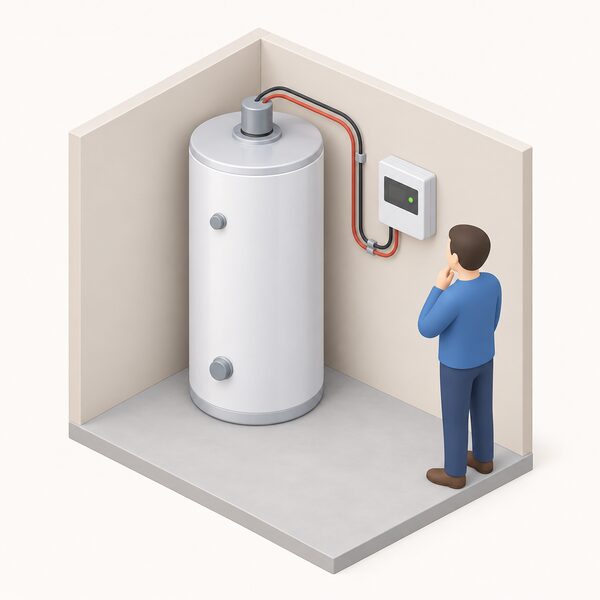
The system has three physical elements. The clamp fits around the meter tails and measures current flow, which tells the sender whether the home is importing or exporting. The sender transmits that reading wirelessly to the control unit. The control unit is wired into the immersion circuit and modulates the power delivered to the immersion heater.
The maker's description of the control behaviour is specific: "When activated, it intelligently controls and adjusts the level of energy flowing to your immersion heater in line with the export levels as they rise and fall"2. This is not a switch that turns the immersion on and off at full power. It varies the load so that the immersion consumes only what would otherwise be exported, which is what keeps the household from importing power to run it.
The controller supports up to two immersions in one cylinder, which matters for cylinders fitted with a second element, and it is supplied with the main unit, the sender with two AA batteries, the clamp and cable, fixing screws, manuals, an installation template and a commissioning form2.
"This is installed next to the hot water tank and intelligently controls the level of energy flowing to your immersion heater, inline with your export levels"
The National Energy Action assessment of solar immersion controllers looked at a myenergi eddi and a Solar iBoost over about a year, and found that savings depended on "the solar PV generation, household electricity consumption, hot water demand and length and position of the immersion heater"5. Those four variables explain why two identical installations can produce very different results.
Cost: around £300 to £500 plus installation
There is no single published price for a fitted Solar iBoost+. Independent guidance puts the device at around £300 to £500, plus the cost of installation3. The maker puts the initial installation cost at usually around £350 to £500, after which "you can start saving on your hot water bills immediately"1. Read together, a fitted job sits in the region of the two figures added, though neither source states a combined total and quotes vary with the wiring route and the cylinder position.
For context, the same independent guidance puts a solar battery at £2,500 to £5,000 as a typical additional installation cost6, and a separate source puts solar batteries at around £4,500 on average on top of an existing system7. A diverter is therefore a fraction of the cost of storage, and it stores energy as heat rather than as electricity.
| Item | Figure | Source |
|---|---|---|
| Solar iBoost+ device | around £300 to £500, plus installation | Which?3 |
| Installation | usually around £350 to £500 | Marlec1 |
| Solar battery, typical added cost | £2,500 to £5,000 | Uswitch6 |
| Solar battery, average | around £4,500 | CPA7 |
| Full domestic PV system | around £7,600 | Energy Saving Trust8 |
The comparison matters because a diverter and a battery are competing for the same surplus. A battery keeps the energy as electricity and can run lights, appliances or an EV later; a diverter turns it into hot water and loses the ability to use it for anything else. Neither is universally better, and the choice turns on hot water demand and on whether the household has a tariff that pays well for export.
Compatibility: PV systems, inverters, batteries and your hot water tank
The maker states the Solar iBoost+ is "designed to work with most residential PV systems" and that there is no strict limit on the size of the PV system it can handle1. It also works with on-site wind power, since the trigger is export rather than the generation technology2. It connects to the existing meter and cylinder, so it does not require a particular inverter brand or a hybrid inverter.
Battery storage is the compatibility question that matters most, because a battery and a diverter both respond to export. The maker's answer is that the unit has "adjustable parameters for compatibility with battery storage systems"2, and that raising the cut-in threshold lets the battery take priority: "you can raise the cut-in threshold so that some of the energy is diverted to your battery as a priority, once fully charged the Solar iBoost+ will then start to heat your water for the rest of the day just using your excess from your solar"1.
That sequencing is the practical answer for a home with both. Without it, the diverter would absorb surplus the battery could have stored, and the household would lose the flexibility that storage provides. Independent guidance on PV systems notes that a system "can be paired with a battery storage system to store excess electricity that your panels generate for when you most need it"9, which is the alternative use of the same electrons.
On the cylinder side, the controller heats up to two immersions in one tank2. A cylinder with a single immersion, a standard vented or unvented cylinder, is the normal case. The device does not replace the boiler: solar water heating "won't give you 100% of your hot water needs" and is best used alongside a boiler or immersion to make up the difference10, and the same limitation applies to a diverter, which can only heat water when there is surplus to divert.
Cut-in threshold: 100W as standard, adjustable to 500W
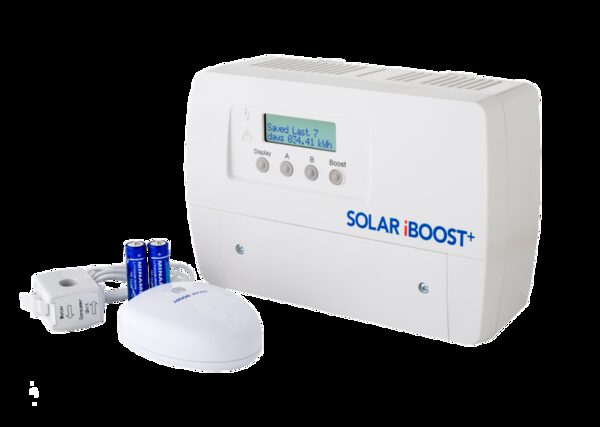
The threshold is the setting that decides when the diverter starts working. The unit is "factory pre-set to operate the immersion when exports exceed 100W", and "this cut-in threshold can be increased by 50W increments up to a maximum of 500W to overcome any battery storage threshold"2.
A low threshold captures more of the day, including the marginal hours at each end when generation is modest. A high threshold leaves small exports alone, which suits a home with a battery that should be charged first, or one where the immersion would otherwise cycle on and off repeatedly for tiny amounts of power.
One maker product page gives 100W as the standard setting, another gives 200W, and the conflict is not resolved in the material available2. A household comparing settings should read the commissioning form supplied with the unit rather than assume either figure.
Timed boost and manual boost: grid power when the sun isn't enough
The diverter only heats water from surplus. When there is not enough sun, the cylinder can still be heated from the grid, and the Solar iBoost+ provides for that: "Boost, gives an instant 'Boost' of full grid power to the immersion in timed increments"2. The maker also notes that the unit can be set "to also heat your water at set times, for example, for your morning shower or after dinner"1.
This is the point at which the device stops being a solar device and becomes a cylinder controller. A timed boost draws grid electricity, at whatever the household's tariff charges at that hour, and it is the same as running an immersion heater by any other means. Which? notes that immersion heaters are a way of heating water electrically, and the cost of doing so depends on the tariff and the volume heated3.
The grid is always there as a fallback. Official guidance on domestic PV states that a home "can draw energy from the national grid in the same way as when there was no solar PV" when consumption exceeds generation11. A diverter does not change that relationship; it only changes what happens to the surplus before it leaves.
For a household thinking about independence, the honest position is that a Solar iBoost+ reduces export and reduces gas or electricity bought for hot water, but it does not reduce reliance on the grid for the hours when the sun is not generating. The cylinder is a store measured in hours, not in days.
Monitoring your savings on the display
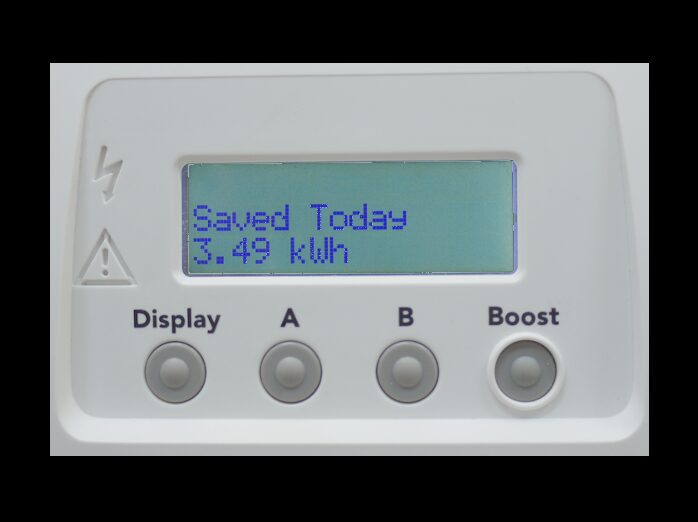
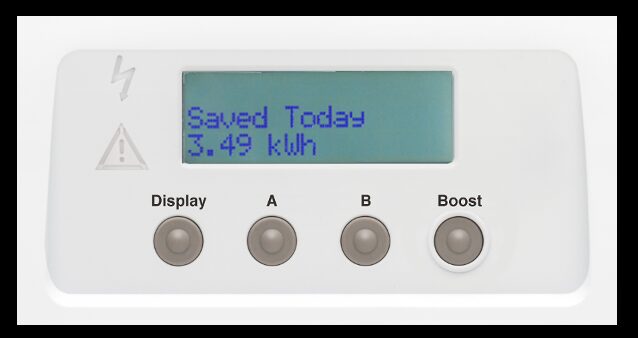
The control unit reports what it has diverted. The maker states that "you can track how much energy you've saved on the device screen" and that it shows savings "in the past 24 hours, the previous day, the past week, the past 28 days, and in total"1. That gives a household a running record of what the diverter has captured, which is the only way to judge whether the settings suit the pattern of hot water use.
An optional accessory, the iBoost+ Buddy, is described as "the wireless home energy monitor and remote control for your Solar iBoost+"2. The maker states it allows a household to "track and manage your household's electricity usage in real time, monitoring your Solar iBoost+ savings and also heat the tank if ever required"1.
The display periods are worth reading carefully. A 28 day total is a rolling window, not a monthly bill, and the "in total" figure accumulates from commissioning. Smart meter in-home displays provide a comparable service for whole-home electricity, giving "updates about how much electricity you use, as you use it"12, and the two together give a fuller picture than either alone.
Installation: where it fits and why a qualified electrician is needed
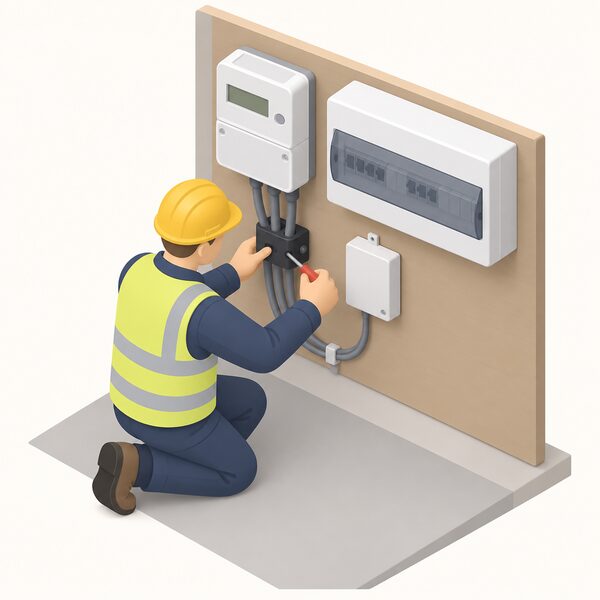
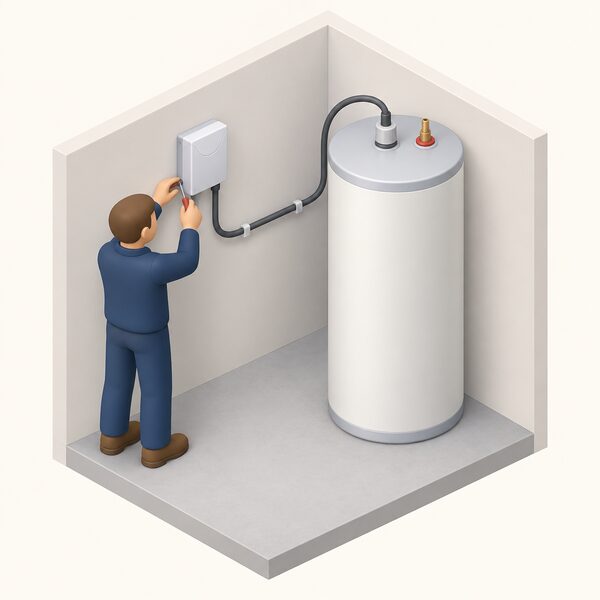
The control unit is "installed next to the hot water tank" and the sender sits at the meter position2. That split siting is what makes the wireless link necessary, and it is also why the job is not a plug-in one: the control unit has to be wired into the immersion circuit, and the clamp has to be fitted around the meter tails.
Official guidance on plug-in solar devices is clear that "any necessary testing and modifications of the building's electrical system ('installation') shall only be performed by professional electricians"13. Independent guidance on plug-in solar adds that households "may wish to use a qualified installer" for additional reassurance14, and the Electrical Safety First consumer guide sets out the safety basis for that position15.
For solar thermal and solar water heating work, the Planning Portal states that "solar installations should always be carried out by a trained and experienced installer"16, and building regulations guidance advises contacting "an installer who can provide the necessary advice, preferably one who belongs to the Competent Person Scheme"17. The same principle applies to a diverter: the electrical work is notifiable in the same way as other fixed electrical installation, and the commissioning form supplied with the unit is the record that the installation was done and set up.
The practical questions at survey are where the sender can be mounted within wireless range of the cylinder, whether there is a spare way in the consumer unit, and whether the immersion circuit is already protected. None of these is unusual, but each affects the time on site and therefore the quote.
Does a Solar iBoost+ affect Feed-in Tariff payments?
No. Feed-in Tariff payments are based on generation, and the tariff rate is assigned "based on a number of factors including, but not limited to" technology type, total installed capacity, position in deployment caps and, for solar, whether the installation is classed as a multi-site generator and whether it meets the Energy Efficiency Requirement18. Diverting surplus to a cylinder does not change any of those.
Two further points are worth recording for households on the legacy scheme. Switching energy suppliers "will not change your Feed-in Tariff payment rate"19, and payments are "commonly made quarterly, but this will vary by supplier"19. Tariff periods for solar PV are quarterly20, and solar installations accredited before 1 August 2012 have a maximum eligibility period of 25 years, longer than the standard term21.
The practical consequence is that a diverter does not put a Feed-in Tariff payment at risk. What it does change is the value of the exported units, which under the legacy scheme were paid for separately. A household weighing a diverter against a battery should compare the export payment it forgoes with the hot water it gains, and that comparison depends on the tariff in force.
Where the Solar iBoost+ has limits
The device is a small electronic unit with a 2 year warranty2, which is a shorter term than the warranties common on panels and inverters. It is also a single point of failure in the hot water system: if the controller fails, the immersion reverts to whatever the household's normal arrangement is, and the cylinder is heated by the boiler or by a manual boost.
The savings are variable by nature. The National Energy Action assessment found that savings depended on generation, household consumption, hot water demand and the immersion heater's length and position5, which means a household with low hot water use, or one that exports at a good rate, may see little benefit. The device also cannot store energy beyond the cylinder's capacity, so a sunny day with a full cylinder and no hot water demand produces no saving at all.
There is a further limit on what the diverter can claim. It heats water, and hot water is one of several uses for a kilowatt hour. A battery can run appliances, lighting or a car charger at any hour; a cylinder can only supply hot water, and only until it is up to temperature. For a household whose main aim is independence from the grid, storage of electricity addresses more of the load than storage of heat.
The wider context is that diverters sit alongside other ways of using surplus. Independent guidance on PV systems notes that a system can be paired with a battery to store excess electricity9, and the choice between the two is a question of what the household needs more: hot water in the evening, or electricity at any time.
Brands and alternatives in the UK diverter market
The Solar iBoost+ is one of two diverters named in independent guidance, the other being the Immersun Power Diverter, both quoted at around £300 to £5003. The National Energy Action assessment worked with a myenergi eddi and a Solar iBoost controller over about a year5, which places the two products in the same comparison.
Marlec is the maker of the Solar iBoost+ and publishes the product page, the knowledge hub guidance and the accessory range1. The iBoost+ Buddy is the optional monitor and remote control2, and the sender and accessories are sold separately at a price range of £23.99 through £109.15 across variants2.
For households comparing approaches rather than brands, the relevant alternatives are a battery, which stores electricity, and solar thermal, which collects heat directly. Independent guidance on solar water heating notes that it "won't give you 100% of your hot water needs" and is best used alongside a boiler or immersion10. A diverter and a solar thermal system both target hot water, but one uses surplus electricity and the other collects heat, and they are not substitutes for each other in every home.
What it means for household energy independence
A Solar iBoost+ increases self-consumption of generated electricity and reduces the amount exported at whatever rate the household receives. It does that with a device costing a fraction of a battery, and it uses an existing cylinder rather than new storage. For a home with high hot water demand and a modest export tariff, that is a direct reduction in the energy bought for water heating.
The dependence that remains is substantial. The immersion still draws grid power when boosted, the cylinder still needs a boiler or heat pump in winter, and the household remains connected to a supplier for every hour the sun does not cover. The controller itself is a manufacturer's device with a 2 year warranty, and the optional monitoring depends on the maker's accessory rather than on an open standard.
The wider system context is that grid capacity is not the constraint on domestic solar. The Solar Roadmap states there is grid capacity available for an additional 10 GW of solar22, and a home with PV can draw from the grid exactly as it did before the panels were fitted11. A diverter is a way of using more of what a system already generates, not a way of leaving the grid.
For households weighing the options, the decision turns on three measurable things: how much surplus the system produces, how much hot water the household uses, and what the export tariff pays. Where surplus is large and hot water demand is high, a diverter captures value that would otherwise leave the home. Where surplus is small or the export rate is good, the case is weaker, and the same money may do more elsewhere in the system.
Sources22 cited
- How do solar panels work with a Solar iBoost immersion controller, Marlec, 2026-09-17
- Solar iBoost+ product page, Marlec, 2026-09-17
- Immersion heaters, Which?, 2026-06-01
- Solar panels, Home Energy Scotland, 2026-09-20
- Increasing self-consumption of solar PV: Monitors and solar immersion controllers, National Energy Action, 2023-06-09
- Solar panels, Uswitch, 2026-09-16
- Battery storage and solar panels, CPA, 2026-01-06
- Solar panels, Energy Saving Trust, 2026-08-27
- Solar photovoltaic (PV), MCS Certified, 2026-07-30
- Boilers, Energy Saving Trust, 2026-05-20
- Solar panels, Oxfordshire County Council, 2026-09-17
- What is a smart meter?, Smart Energy GB, 2026-03-16
- Plug-in solar interim product specification (withdrawn), Department for Energy Security and Net Zero, 2026-07
- Plug-in solar panels: five top tips to save money and stay safe, REA, 2026-08-04
- Plug-in solar consumer guide, Electrical Safety First, 2026-08
- Solar thermal water heating, Planning Portal, 2026-09-17
- Building regulations, Planning Portal, 2026-09-17
- FIT guidance for licensed electricity suppliers, Ofgem, 2026-09-17
- Feed-in Tariff guide, Uswitch, 2026-07-13
- Feed-in Tariffs deployment caps reports, Ofgem, 2026-09-17
- FIT annual report SY14, Ofgem, 2026-09-17
- Small-scale solar, Parliamentary Office of Science and Technology, 2026-06-25
 AIKO solar panelsAIKO's ABC panels promise more power from the same roof space, so what do they actually produce in real UK conditions?
 AIKO Neostar panelsAIKO Neostar panels come in several models, so which one suits your roof?