
In this comparison
Plug-in solar and professionally installed solar are two different products with two different rulebooks. A plug-in kit is solar photovoltaics intended for connection to a home's electricity installation by means of a standard plug and socket, and it is designed for installation and operation by ordinary persons1. A rooftop array is a permanent installation, normally fitted by a trained and experienced installer and certified to MCS standards3.
The scale gap is the whole story. A plug-in kit produces up to 800W of power and is estimated to provide up to 20% of an average home's electricity use, with typical annual generation estimated at up to 720kWh5. A typical domestic rooftop system is 3.5 kW and costs around £6,100 in 20267. Plug-in kits cost between £500 and £1,000, or from around £450, with no installation cost8.
The legal position changed on 27 August 2026, when plug-in solar panels became legal to buy and use across Great Britain5. Before that date, UK standards only permitted solar power generation that was permanently connected6. Northern Ireland is not covered by that change, and the interim product specification applies to Great Britain9.
What plug-in solar is and how it differs from a rooftop array
The legal definition is narrow and precise. Under Part 14 of Schedule 2 to the General Permitted Development Order, plug-in solar means solar photovoltaics intended for connection to the relevant domestic premises' electricity installation by means of a standard plug and socket10. The same definition appears in the 2026 Order, and "solar PV" expressly includes plug-in solar, which means plug-in solar is subject to the limitations and conditions in Classes A and B11.
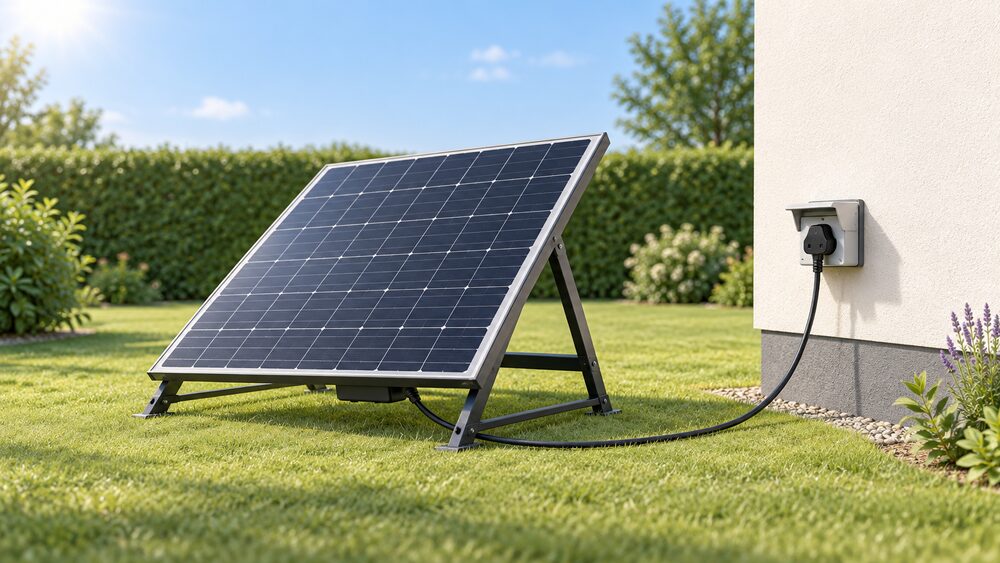
A compliant device comprises at least one PV module, a grid-following microinverter, a connection lead fitted with a plug complying with BS 1363, and a mounting system for the panel2. The interim product specification classifies devices as one-component, two-component or multi-component, and applies to single-phase equipment in a domestic environment with a rated frequency of 50Hz2.
A rooftop array is a different class of installation entirely. It is permanently connected, sized in kilowatts rather than watts, and normally installed and certified by MCS certified contractors working to the latest published MIS3002 standards4. The Feed-in Tariff statistics give a sense of how the installed base is shaped: 98.92% of installations under that scheme were solar PV and 95.38% were domestic, and solar PV installations are on average smaller than installations of other technology types13.
The practical difference for a household is what the system can do. A plug-in kit is a single appliance-scale generator that feeds a socket circuit. A rooftop array is a building-integrated generating asset that can be sized to the home's annual consumption and, with the right inverter and battery, can carry a much larger share of the load. The plug-in route trades scale for access: no scaffold, no roof survey, no installer booking.
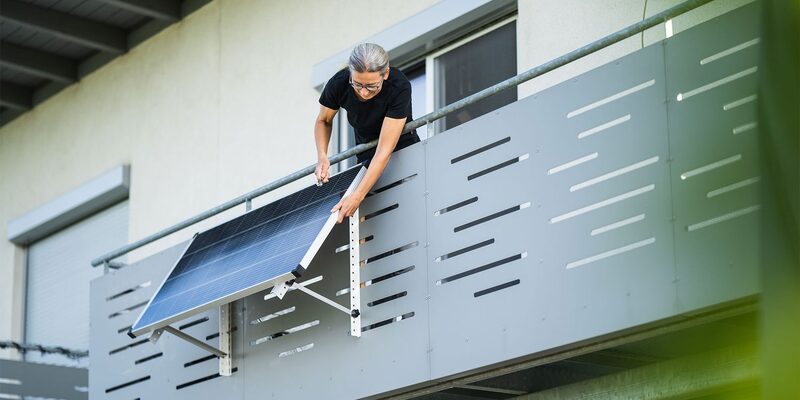
Installation: no professional required, unlike traditional rooftop solar
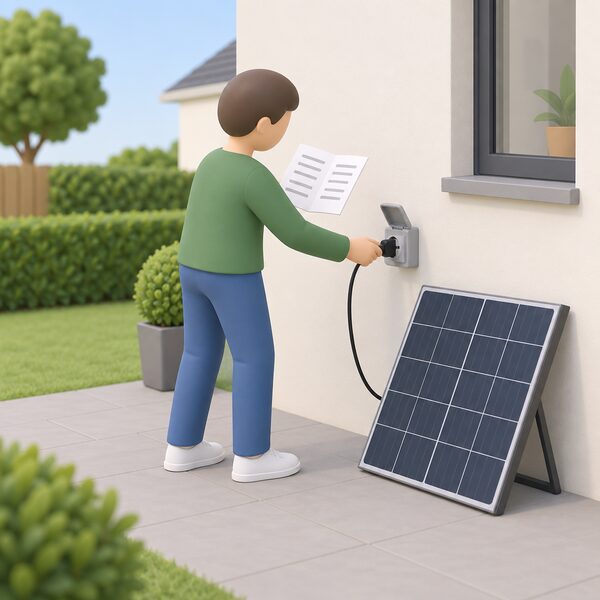
Plug-in solar is designed to be self-install, provided the manufacturer's instructions are followed9. Independent guidance states plainly that anyone can install them without the need for a professional installer or electrician6. The government's own framing is that the panels do not need professional installation and come with no installation cost5.
That does not mean the electrical system is unregulated. The withdrawn interim specification states that any necessary testing and modifications of the building's electrical system shall only be performed by professional electricians12. Independent safety guidance goes further and advises that all homes are checked for suitability and safety by a competent electrician before purchasing plug-in solar panels14. The Renewable Energy Association suggests households may wish to use a qualified installer for additional reassurance, and that a home's electrical installation should be checked before installation, particularly in an older property15.
Rooftop solar sits under a different regime. Official guidance is consistent across sources: solar installations should always be carried out by a trained and experienced installer, and a qualified installer should always be used3. Where a structural assessment is needed, that must be done by a qualified structural engineer16. Installers who are members of a relevant competent person scheme can self-certify certain types of building work, including solar PV installation, avoiding separate building regulations approval17.
Battery storage is the dividing line inside the plug-in category. A plug-in solar device is not intended to be connected to, operated with, or used in conjunction with a battery energy storage system2. Where a household adds battery storage alongside plug-in panels, it must be permanently wired and installed by a qualified electrician6.
Cost and scale: what a plug-in kit delivers versus a full installation
Plug-in kits are priced as consumer goods. Independent guidance puts typical kit prices between £500 and £1,000, and a plug-in solar panel system costs from around £450 to install8. Named products show the spread: the UKSOL Compact 460W Plug-In Solar Pro Kit is listed from £599.00 and the UKSOL Duo 890W Plug-In Solar Pro Kit from £899.00, both ground mount only6. PatioSun kits range from £449 for the 445W PatioSun Lite to £779 for the 2x465W PatioSun Max Plus kit6. The Solar Centre has two kits in the pipeline, a rigid 430W panel kit and a lightweight 200W semi-flexi kit, both with a planned base kit price of £3306. InstaGen's kit carries an RRP of £5496. Entry-level single-panel kits are not officially priced for the UK yet, with Europe-based estimates around £200 to £30018.
| Product | Price | Notes |
|---|---|---|
| UKSOL Compact 460W Plug-In Solar Pro Kit | from £599.00 | Ground mount only6 |
| UKSOL Duo 890W Plug-In Solar Pro Kit | from £899.00 | Ground mount only6 |
| PatioSun Lite 445W | £449 | Part of a five-kit range6 |
| PatioSun Max Plus 2x465W | £779 | Part of a five-kit range6 |
| InstaGen plug-in solar kit | £549 RRP | Availability stated for end of September6 |
| The Solar Centre rigid 430W kit | £330 planned base price | In the pipeline6 |
Against that, the Energy Saving Trust calculates the average domestic solar panel system is 3.5 kW and costs around £6,100 in 20267. That figure is for a typical domestic system and does not include the cost of any battery.
The output comparison is stark. Each plug-in solar kit produces up to 800W of power, enough to provide up to 20% of an average home's electricity use5. Typical annual power generation for plug-in panels is estimated at up to 720kWh6. A plug-in kit is unlikely to power a whole house: 800W covers everyday appliances, but higher-use appliances will still need grid electricity9. Where the total maximum DC power generated by the panels is above 960W, that is two panels each rated at 480W or above feeding into the microinverter, a professional assessment threshold applies14.
Where plug-in solar falls short compared with installed panels
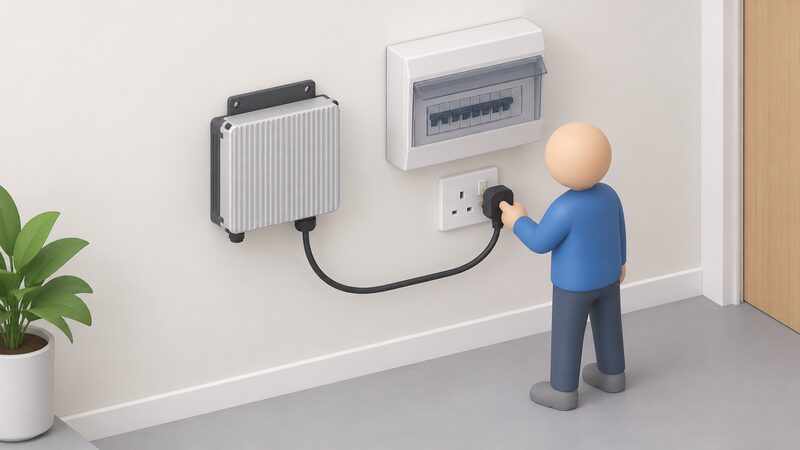
The limits are structural, not incidental. A plug-in kit is capped at around 800W, and UK-compliant devices are limited to a maximum output of around 800W9. Only one kit is allowed per home6. The device must be plugged directly into a permanent wall-socket circuit, and extension cables are not permitted6. It must be connected to socket circuits only, not to circuits supplying lighting or other fixed equipment, and only by the manufacturer-supplied plug12.
Battery storage is not covered. Under the current regulations, plug-in solar panels with integrated battery storage are not covered, and the interim specification states the device is not intended to be connected to, operated with, or used in conjunction with a battery energy storage system9. A household wanting storage is looking at a permanently wired system installed by a qualified electrician6.
Orientation matters as much as it does for a roof array. Independent guidance does not recommend installing plug-in solar panels facing north, as there is not enough sunlight hitting the panels9. Plug-in panels are also designed to switch off if there is a power cut, so they provide no backup supply9.
Safety bodies have raised a specific concern. Electrical Safety First reports that plug-in solar panels feed electricity into a property's wiring in a way it was not originally designed to accommodate, and may render some lifesaving protective devices, such as RCDs, less effective20. The government's own electrical safety study recommended product requirements, consumer guidance, and a simplified registration approach to support safe and proportionate rollout21.
"plug-in solar panels feed electricity into a property's wiring in a way it was not originally designed to accommodate"
A rooftop array avoids most of these constraints: it is sized to the property, can be oriented and tilted for the best yield, can be paired with a battery, and can be designed to keep selected circuits running during an outage. Ground-mounted systems with a solar tracker were reported as 10% to 45% more efficient than a rooftop solar system, which shows how much siting and mounting can move output7.
Availability in the UK: retailers, suppliers and compliant kits

Plug-in solar panels have been available to buy in the UK since 27 August 2026, online and on the high street19. The government confirmed that from 27 August the easy-to-install panels could be plugged into homes across the country, and that major retailers such as Currys, B&Q, Screwfix and Amazon had worked with government on the rollout5. Retailers including Amazon, Argos, Curry's and Wickes have all committed to stocking plug-in solar panels5. Independent guidance expected kits at Lidl, Amazon, B&Q, Currys and Screwfix, and reported that plug-in solar batteries are already being developed for the UK market18. Earlier reporting suggested panels could be available within months at retailers such as Lidl and Sainsbury's22.
UKSOL plug-in solar kits are available online at Argos, with hybrid mount kits coming soon6. The UKSOL Plug-In Solar Pro range is described as an all-in-one consumer package bringing together the solar generation equipment and associated components, designed to give households small-scale solar generation without a traditional rooftop installation17. The Hybrid Mount range, with wall or ground mounting and four power options from 515W to 1260W, is listed as coming on 1 October 20266.
Compliance is the gate. Only plug-in solar devices that are compliant with the interim product specification will be able to be sold in the UK and plugged in under the PSSR amendment, and all plug-in solar equipment supplied for use in the UK would be required to comply with the specifications set out in that document23. The type test register listed more than 50 compliant plug-in solar kits as of 16 September 20266.
| Route to market | Examples | Status |
|---|---|---|
| High street and online retail | Currys, B&Q, Screwfix, Amazon, Argos, Wickes | Committed to stocking5 |
| Online marketplace | Argos (UKSOL kits) | Available6 |
| Energy supplier | Octopus Energy | Kit offered from £4506 |
| Direct from maker | UKSOL, PatioSun, InstaGen | Listed with prices6 |
Rules, certification and official guidance
The regulatory framework has three layers: product specification, network registration, and planning.
On product, the Plug-in Solar Device Interim Product Specification is at Version 2.0, dated July 20262. Devices must be classified to BS EN 61140 as Class I or Class II equipment, and components intended for use internal to a property must have ingress protection better than IP442. The inverter must fulfil BS EN IEC 62109-1, BS EN IEC 62109-2, BS EN IEC 62109-3 where the PV module and inverter are supplied as a mechanical unit, and BS EN 6211612. Instructions and references must be provided in English2. Devices must comply with Engineering Recommendation G98 Issue 2 Amendment 1 for connection and parallel operation with low-voltage distribution networks in Great Britain12.
On registration, manufacturers must register devices on the ENA Type Test Register, the ENA Direct Connect platform, and obtain confirmation that the device has been assessed and identified as compliant before placing them on the market2. Households are legally required to register any plug-in solar panel devices before use in the UK19. Registering the system with the manufacturer activates any warranty and allows contact about a problem or safety recall14. Compliance with the interim specification is also relevant under the Electricity Safety, Quality and Continuity Regulations in determining whether a device may be connected to and used on the consumer's electrical connection24.
On planning, the position is permissive but conditional. Installing solar panels will generally not need planning permission25. Plug-in solar is subject to the limitations and conditions in Classes A and B, and any part of the solar equipment should not be installed on a wooden fence, gate, wall or other means of enclosure11. Where a stand-alone ground-mounted solar installation already exists within the curtilage, permission is needed3. Permitted development rights for roof and wall-mounted panels apply to houses, and flat residents should contact their local planning authority for guidance27. In Wales, the same general principle applies through the Welsh planning guidance25.
Which option fits which household
The two routes suit different homes, and the deciding factors are tenure, space, budget and ambition.
Independent guidance recommends plug-in solar for renters, people in smaller homes such as flats, and those unable to afford full roof system installation costs28. Renters and flat owners need permission from their landlord or freeholder before installing, and there is no clear government guidance for tenants, so double-checking with a landlord is sensible9. Under the Renters' Rights Act 2025, landlords cannot unreasonably refuse permission18. Plug-in solar panels are considered permitted development for flats, subject to restrictions, and landlord or freeholder permission is needed to fix panels to the outside of the building6.
A household with an owned house, a suitable roof and the budget for a 3.5 kW system is in the territory of a full installation, where MCS certified contractors work to MIS3002 and competent person self-certification can cover the building regulations side4. A household that rents, lives in a flat, has a shaded or north-facing roof, or wants to test solar before committing to a roof array is in the territory of a plug-in kit.
For energy independence, the distinction is honest. A plug-in kit reduces the electricity drawn from a supplier by up to 20% of an average home's use, but it does not remove dependence on the grid: it switches off in a power cut, cannot be paired with a battery under current rules, and is capped at 800W5. A rooftop array with a battery can carry a larger share of the load and, with the right design, keep selected circuits running. Neither route removes the connection to a supplier or the network; both reduce the volume of imported electricity.

Sources28 cited
- The Town and Country Planning (General Permitted Development) (England) Order 2015, Schedule 2, Part 14, legislation.gov.uk
- Plug-in Solar Device Interim Product Specification, Version 2.0, DESNZ, 2026-07
- Planning permission: stand-alone solar equipment, Planning Portal, 2026-09-17
- Barcud Solar Panel Installation Scheme Specification, Sell2Wales, 2026-06-15
- Households can save as plug-in solar panels come to market, GOV.UK, 2026-08-27
- Plug-in solar panels, Which?, 2026-09-15
- POSTnote 771: Solar photovoltaics, Parliamentary Office of Science and Technology, 2026-06-25
- Plug-in solar, Centre for Sustainable Energy, 2026-09
- Plug-in solar panels, Energy Saving Trust, 2026-09-17
- The Town and Country Planning (General Permitted Development) (England) (Amendment) Order 2026, legislation.gov.uk
- Solar panels and planning permission, Cornwall Council, 2026-09-17
- Plug-in Solar Device Interim Product Specification (withdrawn), DESNZ, 2026-06
- Feed-in Tariffs Annual Report, Scheme Year 13, Ofgem, 2023-12
- Plug-in solar consumer guide, Electrical Safety First, 2026-08
- Plug-in solar panels: five top tips to save money and stay safe, Association for Renewable Energy and Clean Technology, 2026-08-04
- Solar electricity (photovoltaics), Planning Portal, 2026-09-17
- UKSOL Plug-In Solar Pro first to reach key UK compliance ahead of consumer launch, Solar Energy UK, 2026-08-20
- Plug-in solar explained, Low Carbon Hub, 2026-07-09
- Plug-in solar, Electricity North West, 2026-09-20
- More clarity needed to address potential plug-in solar panel safety concerns, report warns, Electrical Safety First, 2026-09-17
- Plug-in solar electrical safety study, DESNZ, 2026-06-16
- How plug-in solar can save UK homes £1,100 on energy bills, Carbon Brief, 2026-04-02
- Plug-in solar consultation document, DESNZ, 2026-06-16
- Plug-in solar consultation, DESNZ, 2026-06-16
- Planning permission: solar panels, Welsh Government, 2026-09-17
- Plug and play: 7 million want plug-in balcony solar as law changes on 27 August, Uswitch, 2026-08-18
- Britain continues to break clean power records, GOV.UK, 2026-05-28
- Plug-in solar panels guide, Uswitch, 2026-09-04
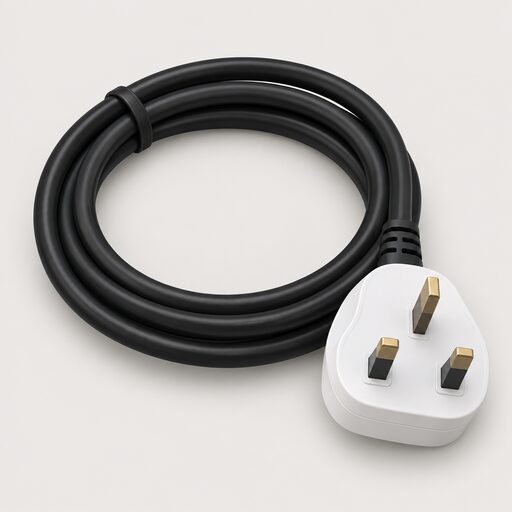 Plug-In Solar KitsCan you really plug solar panels into a normal wall socket in the UK, and is it legal now?
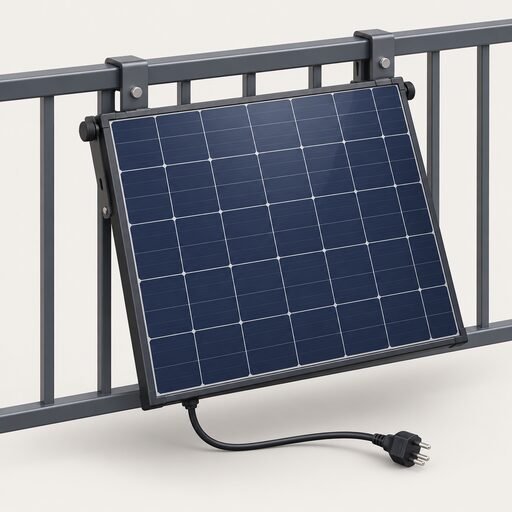 Balcony Solar SystemsCan you really plug solar panels into a normal socket, and what will it save you?
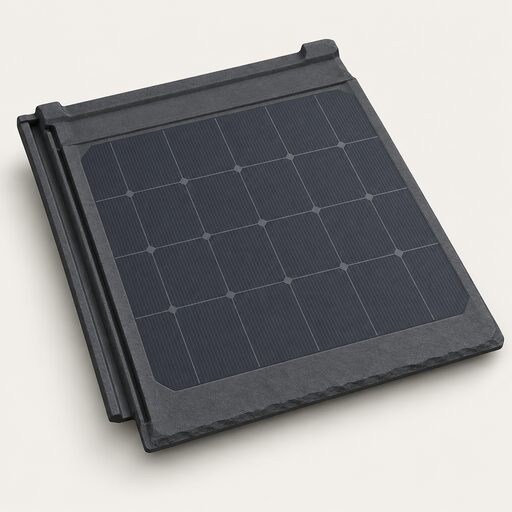 Roof-Integrated SolarSolar tiles replace your roof covering instead of sitting on top of it, so the finished roof looks like a roof.
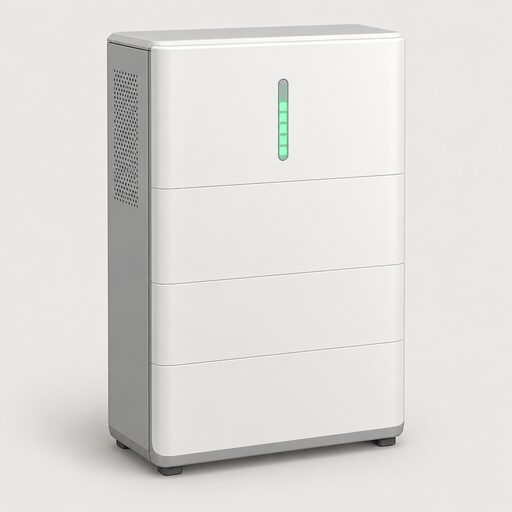 AC-Coupled vs DC-CoupledCan you add a battery to your existing solar panels without swapping the inverter, and does one kind waste more of your solar power than the other?
 Panels by Home TypeCan your house have solar panels, and how many will fit?
 Solar Panel CostsA typical UK home pays somewhere between four and eleven thousand pounds for solar panels fitted, with most landing in the middle.