
In this answer
Short answer
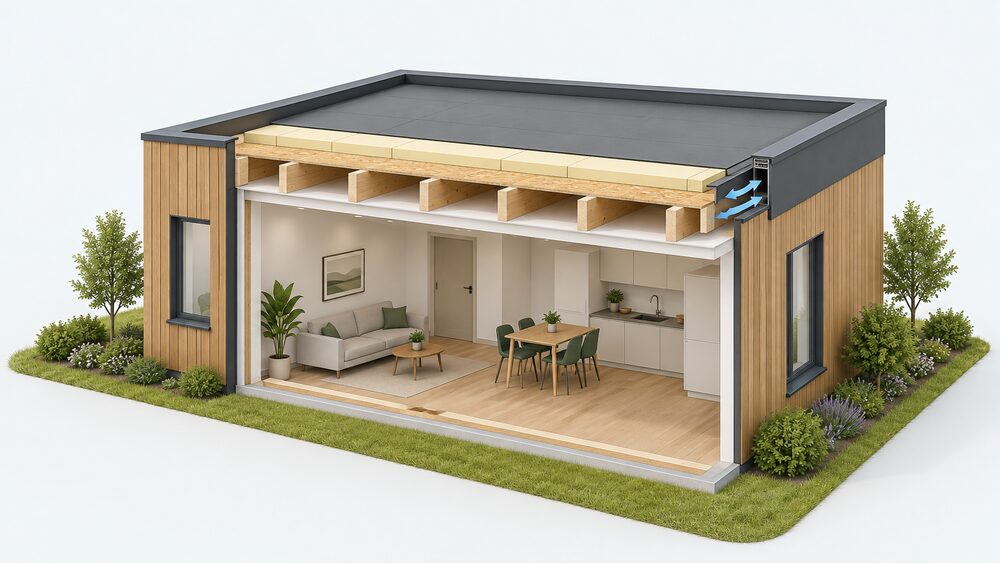
Flat roof insulation needs a professional installer. Independent guidance is direct on the point: if you have a flat roof, it "also needs to be insulated by a professional, as the process is more complicated"1. The complication is not the material, it is the build-up. A flat roof has to be ventilated, the insulation has to sit in the right layer of the roof, and the work usually touches what the building regulations call a thermal element, which brings approval into scope2.
That places flat roof insulation in a different category from cold loft insulation, where rolls can be laid on the loft floor by a householder. It sits closer to warm loft insulation, which independent guidance says generally needs a professional installer because doing it wrong can cause damp and condensation1. The same failure mode applies to flat roofs, and it is harder to see and harder to reverse.
For a household, the practical consequence is that flat roof insulation is a contracted job with a guarantee attached, not a weekend task. It improves the thermal performance of a part of the home that is otherwise a large, cold, uninsulated plane, but it does not remove dependence on the grid or a supplier: it reduces the heat the home loses, and the household still buys its energy.
Why a flat roof is harder to insulate than a pitched one
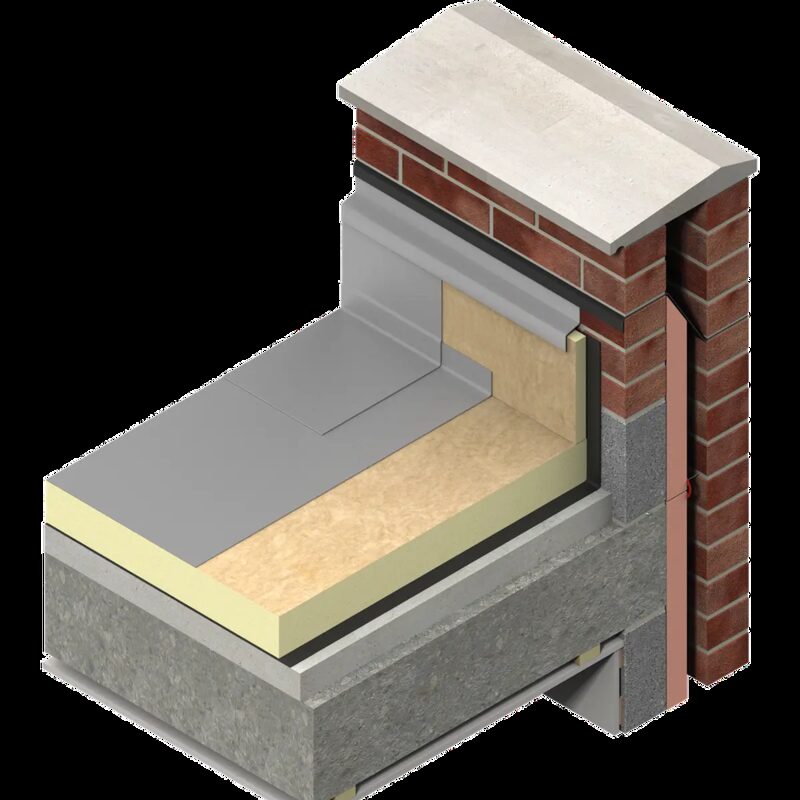
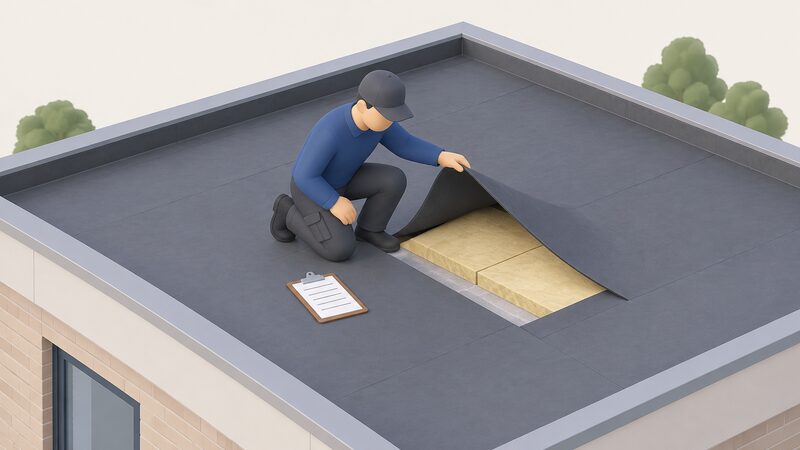
A pitched roof gives an installer a loft, a void and a slope to work in. A flat roof gives a sealed build-up with the insulation, the deck, the membrane and the ceiling all stacked in a thin sandwich. Where the insulation goes in that sandwich determines whether the roof works.
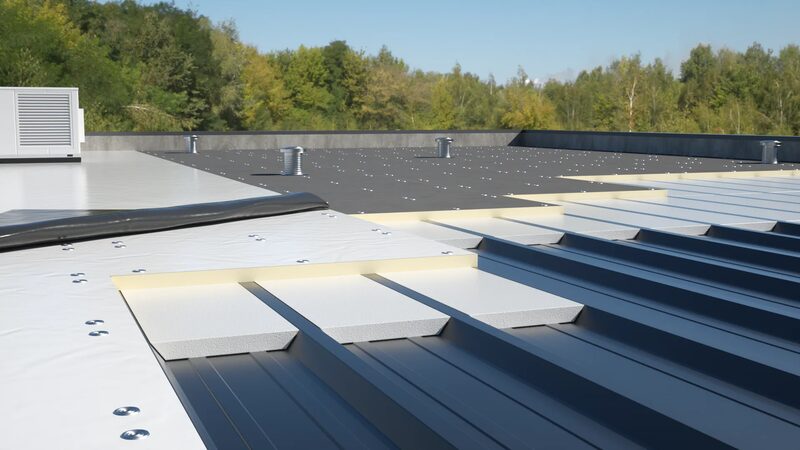
Official guidance for re-covering a flat roof sets out the warm deck option: the insulation can be installed on top of the joists, making a warm deck roof, with a note to check with manufacturers for details2. The thickness of that insulation will vary depending on the manufacturer's specifications7. In a warm roof system more generally, the insulation is placed above the joists or rafters8. Independent guidance describes the inverted alternative, where insulation goes above the weather membrane, protecting it from heat and cold that can shorten its life and that of the roof deck9.
Those are three different physical arrangements, and each has consequences for ventilation, dew point and the life of the structure. Ventilation pathways are a known difficulty even on pitched roofs, particularly around dormers and rooflights10. On a flat roof there is no loft void to absorb a mistake.
Flat roofs do have genuine advantages, including cost, ease of installation and low maintenance requirements, plus the opportunity to incorporate roof terraces, car parking and green roofs11. Those advantages are about the roof as a surface. They do not make the insulation layer simpler, and a green roof or terrace above the insulation adds load and access considerations that a householder cannot assess alone.
What goes wrong when flat roof insulation is done badly
The dominant risk is moisture. Insulation boards can cause damp and condensation if installed incorrectly, and DIY installation of sheet insulation is not recommended1. That is the same failure that makes warm loft insulation a professional job: the insulation is in the plane of the roof, so any error in the build-up traps moisture in the timbers rather than letting it dry.
The precondition is always to deal with water first. Where a loft has damp issues, a professional should sort them out before any insulation goes in13. The same logic applies to walls, where cracks letting water into a cavity must be fixed before insulation is added, because trapping moisture inside creates problems14. A flat roof is more exposed to that sequence than either, because the waterproof layer is directly above the insulation.
There is also a regulatory dimension. Installing insulation to a loft area requires an application for approval under the Building Regulations15. Where a flat roof with integral insulation is to be replaced, the householder may be required to upgrade that thermal element of the structure and reduce the amount of heat originally lost, by upgrading the insulation3. That is a requirement triggered by the roof work itself, not a voluntary improvement, and it is one reason the job runs through a contractor who understands the rules.
Flat roof insulation compared with warm loft insulation
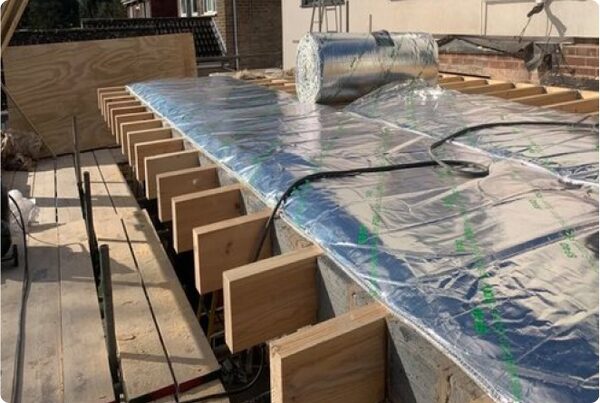
The two measures share a logic and a risk profile. Warm loft insulation is installed directly under the roof slope, between and across the timber rafters1, or put another way, directly under the roof in the plane of the roof's pitch9. Flat roof insulation does the same job on a horizontal plane, sitting above the joists in a warm deck arrangement2.
Both differ from cold loft insulation, which acts as a blanket trapping heat rising from the house below17. Cold loft insulation is the measure a householder can lay personally, and official guidance describes loft insulation as simple and effective, something you can even do yourself15. Warm loft insulation is not in that category: it is not as easy as laying rolls, and professional installation is recommended, though it can still be done as a DIY job by someone with the skills9.
There is a trade-off specific to warm loft insulation that flat roof insulation avoids. Because the insulation follows the roof line, the home's central heating system ends up heating a larger volume of air within the home, so higher heating bills can be expected than with cold loft insulation12. A flat roof has no such penalty, because the ceiling line does not move.
| Measure | Where insulation goes | DIY realistic? | Key risk |
|---|---|---|---|
| Cold loft insulation | Loft floor, as a blanket over the ceiling | Yes, official guidance says you can do it yourself15 | Damp in the loft must be fixed first13 |
| Warm loft insulation | Under the roof slope, between and across rafters1 | Generally needs a professional1 | Damp and condensation if done wrong1 |
| Flat roof, warm deck | Above the joists, under the covering2 | No, professional required1 | Ventilation and build-up errors2 |
| Flat roof, inverted | Above the weather membrane9 | No, professional required1 | Membrane and deck protection detail9 |
Finding and checking a flat roof insulation installer
The clearest published requirement comes from the Home Energy Scotland Grant and Loan: for external wall, internal wall, flat roof, room-in-roof or floor insulation, the chosen contractor must be TrustMark registered4. That is a scheme condition rather than a general legal rule, but it is the most specific standard attached to flat roof insulation in the UK.
TrustMark is described in official scheme guidance as a competent person register, useful for finding an installer who will assess your circumstances and property to identify suitable measures18. Independent guidance goes further and recommends considering only TrustMark approved contractors who are also members of an insulation accreditation body, such as the Installation Assurance Authority19. For wall insulation, the same independent source advises finding a registered and insured insulation expert and asking for a 25-year guarantee5.
Building regulations guidance for related roof work refers to suitably qualified installers, and for re-roofing suggests using an installer registered with the relevant competent person scheme for replacement of roof coverings on pitched and flat roofs3. That is a recommendation rather than a mandate, but it points to the same registers.
"If installing external wall, internal wall, flat roof, room-in-roof or floor insulation then your chosen contractor must be TrustMark registered."
A household checking a quote can work through a short list: registration on TrustMark, membership of an insulation accreditation body, insurance, and a written guarantee term. Where a grant is involved, the scheme's own rules override anything else, and the installer has to meet them for the funding to be paid.
Cost, funding and what the job involves
There is no published price for flat roof insulation. Prices are installer-quoted, and the figures that exist in UK guidance cover other measures. Professionally installed loft insulation using traditional materials such as mineral fibre runs between £600 and £1,100 depending on the size of the property6. A separate professional loft range is given as £650 to £1,20021. For scale at the other end, solid wall insulation is quoted at £8,000 to £12,500 professionally21. None of these is a flat roof figure, and none should be read as one.
VAT treatment depends on the split between materials and labour. Where an installer charges £1,000 excluding VAT, made up of £400 materials and £600 labour, the materials are 40 per cent of the total, so the installer can charge reduced 5 per cent VAT on the total installation cost22. That example is given for Northern Ireland, and the condition is that insulation materials are 60 per cent or less of the total cost22.
On funding, the Energy Company Obligation funds insulation including loft, roofs and walls23. Government and energy companies currently have a number of grants available for either free insulation or a contribution towards the costs12. In Northern Ireland, the Affordable Warmth Scheme requires that where grant aid is awarded for cavity wall or solid wall insulation, the installer must be able to provide a minimum 25-year guarantee for the work24. Scheme rules, eligibility and the measures covered differ across England, Scotland, Wales and Northern Ireland, and the terms in force at the time of application govern the award.
On duration, no verified figure exists for flat roof insulation. Cavity wall insulation is described as a fairly simple process taking just a couple of hours for a typical three-bedroom house25, which gives a sense of how much longer a job involving the roof covering is likely to be, but it is not a flat roof figure.
What flat roof insulation does for energy independence
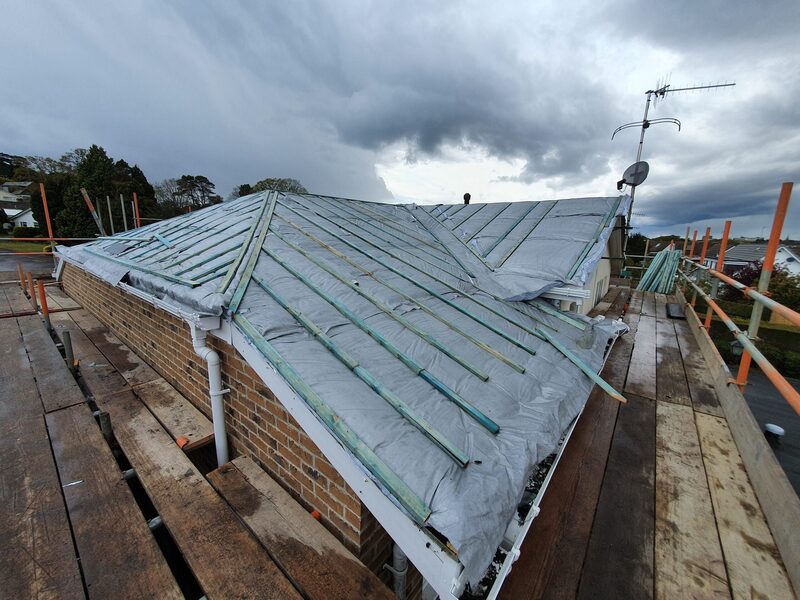
Insulating a flat roof reduces the heat a home loses through that surface, which lowers the demand the household places on whatever supplies its heating. That is the whole of the benefit, and it is a real one: less heat lost means less energy bought.
What it does not do is remove dependence. The household still draws from the grid, still buys from a supplier, and still relies on gas or electricity delivered from outside. The insulation changes the size of the bill, not the source of the supply. It also introduces a new dependence of its own: on the contractor who installed it, on the guarantee that contractor provides, and on the accreditation body standing behind that guarantee. Where a grant is involved, the scheme's rules on who may install and what guarantee they must give become part of the household's protection4.
The measure also interacts with the rest of the home's fabric. A flat roof is one thermal element among several, and the building regulations treat it as such when it is replaced3. Households planning a wider retrofit will find the sequencing matters, and the pages on roof insulation and finding an insulation installer set out the surrounding decisions. For the flat roof itself, the answer stays the same: it is a professional job, and the paperwork and guarantee matter as much as the boards.
Sources25 cited
- Installing blanket insulation, Which?, 2026-05-26
- Building regulations: re-roofing, Welsh Government, 2026-09-17
- Building regulations: re-roofing, Planning Portal, 2026-09-17
- Home Energy Scotland Grant and Loan terms and conditions, Home Energy Scotland, 2026-09-17
- Wall insulation types, Uswitch, 2026-09-04
- Spray foam insulation, Which?, 2026-05-26
- Building regulations: thermal resistance and insulation, Welsh Government, 2026-09-17
- Constructing a new roof, eg extension, Welsh Government, 2026-09-17
- Roof insulation, Which?, 2026-05-05
- Guide to conversion of traditional buildings, Scottish Government, 2026-08-10
- Flat roof insulation, MIMA, 2026-09-20
- How to buy loft insulation, Which?, 2026-05-26
- Insulation and energy saving: what is insulation, Smart Energy GB, 2026-03-16
- Five things I wouldn't do as an insulation expert, Which?, 2025-10-28
- Loft insulation, Planning Portal, 2026
- Building regulations: energy efficiency, Welsh Government, 2026-09-17
- Loft insulation, Centre for Sustainable Energy, 2026
- ECO scheme home energy efficiency, Leeds City Council, 2026-09-20
- Park homes advice, Centre for Sustainable Energy, 2026-07
- Building regulations: flue, chimney or soil and vent pipe, Welsh Government, 2026-09-17
- DIY vs professional home insulation, Uswitch, 2025-11-07
- VAT on energy-saving materials, HM Revenue and Customs, 2026-09-20
- ECO4 Flex open, South Cambridgeshire District Council, 2026-09-17
- Affordable Warmth Scheme, Northern Ireland Housing Executive, 2026-09-17
- Cavity wall insulation, nidirect, 2026-09-02
 DIY or ProfessionalLoft insulation and draught-proofing are jobs most people can tackle, but anything electrical near a kitchen, bathroom or outdoors needs a registered electrician.
 Building Regs Part L InsulationAdding insulation or replacing windows?
 High-Rise Flats and SafetyWho signs off new insulation, cladding or heating in a high-rise flat?
 Building Safety RegulatorWho signs off safety and building work in a tall block of flats?
 Finding an Insulation InstallerHow to find, verify and check an insulation, glazing or ventilation installer in the UK: the registration schemes, trade bodies and guarantee arrangements that cover the work, how to compare quotes, what a written specification should state, and how complaints and disputes are handled.
 Loft InsulationHow much loft insulation do you need, and is your current depth enough?