

In this answer
Short answer
Loft insulation in a rented home is possible, but it is the landlord's decision, not the tenant's. The insulation is fixed to the building, so it becomes part of the landlord's asset and stays with the property when the tenancy ends. That single fact shapes everything else: who approves the work, who pays for it, and who benefits from it.
The practical answer is that a tenant needs the landlord's written consent before any work starts, and Building Regulations approval is required for installing insulation to a loft area1. The landlord, as owner, is the party who applies for that approval. Where a grant is involved, the landlord usually has to agree to the improvements as well3.
The case for doing it is straightforward. Without loft insulation, as much as a third of heating costs can be lost through the roof, and the recommended depth is 270 mm4. Loft insulation could reduce energy bills by up to £340 per year, depending on the home6. None of that changes the permission question, but it explains why the conversation is worth having.
Who pays for and who approves loft insulation in a rented home
The landlord owns the building, so the landlord approves the work and normally carries the cost. Where a grant covers the measure, the funding is attached to the property and the landlord still has to consent. Many energy efficiency schemes offer support for renters as long as the landlord agrees to the improvements3.
Cost data for loft insulation is published as average figures for a terraced, semi-detached and detached house, fitted by a professional6. Those are the figures a landlord would be quoted, and they are installer-quoted rather than fixed. Where a scheme funds the work, the household may pay nothing at all.
Approval runs on two tracks. Building Regulations approval is required for installing insulation to a loft area, and the installation must meet the minimum energy efficiency values set out in the Approved Documents2. Separately, the tenancy agreement governs whether the tenant may make changes at all. For leasehold properties, the lease may require permission from the freehold owner or the building's management company before work starts5.
In Northern Ireland, official guidance for landlords of properties rented to tenants is more specific than elsewhere: the landlord should make sure roof spaces are insulated, replace draughty, ill fitting windows and doors, draught proof external doors and windows (but not rooms containing an open-flue gas appliance), insulate exposed water pipes, and fit the hot water tank with a good quality insulation jacket1. That is a landlord duty, not a tenant option.
Landlord consent: what to ask for before any work starts
Consent should be in writing and should cover the measure, the installer, access arrangements and who is responsible for any subsequent repair. For a multi-occupied building, the building owner's consent is needed before any work can start12. In a block of flats, that may mean the freeholder as well as the immediate landlord.
Two conditions commonly catch households out. The first is the pre-existing loft declaration: the installer, operative or assessor, and either the occupier or landlord, must sign a declaration regarding the presence of loft insulation in the property10. If insulation is already there, the declaration records it, and that affects what can be claimed.
The second is ventilation. Building regulations need adequate ventilation when installing loft insulation, and the local building control office should be consulted13. Insulating a loft without dealing with ventilation risks condensation, and that risk sits with the landlord as owner.
Your rights as a tenant: what you can and cannot change yourself

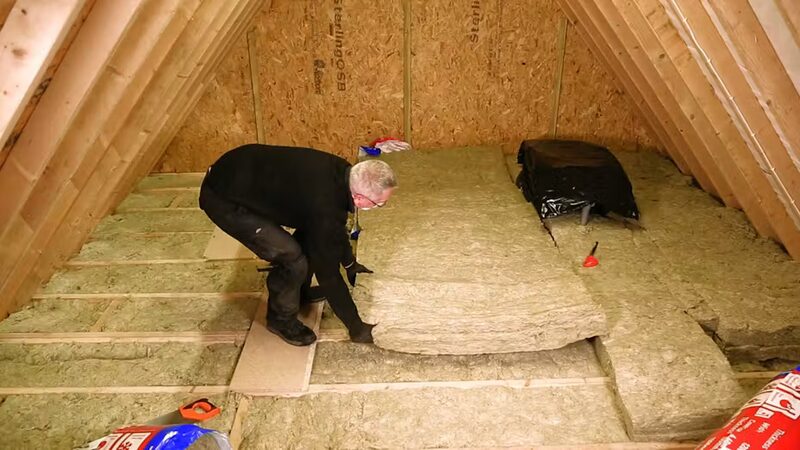
If you rent your home, it is likely you will need permission from your landlord to make changes to your home17. Loft insulation is a change to the building, so it falls on the permission side of that line. Cold loft insulation is technically simple enough that it can be done yourself, and official guidance notes that insulating a loft is a simple and effective way to reduce heating bills and can be done yourself2. That does not remove the consent requirement.
Warm loft insulation, laid at rafter level to bring the roof into the thermal envelope, is a different job. It is not as easy to install as cold loft insulation, and a professional installer is generally needed because doing it wrong can cause damp and condensation7. It also raises heating bills relative to cold loft insulation, because the central heating system is heating a larger volume of air within the home18. That is a trade-off a landlord should understand before agreeing.
A rented home has to be fit for habitation, and it is the landlord's responsibility to ensure this19. In England, the landlord must make sure plumbing and heating work properly20. Those duties sit alongside the permission question: a tenant cannot install insulation unilaterally, but a landlord cannot leave a property in a condition that fails the fitness standard.
Where the property is on a landlord's business energy contract, residents may not have the right to choose their own energy supplier or switch suppliers themselves21. That limits what a tenant can do about the tariff side of the bill, which makes the fabric side more important.
Grants and schemes tenants may qualify for
Grant availability for tenants varies by nation and by scheme. Many schemes offer support for renters as long as the landlord agrees to the improvements3. Eligibility commonly turns on the home's current EPC rating being low, at least a C or below, or the household being classed as in a low income group, dependent on factors including where you live3.
| Scheme | Tenant position | Measure |
|---|---|---|
| Bright Green Homes | Open to homeowners and those in private rented accommodation22 | Energy efficiency improvements |
| Nest (Wales) | Must own or privately rent the home, not local authority or housing association23 | Free home energy efficiency improvements |
| Warm Homes Local Grant | Landlord cannot raise rent because of upgrades24 | Flat roof, loft, solid or underfloor insulation13 |
| Home Upgrade Grant | Funded by local councils25 | Loft insulation, air source heat pumps, electric radiators25 |
| Northern Ireland support | Households may qualify for financial support towards loft and cavity wall insulation26 | Loft and cavity wall insulation |
The Warm Healthy Homes Fund consultation proposes that Private Rented Sector landlords may access fully funded cavity and loft insulation, draught proofing, and ventilation where the tenant meets eligibility criteria27. That is a proposal, not an operating scheme.
How insulation affects rent, EPC rating and energy bills

Installing loft and cavity wall insulation lowers the amount of heat escaping and could cut fuel bills28. Loft insulation could reduce energy bills by up to £340 per year, depending on the home, and professionally installed loft insulation will typically take a couple of years to pay for itself through the savings6.
On the EPC, installing insulation in walls and/or loft is one of the common measures that improves a rating29. Insulation upgrades can raise a rating by up to two bands, from an E to a C, for example30. That matters for landlords because the minimum energy efficiency standard for privately rented homes is set by reference to the EPC band.
Rent is the point where tenant and landlord interests can diverge. Under the Warm Homes Local Grant, a landlord cannot raise rent because of upgrades24. That condition attaches to that scheme; it is not a general rule across all grants.
The minimum standard itself works through exemptions rather than a blanket requirement. Exemption categories include where all relevant improvements have been made but the property remains below band E, where the cost of relevant improvements exceeds the spending cap, where no improvements are possible, where expert written advice says wall insulation would harm the fabric or structure, where third-party consent is required after reasonable attempts, where a RICS registered valuer reports that improvements would reduce market value by more than 5%, where the property was already let when the landlord purchased an interest, and sudden landlord circumstances such as insolvency of a tenant where the landlord was guarantor31.
A recommended measure is only a relevant energy efficiency improvement where third-party funding covers the full cost, or the cost is £3,500 or less inclusive of VAT, or a combination of landlord self-funding and third-party funding totals £3,500 or less inclusive of VAT31. That cap is what determines whether a landlord can be required to act or can register an exemption instead.
Where the landlord purchased an interest in a property that was already let on an existing tenancy, the exemption lasts for six months. After 6 months the exemption expires and the landlord must either have improved the energy efficiency of the property to at least EPC band E, or have registered another valid exemption if one applies, if they intend to continue letting31.
If you move out: what happens to the insulation
The insulation stays. It is part of the building, and a tenant who funded it cannot remove it at the end of the tenancy. That is the clearest reason to secure the landlord's agreement in writing before work starts, and to be clear about who is paying.
Cold loft insulation stops heat escaping from the living area of the home but leaves the loft space uninsulated7. That has a practical consequence for anyone who uses the loft for storage: the space itself can get very cold in winter and hot in summer7. If the loft has been converted into living space, the roof itself has to be insulated instead6.
Where a landlord has paid for the work, the landlord is covered by the contractor's guarantee and is responsible for repairing any faulty upgrades32. That is the arrangement under the Warm Homes Social Housing Fund, and it illustrates the general principle: the guarantee follows the person who commissioned the work, which in a rented home is normally the landlord.
For a tenant, the lasting benefit is a warmer, cheaper home for as long as the tenancy runs. The lasting benefit for the landlord is a permanent improvement to the asset, a better EPC rating, and a property that is easier to let. Both sides gain, which is why the written request is worth making even where the first answer is no.
Sources32 cited
- Checking your home is fit to live in, nidirect, 2026-09-17
- Loft insulation, Welsh Government, 2026-09-17
- Which energy efficiency grants are you eligible for?, Uswitch, 2025-11-03
- Loft insulation, Planning Portal, 2026
- Before you get building work done, Citizens Advice, 2026-09-20
- Loft insulation costs and savings, Which?, 2026-05-05
- Roof insulation, Which?, 2026-05-05
- Installing blanket insulation, Which?, 2026-05-26
- Building regulations extensions: energy efficiency, Welsh Government, 2026-09-17
- ECO4 delivery guidance version 4.0, Ofgem, 2026-03-26
- ECO4 delivery guidance v3.2, Ofgem, 2025-12-08
- LCTs in multi-occupied buildings, UK Power Networks, 2026-09-17
- Apply for a Warm Homes Local Grant, Liverpool City Council, 2026-09-17
- When consent is required, Buckinghamshire Council, 2026-09-17
- Making alterations to a listed building, Bristol City Council, 2026-09-17
- Householder planning consent, Planning Portal, 2026-09-17
- Help with energy efficiency measures, Turn2us, 2026-09-08
- Installing blanket insulation, Which?, 2026-05-26
- Draught proofing, Which?, 2026-05-05
- Make sure your home is energy efficient, Citizens Advice, 2026-09-19
- If you live in a home on a business energy contract, Ofgem, 2026
- Get a grant or loan to improve your home energy efficiency, Bristol City Council, 2026
- Nest eligibility, Welsh Government, 2026-09-17
- Warm Homes Local Grant 2025 to 2028, Birmingham City Council, 2026-09-20
- Home Upgrade Grant, Elmhurst Energy, 2026-09-20
- Loft and cavity wall insulation support, nidirect, 2026-09-02
- Warm Healthy Homes Fund consultation, Department for Communities, 2026-05
- Heating technologies to suit your home, nidirect, 2026-09-17
- EPCs explained, Elmhurst Energy, 2026-09-20
- House insulation: the ultimate guide, Federation of Master Builders, 2026-09-20
- Guidance on PRS exemptions and exemptions register evidence requirements, GOV.UK, 2026-05
- Warm Homes Social Housing Fund, Uswitch, 2025-09-12
 Insulation in Rented HousingWho pays for insulation when you rent, and who has to agree to it?
 Loft InsulationHow much loft insulation do you need, and is your current depth enough?
 Where to Start If You RentRenting means you can switch supplier or get a smart meter yourself, but insulation, glazing and heating need your landlord's agreement.
 Social and Rented Home StandardsWhat condition is your landlord legally required to keep your home in?
 Landlord Energy PermissionHow a tenant raises a request for insulation, heating, glazing or ventilation work in a rented home, what the EPC and the minimum band E rule mean, which grant schemes need landlord consent, and what happens when a landlord refuses.
 Planning for InsulationDo you need planning permission to add insulation, cladding or new windows?