
In this answer
Short answer
In many cases, yes: a landlord is responsible for rising damp in a rented home. The reason is a term implied into the tenancy agreement that makes it the landlord's job to keep the exterior and structure of the home in repair, and rising damp is a structural problem. Where there is a fault in an existing damp-proof course causing the damp, the landlord is likely to be responsible for repairing it1.
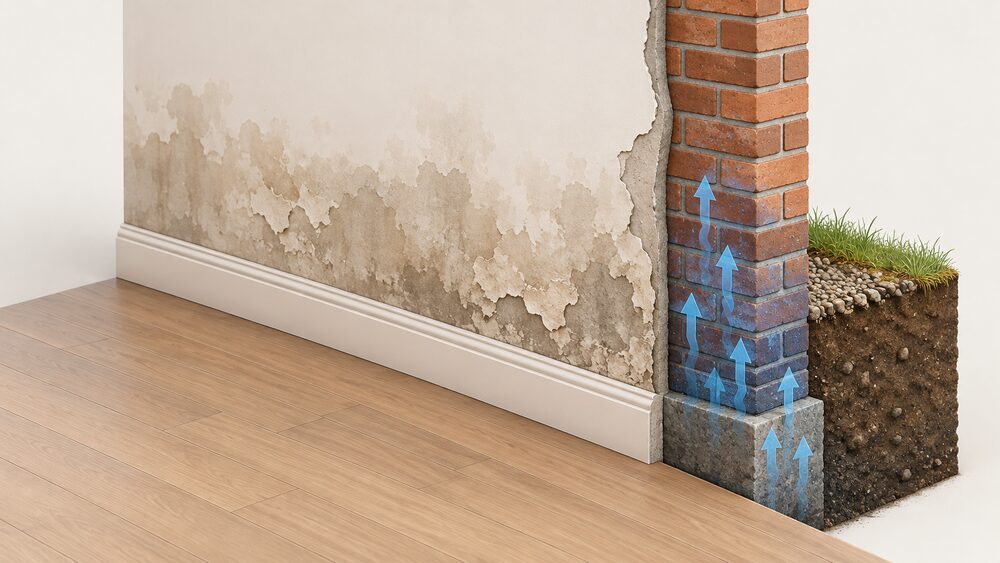
Rising damp is moisture travelling up from the ground through the masonry, generally affecting the lower part of the ground floor up to about one metre, and it is more common in older properties1. It is one of four damp problems a renter may meet, alongside penetrating damp, condensation damp and construction damp, and the responsibility rule differs for each.
The stakes are not cosmetic. Damp homes are linked to a 30 to 50% increase in respiratory problems, and 60% of UK adults believe landlords are primarily responsible for fixing mould in rented accommodation2. This page sets out who fixes what, when a landlord may not be liable, and what a tenant can do when repairs stall.
Rising, penetrating and condensation damp: who fixes what
The three common damp types have different causes, and that shapes who pays.
Rising damp happens when moisture travels up from the ground through the masonry to the height of about one metre1. Because it comes through the structure, the implied repairing term usually puts it on the landlord. The same logic applies to penetrating damp, which happens when water enters the fabric of a building from outside to inside, for example through a leaking downpipe1. The landlord must keep in repair the exterior and structure of the home as well as installations such as basins, sinks, baths, toilets and their pipework, so a leaking roof, cracked wall, leaking guttering or external pipe, leaking drainage pipe, or rotten window or door falls within that duty1. Penetrating damp is the second most likely cause of damp5.
Condensation damp is different. It generally happens when a property cannot deal with normal levels of water vapour because of a lack of insulation, ventilation or heating, or a combination of all three1. It is the most common cause of damp and mould6. Responsibility here is conditional rather than automatic, and is set out below.
Construction damp is caused by a problem with a property's design, for example a defect that lets a basement become damp when the water table rises1.
When the landlord is probably responsible for condensation
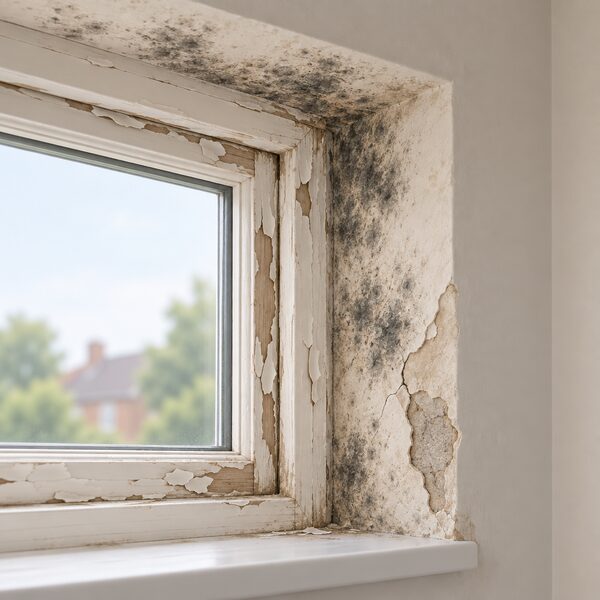
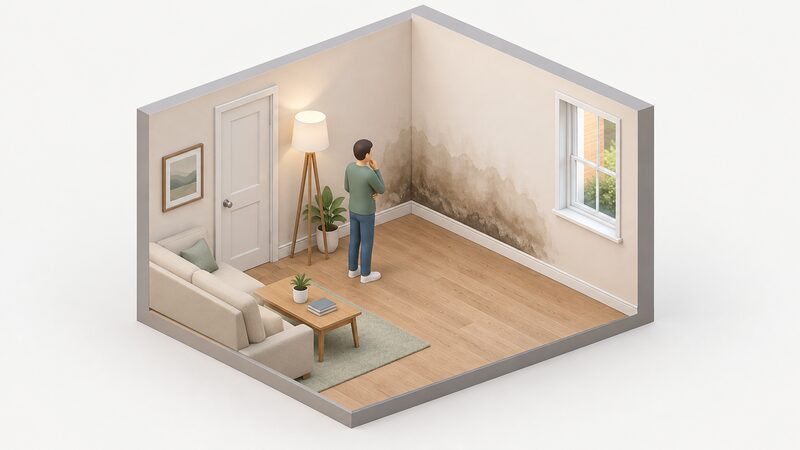
Condensation is the damp type most often disputed, because everyday moisture from cooking, bathing and drying clothes contributes to it. The condition of the building still decides the question in many cases.
A landlord will probably be responsible for dealing with condensation damp if the tenancy agreement says so or says they will keep the home fit to live in; if the damp was caused by the landlord not making certain repairs, such as to heating or ventilation; or if the damp has caused damage the landlord has to repair, such as rotting window frames or damaged plasterwork1.
That third route matters because it converts a condensation argument into a repairing argument. Once plaster or timber has been damaged, the landlord's repairing duty is engaged on the building itself.
For private renters, the wider test is safety: a landlord might be responsible for the damp if it means the home is not safe to live in, for example if it has made the tenant or their family ill1.
"If you live in a rented property and you have tried all the above, but the damp and condensation isn't going away, then contact your landlord"
The same advice is given for Northern Ireland, where tenants who have tried the practical steps and still have persistent damp and condensation are told to contact their landlord8.
When the landlord may not be responsible
Three situations weaken or remove the landlord's duty, and tenants should understand them before a dispute hardens.
No damp-proof course. If the home does not have a damp-proof course, the landlord may not be responsible for putting one in, because the work may be regarded as an improvement rather than a repair. That is considered on its own facts1.
A design problem that causes no damage. If a design problem does not affect the structure or exterior of the home and causes no damage to the building, the landlord may have no responsibility under the tenancy agreement to prevent the damp. Where a design problem does cause damage, for example to wall or ceiling plaster, the landlord is responsible for those repairs1.
Reasonable steps. Under the electrical safety regime, a landlord is not in breach of a duty if they can show they have taken all reasonable steps to comply9. The same principle of demonstrable effort runs through landlord duties generally.
There is also a boundary between landlord and tenant equipment. A landlord is responsible for any gas appliance they own and provide for the tenant's use, and where a tenant has their own gas appliance that the landlord did not provide, the landlord is responsible for parts of the associated installation and pipework but not for the appliance itself10. The householder or landlord is responsible not only for appliances such as a boiler or cooker but also the gas pipes running from the meter to them11.
What council and housing association tenants can rely on
Social tenants have a stronger position than private renters on damp, because the duty is framed around safety and health rather than the tenancy wording alone.
If a tenant rents from the council or a housing association, the landlord is responsible for the damp if it means the home is not safe to live in, or if it is an ongoing serious problem affecting physical or mental health1. A social landlord also has a duty to fix reported damp, mould and emergency repairs by law5.
Where a social landlord arranged an energy efficiency improvement, it is usually the landlord's responsibility to do repairs if the improvement either is not working properly or causes another problem in the home12.
If a social landlord will not act, tenants of a housing association or local council can make a complaint to the Housing Ombudsman Service12.
In Scotland, owners in mixed tenure blocks are liable for their share of common repair costs under the Tenement (Scotland) Act 2004, which matters where a social landlord owns only part of a block13.
Damp, fitness for habitation and the tenancy agreement

The tenancy agreement does not have to name damp for a landlord to be responsible. The implied repairing term does the work for structural damp, and separate fitness standards do it for the condition of the home as a whole.
In Northern Ireland, the fitness standard for private rented properties requires that a home be structurally stable; free from serious disrepair; free from dampness that could damage the occupant's health; have adequate provision for lighting, heating and ventilation; have adequate piped wholesome water; have satisfactory facilities for preparing and cooking food, including a sink with hot and cold water; have a suitably located water closet for the occupant's exclusive use; have a suitably located fixed bath or shower and wash-hand basin with hot and cold water; and have an effective system for draining foul, waste and surface water14.
In Wales, a landlord under an occupation contract is obliged to ensure a dwelling is both in repair and fit for human habitation15.
Energy performance interacts with damp risk. Renters living in homes with an EPC D to G are 73% more likely to experience damp and 89% more likely to experience excessive cold than renters in EPC A to C homes, according to a consultation response on draft Scottish private rented sector regulations4. Retrofit work is intended to ensure a dwelling is fitted with appropriate measures for energy efficiency and the risks associated with damp and ventilation16.
| Nation | Damp-related landlord duty | Source |
|---|---|---|
| England | Implied repairing term; council enforcement and fines | 1 |
| Wales | Occupation contract: in repair and fit for human habitation | 15 |
| Scotland | Repairing standard; EPC D to G renters 73% more likely to experience damp | 4 |
| Northern Ireland | Fitness standard includes freedom from dampness that could damage health | 14 |
What tenants can do next: reporting damp and getting repairs done
The single most important step is to report the problem in writing, because the duty usually attaches only once the landlord knows.
A landlord is usually only responsible for repairing the problem when they become aware of it, so tenants should report it straight away1. A practical first check is the building itself: look for a damaged damp course, rising damp, or roof and window leaks where water may enter the home7.
- Report the damp in writing and keep a copy of the message and any reply.
- Photograph the tide mark, damaged plaster, skirting or window frames, with dates.
- Ask for an inspection and note when it is offered or refused.
- If nothing happens, complain to the council, which can fine a landlord who will not make improvements17.
- Social tenants can escalate to the Housing Ombudsman Service12.
Tenants also have duties that keep the repair route open. In Northern Ireland, tenants must allow the landlord access to the property to carry out maintenance or safety checks on gas appliances or flues that the landlord provides18. Landlords should arrange for heating equipment to be regularly serviced19.
Where a landlord is arranging improvement work, tenants may be asked for permission. Under the Warm Homes: Local Grant scheme, landlords must obtain tenants' permission to carry out work, and the property must have an EPC rating of D or below; a landlord cannot raise rent because of upgrades20. Under the earlier Sustainable Warmth Competition, where a household was low-income and renting, the landlord had to contribute at least a third of the total cost of upgrading the property within the relevant cost caps22.
Where responsibility sits for the household's independence

Damp is a dependence problem as much as a repair problem. A tenant cannot commission structural work, cannot choose the contractor and cannot force a damp-proof course to be installed where the landlord can argue it is an improvement rather than a repair1. The household's comfort depends on a landlord's decision, and on a council's willingness to enforce.
What a tenant does control is the evidence trail and the practical management of condensation: ventilation, heating and reporting. What they do not control is the fabric of the building, and that is where rising and penetrating damp live. For a fuller picture of what renters can and cannot change, see Renting and Home Energy and Damp and Mould in Rented Homes. Landlords' wider obligations are set out in Landlord Duties on Energy, Heating and Home Safety, and the position in social housing in Energy in Social Housing.
Sources22 cited
- Repairs and damp, Citizens Advice, 2026-09-20
- Mouldy Nation report, Uswitch, 2026-02-23
- Warm Homes, Healthy Futures, National Energy Action, 2026
- Consultation on draft Energy Efficiency (Domestic Private Rented Property) (Scotland) Regulations, National Insulation Association, 2025-09-03
- Condensation, damp and mould, Centre for Sustainable Energy, 2025-12
- Retrofit, Act on Energy, 2026
- Four steps to mould-free homes, BESA, 2024-05-17
- Dealing with condensation and mould (Northern Ireland), National Energy Action, 2026-09-07
- Electrical Safety Standards in the Private Rented Sector (England) Regulations 2020, regulation 3, legislation.gov.uk, 2026-09-17
- Gas safety checks: what they involve, Health and Safety Executive, 2026
- Emergency engineer visit, Cadent Gas, 2026-09-20
- What your landlord can charge for energy, Citizens Advice, 2026-09-17
- High Rise Retrofit and Upgrade Programme Phase 1, City of Edinburgh Council, 2026-04-20
- Checking your home is fit to live in, nidirect, 2026-09-17
- Fitness for human habitation guidance for landlords, Welsh Government, 2022-01-13
- How home retrofit can transform energy efficiency in the UK, Stroma, 2024-04-08
- Make sure your home is energy efficient (Wales), Citizens Advice, 2026-09-17
- Domestic gas installation and health and safety, nidirect, 2025-10-28
- Guide to carbon monoxide safety, OFTEC, 2026-09-20
- Warm Homes: Local Grant 2025 to 2028, Birmingham City Council, 2026-09-20
- Warm Homes Local Grant scheme guide, Uswitch, 2026-01-05
- Apply for the Sustainable Warmth Competition, GOV.UK, 2021-06-16
 Damp and Mould in Rented HomesDamp or mould in your rented home is your landlord's problem to fix.
 Energy in Social HousingWhat must your landlord do if your home is cold, damp or mouldy?
 Rented Homes and Landlord MetersWho is responsible for the energy in your rented home?
 HMOs and Shared HousesWho is responsible for the electrics, the gas and the fire alarms when you rent a room in a shared house?
 Landlord Energy and SafetyWhat a landlord must provide and maintain across the four nations: working heating and hot water, an EPC before letting, alarms, gas and electrical safety, and fitness for habitation, with the points where Scottish, Welsh and Northern Irish duties differ from England.
 Controls in Rented HomesCan you change the heating controls in a rented home, and who pays if they break?