
In this answer
Short answer
Yes, existing loft insulation can be topped up without removing it. A new layer is laid over the old one, and the two layers together make up the total depth. The target depth is at least 270mm, and any loft with 100mm or less should be topped up1.
The saving from a top-up is modest because the loft is already partly insulated. Going from 120mm to at least 270mm saves around £17 a year in Great Britain and £20 a year in Northern Ireland3. That is a different figure from insulating a bare loft, where independent guidance puts the saving at around £155 a year, or up to £340 a year depending on the home4.
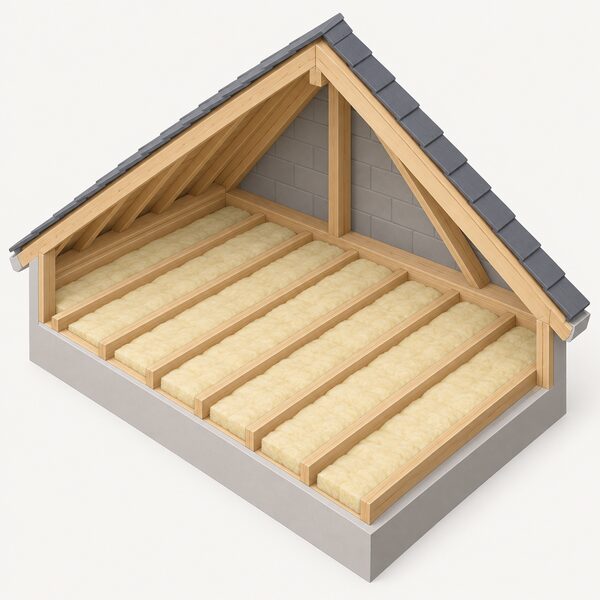
The work itself is straightforward where the loft is a cold one, meaning insulation sits at ceiling level between and over the joists. It is a do-it-yourself job in an accessible, dry loft that is not a flat roof1. Where insulation follows the roof line instead, a professional is generally needed.
How topping up works: laying a new layer over the old
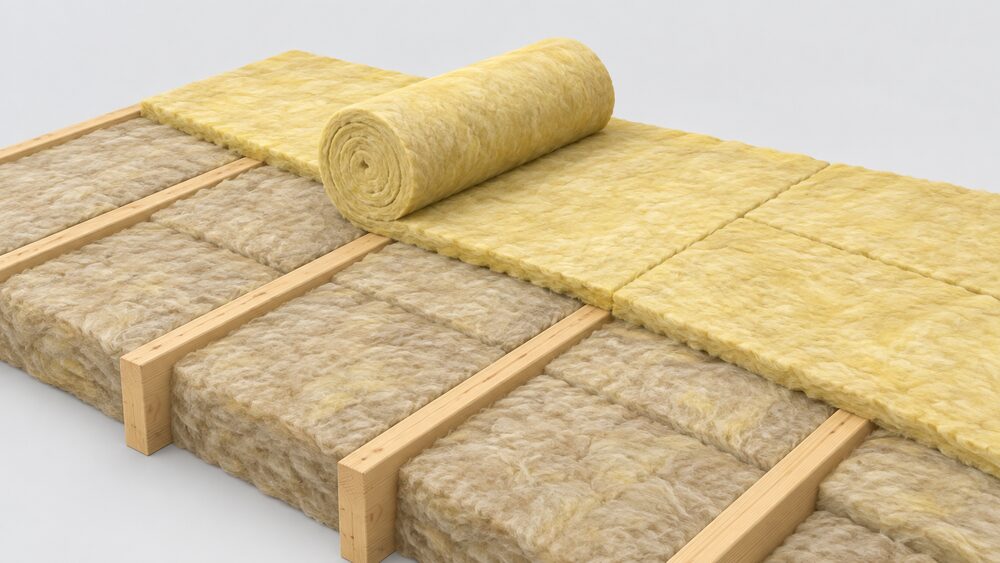
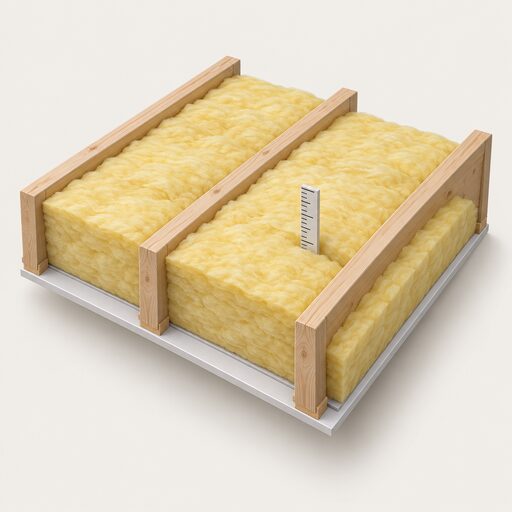
Loft insulation at ceiling level works as a blanket, trapping heat that rises from the rooms below4. Topping up thickens that blanket. The existing material is left in place and a new layer is added, either between the joists, on top of them, or both8.
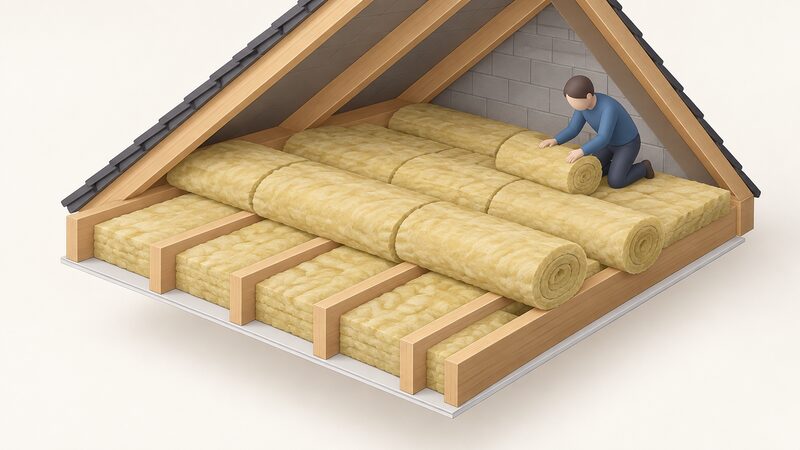
The one rule that matters most is orientation. New insulation must be laid perpendicular to the old, at right angles to it, so that the joints between rolls do not line up and no continuous gap is left through the full thickness6. Laid that way, the two layers overlap and the cold bridges at the joints are broken.
Depth is the measure of whether a top-up is needed. Any home with 4 inches, or 100mm, or less should have it topped up, and the finished loft should have at least 10 to 11 inches, or 270mm2. Northern Ireland's Affordable Warmth Scheme funds installation or topping up of loft insulation to 300mm, slightly deeper than the 270mm figure used in Great Britain9.
What has changed over time is the standard itself. Previous minimum depths have been increased and the recommended material has changed, so what was best practice a few years ago may now be below standard10. A loft insulated to the depth recommended in the 1990s or 2000s is a common candidate for a top-up.
Do you need to remove the old insulation first?
No. Topping up is defined by leaving the old layer in place. Removal is a separate question, and it arises only where the existing material is wet, damaged, contaminated or otherwise failing, which is an assessment rather than a routine part of a top-up.
Where a scheme funds the work, the presence of existing insulation is formally recorded. Under ECO4, the installer, operative or assessor, and either the occupier or landlord, must sign the pre-existing loft declaration regarding the presence of loft insulation in the property8. That declaration exists because a top-up and a first-time installation are different measures with different costs and different savings.
There is a related rule for roofs rather than lofts. Where a flat roof with integral insulation is to be replaced, the householder may be required to upgrade that thermal element of the structure and reduce the heat lost compared with the original11. That is a re-roofing trigger, not a top-up trigger, but it explains why some roof work brings an insulation obligation with it.
For a listed building, ceiling-level loft insulation does not normally require listed building consent13. That covers the common case of insulation laid at joist level in a historic roof space.
Cost of a loft insulation top-up by property type
Published costs for loft insulation are usually given as averages for a terraced, semi-detached or detached house, fitted by a professional7. A top-up is not the same job as a first installation, and the material cost is lower because the depth being added is smaller.
The clearest published figure for a top-up is for a typical three-bedroom semi using mineral fibre: £20 to go from 120mm to 270mm15. That is a materials figure for a straightforward job, not a fitted price, and it shows how little material a top-up can involve where access is easy and the joists are already clear.
For a bungalow, government modelling produced an average installation cost of £970 in the 2022 consultation, updated to £1,320 in 2022 prices7. Those are modelled averages for the scheme, not quotes, and they are several years old. Prices are installer-quoted, and no current range is published.
| Property type | Published cost figure | Basis |
|---|---|---|
| Three-bedroom semi, mineral fibre | £20, from 120mm to 270mm | Materials, typical job15 |
| Bungalow | £970 (2022 consultation), £1,320 (updated), 2022 prices | Modelled average installation cost7 |
| Terraced, semi-detached, detached | Averages published by house type | Professional fit7 |
A separate consultation figure puts loft insulation installation at a little over £1,000 where disruption is low16. That is a whole-loft figure rather than a top-up, and it sits in the same order of magnitude as the bungalow modelling.
Annual saving: around £40 a year from topping up
The saving depends entirely on the starting depth. Topping up from 120mm to at least 270mm saves around £17 a year in Great Britain and £20 a year in Northern Ireland3. Those are the figures to use for a top-up specifically.
Wider loft insulation figures are much larger because they assume a colder starting point. Independent guidance puts loft insulation savings at around £155 a year, and up to £340 a year depending on the home4. Age UK describes insulating roof and loft spaces as saving hundreds of pounds a year17. None of those describe a top-up from an already insulated loft.
Modelling for Scottish clean heating requirements gives a top-up roof insulation saving for an inter-war semi of £40 a year in the wide scenario, £31 in the medium scenario and £25 in the narrow scenario, compared with other cost-effective upgrades and with a heat pump installed18. The spread across the three scenarios shows how much the estimate depends on assumptions about energy prices and how the home is heated.
The practical point is that a top-up is a small, cheap measure with a small saving. It is worth doing because the material cost can be very low and the work is quick, not because it transforms a bill. Where a loft has no insulation at all, the saving is an order of magnitude larger, and that is a different job.
Getting a top-up done: installers and funding schemes
A cold loft that is easy to access, free from damp and not a flat roof can be insulated by the householder1. The same conditions apply to a top-up: access, dryness and roof type19. Where the loft is warm, with insulation following the roof line, a professional installer is generally needed because doing it wrong can cause damp and condensation6.
Grant funding has changed shape. Loft insulation has been a fundable measure under ECO4, which covered insulation such as loft, roofs and walls20. Under ECO4 Flex, the measures that could be installed included solid wall insulation, cavity wall insulation, room in roof insulation, loft insulation and flat roof insulation, among others, determined by the ECO provider, agent or installer21. The Great British Insulation Scheme closed to new applicants in October 20258, and ECO4 closed to new applications at the end of March 2026.
Successor and local support varies by nation and by council:
- England: the Warm Homes Local Grant funds loft insulation alongside cavity wall, external wall, park home, underfloor and internal wall insulation, windows and doors, solar PV, solar thermal and battery storage, with low carbon heating including air source heat pumps and high retention storage heaters22. The Home Upgrade Grant has funded loft insulation, air source heat pumps and electric radiators through local councils23.
- Northern Ireland: the Affordable Warmth Scheme lists installation or topping up of loft insulation to 300mm as a Priority 1 measure, alongside roof, loft and eaves ventilation, a hot water cylinder jacket, cavity wall insulation where suitable, draught proofing and replacement of ineffective cavity wall insulation9. The Northern Ireland Sustainable Energy Programme takes a whole-house approach, so when a heating system is installed, both loft and wall insulation should also be installed where suitable and required24.
- Scotland and Wales: support runs through separate national and local routes, and eligibility differs from England.
When topping up is not the whole answer
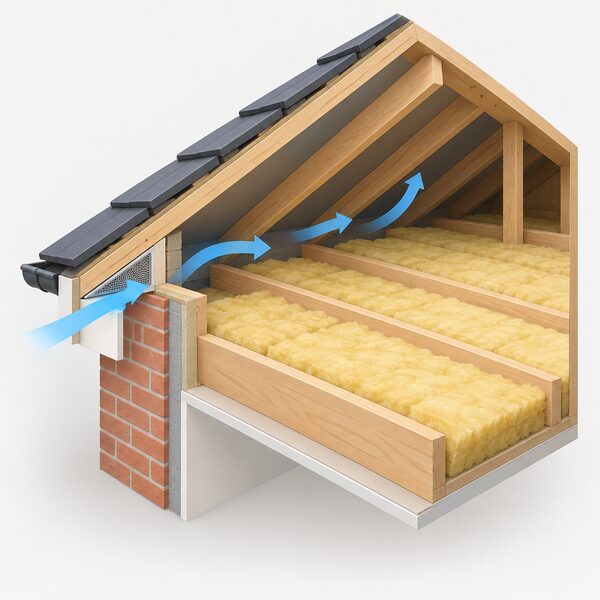
A top-up addresses the ceiling, and nothing else. Where the loft has been converted, or where the roof line is the thermal boundary, the ceiling is not the right place to add insulation, and a different approach applies.
Pitched roof insulation should only be applied in lofts with existing habitable rooms which do not meet the criteria for being considered a room in roof, and in vaulted ceilings with no loft space8. That is a narrower set of properties than a standard cold loft, and it is a different measure from a top-up.
Partial insulation of a loft conversion is not recommended. Insulating only the parts of the loft which are easy to reach can cause problems with condensation and mould on the remaining uninsulated areas26. Where a conversion is involved, the work needs to be planned as a whole rather than patched.
Ventilation matters as much as depth. Cavity wall and loft insulation, or specialist insulation materials fixed to the outside of a house, all change how a home manages moisture27. A tighter loft can concentrate moisture elsewhere, and the general guidance on condensation, damp and mould after insulation sets out what to watch for.
Finally, a top-up is one measure among several. Where a heat pump is planned, the fabric of the home determines how well it performs, and the relationship between insulation and heat load is set out in what insulation a heat pump needs. For the wider picture, loft insulation covers types, thickness and installation, and insulation and energy independence explains what a top-up does and does not do for a household's reliance on the grid and on gas.
Sources27 cited
- Stay warm in winter: five areas to add insulation in your home, Energy Saving Trust, 2025-02-07
- Keeping your home warm in winter, Met Office, 2026-09-20
- Tips to improve the EPC rating of your home, Energy Saving Trust, 2026-08-03
- Loft insulation, Planning Portal, 2026
- Loft insulation costs and savings, Which?, 2026-05-05
- Installing blanket insulation, Which?, 2026-05-26
- GB Insulation Scheme: government response, Department for Energy Security and Net Zero, 2022
- ECO4 delivery guidance version 4.0, Ofgem, 2026-03-26
- Affordable Warmth Scheme, Northern Ireland Housing Executive, 2026-09-17
- Retrofit, Act on Energy, 2026
- Building regulations: new roofs, thermal resistance and insulation, Planning Portal, 2026
- Building regulations: roof, thermal resistance and insulation, Welsh Government, 2026-09-17
- Permitted development checklist, Bath and North East Somerset Council, 2015-01
- Installing blanket insulation, Which?, 2026-05-26
- DIY loft insulation, Centre for Sustainable Energy, 2025-07
- Tenement law discussion paper response, Energy Saving Trust, 2026-04-23
- Energy saving tips, Age UK, 2026-04-02
- Exploring the costs to consumers of Scottish clean heating requirements, Nesta, 2024-08-01
- DIY vs professional home insulation, Uswitch, 2025-11-07
- ECO4 Flex open, South Cambridgeshire District Council, 2026-09-17
- ECO4 Flex and GBIS Flex information document, Ceredigion County Council, 2025-11
- Warm Homes Local Grant, Surrey County Council, 2026-09-17
- Home Upgrade Grant, Elmhurst Energy, 2026-09-20
- NISEP list of schemes 2026-27, Utility Regulator Northern Ireland, 2026-04
- ECO4 delivery guidance version 3.2, Ofgem, 2025-12-08
- Loft conversions: insulation and ventilation, Centre for Sustainable Energy, 2026-08
- How to stop condensation, Which?, 2026-05-26
 Loft InsulationHow much loft insulation do you need, and is your current depth enough?
 Insulation a Heat Pump NeedsWill a heat pump still work if your home is not well insulated, and would you need to add loft, wall or floor insulation first?
 Room-in-Roof InsulationTurning a loft into a room changes how the roof keeps heat in, so the insulation has to work with the ventilation rather than being squeezed in afterwards.
 Insulation Savings and PaybackHow much can you really save by adding insulation, and does it depend on your home, your heating and how you use it?
 Floor InsulationHow much warmth escapes through the floor, and is it worth insulating?
 Prepayment MetersHow do you top up a prepayment meter for gas or electricity, and what happens when the credit runs out?