
In this guide
If you own a flat on a long lease, you own a lease, not the building. The roof, the external walls, the balcony surfaces and the grounds are usually retained by the freeholder, and that is where almost all household energy equipment has to go. Planning authorities across England state the position in near identical words: a leaseholder may need to get permission from the landlord, freeholder or management company before installing solar panels1. That permission is separate from, and additional to, anything the planning system requires.
The same layering applies to the newest and lightest technology. When plug-in solar panels came to market, government guidance was explicit that the permissions needed may include permission from a landlord and or building owner or freeholder permission, planning permission or listed building consent5. A product that unplugs and moves with you still attaches to somebody else's building, and the lease or tenancy governs that.
The consent question is not marginal. Ofgem's 2021 consumer survey found that 18% of owner occupiers not planning energy efficiency upgrades, and 11% of those not planning low carbon heating, gave "I'm renting/freeholder/owner will not allow" as a reason6. For flats in particular, the gate that has to be opened first is usually a private one.
Who needs permission: leaseholders, flat owners and renters
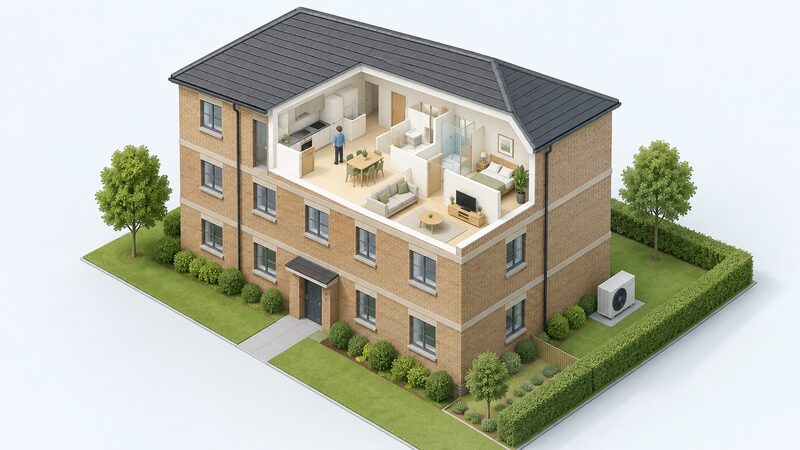
Three groups sit in different positions. A freeholder of a house owns the structure outright and deals only with the planning system, building control and, where relevant, the network operator. A leaseholder of a flat, and often of a house on a long lease, holds a demised area defined by the lease, typically the internal surfaces, with structure, roof and grounds retained. A tenant holds a much shorter interest and is bound by the tenancy agreement as well as by whatever the landlord's own lease permits.
Because the plant has to go somewhere physical, the distinction bites hardest on external work: panels on a roof or balcony, a heat pump on a wall or in a garden, a flue, external pipework, a cable run through common parts, or replacement glazing in a window frame the freeholder owns. Councils are consistent that leaseholders may need permission from the landlord, freeholder or management company for solar panels, and that this is in addition to planning1.
Some plant sits in the grounds rather than on the building, which changes the planning answer but not the lease answer. New Forest District Council states that installation of a ground source heat pump within the curtilage, the garden or grounds, of a house or block of flats does not require planning permission, though listed building consent may be needed if the property is listed10. In a block, that garden is almost always common part: planning silence is not permission from the person who owns the ground.
For tenants, the practical route is a written request to the landlord rather than a licence to alter, and the surrounding duties are set out separately in our pages on renting and home energy and asking a landlord for energy improvements.
Whose permission you may need: freeholder, landlord or management company
The published guidance names three possible consent-givers, and it names them together because which one applies depends on the building's arrangements: "If you are a leaseholder you may need to get permission from your landlord, freeholder or management company."1
In practice the freeholder may have granted a head lease, a residents' management company may hold the management functions, and a managing agent may act for either. The lease is the document that says who grants consent for alterations, whether the freeholder must join in, and whether the covenant against alterations is absolute or qualified. Where works touch common parts or the structure, more than one party may need to be a party to the licence to alter.
A written consent, commonly a licence to alter, typically records what is being installed, where, who maintains it, who insures it, what happens at the end of the lease and what reinstatement is required. None of those points is settled by the planning system.
Plug-in solar panels: the lighter option, but permission still applies
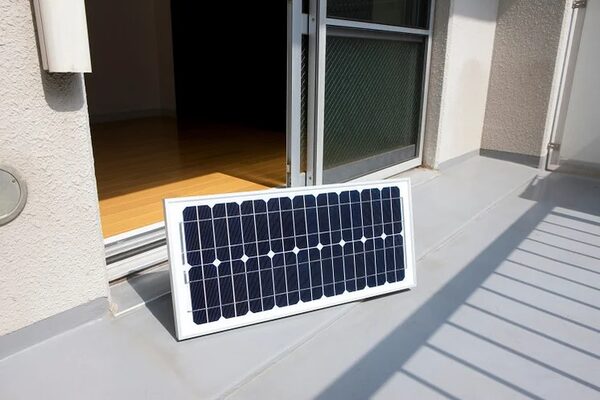
Plug-in solar is the first generation of domestic generation aimed squarely at flats and rented homes, because it needs no fixed wiring. Government guidance issued when the products came to market states that the permissions that may be needed include permission from a landlord and or building owner or freeholder permission, planning permission or listed building consent5.
That list matters for balconies in particular. A balcony is usually demised for use but forms part of the building's external appearance, and the lease will normally restrict anything fixed to it or projecting from it. The planning treatment also differs from a roof installation: free-standing solar, defined in Scottish guidance as solar photovoltaics or solar thermal equipment which is not installed on a building, is handled under different rules from panels fixed to a roof slope11.
Connection is a further, separate step. Hammersmith and Fulham's guidance for solar photovoltaic panels states that an installation must be registered with UK Power Networks, usually done by the installer12. That is a dependence that no consent from a freeholder removes: the household remains connected to, and registered with, a network operator.
Planning permission, permitted development and where it stops
For most flats and houses in England, roof-mounted solar is not the planning problem people expect. Wirral states that placing solar panels on the roof of a house or flat, or on a building within the grounds, is considered in most cases permitted development under the Town and Country Planning (General Permitted Development) (England) Order 2015, Schedule 2, Part 14, Class J7. Bromley puts it as installation on residential buildings that may be permitted development with no need to apply for planning permission13, and Cornwall as usually permitted development, with a few exceptions14. Bedford adds the qualifier that matters: in most cases no permission is needed, subject to certain conditions being met8.
The exceptions cluster in three places.
| Situation | Planning position |
|---|---|
| Panels parallel to the existing roof slope, not listed, not a flat | Planning permission not normally required, subject to all criteria15 |
| Stand-alone panels in the grounds of a house or block of flats | Full planning permission (flats) or householder planning permission (houses) where a trigger applies7 |
| Free-standing panels within the curtilage of a dwelling | Planning permission required16 |
| Free-standing panels in a conservation area or World Heritage Site, visible from the highway | Not permitted development16 |
| Free-standing panels in the curtilage of a listed building | Listed building consent always required16 |
Scotland and Wales run their own systems. Scottish Government Circular 1/2024 sets out Class 6HA, the installation, alteration or replacement of solar photovoltaic or solar thermal equipment on a dwelling, and for free-standing wind turbines describes a prior notification process expiring 28 days after the planning authority receives the application17. Welsh Government guidance states that where a property is a listed building the installation will require planning permission and is likely to require an application for listed building consent18, and its householder guides on solar electricity and solar water both list listed building consent where a building is listed19.
Nothing in any of this displaces the lease. Our page on permitted development and planning by home type sets out the planning side in more detail.
Listed buildings and conservation areas: a second consent regime
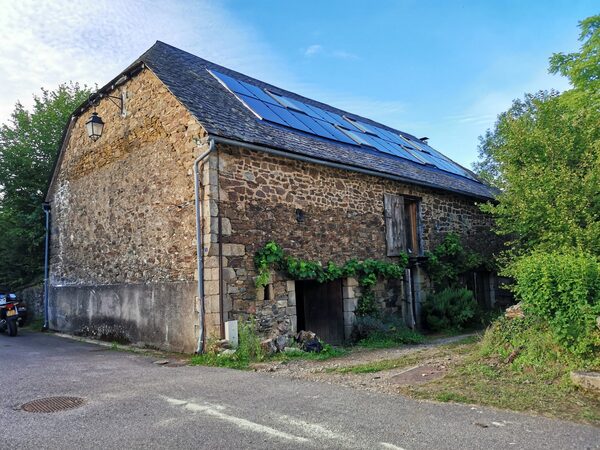
Where a building is listed, a further consent sits on top of both planning and the lease, and it is the one most likely to shape the design. Cornwall states that solar panels on listed buildings will need planning permission and listed building consent3. Islington says the same1, as does Rother, which states that if a house or flat is a listed building the owner must also apply for listed building consent21. Frome Town Council's 2025 guidance is blunter still: if a property is listed, planning permission and listed building consent are always needed22. York states that listed building consent is needed before work can commence23.
The listing reaches further than the building itself. West Suffolk's guidance states that listed building consent will be required to place solar panels on a listed building, including buildings within the curtilage of the listed building which pre-date July 194825. Buckinghamshire lists adding solar panels to the building or curtilage among works requiring consent26, and North Northamptonshire lists central heating or other flues, solar panels, air conditioning and heat recovery units and pipework among minor works that may require it27.
Heat pumps are treated the same way or more strictly. New Forest states that in a listed building both planning permission and listed building consent will be needed10. Richmond's heat pump guidance, updated in April 2026, states:
"If your property is listed, you will need listed building consent to install any type of heat pump."
Westmorland and Furness states that a listed property will usually need listed building consent before an air source heat pump is installed, even if planning permission is not required28. Pendle and Croydon both set out planning permission and, in some cases, listed building consent for listed buildings29. Bristol frames the outcome as conditional rather than barred: renewable energy solutions such as solar panels or air and ground source heat pumps "might be acceptable but will require listed and or planning consent"31. Exeter's guidance on whether panels can go on a listed building answers that it depends on the building and how the installation would affect its character32. Southampton's and Bath and North East Somerset's householder guidance take the same line for solar and for air source heat pumps respectively33.
Two authorities have tried to compress this. Kensington and Chelsea noted in January 2022 that all listed buildings then needed to apply for individual listed building consent, with some requiring planning permission too34, and subsequently used a Local Listed Building Consent Order giving consent for solar panels on most Grade II and Grade II* listed buildings without the need for individual listed building consent35. Bristol's Clifton order takes the same approach: planning permission will not be required for solar PV or solar thermal equipment consented under the order on residential houses and flats provided it complies with Class A, Part 14, Schedule 2 of the General Permitted Development Order 2015 as amended, while non-residential listed buildings still require planning permission, and panels on buildings within a listed building's curtilage require planning permission in both cases37. These orders are local. They remove a consent in one defined area and nowhere else, and they say nothing about the lease.
Where a refusal or a silence leaves the household
There is no published route in this material by which a freeholder's refusal can be bypassed. A covenant against alterations is a contractual term; disputes about whether consent has been unreasonably withheld are matters of property law rather than energy regulation, and the outcome depends on the wording of the individual lease.
Two things are worth knowing about how refusal is treated elsewhere in the system. First, it is recognised as a real obstacle: Ofgem's 2021 survey recorded 18% of owner occupiers not planning efficiency upgrades and 11% of those not planning low carbon heating citing renting, or the freeholder or owner not allowing it6. Second, in the private rented sector a refusal has formal consequences: the third party consent exemption under the minimum energy efficiency standard requires a landlord to demonstrate that consent for a relevant energy efficiency measure was required and sought, and that it was refused, or granted subject to a condition the landlord was not reasonably able to comply with39. That is a landlord's exemption, not a leaseholder's remedy, but it shows that written requests and written replies are the evidence the system runs on.
Where energy itself is resold through a landlord or site owner, the escalation route differs again. Ofgem states that where a household pays a site owner or landlord for energy and has a problem or complaint, the site owner or landlord should be contacted first41, and that a resident on a landlord's business contract may not be able to complain directly to the energy supplier without a contract with them42.
Service charges and block-wide energy works
Where an energy project is done to the building rather than to one flat, communal heating plant, a shared solar array, external wall insulation, roof or window replacement, the cost usually travels back to leaseholders through the service charge, and the consultation obligations that attach to major works apply. The individual leaseholder's decision then changes shape: the question is no longer whether consent will be granted for a private installation but whether a collective scheme proceeds and what each flat is asked to pay. Our pages on energy improvements in flats, energy work in high-rise and higher-risk buildings and retirement housing and service charges deal with those arrangements.
What leasehold consent means for energy independence

A flat in a block is the hardest place in the UK housing stock to reduce external dependence, and consent is the reason. The measures that most reduce reliance on a supplier, generation, storage and a heat pump, are precisely the ones that need space the leaseholder does not own. Insulation and glazing changes are also, for most flats, work to retained structure.
Even where consent is granted, dependence does not end. A solar installation must be registered with the distribution network operator, usually by the installer12, so the household remains a connected, registered participant in the grid. The equipment sits on somebody else's building under a licence that may impose maintenance, insurance and reinstatement obligations. And the consents themselves are held by third parties: a planning authority, a conservation officer where the building is listed, and a freeholder or management company whose decision is governed by a private document.
The realistic sequence for a leaseholder is therefore to read the lease first, establish who grants consent, check the planning and listed building position for the specific building, and keep the request and reply in writing. Where the building is listed, expect the design to be shaped by the conservation view as much as by the technical one, since councils describe acceptability in terms of how the installation would affect the building's character32. Further context on the options that remain open sits in energy independence when you rent or live in a flat and across the home type and household guide.
Sources42 cited
- Solar panels guidance, Islington Council
- Solar panels and permitted development, Richmond upon Thames Council, 2026-07-06
- Solar panels and planning permission, Cornwall Council
- Planning permission for stand-alone solar equipment, Planning Portal
- Households can save as plug-in solar panels come to market, GOV.UK, 2026-08-26
- Consumer Survey 2021: decarbonisation and home energy use, Ofgem, 2021
- Solar panels, Wirral Council
- Solar panels advice note, Bedford Borough Council, 2022-06
- Planning guidance: heat pumps, Richmond upon Thames Council, 2026-04-22
- Heat pumps, New Forest District Council
- Circular 1/2024: householder permitted development rights, free-standing solar, Scottish Government, 2024-05-28
- Solar panels, Hammersmith and Fulham Council
- Solar photovoltaic (PV) panels, Bromley Council
- Do I need planning permission?, Cornwall Council, 2026-09-09
- Solar note: installations under 50kW, Maidstone Borough Council, 2014-01
- Permitted development checklist, Bath and North East Somerset Council, 2015-01
- Circular 1/2024: householder permitted development rights, Scottish Government, 2024-05-28
- Planning permission: solar panels, Welsh Government
- Generating your own energy: solar electricity, Welsh Government
- Generating your own energy: solar water, Welsh Government
- Renewable energy: solar panels and heat pumps, Rother District Council
- Planning and solar, Frome Town Council, 2025-09-02
- Solar panels, City of York Council
- Solar panels guidance, City of York Council
- Solar photovoltaics and planning in conservation areas, West Suffolk Council
- When listed building consent is required, Buckinghamshire Council
- Getting consent for works to a listed building, North Northamptonshire Council
- Air source heat pumps, Westmorland and Furness Council
- Fact sheet 5: air source heat pumps, Pendle Borough Council
- Air and ground source heat pumps, Croydon Council
- Making alterations to a listed building, Bristol City Council
- FAQs for listed building owners and occupiers, Exeter City Council
- Solar Together domestic planning guidance, Southampton City Council
- Making solar power an option for more homes, Royal Borough of Kensington and Chelsea, 2022-01-21
- Local Listed Building Consent Order case study, Local Government Association, 2022-07-11
- Building consent order: solar panels consultation, Royal Borough of Kensington and Chelsea
- Clifton Local Listed Building Consent Order guidance, Bristol City Council, 2025-02
- Draft LLBC Order for the Clifton Conservation Area, Bristol City Council, 2025
- Guidance on PRS exemptions and exemptions register evidence requirements, GOV.UK, 2026-05-05
- Worried about your energy bills, Energy Ombudsman, 2026-03-24
- Alternative homes energy guidance, Ofgem, 2026
- If you live in a home on a business energy contract, Ofgem, 2026
 Air Conditioning in FlatsExplains the lease, freeholder and landlord consents that govern fixed air conditioning in flats, and building safety points for higher-risk buildings.
 Energy Improvements in FlatsLiving in a flat, what can you actually change yourself and what needs the freeholder or management company to agree?
 Listed Buildings and AreasYour home is listed or sits in a conservation area, so do you need permission before adding solar panels, insulation or a heat pump?
 Renting and Home EnergyThe position of a tenant in a privately rented home: which measures need no permission, which are fixtures the landlord controls, and what the law says about heating, insulation, certificates and bills across the four UK nations.
 High-Rise Flats and SafetyWho signs off new insulation, cladding or heating in a high-rise flat?
 Landlord Energy PermissionHow a tenant raises a request for insulation, heating, glazing or ventilation work in a rented home, what the EPC and the minimum band E rule mean, which grant schemes need landlord consent, and what happens when a landlord refuses.