
In this guide
A park home is a factory-built dwelling, usually a single-storey structure with a timber or composite frame, panel walls and a shallow pitched roof. That construction is the root of the energy problem: the walls are not traditional cavity walls, so the standard insulation routes do not apply, and heat loss through them is high. The Energy Company Obligation, the scheme that funded most domestic insulation in Great Britain since 2013, treated park homes as a separate category with its own measure, Park Home Insulation, covering the walls, ceiling and floor1.
That route has now closed. The government announced it would end ECO, with no levies on bills from April 2026, and energy suppliers have stopped advertising or accepting applications for ECO4 funding2. The scheme was extended to 31 December 2026 only to meet existing targets and remediate non-compliant installations3. For a park home owner, the practical position in 2026 is that grant-funded wall, ceiling and floor insulation is no longer available through ECO, and the remaining support is the Park Homes Warm Home Discount scheme, which is itself capped and closes once its allocated funding is spent4.
ECO funding has closed: what it means for park home owners
The Energy Company Obligation was funded by a levy on household energy bills, with government setting the overall targets and rules2. It placed legal obligations on energy suppliers to deliver energy efficiency measures to domestic premises, and its main objective was to reduce fuel poverty by improving the least energy efficient housing occupied by low income and vulnerable households9. Between 2013 and December 2025 it delivered 4.4 million measures in 2.6 million homes across Great Britain2.
The closure was a budget decision. The government decided to end ECO because it did not represent strong value for money2. Birmingham City Council's announcement is blunt about the mechanism: following the Chancellor's 2025 Autumn Budget, which confirmed the end of the green levy and consequently the end of ECO4 funding, installer partners can no longer secure funding from energy companies10. Energy suppliers have now stopped advertising, or accepting applications for ECO4 funding3.
For park home owners the consequences are specific. Park homes were not eligible for wall, roof/loft and floor insulation under ECO4 but instead could receive Park Home Insulation, a measure defined as the insulation of the walls, ceiling and floor of a park home1. That was the one route through which the fabric of a park home could be treated at no cost to the resident. With ECO4 closed to new applications, that route is gone.
Other schemes have closed alongside it. The Green Homes Grant, Home Upgrade Grant and Green Deal loans are all now closed2. In Scotland, the Scottish Central Government Energy Efficiency Grant Scheme has not been funding new measures since January 2024 and funding is due to end in 202611. The Energy Price Guarantee scheme is also closed2. What remains is the Warm Homes Plan, through which the government said it would continue fuel poverty investment2.
How the Energy Company Obligation worked, and what it funded
ECO started operating in January 2013 and ran through four iterations: ECO, ECO1, ECO2 and ECO312. ECO2 ended on 31 March 201712. The scheme was a requirement placed upon energy companies to help improve the domestic energy efficiency of lower income homes, and it was funded through a levy on energy bills9. From December 2018 it set suppliers only a target to reduce household energy bills, the carbon obligations having been removed2.
The measures delivered were weighted heavily towards the cheapest interventions. Of the 4.4 million measures delivered between 2013 and December 2025, 25% were cavity wall insulation, 21% new boilers, 18% loft insulation, 23% other heating measures mainly new heating controls, 6% solid wall insulation and 4% other insulation2. Solid wall insulation, the category closest to what a park home needs, was the smallest significant share.
| Measure | Share of ECO measures, 2013 to December 2025 |
|---|---|
| Cavity wall insulation | 25% |
| Other heating measures (mainly heating controls) | 23% |
| New boilers | 21% |
| Loft insulation | 18% |
| Solid wall insulation | 6% |
| Other insulation | 4% |
The scheme supported energy efficiency measures in the home of those considered to be in fuel poverty, and domestic households in Great Britain were eligible13. It was a Great Britain scheme, so it did not extend to Northern Ireland9. Local authorities could set their own criteria for eligibility for funding for domestic energy efficiency measures, and had to publish a statement of intent defining who was eligible before that could happen14. That is the origin of the ECO Flex routes that many councils ran.
Which benefits qualified for ECO support
Eligibility ran through benefit receipt. The qualifying benefits were Child Benefit, Pension Guarantee Credit, Income-related Employment and Support Allowance, Income-based Jobseeker's Allowance, Income Support, Universal Credit, Housing Benefit and Pension Credit Savings Credit13. Child Benefit was subject to income caps and household composition rules14. Housing Benefit was a qualifying benefit under the Affordable Warmth route in ECO49.
Receipt of a benefit was a starting point rather than a guarantee. The scheme focused on supporting low-income, vulnerable and fuel poor households, and participation under some routes was optional for suppliers1. Councils that ran flexible eligibility set their own criteria, which is why the same household could be eligible in one area and not in the next.
The Park Homes Warm Home Discount scheme is the route that now matters most to park home residents. To be eligible in 2026/27, applicants must be a permanent resident of a park home, pay the park site owner for electricity usage, and be on a relevant qualifying benefit or demonstrate household income or fuel poverty criteria4. That last condition matters because many park home residents buy electricity from the site owner rather than directly from a supplier, which excludes them from the standard Warm Home Discount.
One further rule constrains how support can be stacked: ECO and Warm Home Discount funding cannot be combined for any measures1.
Insulating park home walls: outside or inside
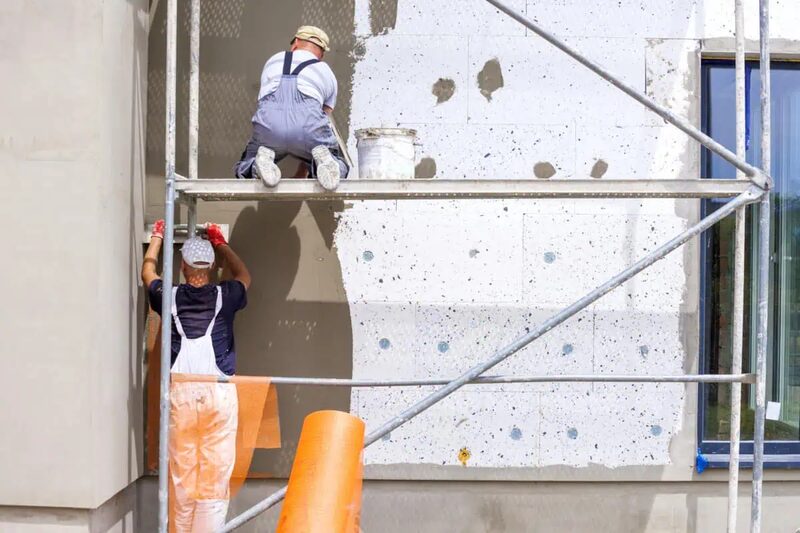
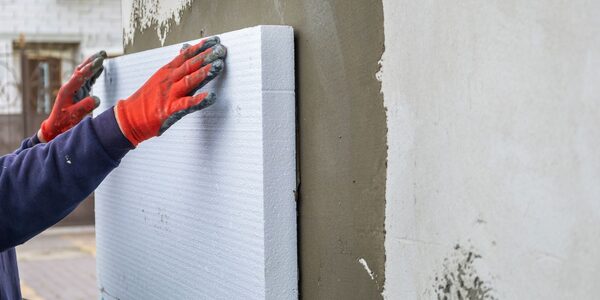
A park home's walls are the main fabric problem. Solid walls lose even more heat than cavity walls, and the standard remedy is either an external insulating treatment or internal insulation boards5. External wall insulation is usually installed where there are severe heating problems or where the exterior of the building requires some form of other repair work, providing the opportunity of adding insulation at the same time5.
For a park home, the choice between outside and inside is not symmetrical. External insulation wraps the structure without reducing internal floor area, which matters in a dwelling that is typically compact. It also addresses thermal bridging at the frame, where a panel construction loses heat disproportionately. Internal insulation avoids scaffolding and any question about the appearance of the home on the park, but it costs floor space and disrupts every room being treated.
The types of internal insulation available are ready made insulation and plasterboard laminates, wooden battens in-filled with insulation, or flexible linings5. External work is a decorative, weatherproof insulating treatment on the outside of the walls1.
In Scotland, the Energy Efficient Scotland Area Based Scheme has funded a list of measures that includes External wall insulation, Park Home Insulation, Internal wall insulation, Cavity wall insulation, Loft insulation, Underfloor insulation and Room-in-Roof Insulation11. That is the clearest official recognition that park homes need a distinct measure rather than a standard cavity fill.
What solid wall insulation costs, and what it saves
Solid wall insulation can be expensive, so the ideal time to do it is when the walls need some other corrective work1. That is the whole economics of the decision: the insulation is rarely worth doing on its own account, but it becomes sensible when the wall is being repaired or re-rendered anyway.
The savings evidence is more solid than the cost evidence. Official statistics on installations in England and Wales between 2011 and 2015 found that the gas savings from solid and cavity wall insulation appear to be sustained in the five years following installation7. That is a five-year window, not a lifetime figure, and it is drawn from the period when these measures were being installed at scale under government schemes.
The benefits beyond the meter are worth stating. Insulation helps create a more even temperature in the home, helps prevent condensation on the walls and ceilings, and can reduce the amount of heat building up inside during summer hot spells5. For a park home, where surface condensation on cold panel walls is a common complaint, the even-temperature effect may matter as much as the bill.
Published cost figures for solid wall insulation vary widely between sources and are not consistent enough to quote as a single number. Prices for park home work are installer-quoted, and the scope of the job, the access, the wall condition and the finish all move the figure. The audit history is a caution here: official statistics were published on solid wall insulation installed through ECO4 and GBIS specifically to understand the extent of non-compliance in measures installed under those schemes15. Any household commissioning this work should expect the specification and the guarantee to be set out in writing before work starts.
Guarantees, planning permission and installer rules
External wall insulation on a park home raises two separate permission questions. The first is planning. Solid wall insulation is treated as a common project in the planning system, and householder planning consent covers a defined list of projects5. Whether a specific installation needs an application depends on the property and the site.
The second question is the park itself. A park home sits on a pitch under an agreement with the site owner, and the site owner's consent is a separate matter from planning permission. The agreement governs what can be done to the unit and the pitch.
On guarantees, the position is that terms are set by the installer and the product manufacturer rather than by any scheme. The evidence base that a household can point to is the performance data: gas savings from solid and cavity wall insulation appear sustained in the five years following installation7. A guarantee that runs shorter than the period over which savings are expected to persist is worth reading carefully.
For park home residents in Scotland, the Area Based Scheme list of funded measures is the reference point for what has been supported there, and it includes Park Home Insulation as a named category11.
Portable electric heaters: a stopgap, not a heating system
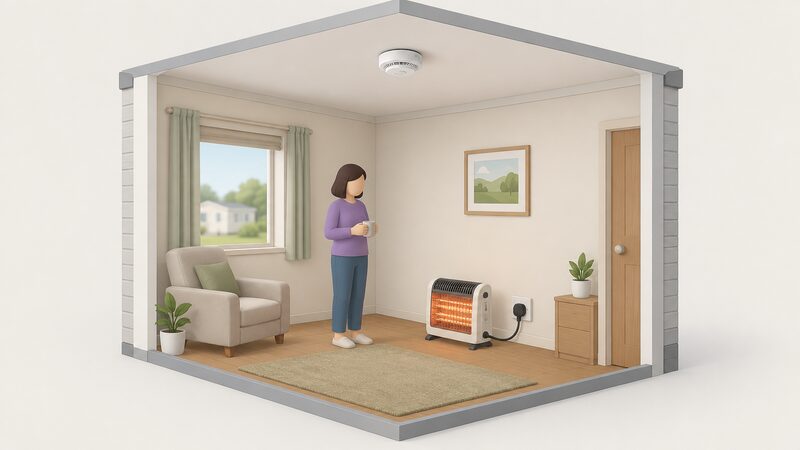
Where a park home has no gas supply, or where the central heating has failed, a portable electric heater is the usual fallback. It is worth being clear about what it is. Resistive electric heating converts electricity to heat at the point of use, and it is among the most energy-intensive ways to heat a room. Electric patio heaters, a comparable resistive load, use more energy than most other electrical products in a home, though they are generally more cost-effective than gas17.
The case for a portable heater is that it heats one room, immediately, without any installation. The case against is that it does nothing for the fabric of the home, so the heat it produces leaves through the same walls that made the home expensive to heat in the first place. It is a stopgap for a single occupied room, not a heating system for a dwelling.
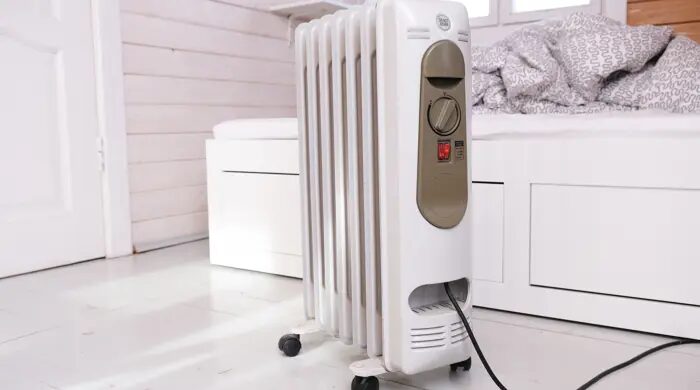
Buying matters as much as running. Guidance is to buy from a reputable retailer rather than a third-party seller online, and all portable heaters must be fitted with a UK 3-pin plug8. Register the heater so you can be contacted easily if there is a safety recall8.
Using a portable heater safely
The safety rules for portable heaters are short and absolute. Never leave the heater unattended while in use or while asleep, and it is recommended not to use a portable heater overnight8. Use smoke alarms or heat detectors nearby8. Avoid powering a heater from an extension lead, and a patio heater should not be plugged into an extension lead at all: it needs a cable long enough to reach a socket directly8.
"Never leave your heater unattended while in use or while you are asleep."
The same caution applies to other resistive heating in a park home. Electric blankets can be dangerous if left on overnight unless they have a safe all-night setting, and should never be used with a hot water bottle18.
Bills: what drives them and what cuts them
A park home's bill is driven by three things: the fabric, the fuel and the metering arrangement. The fabric is the panel wall and the shallow roof, which lose heat faster than a traditionally built home of the same size. The fuel is often electricity, bought either from a supplier or from the site owner. The metering arrangement determines whether the resident can switch supplier at all, and whether they can access schemes such as the Warm Home Discount directly.
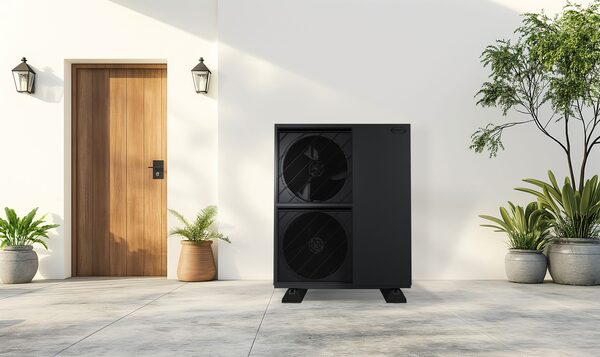
On the fabric, the measures that matter are the ones Park Home Insulation covered: walls, ceiling and floor1. On the fuel, the choice is between resistive electric heating, which is expensive per unit of heat delivered, and a heat pump, which runs on electricity but moves heat rather than generating it. Because heat pumps run on electricity, they can also make savings on your bills19. That is a general statement about the technology, and its applicability to a specific park home depends on the fabric and the emitter system.
On support, the position in 2026 is that the grant-funded route through ECO has closed to new applications3. Councils now refer residents on rather than accepting ECO requests themselves: the council will not be accepting any ECO related requests, and residents assessed as potentially eligible are referred to the relevant funding scheme provider or an approved installation company14. Free and impartial energy and bill saving advice remains available through local authority services, which provide advice, planning and delivery to help reduce the costs of bills as well as carbon emissions associated with home energy and heating9.
For a park home household, the honest summary is that independence from the grid is not realistic, and independence from the site owner's metering depends on the individual agreement. What is achievable is a better fabric, a heating system suited to the fuel available, and access to the advice and discount routes that remain open.
Sources19 cited
- ECO4 new measures and products guidance v3.0, Ofgem, 2026
- Energy Company Obligation: statistics and closure, House of Commons Library, 2026
- Energy Company Obligation: closure and extension, House of Commons Library, 2026
- Warm Home Discount eligibility statement, England and Wales, 2026 to 2027, GOV.UK, 2026
- Solid wall insulation, Planning Portal, 2026
- Wall insulation, AgilityEco, 2026
- National Energy Efficiency Data Framework: need report, GOV.UK, 2026
- Portable heaters, Electrical Safety First, 2026
- Home energy efficiency, Argyll and Bute Council, 2026
- End of ECO announcement, Birmingham City Council, 2026
- Heat in buildings: progress report 2025, Scottish Government, 2025
- Energy Company Obligation, Ofgem, 2026
- ECO: information for homeowners and tenants, Ofgem, 2026
- Home energy efficiency, Bridgend County Borough Council, 2026
- Solid wall insulation installed under ECO4 and GBIS: statistical audit results, GOV.UK, 2025
- Householder planning consent, Planning Portal, 2026
- Patio heaters, Electrical Safety First, 2026
- Stay warm at winter, Belfast City Council, 2026
- Heat pumps, Welsh Government, 2025
 Installation Cost TrendsTracks the published median and average installed costs of domestic solar, heat pumps and batteries and how they have moved.
 Selling a Home With Energy KitCovers the paperwork a sale requires when a home has solar panels, a heat pump, insulation or a leased roof, and how warranties, export payments and guarantees transfer.
 The Full Heat Pumps GuideWill a heat pump keep my house warm in winter, and what does one cost to buy and run?
 New Build Homes and EnergyWhat heating will a new build actually have, and will it be a heat pump rather than a gas boiler?
 Policy, Targets and Coming RulesHeat pumps are central to the government's plans for greener home heating.
 UK Cooling DemandPublished data on air conditioning ownership and home overheating, with projections for summer temperatures in each UK nation, and what rising cooling demand means for summer electricity use.