
In this guide
The Disabled Facilities Grant is the main public funding route for adapting a home so that a disabled person can live in it safely and independently. In England the maximum award is £30,000, in Wales £36,000 and in Northern Ireland £25,0001. Scotland does not operate the scheme at all1. The grant is administered by your council, is usually means tested, and is paid in instalments as the work progresses1.
What it buys is practical independence: ramps and widened doors, a stairlift or level access shower, better access to the garden, a downstairs bedroom, and a heating system suited to the occupant's needs2. That last point matters for energy sovereignty, because a household that cannot reach its heating controls, or cannot afford to run a system sized for its needs, is dependent on both the grid and whoever operates the boiler. The grant does not remove that dependence, but it can remove the physical barrier between a disabled person and the controls of their own home.
The scheme is not a general home improvement fund. It is a statutory adaptation grant with a means test, a land charge on larger awards, and a defined list of eligible works. This page sets out the amounts in each nation, who qualifies, what the money covers, how the application runs, and what happens when the grant is not enough.
How much you can get: £30,000 in England, £36,000 in Wales
The headline figures are national maxima, not entitlements. England sets a ceiling of £30,000, Wales £36,000 and Northern Ireland £25,0001. A council may give more than the national figure in some cases, and the amount actually awarded depends on the household income assessment1.
Wales illustrates how the layers stack. The mandatory Disabled Facilities Grant there has a maximum of £36,000, and Swansea Council's published policy adds a discretionary Disabled Facilities Grant of up to £14,000 and a discretionary Disabled Facilities Loan of up to £10,0005. The same policy sets an Adapted Home Relocation Grant with a maximum of £36,000, a Minor Adaptations Grant with no means test on the disabled applicant, a Discretionary Fast Track Adaptations Grant, and Comfort Safety and Security Grants capped at £1,000 per three-year period5. A household in Wales therefore faces a different set of ceilings from one in England, and the discretionary layer varies by council.
| Nation | Maximum mandatory award | Notes |
|---|---|---|
| England | £30,000 | Some councils may give more1 |
| Wales | £36,000 | Discretionary grants and loans on top, set locally1 |
| Northern Ireland | £25,000 | Administered by the Housing Executive1 |
| Scotland | Not available | No Disabled Facilities Grant scheme1 |
The practical effect is that the grant is a contribution towards an assessed need, not a budget. Where the cost of eligible works at design stage exceeds the Welsh £36,000 limit, Swansea's policy offers a Discretionary Disabled Facilities Loan as top-up funding to owner occupiers with an approved grant5. In England, the equivalent top-up usually comes from council discretion or from a home improvement loan, and Cornwall's rules require homeowners to seek Disabled Facilities Grant funding first before a Home Improvement Loan can be considered6.
For a household's independence, the ceiling is the constraint. A stairlift, a level access shower and a downstairs bedroom can together exceed the maximum, and the gap has to be met from savings, a loan secured on the property, or a smaller scheme of works. The grant widens what a disabled household can do in its own home; it does not remove the means test that decides how much of the cost falls on the household.
Eligibility and means testing

Eligibility starts with disability, defined in Section 100 of the Housing Grants, Construction and Regeneration Act 1996, and covers an owner, a private tenant or a council tenant who is disabled or has a disabled person living in the property5. Official guidance describes the group more broadly: people who are physically disabled, have a learning disability, have age-related needs, are autistic, have a cognitive impairment such as dementia, have a progressive condition such as motor neurone disease, have a terminal illness, or have a mental health condition2.
The means test is the second gate. Applications for large adaptation grants in respect of disabled adults are means tested, but applications for disabled children and young people under 19 who are dependent are exempt5. The same exemption applies to the Adapted Home Relocation Grant5. Household savings over £6,000 are taken into account, and the assessment considers disability among its factors1. Northern Ireland applies a means test to grant applicants as well3.
"Disabled children under 18 can get a grant without their parents' income being taken into account"
Two groups are treated separately from the household's own resources. Landlords can get a grant without their income and savings being taken into account, which matters where a tenant needs adaptations to a property the landlord owns1. And where a landlord receives a grant, the council may ask for the property to be let to another disabled person if the current tenant moves within five years1.
The means test is where the grant's reach ends for many households. A disabled adult with modest savings and a low income may receive the full assessed cost; a household with savings above the threshold will be expected to contribute. Because the assessment is on household income, two households with identical adaptation needs can receive very different awards. That is the design of the scheme, not an anomaly, and it is the reason the grant is best understood as a targeted adaptation fund rather than a universal entitlement.
What the grant funds: ramps, stairlifts, access and facilities
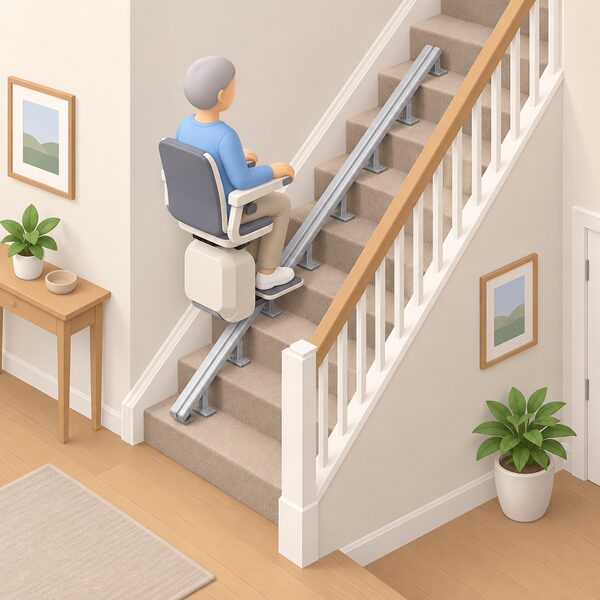
The eligible works list is specific and practical. It covers widening doors and installing ramps or grab rails; improving access to rooms and facilities, such as a stairlift or a level access shower; improving access to the garden; building an extension such as a downstairs bedroom; providing a heating system suitable for your needs; and adapting heating or lighting controls to make them easier to use2.
The heating element is the part most relevant to energy independence. A heating system suitable for the occupant's needs, and controls adapted so they can be operated, are eligible where they relate to the disability2. This is not the same as a general energy efficiency grant: the test is whether the work is needed because of the disability, not whether it lowers bills. A household that cannot reach a thermostat, or cannot operate a programmer, is dependent on someone else to run its heating; adapting the controls changes that.
Smaller works sit under separate discretionary schemes in some councils. Swansea's Minor Adaptations Grant covers internal and external handrails, lever taps, small ramps to aid access, key safes, door entry systems, replacement shower seats, replacement shower heads and anti-scald fittings, and the installation of electrical sockets for a community alarm system5. These are the low-cost items that keep a household out of the larger grant process altogether.

The distinction between adaptation and improvement runs through the whole scheme. A new boiler because the old one has failed is a repair; a heating system suited to a disabled occupant's needs is an adaptation. A ramp is an adaptation; a new driveway is not. Households that approach the grant expecting general renovation funding will find the eligible works list narrower than they hoped, and the assessment focused on what the disabled person needs to use their home.
How to apply and when your council must decide
The route begins with an occupational therapist, who makes a recommendation3. That recommendation feeds the council's assessment, and the council decides the award. The grant is then paid in instalments as the work progresses, and the council may pay the contractor directly or give you the money to pass on1. The payment agreement is settled when the application is approved1.
Two conditions govern the timing. First, you might not get any grant if you start work on your property before the council approves your application1. Second, for a Disabled Facilities Grant an occupational therapist must also inspect and sign off the work before the final payment, which is released when you and the council are happy with the finished work1.
- Contact the council and request an assessment; an occupational therapist makes a recommendation3.
- Submit the application and complete the means test1.
- Wait for approval before any work begins1.
- Have the work carried out and inspected, with an occupational therapist signing off3.
- Receive payment in instalments, with the final payment on completion1.
If you or a relative do the work, the council will normally accept invoices only for materials or services you have bought, so your own labour is not funded1. The Northern Ireland Housing Executive publishes a separate guide to how long the whole process takes, reflecting that the sequence of assessment, approval, works and sign-off is the same in each administration even where the amounts differ3.
The approval-before-work rule is the one that catches households out. It is not a formality: starting early can forfeit the grant entirely, and the money is released against completed stages rather than up front. A household that needs the adaptation urgently still has to wait for the assessment and approval sequence, and the occupational therapist's sign-off at the end is a condition of the final payment, not an optional check.
Renting with a disability: tenants, landlords and permission
Tenants can apply. Eligibility covers an owner, a private tenant or a council tenant who is disabled or has a disabled person living in the property5. Where the property is leasehold, permission may be needed from the landlord, freeholder or management company8. That consent requirement sits alongside the grant process rather than replacing it, and it is the point at which a tenant's adaptation can stall.
Landlords have their own route. A landlord can get a grant without their income and savings being taken into account, and the council may ask for the property to be let to another disabled person if the current tenant moves within five years1. That re-letting condition is the trade for the landlord's exemption from the means test: the adaptation stays with the property and continues to serve a disabled occupant.
For tenants in the private rented sector, the practical sequence is permission first, then the grant application. A landlord who refuses consent blocks the adaptation regardless of the tenant's eligibility, and the grant cannot be paid for works the landlord will not permit. Where consent is given, the landlord's own finances are not assessed, which removes one common obstacle. Tenants in social housing apply through the same council route, and the landlord is the housing provider.
The dependence here is on the landlord's consent and on the property itself. A tenant who needs a level access shower or a stairlift cannot install either without the owner's agreement, and cannot take the adaptation with them if they move. The grant funds the property, not the person, which is why the re-letting condition exists and why a tenant's independence is tied to a tenancy that may end.
The land charge: when a grant must be repaid
For owner occupiers, a Disabled Facilities Grant above £5,000 is subject to a local land charge, and if the property is sold within ten years the grant must be repaid up to a maximum of £10,0004. Discretionary adaptation grants carry a five-year version of the same condition, also capped at £10,0004. The charge is registered against the property, so it passes with the title rather than following the applicant.
Discretionary loans work differently. A Discretionary Disabled Facilities Loan is registered as a local charge and is repayable on sale or transfer of title, or on the applicant moving into long term care or sheltered accommodation; for joint applicants it is repayable on the death of the surviving final borrower5. Swansea's loan terms are interest free, with fees charged for administration costs that may be added to the loan, and repayment structured as a lump sum at the end of the term for loans of three years or less, with staged lump sums for longer terms5.
The charge also bites in other circumstances. Where an insurance claim or legal damages relate to works funded by grant or loan, the council will require repayment of the total value paid, or the value of the insurance payment or legal damages if lower5. A breach of conditions requires full repayment, with discretion to agree a lesser amount in exceptional circumstances such as significant financial hardship or a deficit estate5.
For a household's independence, the land charge is a claim on the property's value rather than on income. It does not affect the household's ability to live in and use the adaptation, and it does not affect benefits, but it reduces what the household realises on sale. A family that adapts a home for a disabled member and later sells within the ten-year window should expect the charge to be settled from the proceeds.
When the grant is not enough: other routes to funding adaptations

The grant is capped, means tested and limited to eligible works, so gaps are common. Several routes exist to fill them, and they differ by nation.
In Wales, the Discretionary Assistance Fund helps those in severe financial hardship who do not qualify for the heating fuel costs support scheme9. The Welsh Government's home improvement loan may assist consumers without a valid cavity wall insulation guarantee who face the cost of remedial work10. The Homefix loan is a Welsh Government funded scheme offering interest free loans to help homeowners carry out repairs11. Nest Warm Homes offers free energy efficiency advice and improvements to low-income Welsh households12.
In England, the Warm Homes: Local Grant provides support at no cost to all participating local authorities from the Retrofit RISE service13. The Warm Home Discount requires receipt of a qualifying means-tested benefit on the qualifying date14. Ofgem's guidance covers additional support credit and alternative forms of support where appropriate15. The Fuel Bank Foundation helps households including those with prepayment meters and at risk of imminent disconnection18.
Where a household does not qualify for a grant at all, councils may offer non-financial assistance. Swansea's policy provides for a schedule of repair works or signposting to partners such as Western Bay Care and Repair for those not eligible or not proceeding5. Cornwall's rules require homeowners to seek Disabled Facilities Grant funding first before a Home Improvement Loan can be considered, which means the grant is the gateway rather than one option among several6.
The pattern across all these routes is that the grant is the first call and the others are residual. A household that has been refused, or has hit the maximum, is not without options, but each alternative has its own eligibility test, its own nation-specific rules, and often its own repayment terms. The grant remains the only route designed specifically for disability-related adaptation.
Care & Repair Cymru: free help for older homeowners in Wales
Care and Repair agencies exist to relieve the needs of older people in the locality who are disadvantaged by reason of health, ill-age or disability19. In Wales they operate alongside the grant system, helping older homeowners navigate assessments and works, and Swansea's policy names Western Bay Care and Repair as a signposting partner for those not eligible or not proceeding with grant funding5.
The wider Welsh support landscape is substantial. The Welsh Government provides help with home energy bills, and its guidance directs households to that support16. Green Homes Wales helps homeowners in Wales improve their homes with energy efficiency upgrades, offering fully funded expert support, interest-free loans and in some cases grant money20. The Retrofit Coordinator Grant applies to domestic properties located in Wales and to owner-occupied homes with a freehold or long-leasehold interest21. The Help to Stay Wales Scheme supports Welsh homeowners who are in or facing financial difficulty in paying their mortgage22. AdviceLink Cymru's Claim What's Yours helpline helps people access benefits, pensions, help with care costs and council tax reductions23.
For an older homeowner in Wales, the practical value of these services is navigation rather than cash. The grant process requires an occupational therapist's recommendation, a means test and approved works, and an agency that knows the sequence can shorten the path. The support is free at the point of use, and it sits alongside the grant rather than replacing it. Households outside Wales do not have Care and Repair in the same form, and their equivalent help comes through council housing departments and the national schemes described above.
Sources23 cited
- Disabled Facilities Grants: What you'll get, GOV.UK, 2026-09-17
- Disabled Facilities Grants, GOV.UK, 2026-09-20
- How much grant funding can you get, Northern Ireland Housing Executive, 2026-09-17
- Financial Assistance Schedule, Bristol City Council, 2025-05
- Private Sector Housing Renewal and Disabled Adaptations, Swansea Council, 2026-09-20
- Eligible and non-eligible works, Cornwall Council, 2025-10-01
- How long will the whole process take, Northern Ireland Housing Executive, 2026-09-17
- Planning permission: stand-alone solar equipment, Planning Portal, 2026-09-17
- Written statement: support for heating fuel costs, Welsh Government, 2026-03-31
- Issues arising from cavity wall insulation installations guidance, Welsh Government, 2022-02
- Help to repair your home, Swansea Council, 2025-05-07
- Thousands of Welsh households get help with oil and LPG heating costs, Welsh Government, 2026-03-31
- Warm Homes: Local Grant, GOV.UK, 2024-09-23
- Warm Home Discount eligibility statement 2026 to 2027, GOV.UK, 2026-09-17
- Additional support credit: our expectations, Ofgem, 2025-11-06
- Get help with your home or business energy bills, Ofgem, 2026-09-17
- Get help with your energy bills, Ofgem, 2026
- Boosting the Fuel Insecurity Fund, Scottish Government, 2026-09-17
- Energy costs, Swansea Council, 2022-12-14
- Choosing a retrofit coordinator: what you need to know, Development Bank of Wales, 2025-09-30
- Retrofit Coordinator Grant terms and conditions, Development Bank of Wales, 2026
- Help with household costs, Isle of Anglesey County Council, 2026-09-20
- Written statement: support available to help with cost of living, Welsh Government, 2026-03-18
 The Full Grants and Schemes GuideWhich grants can you actually get right now, and how do you apply for them?
 Vulnerable Households EnergyIf someone in your home relies on powered medical equipment, or needs extra warmth because of a health condition, what help is available?
 Energy Improvements in FlatsLiving in a flat, what can you actually change yourself and what needs the freeholder or management company to agree?
 The Full Your Type of Home GuideLiving in a flat, an old listed house or somewhere off the gas grid changes what energy help you can get and what you are allowed to install.
 Grants and Energy IndependenceCan you get a grant for solar panels or a battery?
 Why Energy Grants DifferWhere you live in the UK changes which home energy grants you can get.