

In this guide
The private rented sector is now one of the three main tenures in the United Kingdom and the one with the weakest energy performance. In England it accounted for 4.7 million households, or 19 per cent of all households, in 2023 to 20241. In Scotland, the most recent house condition survey puts 14 per cent of private rented dwellings in Energy Performance Certificate bands E, F or G, against 12 per cent of owner-occupied dwellings and around 2 per cent of social sector dwellings2. Scottish Government consultation material gives the same 14 per cent figure for E, F and G rated private rented properties and states that 48 per cent of the sector is rated EPC D or lower, compared with 5 per cent of social rented properties in the lowest three bands3.
The legal floor is low. Across England and Wales, a domestic private rented property must reach an EPC rating of E or above, and a property rated F or G must be improved to at least an E before it can be let, unless a valid exemption is registered on the public exemptions register. Both governments have consulted on raising that floor to the equivalent of EPC C, in England and Wales by 2030 and in Scotland by the end of 2028, but neither requirement is yet in force.
For a household, this matters because a renter controls almost nothing that sets the bill. Fabric, heating system, glazing and controls are the landlord's property; the tenant carries the running cost. That is the central constraint on energy independence in this tenure, and it is why the published statistics on bands, standards and exemptions are the ones worth knowing.
What the private rented sector is and how big it is
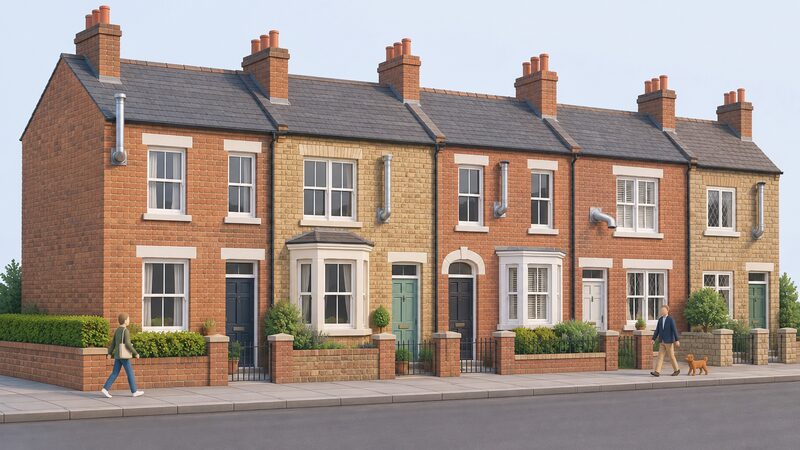
The private rented sector covers homes let by private individuals and companies, as distinct from social housing let by councils and housing associations and from owner-occupation. In England it is the second largest tenure after owner-occupation, at 4.7 million households and 19 per cent of the total in 2023 to 20241.
The evidence base differs by nation, and that shapes what can be said. England's figures come from the English Housing Survey. Scotland publishes the Scottish House Condition Survey alongside the Scottish Household Survey, which draws a random sample of addresses every year and gathers evidence on the characteristics, attitudes and behaviour of private households as well as on the physical condition of Scotland's homes, covering housing, neighbourhoods, finances, local services and more6. In Wales, Rent Smart Wales publishes an energy performance dashboard for the rented stock, which does not take account of properties registered as exempt from the Minimum Energy Efficiency Standards7.
That last point is worth holding on to when comparing nations: a dashboard or survey built from lodged certificates does not see the properties that have been taken out of the standard by an exemption, and a sector with a high exemption count will look better in the published data than it is on the ground.
EPC ratings A to G: what each band means

An Energy Performance Certificate rates how energy efficient a building is, with ratings from band A, very efficient, to band G, inefficient8. Behind the letter sits a number: both the energy efficiency rating and the environmental impact rating are scored on a scale of 1 to 100 and then split into bands A to G9. Non-domestic certificates add a band A+ at the top of the scale10.
A certificate is required when an existing building is sold or let11, and it is valid for a maximum of ten years, or until another certificate is commissioned for the same building, whichever comes sooner5. That ten-year life is the single most common source of confusion for tenants: a certificate showing band D may have been lodged before a new boiler, new windows or loft insulation went in, or before a system was removed.
The banding system itself is being reformed. Scottish Government work on Energy Performance Certificate reform sets out the role a new rating system could play in supporting proposed regulations such as a private rented sector minimum energy efficiency standard12, and the reformed domestic certificate introduces a separate Heat Retention Rating that a future Scottish standard would be set against13. In England and Wales, a published roadmap describes landlords being required to meet a minimum score of EPC C against a fabric performance metric and either the heating system or smart readiness metric, with an October 2030 date attached14. In other words, the single letter familiar today is expected to become a set of metrics, and a household reading a certificate in the next few years may be reading a different document from the one described here.
Private rented stock ranks lowest of the three tenures
The Scottish Government's own words are direct:
"We know that homes in the private rented sector are the least energy efficient of all housing tenures."
The numbers support it. In Scotland, 14 per cent of private rented properties are rated E, F or G, the highest share of any tenure, against 5 per cent in the social rented sector3. The house condition survey gives around 2 per cent for the social sector, 12 per cent for owner-occupied and 14 per cent for private rented in those bands2. At the other end, 50 per cent of private rented dwellings were rated C or better, slightly below the owner-occupied figure of 52 per cent2, while the 2023 progress reporting put the private rented share at 52 per cent12. The two published figures are close but not identical, and they cover different reference years.
Earlier consultation material framed the gap more starkly still: twenty per cent of private rented housing had a poor EPC rating of E, F or G, compared with just 6 per cent of social housing16. The improvement since then is real, but the ordering of tenures has not changed.
| Tenure (Scotland) | In bands E, F or G | Source year |
|---|---|---|
| Social rented | around 2%2 | 2024 |
| Owner-occupied | 12%2 | 2024 |
| Private rented | 14%2 | 2024 |
Social housing has moved fastest. Homes in the Scottish social rented sector are now described as some of the most energy efficient in Scotland, with 85 per cent already achieving EPC band D or above17. Private rented stock is also not the worst on every measure: 25 per cent of private rented dwellings in Scotland fell below the tolerable standard, a lower rate than the comparator given in the same survey2.
Why rented homes lag, and who bears the cost

Three structural features explain most of the gap. The first is split incentives: the landlord pays for the insulation and the tenant collects the saving, so the investment case for the person holding the asset is weak unless regulation or grant funding closes it. Successive policy documents treat minimum energy efficiency standards as the instrument for that, applied separately to private rented, owner-occupier and social housing18.
The second is tenure churn and information. Older Scottish analysis estimated around 60 per cent of tenancies in the sector as a whole lasting less than two years, while around a quarter of tenancies in privately rented dwellings with an EPC of F or G were estimated to last for more than ten years19. Short tenancies weaken a tenant's ability to press for work; long tenancies in the worst-rated homes mean the poorest stock is not routinely exposed to the point of sale or re-letting where standards bite. Information has been patchy too: evidence submitted to Parliament reported that only one in four consumers in the private rented sector received an EPC when renting a property20.
The third is the overlap with low income. Among households in homes below EPC band C, the fuel poor were less likely to live in the owner occupied sector, 75 per cent versus 45 per cent, and more likely to be in the rental sectors, 20 per cent against 11 per cent in private rental and 35 per cent against 14 per cent in social renting21. Scottish fuel poverty scenario modelling to the October to December 2026 price cap period reports the figure remaining stable for those in the private rented sector22. The consequence for independence is plain: the tenure with the least control over fabric and heating also contains a disproportionate share of the households least able to absorb a bill. This is covered further in fuel poverty in the UK and in renting and home energy.
The minimum standard now in force: EPC band E
The operative rule in England and Wales is the 2018 Minimum Level of Energy Efficiency standard, EPC band E23. No property which has not at least got an EPC rating of E or above can be rented out unless an exemption applies, and if the rating is F or G it must be improved to at least an E4. Landlords of domestic private rented properties, including public sector landlords, may not grant a tenancy to new or existing tenants where the property is band F or G, unless an exemption applies24. Guidance to landlords already letting an F or G rated property is that it must be improved to a minimum rating of E, or an exemption registered where applicable23.
The standard has always carried a cost limit. When the regulations were made, it was stated that in the domestic sector a landlord will not be required to reach an E EPC by installing measures which are not cost effective, provided all improvements fundable through a Green Deal, the energy company obligation and any available grant funding have been carried out25. Non-domestic property sits under a parallel regime: around one in five of the non-domestic private rented stock fell within the lowest two bands, F and G, when the standard was introduced25, and privately rented commercial buildings in England and Wales have been set a minimum efficiency standard of EPC band B by 203026.
Raising the floor to EPC C: what is proposed, and where
Every UK administration has proposed a C-equivalent standard, but on different dates and different measurement systems.
| Nation | Proposed standard | Date | Status |
|---|---|---|---|
| England and Wales | equivalent of EPC C for privately rented homes27 | 203027 | consulted, 2025 update27 |
| England and Wales | minimum score of EPC C against the fabric performance metric and either the heating system or smart readiness metric14 | 1 October 203014 | set out in published roadmap14 |
| Scotland | minimum standard equivalent to EPC C where technically feasible and cost-effective28 | 202828 | consulted, under analysis29 |
| UK social housing | EPC rating of at least C or equivalent30 | 203030 | government commitment30 |
The England and Wales proposal is to raise the minimum energy efficiency standard required of privately rented homes to the equivalent of EPC C by 203027, a proposal also recorded in parliamentary committee reporting31 and in departmental impact analysis covering new proposals for private and social rented homes to meet EPC C by 203032. The policy history is not linear: a previous plan to require EPC C by 2028 for private rented homes was scrapped in 202333, and the sector's regulatory milestones have been reset more than once, with earlier regulations framed around 2020, 2025 and 203022. Welsh housing decarbonisation analysis argues that short-term UK targets such as EPC C for private rented housing need to go further34.
Scotland's proposals run on a shorter clock. The Heat in Buildings Strategy set out requiring all private rented sector properties to reach a minimum standard equivalent to EPC C by 2028 where technically feasible and cost-effective at change of tenancy, with a backstop of 2028 for all remaining existing properties28. Fuel poverty reporting repeats the same target18, and the published consultation on a Heat in Buildings Bill proposed that properties not meeting the standard by the end of 2028 would not be allowed to be leased to a new tenant35. The Committee on Climate Change has said a Scottish plan should include minimum energy efficiency standards for privately rented homes36.
The Scottish consultation on a private rented sector minimum energy efficiency standard ran between 6 June and 29 August 2025 and its responses are under analysis29. It would use the reformed domestic EPC's new Heat Retention Rating as the basis for the standard13, meaning all privately rented properties, as far as possible, achieving a Heat Retention Rating of Band C37. Earlier Scottish trajectories, since superseded, had proposed all dwellings reaching EPC E by 31 March 2022 and EPC D by 31 March 202519.
Exemptions and the register
A property need not meet the standard if it cannot reasonably be brought up to it. The public register is where those cases are recorded: it lets anyone find private rental properties that are registered as exempt from the minimum standard of energy efficiency, and it shows when the property was registered as exempt and the reason38. The same register can be searched for properties that have been issued penalties for failing to comply with these standards38.
The register applies to properties which are legally required to have an EPC, are let on a relevant tenancy type, and cannot be improved to meet the minimum standard of EPC band E for one of the listed reasons39. Registering requires the address of the rental property, which exemption type is being registered, and a valid Energy Performance Certificate for the property39.
Exemptions are time-limited rather than permanent. Where a high cost exemption is used, it will expire, and the landlord must try again to improve the property's EPC rating to meet the minimum level of energy efficiency; if this still cannot be achieved, a further exemption may be registered39.
Separately, certain buildings fall outside the certificate requirements altogether. Under the regulations these include:
- listed or officially protected properties where the requirements would unacceptably alter them24
- temporary buildings used two years or less, and places of worship24
- low-energy industrial sites, workshops and non-residential agricultural buildings24
- detached buildings under 50 m2 of total floor space24
- buildings occupied less than four months a year with expected energy consumption under 25 per cent of all-year use24
- properties due for demolition with consents in place24
- certain houses in multiple occupation not sold or let as a single rental in the past ten years24
Residential buildings to be used for 25 per cent of the year or less are likewise outside the certificate requirement11, and non-residential agricultural buildings in use by a sector covered by a national sectoral agreement on energy performance are excluded under the 2012 regulations for England and Wales40. Building regulations carry a parallel carve-out for listed buildings, buildings in conservation areas and scheduled monuments where compliance would unacceptably alter their character or appearance41. The 2025 England and Wales consultation proposed increasing the number of exemptions available and amending current ones27. Related duties are set out on landlord energy and safety duties and HMOs and shared houses.
What the EPC does and does not tell a tenant or landlord

The certificate is a modelled rating of the building, not a measurement of a household's bills. It reflects the fabric, heating system and controls as assessed on the day, and it stays on the register for up to ten years5. It says nothing about how the home is actually occupied, how a tenant heats it, or whether ventilation is adequate, which is why damp and mould in rented homes is a separate question from the band.
It also does not establish that a property is exempt or compliant. That information sits on the exemptions register, which records the reason and the date38, and in Wales the published performance dashboard explicitly excludes exempt properties from its picture7.
Bands do, however, open and close doors to funding. The Warm Homes: Local Grant treats privately rented properties with an EPC rating of band F or G which have a registered exemption under the Energy Efficiency (Private Rented Property) (England and Wales) Regulations 2015 as eligible households42. Under the Energy Company Obligation 4, a tenant renting from a private landlord must have a house with an energy efficiency rating of E, F or G to be eligible, and the owner's permission is required43. More on this in funding energy upgrades as a landlord and asking a landlord for energy improvements.
Scotland's differences: survey data, targets and landlord loans
Scotland differs in three ways that matter. First, the evidence: the Scottish House Condition Survey and the Scottish Household Survey provide annual, address-sampled data on both household characteristics and the physical condition of homes, designed to be representative of everyone in Scotland rather than particular groups6.
Second, the target and the metric. Scottish policy has carried a 2030 aim for private rented sector properties to achieve an equivalent of EPC C16, and the Heat in Buildings Strategy brought that to 2028 where technically feasible and cost-effective28. The proposed standard would be measured on the reformed certificate's Heat Retention Rating rather than the current single letter13, and the consultation closed on 29 August 202529. A separate consultation on a minimum energy efficiency standard for the private rented sector has also been confirmed in government communications3.
Third, direct financial support to landlords. The Private Rented Sector Landlord Loan Scheme provides private registered landlords with interest free and low interest loan funding to improve the energy efficiency of their properties and install clean heating systems44. Since 2020 the scheme had supported landlords to install over 300 energy efficiency and 34 renewables or clean heat measures45, and later reporting records over 350 energy efficiency and clean heating or renewable measures in total44. Set against a sector of this size, the scale is modest.
Cost assumptions from the Scottish appraisal of a band E standard give a sense of the sums involved: an upgrade cost of £33.2 million in total, or £1,110 per dwelling, a post-upgrade certificate cost totalling £2.1 million at an average of £70 each, and a net present value after in-use factors of £155.6 million, or £5,190 average per dwelling19. These are 2017 modelling figures for one option, not prices quoted to a landlord today.
What this means for a household's independence

A tenant in the private rented sector faces the same dependencies as any grid-connected household, on a supplier, on the gas or electricity network, on imported fuel, but with one extra layer: the decisions that would reduce those dependencies belong to someone else. Insulation, glazing, heating plant and controls are the landlord's; so is the right to commission a new certificate. Regulation is the main lever the tenant has, and today it sets the bar at band E in England and Wales4, with C-equivalent standards proposed but not in force27.
Within that, the measures a renter can take are the portable and reversible ones, and grant eligibility for a low-rated rented home still requires the owner's permission43. Options are set out in energy independence when you rent or live in a flat, and the wider picture by household type sits on the homes and households guide.
Sources45 cited
- English Housing Survey 2023 to 2024: profile of households and dwellings, GOV.UK, 2023-24
- Scottish House Condition Survey 2024: key findings, Scottish Government, 2024
- Private rented minimum energy efficiency standard consultation, Scottish Government
- Minimum Energy Efficiency Standards, Planning Portal
- Energy Performance Certificates: trading standards guidance, Isle of Anglesey County Council, 2025-09
- Scottish Household Survey, Scottish Government
- Energy performance dashboard for rented homes, Rent Smart Wales
- Energy Performance Certificates briefing, House of Commons Library
- Energy Performance Certificates in buildings, House of Commons Library
- Energy Performance of Buildings Certificates statistical release, January to March 2026, GOV.UK, 2026-05-19
- When is an Energy Performance Certificate required, Planning Portal
- Heat in Buildings progress report 2025, Scottish Government, 2025
- Energy Performance of Buildings (Scotland) Regulations 2025: government response, Scottish Government, 2025-10-10
- Clean Flexibility Roadmap, July 2026 update, GOV.UK, 2026-07
- Energy efficiency programme consultation, Scottish Government
- Heat in Buildings Strategy consultation, Scottish Government, 2021-02-05
- Energy efficiency in homes, Scottish Government
- Tackling fuel poverty in Scotland: periodic report 2021-2024, Scottish Government, 2025-04
- Minimum standards of energy efficiency in private rented sector housing: partial business assessment, Scottish Government, 2017-04
- Green Deal watching brief part 2: written evidence, UK Parliament, 2014-02
- Tackling fuel poverty in Scotland: strategic approach, Scottish Government, 2017-19
- Fuel poverty scenario modelling based on Ofgem energy price caps, Scottish Government, 2026
- Minimum energy efficiency standards for landlords, Carmarthenshire County Council
- Minimum energy efficiency of rented property: guidance, Isle of Anglesey County Council, 2026-05
- Energy Efficiency (Domestic Private Rented Property) Order 2015 debateOrder2015), Hansard, 2015-03-19
- Heat and Buildings Strategy, GOV.UK
- Improving the energy performance of privately rented homes: 2025 update, GOV.UK, 2025-02-07
- Heat in Buildings Strategy summary, Scottish Government, 2021-10
- Proposals for a Heat in Buildings Bill, Scottish Government, 2025
- Accelerating to net zero: government response to the CCC progress report, GOV.UK, 2024-12-17
- Committee report on heat and buildings, UK Parliament, 2025-05-09
- Economic impact of net zero assessment: heat and buildings, GOV.UK, 2025-06
- CCC assessment of recent announcements on net zero, Climate Change Committee, 2023-10-12
- Homes of today for tomorrow: decarbonising Welsh housing, Welsh Government, 2024-02
- Delivering net zero for Scotland's buildings: Heat in Buildings Bill consultation, Scottish Government, 2023-11
- Scotland's plan means immediate climate targets are now within reach, Climate Change Committee, 2026-02-25
- HEETSA scoping consultation: partial business and regulatory impact assessment, Scottish Government, 2025-06-06
- View private rented sector energy standards exemptions, GOV.UK, 2026-05-05
- Guidance on PRS exemptions and exemptions register evidence requirements, GOV.UK, 2026-05-05
- Energy Performance of Buildings (England and Wales) Regulations 2012, regulation 5, legislation.gov.uk
- Exemptions from building regulations, Planning Portal
- Warm Homes: Local Grant, Greater Manchester Combined Authority
- ECO4 and ECO Flexible Eligibility, Breckland Council
- Heat in Buildings progress report 2025: delivery programmes, Scottish Government, 2025-10-02
- Heat in Buildings progress report 2024, Scottish Government, 2024-10-10
 Renting and Home EnergyThe position of a tenant in a privately rented home: which measures need no permission, which are fixtures the landlord controls, and what the law says about heating, insulation, certificates and bills across the four UK nations.
 Social and Rented Home StandardsWhat condition is your landlord legally required to keep your home in?
 The Full Statistics GuideHow many homes in the UK have solar panels, heat pumps or batteries?
 Insulation in Rented HousingWho pays for insulation when you rent, and who has to agree to it?
 Rented Homes and Landlord MetersWho is responsible for the energy in your rented home?
 Housing Stock Data for EnglandHow energy efficient are English homes, and how many have insulation or low carbon heating?