
In this guide
Changeworks is Scotland's leading energy efficiency organisation, with over 35 years of expertise in delivering high impact solutions for low-carbon living1. It is based at 36 Newhaven Road, Edinburgh, EH6 5PY, and its work is Trust funded across Scotland1. For a householder, the practical significance is that Changeworks is the delivery body behind the Home Energy Scotland advice line, the free and impartial service funded by the Scottish Government that handles energy efficiency enquiries, grant signposting and referrals across the country3.
The organisation sits at the intersection of two things: domestic retrofit advice and fuel poverty work. Edinburgh City Council describes Changeworks as its trusted partner for energy efficiency advice, able to help residents find out what they can do to feel warmer in their home and what support and grants are available3. Argyll and Bute Council names Home Energy Scotland, which Changeworks delivers, as its referral partner for eligibility enquiries, providing free and impartial advice funded by the Scottish Government5.
What Changeworks is and where it works
Changeworks operates across Scotland rather than being confined to Edinburgh, though its registered address and its council partnership are both in the capital1. The British Gas Energy Trust, which funds some of its work, describes it as one of two Trust funded organisations working across Scotland2. That national scope matters because the advice line it delivers, Home Energy Scotland, is the single entry point for Scottish Government funded energy advice, and it is not restricted by council boundary5.
The organisation's role is delivery rather than regulation. It does not set grant rules or approve installations; it advises households, signposts funding and, in its project work, builds capacity within communities. In July 2024, employees from the Trust and Changeworks presented findings at a roundtable alongside suggestions for new interventions to support households, which places it in the policy conversation as well as the advice one2.
For a household's energy independence, the value of a body like Changeworks is informational: it shortens the distance between a householder and the schemes they are eligible for, and it provides an independent voice that is not selling an installation. The dependence it creates is minimal, since the advice is free and does not tie a household to any supplier or installer. What it cannot do is change the physical facts of a home or the fuel it runs on.
Nearly 40 years of energy advice in Scotland

Changeworks has over 35 years of expertise in delivering high impact solutions for low-carbon living1. That span covers the period in which domestic energy efficiency moved from a niche concern to a regulated policy area with statutory targets, and it means the organisation has worked through several generations of grant schemes.
The current landscape it operates in is dense. The Community and Renewable Energy Scheme, for instance, runs a network of development officers across Scotland to provide free, expert and impartial advice and support to community groups, charities and other eligible organisations seeking to explore their renewable energy options7. Home Energy Scotland provides free impartial advice on energy efficiency and renewable energy in Scotland8. These are separate from Changeworks but form the same advice ecosystem, and a householder navigating it will often be passed between them.
The longevity is relevant to a householder in a practical way: an organisation that has delivered advice across multiple scheme cycles is more likely to know which funding route currently applies to a given property and tenure. It is also the reason councils name it as a referral partner rather than directing residents to a generic national line5.
Home Energy Scotland: the advice line Changeworks delivers
Home Energy Scotland is described in Scottish Government progress reporting as a free independent advice and referral scheme4. It offers free advice on improving the energy efficiency of your home, and it is the route through which Scottish Government funded support reaches households3.
The service model is referral and signposting rather than direct installation. Argyll and Bute Council directs eligibility enquiries to Home Energy Scotland, which provides free and impartial advice and support funded by the Scottish Government5. Ofgem's guidance on the Domestic Renewable Heat Incentive also points householders to Home Energy Scotland for free impartial advice on energy efficiency and renewable energy in Scotland8. That cross-referencing from a regulator is a useful indicator of the line's standing.
For a householder, the practical sequence is straightforward: contact the advice line, describe the property and the concern, and receive advice on measures and on what funding may apply. The advice is independent, which means it is not tied to a particular installer or product. The limit is that advice does not itself pay for work, and the schemes it signposts have their own eligibility rules and their own delivery timescales.
Retrofit and the 'fabric first' approach
Retrofitting means making changes to existing buildings to reduce energy use and therefore carbon emissions9. The fabric first principle follows from that definition: the building's own envelope, its walls, roof, floor and windows, is addressed before the heating system is changed, because a better insulated home needs less heat whatever the source.
The retrofit sector in Scotland has a documented capacity problem. A Scottish Government policy report records that skills shortages are directly impacting on capacity to deliver sufficiently technical standards of independent and impartial advice, leading to projects with sub-standard and negative outcomes, which then impact on public trust10. A separate report on tenement retrofit states that sufficient numbers of appropriately trained architects, surveyors and tradespeople are needed within the industry, preferably with local knowledge and specialist expertise11. These are the conditions under which advice bodies operate, and they explain why independent coordination matters.
The current Energy Company Obligation phase, ECO4, focuses on whole house retrofits12. That is a shift from measure-by-measure funding towards a whole-property approach, and it aligns with the fabric first logic. For a householder, the implication is that a plan covering the whole house is more likely to match how funding is now structured than a single measure applied in isolation.

Fuel poverty: who is worst hit and what Changeworks is calling for
The Scottish figures are stark. Scottish Government modelling estimates that from April to June 2026, 47% of all fuel poor households will be in extreme fuel poverty6. An earlier scenario, for January to March 2026, put the share at 50%13. The two documents give different figures for different periods, and both are estimates rather than counts.
Fuel poverty is not evenly distributed. Official guidance identifies the groups most seriously affected as young children, people with reduced mobility, people aged over 65, and people with a health condition14. Rural communities face additional pressures, which is the subject of separate Trust research2.
The policy framework differs across the UK. The definition in England changed in 201315, and the Fuel Poverty Strategy for England lists making energy more affordable among its priority outcomes16. In England, the aggregate fuel poverty gap increased by an estimated 47% between 2020 and 2023, before falling by 7% in 202417. Wales has its own strategy, Tackling Fuel Poverty 2021-2035, which targets halving the number of households at risk of falling into fuel poverty based on the 2018 estimate by 203518. Scottish fuel poverty targets run to the end of 204019.
The calls Changeworks and similar bodies make follow from these numbers: that advice and funding reach the households least able to act without them, and that the schemes are structured so that the worst-hit groups can actually access them.
Reach and results: the numbers behind the work
Measuring the reach of advice work is difficult, because the outcome is often a household taking up a scheme rather than a figure the advice body controls. The figures that exist tend to come from the schemes themselves. Cornwall's Winter Wellbeing programme, for example, reports that 713 households remain in work and progress towards work20. That is a different programme in a different nation, but it illustrates the kind of employment and wellbeing outcome that fuel poverty work is now measured against.
Official statistics have their own conventions. The EPC statistical release rounds figures to the nearest 1000 within the release to make it more accessible and user friendly, while percentage changes use unrounded figures21. That matters when reading any headline about homes improved or EPC bands upgraded: the rounding is deliberate and the underlying numbers are more precise than the published ones.
Ofgem's price cap workplan sets out its planned reviews and priorities, providing transparency and confidence in how the energy price cap is set22. The cap is the backdrop against which all fuel poverty figures are calculated, so its review cycle shapes what the estimates show from one quarter to the next.
For a household, the practical reading is that advice services are judged on whether households actually get work done, not on how many calls they take. The numbers behind that are held by the funding bodies and the schemes, not by the advice line.
Quality standards and how advisors are trained
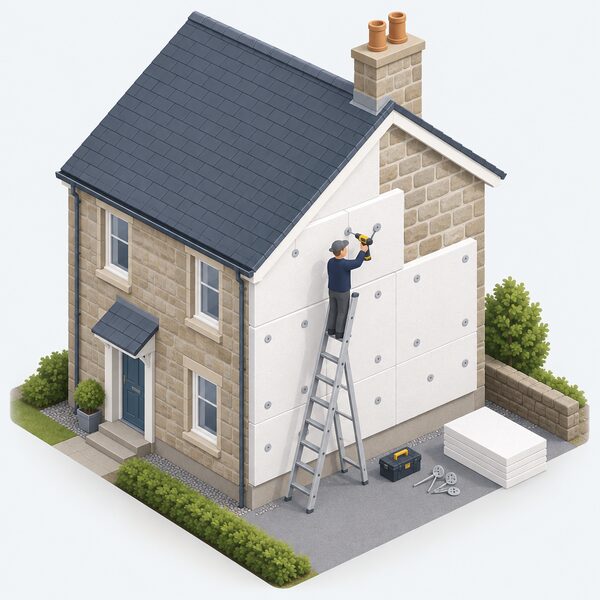
Retrofit advice and installation in the UK is underpinned by quality schemes. TrustMark is a government endorsed quality scheme, and it acts as quality scheme administrator23. For a householder, a TrustMark registered installer is the standard marker that the work will be done to a recognised specification.
The technical standards are set out in regulation. The Boiler Upgrade Scheme regulations cite BS EN ISO/IEC 17065:2012, the conformity assessment standard for bodies certifying products, processes and services25. Edinburgh's High Rise Retrofit and Upgrade Programme Phase 1 records standards exceeded of EESH2 and SHNZS26. These are the benchmarks against which retrofit work in Scotland is assessed.
The training pipeline is the weak point. The Scottish Government's review of retrofit assessment records that skills shortages are directly impacting on capacity to deliver sufficiently technical standards of independent and impartial advice, leading to projects with sub-standard and negative outcomes, which then impact on public trust10. The tenements working group report states that sufficient numbers of appropriately trained architects, surveyors and tradespeople are needed within the industry, preferably with local knowledge and specialist expertise11. CITB's Building Skills for Net Zero work projected annual recruitment ramping up by 30,000 each year in the following five years to meet the government's Net Zero target27.
For a householder, the implication is that the quality of advice and installation depends on who is doing it, and that the sector itself acknowledges a shortage of people trained to the required standard.
Getting in touch: offices, advice line and newsletters
Changeworks is based at 36 Newhaven Road, Edinburgh, EH6 5PY1. The main route for energy advice is the Home Energy Scotland line, which it delivers on behalf of the Scottish Government4. Edinburgh residents can also reach support through the city council's energy efficiency pages, which name Changeworks as the trusted partner for energy efficiency advice and describe the help available as finding out what you can do to feel warmer in your home and what support and grants are available3.
For households in other parts of Scotland, the council route varies. Argyll and Bute, for example, directs home energy efficiency enquiries to Home Energy Scotland as its referral partner5. Ofgem's Domestic RHI guidance also points to Home Energy Scotland for free impartial advice on energy efficiency and renewable energy in Scotland8.
Northern Ireland has a separate arrangement: NI Energy Advice states that its advice is free and impartial28. The Northern Ireland Housing Executive also provides energy advice28. The energy-saving materials rules applying to Northern Ireland exist for the purpose of ensuring consistency across the whole of the United Kingdom29, but the advice delivery bodies are distinct.
The Green Deal scheme helped people to make energy-saving improvements to their home30, and it is now closed to new applicants, so it is not a current route. Changeworks published a case study in October 2025 describing the Green Energy Helpline supporting a householder called James, where an advisor helped him find an MCS accredited installer for extra battery storage and referred him to Home Energy Scotland for solar thermal and floor insulation funding.
"If you haven't already been offered a smart meter, you can request one from your supplier."
Sources31 cited
- Changeworks, British Gas Energy Trust, 2026-02-04
- Tackling fuel poverty in rural communities, British Gas Energy Trust, 2024-07-24
- Financial help, energy efficiency and low carbon heating improvements, City of Edinburgh Council, 2026-09-20
- Heat in Buildings progress report 2025, Scottish Government, 2025-10-02
- Home energy efficiency, Argyll and Bute Council, 2026-09-17
- Fuel poverty scenario modelling based on Ofgem energy price caps up to April to June 2026, Scottish Government, 2026
- Local and small scale renewables, Scottish Government, 2026-09-17
- Who to contact, Ofgem
- Do you need planning permission for retrofitting, South Oxfordshire District Council, 2025-08-15
- Review of retrofit assessment in Scotland, Scottish Government, 2025-06-06
- Tenements short life working group: energy efficiency and zero emissions heating, Scottish Government, 2023-11-28
- ECO4 Flex and GBIS Flex information document, Ceredigion County Council, 2025-11
- Scenario modelling: impact of the reduction of the Renewables Obligation and ending ECO, Scottish Government, 2026
- Getting help with your energy bills, Birmingham City Council, 2026-04-15
- Fuel poverty definitions, House of Commons Library, 2026-09-17
- Fuel Poverty Strategy for England, UK Government, 2026-01-21
- Fuel poverty in England, House of Commons Library, 2025-04
- Tackling Fuel Poverty 2021-2035, Welsh Government, 2021-04
- Fuel poverty, Scottish Government, 2026-09-17
- Winter Wellbeing, Cornwall Council, 2026-06-30
- Energy Performance of Buildings Certificates statistical release, UK Government, 2026-05-19
- Energy price cap: programme of work for 2026 and 2027, Ofgem, 2026-08-26
- What to do if you have poor quality wall insulation, UK Government, 2025-01-23
- Get a grant or loan to improve your home energy efficiency, Bristol City Council, 2026
- Boiler Upgrade Scheme regulations: approved standards, grant categories and grant levels, UK Government, 2026-07-21
- High Rise Retrofit and Upgrade Programme Phase 1, City of Edinburgh Council, 2026-04-20
- Building Skills for Net Zero, UK Government, 2021
- NI Energy Advice, Northern Ireland Housing Executive, 2026-09-17
- VAT energy saving materials and grant funded heating supplies, HM Revenue and Customs, 2026-09-17
- Green Deal energy saving measures, UK Government, 2026-09-17
- How accurate are smart meters?, Smart DCC, 2026