

In this answer
Short answer
The Warm Home Discount is a one-off £150 discount off household electricity bills, funded through a levy on all domestic electricity suppliers and delivered by energy suppliers rather than by the government directly1. It is a fuel poverty reduction scheme, reducing the energy costs of low-income and vulnerable households across Great Britain, and in winter 2025-26 it reached around 6 million households1.
Eligibility turns on three things: who supplies your electricity, which benefits the person named on the bill receives, and whether that person was named on the bill on the qualifying date. For winter 2026 to 2027 the qualifying date is 23 August 20263. For winter 2025/26 it was 24 August 20254.
The scheme operates in England, Wales and Scotland. It does not run in Northern Ireland, where separate arrangements apply. Scotland has its own regulations and a different structure of groups, and park home residents who buy electricity through their site owner fall outside the main scheme entirely and use a separate application route3.
What the Warm Home Discount is and who it is for
The scheme was first introduced by the Government in 2011 to support low-income households9. It is administered by larger energy suppliers, with some smaller suppliers participating voluntarily, and its stated purpose is to support people who are in or at risk from being in fuel poverty10. Ofgem describes it as a fuel poverty reduction scheme, reducing the energy costs of low-income and vulnerable households across Great Britain1.
The £150 rebate is funded through a levy on all domestic electricity customers, so the cost is spread across the supplier base rather than met by government spending1. That structure matters to how the scheme behaves: suppliers are obliged to deliver it, and the obligation falls on suppliers with more than 1,000 domestic customers, while smaller suppliers may offer it voluntarily11.
The scheme has been continued rather than wound down. Regulations re-enact with amendments the 2022 Regulations to continue the Scheme in England and Wales until 31 March 20308. In Scotland the Warm Home Discount (Scotland) Scheme has effect until 31 March 2031, with certain duties continuing afterwards5. A government consultation outcome set out a plan to merge the current Core Group 1 and Core Group 2 into a single Core Group in England and Wales, retaining the expanded eligibility criteria from 2025/268.
For a household, the discount is a direct reduction in the electricity bill and requires no capital outlay, no installer and no property works. What it does not do is reduce consumption or remove dependence on the grid and a supplier: it is a payment routed through the electricity account, and it depends on that account remaining with a participating supplier. Households looking at the wider picture of bill reduction and self-sufficiency can compare it with the Winter Fuel Payment and with grant-funded measures covered in the Home Energy Grants and Schemes in the UK guide.
The discount: £150 off your electricity bill
The scheme primarily provides support through the provision of £150 energy bill rebates1. The same figure appears across the official documents: a one-off £150 discount off household electricity bills2, a £150 rebate off electricity bills12, and a £150 one-off discount on the electricity bill13. The Met Office describes it as a one-off payment giving eligible older and low-income consumers £150 off their energy bill14.
Two points about the money are worth stating plainly. First, it is a discount on electricity, not on gas, even though the household's total energy costs are the reason for the scheme. Second, it is one payment per household, not per person and not per fuel.
The scheme is a one-off £150 discount on the electricity bill, funded through a levy on all domestic energy bill payers and paid to eligible older and low-income consumers1. The same £150 figure appears across the official guidance, the statistics publication and the legislation: a £150 rebate off electricity bills, a £150 energy bill rebate, and a £150 one-off discount on your electricity bill2.
The scheme's value to a household is also modest in proportion to a bill. Independent reporting has put the discount at around 14% of a typical bill in one account and around 8% in another, published on the same date. Those two figures disagree and neither is ruled on, so the proportion should be treated as uncertain. What is not uncertain is the cash value and the fact that it is applied to the electricity account.
"The scheme primarily provides support through the provision of £150 energy bill rebates, funded through a levy on all domestic electricity suppliers."
Core group and broader group: which one qualifies you
The scheme sorts eligible households into groups, and which group you fall into determines whether the discount arrives automatically or has to be applied for.
In England and Wales, the core group is the automatic route. Being in the core group means the discount is applied without an application15. The eligibility statement for the 2025 to 2026 scheme year describes eligibility for a rebate under Core Group 2 as determined by low-income criteria (qualifying means tested benefits) and eligible property types4. The government has since consulted on merging Core Group 1 and Core Group 2 into a single Core Group in England and Wales, retaining the expanded eligibility criteria from 2025/268.
In Scotland the structure is different. The core group there also requires no application, but eligibility criteria must still be met, and the broader group requires an application and the meeting of eligibility criteria16. Ofgem confirms that in Scotland the core group, industry initiatives and broader group apply to the scheme1. An application process still applies in Scotland for those people in Core Group 2, known there as the Broader Group17.
The practical consequence is that a household in England or Wales receiving a qualifying means-tested benefit can generally expect the rebate without doing anything, while a household in Scotland may need to apply depending on which group it falls into. The Warm Home Discount page covers the scheme as a whole, and the Warm Home Discount vs Winter Fuel Payment comparison sets the two payments side by side.
| England and Wales | Scotland | |
|---|---|---|
| Automatic route | Core group, no application needed15 | Core group, no application needed but criteria must be met16 |
| Application route | Core Group 2 historically, being merged into a single Core Group8 | Broader group, application required16 |
| Vulnerability test | Not part of the core benefit test | Required for the broader group18 |
| Scheme end date | 31 March 20308 | 31 March 20315 |
Eligibility in England and Wales: the qualifying means-tested benefits

The central change in England and Wales is the removal of the property test. Removing the high cost to heat threshold makes all energy bill payers who receive a qualifying means-tested benefit eligible1. The high-cost-to-heat eligibility threshold which applied in England and Wales has been removed from October 2025, allowing all households in receipt of specified means-tested benefits to qualify2. The qualifying benefits are Housing Benefit, income-related ESA, income-based JSA, Income Support, Pension Credit and Universal Credit, and the energy provider must be part of the scheme3.
That means the condition is about the benefit and the bill, not about the building. The person named on the energy bill, or their partner or legal representative, must receive a qualifying means-tested benefit on the qualifying date8. For winter 2026 to 2027 the qualifying date is 23 August 20263.
The qualifying benefits for the core group in England and Wales are Housing Benefit, Income-related Employment and Support Allowance, Income-based Jobseeker's Allowance, Income Support, the Savings Credit element of Pension Credit, and Universal Credit18. Independent guidance lists the same set in slightly different words: Housing Benefit, income-related ESA, income-based JSA, Income Support, Pension Credit and Universal Credit11.
The two core group definitions differ in scope. Core Group 1 in England and Wales turned on receipt of the Guarantee Credit element of Pension Credit on the qualifying date for that scheme year, while Core Group 2 turned on the wider list of means-tested benefits1. From winter 2026/27, eligibility rests on receipt of the Guarantee Credit element of Pension Credit or a qualifying benefit by the person named on the bill, or their partner or legal representative, on the qualifying date2.
For a household, the removal of the property threshold is the significant change: a flat that is cheap to heat now qualifies on the same terms as a poorly insulated house, provided the benefit condition is met on the qualifying date. Households whose benefit position is uncertain can check which benefits open other routes in Which Benefits Qualify You for Energy Grants.
Eligibility in Scotland: the different rules
Scotland operates under its own regulations and its own eligibility test. Fuel poverty is a devolved matter, and Scottish Government ministers have determined eligibility for Warm Home Discount in Scotland for the next scheme period within the funding limit8.
The Scottish broader group applies a two-part test. Applicants must meet a low-income requirement tested through specific qualifying benefits, and a vulnerability requirement. The vulnerability criteria are a child under 5, an income related qualifying component, limited capacity for work element, a disabled child element, or a disabled element18. That is a materially different test from England and Wales, where the property threshold has been removed and the benefit condition carries the weight.
Independent guidance describes the Scottish automatic route as turning on being named on the electricity bill before 23 August 2026 and getting a qualifying benefit, listing Pension Credit, an extra amount of Universal Credit for disability or health condition, a disability or pensioner premium of income-related ESA, or a disability or pensioner premium with a Support for Mortgage Interest loan11.
The Scottish regulations also set out eligibility based on receipt of loan payments under the Loans for Mortgage Interest Regulations 2017 and related provisions5. The scheme in Scotland has effect until 31 March 2031, with certain duties continuing afterwards5.
For a Scottish household the practical difference is the application step and the vulnerability test. A household on a qualifying benefit without one of the vulnerability criteria may not qualify through the broader group, even where the same household in England or Wales would receive the rebate automatically. The Home Energy Grants in Scotland page covers the separate Scottish grant landscape.
Park homes: a separate scheme with its own application
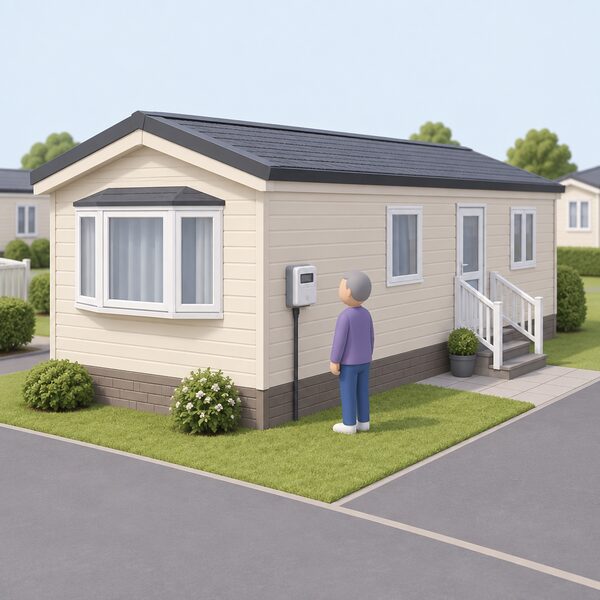
Households that buy electricity through an intermediary, such as a park site owner, are not eligible for the main Warm Home Discount scheme3. Instead they use the Park Homes Warm Home Discount Scheme.
To be eligible for the Park Homes scheme in 2026/27, applicants must be a permanent resident of a park home, pay the park site owner for electricity usage, and be on a relevant qualifying benefit or demonstrate household income or fuel poverty criteria3. The scheme is for permanent residents of park homes who pay the site owner for their electricity, and residents need to apply each year, with only one application per household considered18. The 2025/2026 payment was £15018.
Eligibility is decided by the scheme administrator, currently Charis Grants3. Ofgem's guidance for alternative homes confirms that a resident of a park home who pays the site owner for energy could qualify for the Park Homes Warm Home Discount Scheme19.
The independence point here is direct: because the electricity account sits with the site owner rather than the resident, the resident cannot be matched automatically and cannot receive the main scheme's rebate. The separate scheme exists precisely because the supply arrangement breaks the normal data-matching route.
How the payment arrives, and when
The payment for the 2026-2027 scheme will be made at any time from October 2026 to the end of March 20276. Most people should receive their Warm Home Discount by 31 March20, and the payment deadline is 31 March 20277. In England and Wales, if eligible, the electricity supplier will apply the discount to the bill by 31 March 20277.
The discount is paid automatically through the electricity supplier, either by adding credit to the account or by issuing a voucher for prepayment meter top-up6. Prepayment and pay-as-you-go electricity meter customers can still get the discount if eligible20. Where a prepayment meter is in use, the supplier confirms how the discount is given, and it might be a voucher to top up the meter11.
Notification comes before payment. A letter from the supplier arrives before January of the qualifying year if the household is eligible for the scheme or is being migrated onto it17. If the discount has not appeared on the bill by the end of March, the supplier should be contacted21. Where a household believes it meets the criteria but has not received a letter, the Warm Home Discount helpline covers England, Wales and Scotland22.
Two conditions govern the payment. The household must stay with the same supplier until the discount is paid11. And switching away from a supplier that offers the discount to one that does not means losing it, even for the core group, so the new supplier's criteria are worth checking before switching11. If a switch happens after the date eligibility is checked, the discount might still come from the supplier the household was with on that date20. Not all suppliers offer the scheme, and switching after receiving the discount avoids losing it that year23.
Claiming the Warm Home Discount does not affect eligibility for any other discounts or payments6. It sits alongside the Winter Fuel Payment, which is a £150 discount on bills for people who get Pension Credit or live in a low-income household24, and alongside Cold Weather Payments. Households in debt or facing a crisis have separate routes through Crisis Funds, Hardship Grants and Energy Debt Help.
Sources24 cited
- Warm Home Discount (WHD), Ofgem, 2026-09-17
- Warm Home Discount statistics 2025 to 2026, GOV.UK, 2026-09-17
- Warm Home Discount eligibility statement, England and Wales, 2026 to 2027, GOV.UK, 2026-09-17
- Warm Home Discount eligibility statement, England and Wales, 2025 to 2026, GOV.UK, 2025-09-30
- The Warm Home Discount (Scotland) Scheme 2026, legislation.gov.uk, 2026
- Warm Home Discount guide, Uswitch, 2026-08-12
- Grants and benefits to help you pay your energy bills, Citizens Advice, 2026-09-17
- Continuing the Warm Home Discount Scheme: government response, GOV.UK, 2026-01-30
- DESNZ annual report and accounts 2025 to 2026: performance report, GOV.UK, 2026-05-07
- Heating your home, Carmarthenshire County Council, 2026-04-04
- Warm Home Discount, Which?, 2026-08-04
- Grants and funding, Tameside Council, 2026-09-17
- Financial support for home energy, Energy Saving Trust, 2026-09-14
- Keeping your home warm in winter, Met Office, 2026-09-20
- Warm Home Discount: if you live in England and Wales, GOV.UK, 2026-09-17
- Warm Home Discount Scheme, OVO Energy, 2026-08-12
- Your home energy checklist, National Energy Action, 2026-09-10
- Warm Home Discount Scheme (research briefing SN06163), House of Commons Library, 2026-02-26
- Alternative homes energy guidance, Ofgem, 2026
- Grants and benefits to help you pay your energy bills (Scotland), Citizens Advice Scotland, 2026-09-17
- Warm Home Discount, Fuse Energy, 2026-07-05
- Warm Home Discount, StepChange, 2026-09-20
- Dealing with your energy supplier, Centre for Sustainable Energy, 2026-01
- Winter Fuel Payment, GOV.UK, 2026-09-17
 The Full Grants and Schemes GuideWhich grants can you actually get right now, and how do you apply for them?
 Check Which Energy Grants ApplyWhich energy grants can you actually get right now, and which have closed?
 Older People and Home EnergyOlder people often pay more to keep warm and can miss out on help they are entitled to.
 Why Energy Grants DifferWhere you live in the UK changes which home energy grants you can get.
 The Full Heat Pumps GuideWill a heat pump keep my house warm in winter, and what does one cost to buy and run?
 Which Homes Suit a Heat PumpMost UK homes can have a heat pump fitted, so the real question is whether yours makes it easy or expensive.