

In this comparison
The Warm Home Discount and the Winter Fuel Payment are two separate payments with two separate purposes. The Warm Home Discount is a £150 one-off discount off household electricity bills, funded through a levy on all domestic gas and electricity customers and administered by large energy suppliers1. The Winter Fuel Payment is a payment to help with winter heating bills, made automatically to eligible people, usually between November and December3.
They are not alternatives to each other. A household receiving Pension Credit should also be eligible for the Winter Fuel Payment, so the two can arrive in the same winter4. The Warm Home Discount covers England, Scotland and Wales and runs until 31 March 20312. The Winter Fuel Payment is administered separately, with a letter in October or November telling recipients how much they will get3.
The practical difference is what each payment is for. The Warm Home Discount is a fuel poverty reduction scheme, reducing the energy costs of low-income and vulnerable households across Great Britain since its inception in 20112. The Winter Fuel Payment is a broader winter heating payment, and it is not the same as a Cold Weather Payment, which is triggered by sustained cold weather in a local area6.

Two different payments, two different purposes
The Warm Home Discount is targeted support, described in official guidance as direct financial assistance for paying bills9. It is a one-off £150 discount off household electricity bills, applied through the supplier1. The scheme helps households in, or at risk of, fuel poverty with direct energy bill payments as well as other financial and energy-related support10.
The Winter Fuel Payment is a payment to help with winter heating bills3. It is paid automatically to eligible people, usually between November and December, and recipients get a letter in October or November telling them how much they will get3. It is not the same as a Cold Weather Payment, which is a separate scheme triggered by cold weather in a local area6.
The two payments also differ in how they are funded. The Warm Home Discount is funded through a levy on all domestic gas and electricity customers, so every household with a domestic energy account contributes to it2. The Winter Fuel Payment is paid from general taxation and is not a levy on energy bills.
For a household's energy independence, neither payment reduces dependence on the grid or on a supplier. Both are cash transfers that reduce the size of a bill. The Warm Home Discount in reality has no impact on improving energy efficiency, and therefore does not help deliver policy aims such as reducing greenhouse gas emissions, cutting reliance on fossil fuel imports and providing green jobs11. That is a limit worth stating plainly: the discount lowers the cost of the energy a household buys, but it does not change how much energy the home needs or where that energy comes from.
Warm Home Discount: a £150 discount on the electricity bill
The Warm Home Discount is a one-off £150 discount off household electricity bills1. It is described in official guidance as a £150 energy bill rebate, funded through a levy on all domestic gas and electricity customers2. The scheme requires large domestic energy suppliers to provide an annual discount of £150 to eligible households7.
The discount is applied to the electricity bill, not the gas bill, and it is a one-off payment rather than a weekly or monthly credit1. It is applied to eligible customers' electricity bills between October and April8. The scheme runs in annual scheme years2.
There is a conflict in the published figures. One official source describes the payment as a one-off £140 payment applied to eligible customers' electricity bills between October and April8, while the current scheme figure is £1501. The £150 figure is the one used in the current scheme statistics and in the eligibility statements, and the £140 figure appears in older material. Households should work on £150 for the current scheme year.
The scheme has grown. It now reaches around 6 million households, and has been confirmed through to 2030-317. Earlier material described it as supporting two and a half million low-income and vulnerable households8, and a 2021 select committee report said the scheme helps over 2 million low income and vulnerable households each winter with their energy costs12. The growth reflects both the removal of the high-cost-to-heat threshold and the expansion of the scheme.
Who qualifies for each payment
Eligibility for the two payments works in different ways.
For the Warm Home Discount in England and Wales, a household qualifies if its energy provider is part of the scheme and it is receiving a means-tested benefit: Housing Benefit, income-related ESA, income-based JSA, Income Support, Pension Credit or Universal Credit4. The high-cost-to-heat eligibility threshold that applied in England and Wales has been removed from October 2025, allowing all households in receipt of specified means-tested benefits to qualify13. Removing the high cost to heat threshold makes all energy bill payers who receive a qualifying means-tested benefit eligible14.
For the Winter Fuel Payment, eligibility is based on age and benefit receipt, and most people eligible are paid automatically, with a letter in October or November and most payments made in November or December13. Payment is usually made automatically to eligible people during November and December15.
Scotland runs its own arrangements. The Winter Heating Payment is a single annual payment of £59.75 to all eligible households for winter 2025/2613. Unlike the Cold Weather Payment, eligibility does not depend on a period of cold weather where the household lives; households qualify if they were getting a qualifying benefit and met the other conditions on any day of the qualifying week, the week running from the first Monday in November13. The Child Winter Heating Payment is paid once a year from October and through the winter16.
| Payment | Amount | Who it reaches | When |
|---|---|---|---|
| Warm Home Discount | £150 off electricity bills1 | Low-income and vulnerable households in England, Scotland and Wales2 | Between October and April8 |
| Winter Fuel Payment | Set by eligibility and age3 | Eligible older people, paid automatically3 | November to December3 |
| Winter Heating Payment (Scotland) | £59.75 for winter 2025/2613 | Low-income households in Scotland meeting the qualifying conditions13 | December to February13 |
| Child Winter Heating Payment (Scotland) | Paid once a year16 | Families with a disabled child or young person16 | From October through the winter16 |
How and when each payment reaches you
The Warm Home Discount should appear on the electricity bill by the end of March 2027, and the household must stay with the same supplier until it is paid4. The discount is applied between October and April8. Suppliers confirm how the discount is given, and for prepayment meter customers it may be a voucher to top up the meter4.
The Winter Fuel Payment is usually made automatically between November and December3. Recipients get a letter in October or November telling them how much they will get5. Most eligible people will be paid in November or December 20263.
In Scotland, the Winter Heating Payment is paid from December and through winter each year17. Payments should be made automatically, between December and February13. It appears as WHP on bank statements17.
The Winter Fuel Payment is also paid automatically in Northern Ireland, with payment usually made automatically to eligible people during November and December15. Eligible recipients get a letter during October or November18.
For a household, the practical point is that neither payment requires a claim in the normal case. Both arrive automatically once eligibility is established, and the letter is the notification rather than an application form.
Can you get both?
Yes. The two payments are separate and a household can receive both in the same winter. Households receiving Pension Credit should also be eligible for the Winter Fuel Payment4. Since Pension Credit is also a qualifying means-tested benefit for the Warm Home Discount in England and Wales4, a Pension Credit household can receive the £150 electricity discount and the Winter Fuel Payment in the same winter.
The two payments are not mutually exclusive and neither reduces the other. The Warm Home Discount is a discount off the electricity bill1, while the Winter Fuel Payment is a payment to help with winter heating bills3. They are administered through different routes: the discount through the energy supplier, the Winter Fuel Payment through the Department for Work and Pensions.
A household in Scotland can receive the Winter Heating Payment and the Warm Home Discount, since the Warm Home Discount covers Scotland as well as England and Wales2. The Scottish scheme has its own eligibility rules, which are set by Scottish Government ministers within the funding limit19.
Where the Warm Home Discount falls short
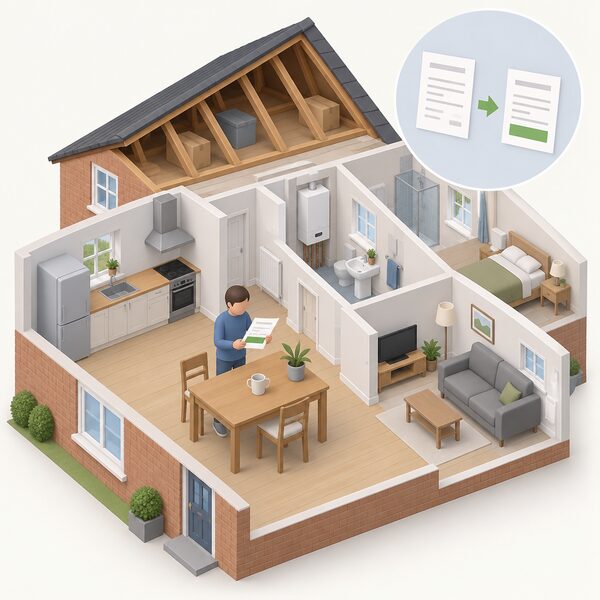
The Warm Home Discount has a clear limit: it reduces the bill but does not reduce the energy a home needs. In reality it has no impact on improving energy efficiency, and therefore does not help deliver policy aims such as reducing greenhouse gas emissions, cutting reliance on fossil fuel imports and providing green jobs11.
That matters for a household thinking about energy independence. The discount is a transfer from other energy customers, not an investment in the home. It does not insulate a loft, replace a boiler or install a heat pump. Households wanting to reduce their dependence on bought energy need a different route, such as the Warm Homes: Local Grant or the Energy Company Obligation.
The discount is also capped by the levy that funds it. It currently costs £350 million per year8, and the scheme is funded through a levy on all domestic gas and electricity customers2. That means the cost is spread across every domestic energy account, including those of households that do not receive the discount.
There is also a timing limit. The discount should appear on the electricity bill by the end of March 2027, and the household must stay with the same supplier until it is paid4. A household that switches supplier before the discount is paid risks losing it.
How the Warm Home Discount is funded and what it costs everyone
The Warm Home Discount is funded through a levy on all domestic gas and electricity customers2. It currently costs £350 million per year8. The scheme primarily provides support through the provision of £150 energy bill rebates, funded through a levy on all domestic customers20.
The scheme helps households in, or at risk of, fuel poverty with direct energy bill payments as well as other financial and energy-related support10. That means not all of the £350 million goes out as £150 discounts. Some is spent on other financial and energy-related support, including the Industry Initiatives element.
From April 2026 there is a change to how the cost is recovered. The government is shifting the recovery of Warm Home Discount costs from the standing charge to the unit rate from April 20267. That changes how the cost appears on a bill: instead of being spread across the standing charge, it is recovered through the price per unit of energy used.
For a household, the levy means the Warm Home Discount is not free money from government. It is a redistribution across domestic energy customers. Households that do not qualify still contribute through their bills. That is the trade-off the scheme embodies: a guaranteed £150 for eligible households, paid for by a small addition to everyone's energy costs.
What changes are proposed for the scheme
The Warm Home Discount has been confirmed through to 2030-317. The scheme covers England, Scotland and Wales and will run until 31 March 20312. The government will be consulting later in the year on the future of the scheme beyond the current regulations14.
The Scottish scheme has its own legislative basis. The scheme for reducing fuel poverty was established by the Warm Home Discount Regulations 2011 and continued in Scotland by the Warm Home Discount (Scotland) Regulations 202221. The Warm Home Discount (Scotland) Scheme has effect until 31 March 2031, with certain duties continuing afterwards21. Scottish Government ministers have determined eligibility for Warm Home Discount in Scotland for the next scheme period within the funding limit19.
There is also a supplier duty that matters when the scheme changes. A supplier that participated in the preceding scheme year but not the current one must place a statement on its website that it is not participating in the Warm Home Discount scheme, and notify former core group customers in writing, on or before the date one month after the scheme year starts22.
For households, the direction of travel is a scheme that continues but is under review. The consultation on the future of the scheme beyond the current regulations is the point at which eligibility and funding could change. Households that rely on the discount should watch for the outcome of that consultation rather than assume the current rules continue indefinitely.
Warm Home Discount in Scotland, Wales and Northern Ireland
The Warm Home Discount covers England, Scotland and Wales2. It does not run in Northern Ireland, where an Affordable Warmth Scheme is available instead2. Northern Ireland also received separate price support, with discounts of up to 19.9 p/kWh for electricity and 4.8 p/kWh for gas in the fourth quarter of 202223.
Scotland has a separate eligibility route. Households there should get the Warm Home Discount automatically if they are named on the electricity bill before 23 August 2026 and are getting a qualifying benefit: Pension Credit, an extra amount of Universal Credit for a disability or health condition, a disability or pensioner premium of income-related ESA, or a disability or pensioner premium with a Support for Mortgage Interest loan4. Fuel poverty is a devolved matter, and Scottish Government ministers have determined eligibility for Warm Home Discount in Scotland for the next scheme period within the funding limit19.
Wales is covered by the England and Wales scheme, and Welsh households qualify on the same means-tested benefit basis4. Local authority material in Wales points households to the Warm Homes Discount as one of the supports available, alongside other cost-of-living help24.
Park home residents have a separate route. The Park Homes Warm Home Discount Scheme is for permanent residents of park homes who pay the site owner for their electricity, are paying council tax and receiving certain benefits or on a low income; they need to apply each year and only one application per household is considered13. For 2026/27, applicants must be a permanent resident of a park home, pay the park site owner for electricity usage and be on a relevant qualifying benefit or demonstrate household income or fuel poverty criteria10. The scheme pays £150 and is funded by participating energy suppliers as part of Industry Initiatives13. Caravan residents who need to claim should contact the Warm Home Discount helpline and provide evidence that the caravan is their sole, legal residence and that they are named on the electricity bill10.
Sources25 cited
- Warm Home Discount statistics 2025 to 2026, GOV.UK, 2026
- Warm Home Discount, Ofgem, 2026
- Winter Fuel Payment, GOV.UK, 2026
- Warm Home Discount, Which?, 2026
- Winter Fuel Payment: how much you'll get, GOV.UK, 2026
- Cold Weather Payment, GOV.UK, 2026
- Warm Home Discount statistics 2025 to 2026, GOV.UK, 2026
- DESNZ annual report and accounts 2025 to 2026, Department for Energy Security and Net Zero, 2026
- Warm Home Discount statistics 2024 to 2025, GOV.UK, 2025
- Warm Home Discount eligibility statement England and Wales 2026 to 2027, GOV.UK, 2026
- Evaluation of the Warm Home Discount Scheme 2022 to 2024, GOV.UK, 2025
- Warm Home Discount, House of Commons Environmental Audit Committee, 2021
- Warm Home Discount, House of Commons Library, 2026
- Warm Home Discount (Amendment) Regulations 2025Regulations2025), Hansard, 2025
- Cost of living and winter support, Belfast City Council, 2026
- Child Winter Heating Payment, mygov.scot, 2026
- Winter Heating Payment, mygov.scot, 2026
- Winter Fuel Payment, nidirect, 2026
- Continuing the Warm Home Discount Scheme: government response, GOV.UK, 2026
- Warm Home Discount guidance England and Wales, Ofgem, 2022
- The Warm Home Discount (Scotland) Regulations 2026, legislation.gov.uk, 2026
- The Warm Home Discount Regulations 2018, legislation.gov.uk, 2018
- Winter fuel payment schemes, House of Commons Library, 2026
- Help with household costs, Isle of Anglesey County Council, 2026
- Heating your home, Carmarthenshire County Council, 2026
 Older People and Home EnergyOlder people often pay more to keep warm and can miss out on help they are entitled to.
 Dual Fuel TariffsExplains what a dual fuel tariff is, how discounts and single billing work, and where separate gas and electricity contracts remain available.
 Vulnerable Households EnergyIf someone in your home relies on powered medical equipment, or needs extra warmth because of a health condition, what help is available?
 Fuel Poverty in the UKWho counts as living in fuel poverty, and why does the number change depending on where in the UK you live?
 Flexibility Payments for HomesCan you really get paid for using less electricity at peak times, and how much would a household actually earn?
 Weather Compensation ControlsDoes your boiler or heat pump run hotter on cold days and cooler when it is mild?