
In this answer
Short answer
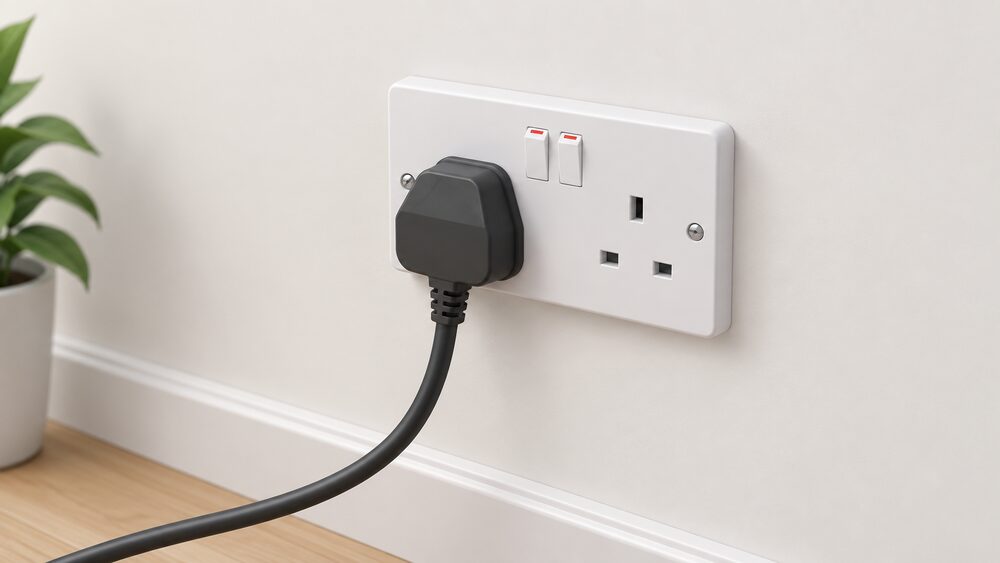
Extension leads, cable reels and multi-socket adaptors are prohibited for plug-in solar connections in Great Britain. The interim product specification for plug-in solar devices states that extension cables, multi-way adaptors, RCD adaptors and travel adaptors are not permitted1. Electrical Safety First, the independent safety charity, confirms that extension leads and multi-socket adaptors are prohibited2. The system must connect directly to a suitable socket.
The prohibition exists because plug-in solar panels feed electricity into a property's wiring in a way it was not originally designed to accommodate, which may render some lifesaving protective devices, such as RCDs, less effective3. Extension leads and adaptors are not designed for the backflow of current that solar generation creates4. A joint statement from five electrical safety bodies warns that improvised installations significantly increase the likelihood of overheating and fire5.
Plug-in solar became legal across Great Britain on 27 August 2026, provided products meet defined safety requirements6. The rules allow consumers to connect plug-in solar systems without batteries directly to a standard mains socket, but the connection method is tightly specified7. This page sets out what the rules say about extension leads, what counts as an approved connection, and what the alternatives are.
The short answer: extension leads are not an approved connection method
The rules on this are unambiguous. Extension leads and multi-socket adaptors are prohibited for plug-in solar2. The interim product specification, published by the government in July 2026, states that the use of extension cables, multi-way adaptors, RCD adaptors and travel adaptors are not permitted1. An earlier version of the specification, from June 2026, required a warning that plug-in solar devices shall not be connected to extension cable or multi-way adaptor1.
The prohibition extends beyond simple extension leads. Cable reels, multiway adaptors, travel adaptors and plug-in RCD adaptors should not be used8. The specification also prohibits AC interconnection or connection of multiple inverter units to the same circuit by means of extension cables, plug couplers or in-line connector systems1. Multi-way adaptors, travel adaptors and plug convertors shall not be permitted on the AC side1.
The reason is electrical safety. Extension leads, smart plugs and adaptors are not designed for the backflow of current, and using them for plug-in solar is unsafe4. Plug-in solar panels feed electricity into a property's wiring in a way it was not originally designed to accommodate, and this may render some lifesaving protective devices, such as RCDs, less effective3. The risk is not theoretical: a joint statement from the ECA, Electrical Safety First, IET, NICEIC and SELECT warns that improvised installations significantly increase the likelihood of overheating and fire, with trip and fall hazards and risk of falling from height, a particular concern in high-rise buildings5.
For a household, the practical effect is that the panel's cable must reach a suitable socket without any intermediate lead or adaptor. If the cable does not reach, the installation is not compliant. The socket itself must be on a circuit that meets the specification's requirements.
Why the connection method matters for safety
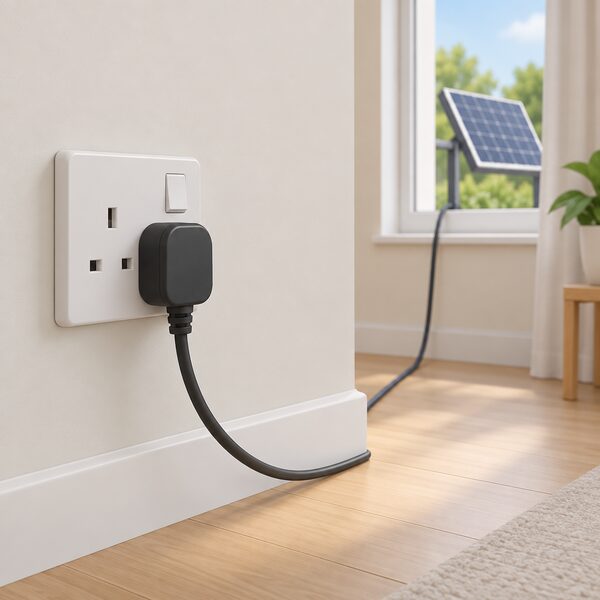
The connection method is the single most important safety variable in a plug-in solar installation. Unlike a rooftop system, which is hard wired into the property via its own dedicated circuit, a plug-in system relies on the existing ring main and its protective devices3. That is why the specification is so prescriptive about what may and may not be used.
Plug-in solar PV systems connected to standard household sockets can cause overheating or impair the operation of protective devices such as RCDs in a property, according to the electrical safety study commissioned by the government10. The risk remains low, but without wiring regulation changes and under certain conditions, these effects are possible10. The study proposed a simplified registration approach to support safe and proportionate rollout11.
The specification addresses this by requiring that any necessary testing and modifications of the building's electrical system shall only be performed by professional electricians1. It also requires that any attachment method shall be reversible and non-permanent1. The installation must not be on ACM cladding systems, MCM cladding systems, HPL cladding systems, timber cladding systems or timber balconies1.
"Improvised installations significantly increase the likelihood of overheating and fire"
The safety concern is not limited to the lead itself. Extension leads introduce additional resistance and connection points, each of which is a potential source of overheating. They also create trip hazards and, in high-rise buildings, raise the risk of falls from height when cables are run across balconies or through windows5. The specification's prohibition is therefore a package of measures, not a single rule.
For a household, the safety case for avoiding extension leads is straightforward: the protective devices in the property, particularly RCDs, are designed around a direct connection. Introducing an extension lead or adaptor can undermine that protection. The specification exists to ensure that the connection is made in the way the wiring was designed to accommodate.
What counts as an approved connection for plug-in solar
An approved connection is a direct connection to a standard UK household socket using a plug designed to BS 1363-11. The plug-in solar device must comply with the interim product specification, and compliance with that specification is relevant under the Electricity Safety, Quality and Continuity Regulations in determining whether a device may be connected to and used on the consumer's electrical connection7.
The legislation on plug standards is specific. A standard plug intended to be fitted to or supplied for use with a plug-in microgenerator is approved if plugs of that type do not conform to BS 1363 because BS 1363 contains a provision which prohibits or restricts the use of the plug for the connection of an electricity-generating device to a socket-outlet; except in respect of that prohibition or restriction, plugs of that type conform to BS 1363; plugs of that type comply with the Plug-in Solar Device Interim Product Specification; and by means of inspection or testing of samples of plugs of that type, the manufacturer of the plug may reasonably be expected to ensure that normal production and design of the plug will result in plugs of that type corresponding with the samples12.
In practice, this means the plug on a compliant plug-in solar kit is a special variant of the standard UK plug, designed to allow reverse current flow while retaining the safety features of BS 1363. The specification also requires that all connectors shall fulfil the requirements of BS EN 62852 for DC-side connectors1.
The connection must be to a suitable socket. The Energy Networks Association's guidance states that plug-in solar is designed to connect directly to a standard UK household socket, and the use of extension cables is not permitted13. The consumer guide from Electrical Safety First lists prohibited connections: extension leads, cable reels, multiway adapters, travel adapters, RCD adapters, lighting circuits, and circuits supplying fixed equipment such as ovens and hobs14.
| Connection method | Status | Source |
|---|---|---|
| Direct to standard UK socket | Permitted | 1 |
| Extension lead | Prohibited | 1 |
| Cable reel | Prohibited | 8 |
| Multiway adaptor | Prohibited | 1 |
| Travel adaptor | Prohibited | 1 |
| RCD adaptor | Prohibited | 1 |
| Lighting circuit | Prohibited | 14 |
| Circuit supplying fixed equipment | Prohibited | 14 |
The socket itself should be on a circuit protected by at least a Type A bidirectional RCD8. This is a recommendation from Electrical Safety First, not a requirement of the specification, but it reflects the concern that standard RCDs may not operate correctly with reverse current. A bidirectional RCD is designed to detect faults regardless of the direction of current flow.
What the rules say about plug-in solar in Great Britain

Plug-in solar became legal across Great Britain on 27 August 20266. Before that date, UK standards only permitted solar power generation that was permanently connected, meaning wired into the mains and not plugged into a socket15. The change was enabled by the interim product specification, which allows compliant plug-in solar products to be sold and used in the UK16.
The specification applies to single-phase plug-in solar intended for use in a domestic environment1. It requires compliance with the technical requirements for connection and parallel operation with low-voltage distribution networks in Great Britain, specifically Engineering Recommendation G98 Issue 2 Amendment 11. This is the same standard that applies to professionally installed solar systems, and it governs how the system interacts with the grid.
The legal basis for the change includes the Plug-in Solar Device Interim Product Specification, which was published in July 202616. The government consultation on plug-in solar, which ran in June 2026, proposed to allow consumers to connect plug-in solar systems without batteries directly to a standard mains socket, provided products meet defined safety requirements7. The consultation also noted that plug-in solar products will be covered by the General Product Safety Regulations 2005 in Great Britain17.
The planning framework was also amended. The definition of plug-in solar in the legislation means solar photovoltaics that are intended for connection to the relevant domestic premises' electricity installation by means of a standard plug and socket18. Solar PV expressly includes plug-in solar under the 2026 Order, which means plug-in solar is subject to the limitations and conditions in Class A of the permitted development rights19. One of those conditions is that any part of the solar equipment should not be installed on a wooden fence, gate, wall or other means of enclosure20.
The specification also sets out installation restrictions. Installation is not permitted on aluminium composite material cladding systems, metal composite material cladding systems, HPL cladding systems, timber cladding systems or timber balconies1. Any attachment method shall be reversible and non-permanent1. These conditions apply alongside the connection rules.
What happens if I use an extension lead or loose adapter with plug-in solar?
Using an extension lead or loose adapter with plug-in solar is unsafe and non-compliant. Extension leads, smart plugs and adaptors are not designed for the backflow of current, and using them for plug-in solar is unsafe4. The joint statement from the five electrical safety bodies warns that improvised installations significantly increase the likelihood of overheating and fire5.
The risks are multiple. Overheating and fire are the primary concern, because the lead and its connections are not rated for continuous reverse current. There are also trip and fall hazards from cables running across floors or balconies, and a risk of falling from height, which is a particular concern in high-rise buildings5. The safety bodies specifically highlighted the risk in high-rise buildings, where cables may be run through windows or across balconies.
The specification prohibits not only extension leads but also cable reels, multiway adaptors, travel adaptors and RCD adaptors1. It also prohibits AC interconnection or connection of multiple inverter units to the same circuit by means of extension cables, plug couplers or in-line connector systems1. This means that daisy-chaining multiple kits or inverters through any kind of intermediate connector is not permitted.
Only one plug-in solar kit is allowed per home, so multiple kits cannot be plugged into different sockets or run through adaptors2. This rule is separate from the extension lead prohibition but reinforces it: the system is designed as a single, direct connection, not as a distributed arrangement.
For a household, the consequence of using an extension lead is that the installation does not comply with the interim product specification. That may affect insurance, warranty and the legal status of the installation. The specification is the basis on which plug-in solar is permitted, and non-compliant installations fall outside that permission.
What kind of socket should a plug-in solar panel be connected to?
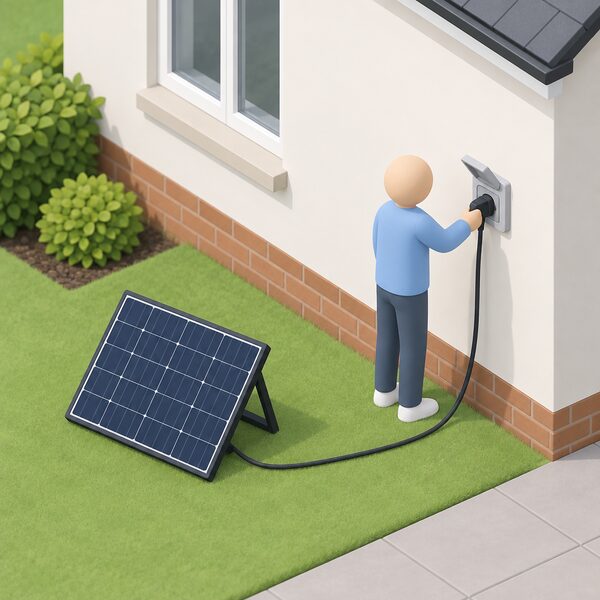
A plug-in solar panel should be connected directly to a standard UK household socket, using a plug designed to BS 1363-11. The socket should be on a circuit that is suitable for the purpose. The Energy Networks Association's guidance states that the system is designed to connect directly to a standard UK household socket, and the use of extension cables is not permitted13.
The consumer guide from Electrical Safety First lists the connections that must be avoided: extension leads, cable reels, multiway adapters, travel adapters, RCD adapters, lighting circuits, and circuits supplying fixed equipment such as ovens and hobs14. Lighting circuits are prohibited because they are not designed for the current levels involved, and circuits supplying fixed equipment are prohibited because the equipment may be in use when the solar system is generating.
Electrical Safety First recommends that households have at least a Type A bidirectional RCD protecting circuits intended for use with plug-in solar panels8. A bidirectional RCD is designed to detect faults regardless of the direction of current flow, which is important because plug-in solar can feed current back into the circuit. Standard RCDs may not operate correctly under reverse current conditions.
The specification also requires that all connectors shall fulfil the requirements of BS EN 62852 for DC-side connectors1. This applies to the connectors between the panels and the inverter, not to the AC connection to the socket. The AC connection must use a plug designed to BS 1363-11.
In practice, the socket should be one that is not used for other high-power appliances and is on a circuit that can accommodate the solar generation. An outdoor wall socket is often recommended, because it allows the panel cable to reach the socket without running through a window or door. The Renewable Energy Association's guidance states that the system should always be connected directly to a suitable outdoor wall socket, and never plugged into an extension lead10.
How to connect a plug-in panel safely instead
The safe connection method is direct: the panel's cable plugs into a suitable socket, with no intermediate lead or adaptor. The Renewable Energy Association's guidance is to always connect the system directly to a suitable outdoor wall socket, and never plug a solar panel into an extension lead10. The Energy Networks Association states that the system is designed to connect directly to a standard UK household socket13.
Before connecting, the circuit should be checked. The specification states that any necessary testing and modifications of the building's electrical system shall only be performed by professional electricians1. The Energy Saving Trust advises getting a qualified electrician to connect the panels to your electrical system21. While plug-in solar is designed for DIY connection, the state of the existing wiring matters, and a qualified electrician can confirm that the circuit is suitable.
The installation itself must meet the specification's requirements. Any attachment method shall be reversible and non-permanent1. Installation is not permitted on ACM cladding, MCM cladding, HPL cladding, timber cladding or timber balconies1. Any part of the solar equipment should not be installed on a wooden fence, gate, wall or other means of enclosure20. These restrictions apply alongside the connection rules.
The specification also requires compliance with G98 for connection and parallel operation with low-voltage distribution networks1. This is the same standard that applies to professionally installed systems, and it governs how the system interacts with the grid. Compliance with the interim product specification is relevant under the Electricity Safety, Quality and Continuity Regulations in determining whether a device may be connected to and used on the consumer's electrical connection7.
For a household, the practical steps are: identify a suitable socket on a circuit that is not a lighting circuit and does not supply fixed equipment; check that the circuit has at least a Type A bidirectional RCD; ensure the panel cable reaches the socket without an extension lead; and confirm that the mounting location is not on a prohibited surface. If any of these conditions cannot be met, the installation is not compliant.
What this means for household energy independence
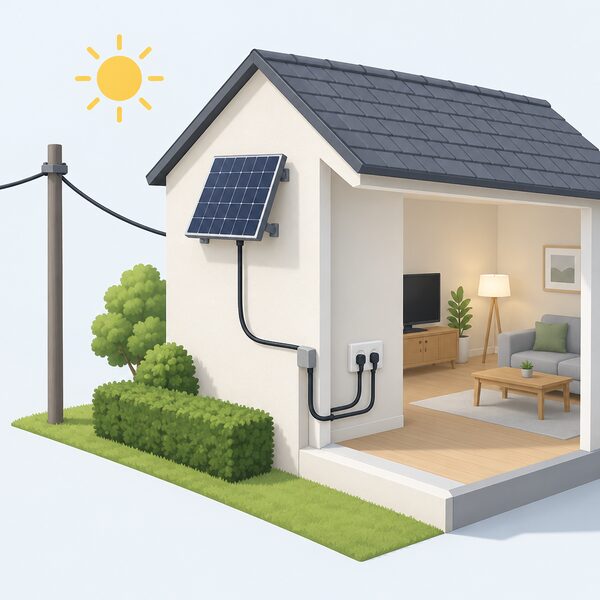
Plug-in solar offers a measure of energy independence, but it is limited. UK-compliant plug-in solar devices are limited to a maximum output of around 800W, which is enough for everyday appliances but higher-use appliances will still need grid electricity22. The system size is typically one to two panels9. This means the household remains dependent on the grid for most of its demand, particularly for heating, hot water and high-power appliances.
The benefit is that the household generates some of its own electricity during daylight hours, reducing the amount drawn from the grid. A load controller can increase savings and reduce grid dependency by maximising solar energy self-consumption23. However, the system is grid-tied, so it operates in parallel with the grid and does not provide backup power during a power cut. The household remains dependent on the grid for continuity of supply.
The connection rules are part of what makes this possible. By requiring a direct connection to a suitable socket, the specification ensures that the system interacts safely with the property's wiring and protective devices. The prohibition on extension leads is not an arbitrary restriction; it is a condition of the safety case that allows plug-in solar to be legal at all. Compliance with the connection rules is therefore part of what makes the system safe and lawful.
For a household, the independence gained is partial. The system reduces the amount of electricity purchased from a supplier, but it does not remove the need for a grid connection or a supplier. It does not provide power during a power cut. It does not heat the home or provide hot water. Within those limits, it offers a modest but real reduction in dependence on purchased electricity, provided the installation complies with the specification.
The rules on extension leads are therefore part of a wider picture. The system is designed to be simple and safe, but it is not a substitute for a full rooftop installation. It is a supplementary measure that can reduce bills and increase self-consumption, within the limits set by the specification and the grid connection.
Sources23 cited
- Plug-in solar interim product specification, GOV.UK, 2026-07
- Plug-in solar panels, Which?, 2026-09-15
- More clarity needed to address potential plug-in solar panel safety concerns, Electrical Safety First, 2026-09-17
- Plug-in solar advice, Centre for Sustainable Energy, 2026-09
- Joint statement on plug-in solar panels, NICEIC, 2026-06-08
- Households can save as plug-in solar panels come to market, GOV.UK, 2026-08-27
- Plug-in solar consultation document, GOV.UK, 2026-06-16
- Plug-in solar panels safety advice, Electrical Safety First, 2026-09-17
- SolarEdge Home Load Controller, SolarEdge, 2026-09-17
- Plug-in solar panels: five top tips, Renewable Energy Association, 2026-08-04
- What the Future Homes Standard means for homeowners, NICEIC, 2026-04-22
- The Plug-in Solar Device Interim Product Specification, legislation.gov.uk, 2026-07-16
- Plug-in solar, Electricity North West, 2026-09-20
- Plug-in solar consumer guide, Electrical Safety First, 2026-08
- Saving money safely, Electrical Safety First, 2026-09-19
- How plug-in solar can save UK homes, Carbon Brief, 2026-04-02
- General Product Safety Regulations 2005, legislation.gov.uk, 2026-09-17
- The 2026 Order, legislation.gov.uk, 2026-08-27
- Plug-in solar panels, Energy Saving Trust, 2026-09-17
- Solar panel installation, Energy Saving Trust, 2026-09-07
- First regional solar breakdown as installations hit record highs, GOV.UK, 2026-08-27
- Solar panels safety advice, Electrical Safety First, 2026-09-17
- Statement on the announcement of the Future Homes Standard, Electrical Safety First, 2026-09-19
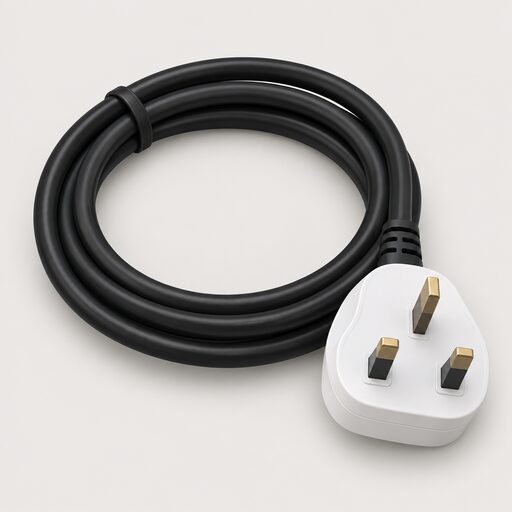 Plug-In Solar KitsCan you really plug solar panels into a normal wall socket in the UK, and is it legal now?
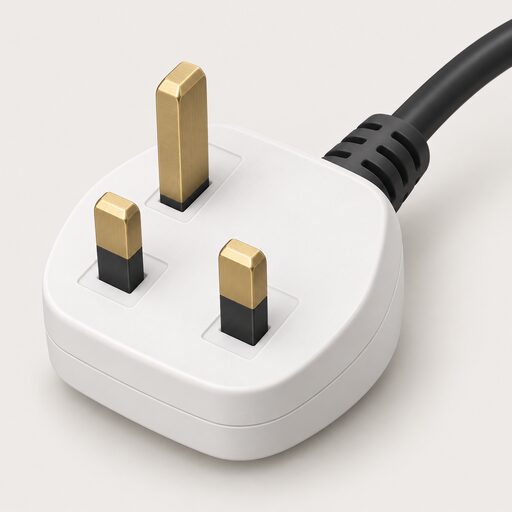 Plug-In Battery StoragePlug-in batteries are not legal in a grid-connected British home, even though plug-in solar panels are.
 Planning Permission EnglandMost homes in England can have solar panels fitted without planning permission, but does yours count as one of the exceptions?
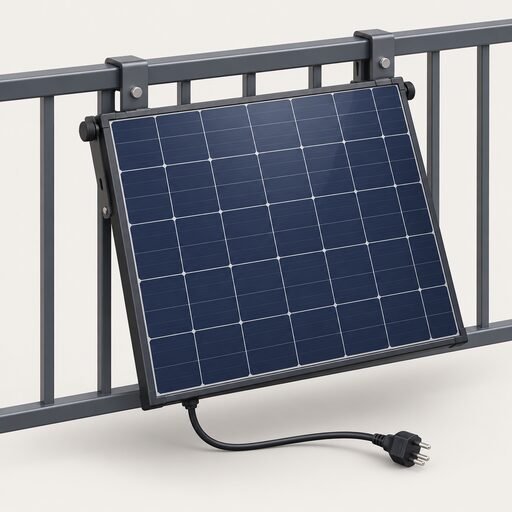 Balcony Solar SystemsCan you really plug solar panels into a normal socket, and what will it save you?
 Panels by Home TypeCan your house have solar panels, and how many will fit?
 Solar Charging a Power StationCharging a portable power station from solar panels comes down to a few practical questions.