
In this answer
Short answer
Plug-in solar panels became legal to use in Great Britain on 27 August 2026, and they are now on sale from major retailers1. A fence is one of the first places householders think of, because it is already there, it faces the sun, and it needs no roof access. The law, however, draws a hard line at timber: the amended permitted development right states that, in the case of plug-in solar, no part of the equipment should be installed on a wooden fence, gate, wall or other means of enclosure1.
That single restriction shapes everything else on this page. A compliant device is limited to a maximum output of around 800W, and typical annual generation is estimated at up to 720kWh2. It connects to a standard UK household socket, and the electricity it makes is used in the home as it is generated, because plug-in panels cannot be used to sell power back to the grid3.
Fences and plug-in solar: what the law now allows
The legal change is recent and specific. Plug-in solar panels that meet certain standards have been legal to use in Great Britain since 27 August 2026, and the government confirmed that plug-in solar panels became legal across Great Britain on that date1. Before then, UK standards only permitted solar power generation that was permanently connected, which excluded a plug-in device3. Independent guidance now describes plug-in solar panels as legal to use and available to buy across the country4.
The permitted development position is where the fence question is settled. Solar PV expressly includes plug-in solar, as defined in Paragraph P of the Town and Country Planning (General Permitted Development) (England) (Amendment) Order 20266. The permitted development right for stand-alone solar equipment within the grounds of a house was updated on 27 August 20267. The accompanying restriction is unambiguous: in the case of plug-in solar, any part of the solar equipment should not be installed on a wooden fence, gate, wall or other means of enclosure7. A parallel formulation says no part of the equipment should be installed on a wooden wall, balcony or enclosure, or any exterior clad in timber8.
For a householder, that means a timber fence panel is not a lawful mounting surface under the permitted right, even though the panel itself is now legal to buy and plug in. A non-combustible mounting arrangement, such as a purpose-made frame or a wall of suitable construction, sits inside the rules; a timber fence does not. Where the installation falls outside permitted development, planning permission can be applied for, and listed buildings need planning permission and listed building consent9.
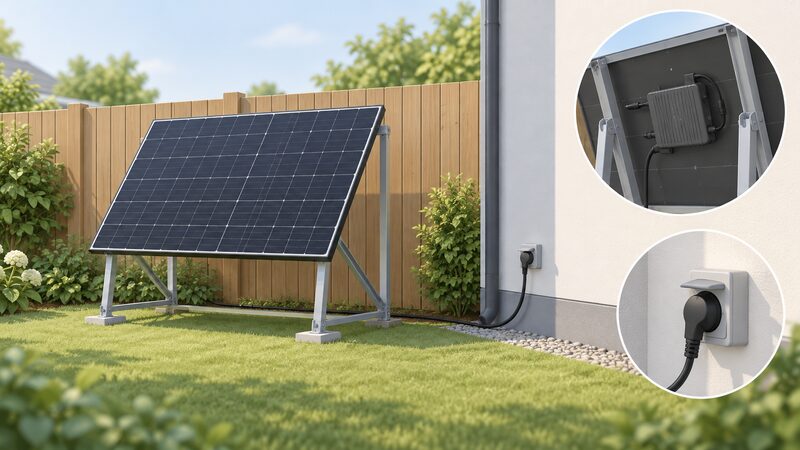
How a fence panel works: self-consumption first
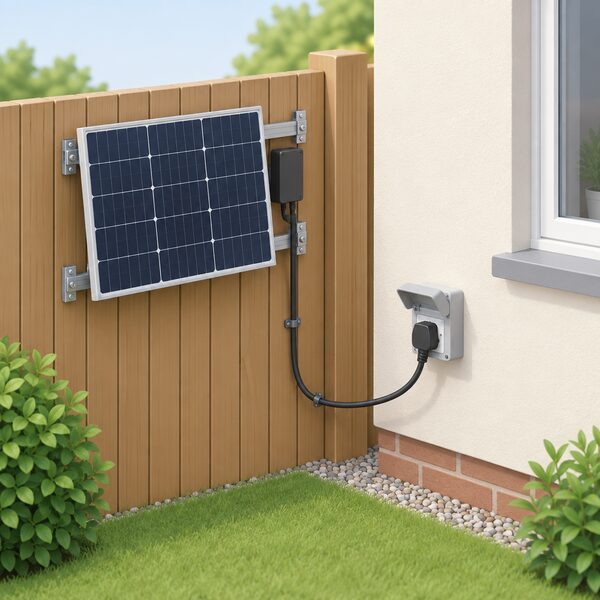
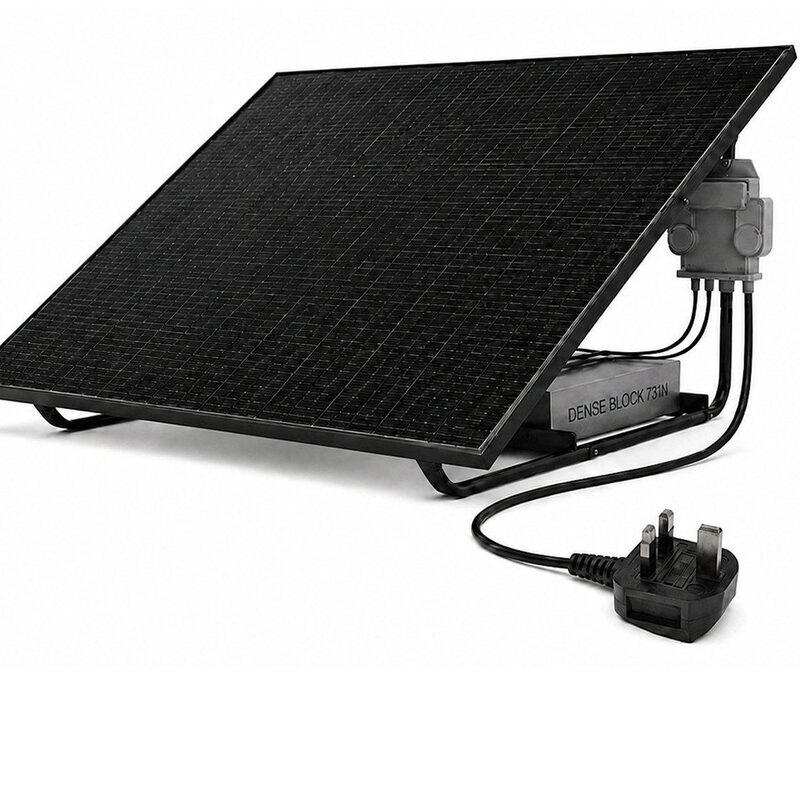
A plug-in solar device is a small generating set, not a full rooftop array. It comprises at least one PV module, a grid-following inverter, a connection lead fitted with a plug complying with BS 1363, and a mounting system for the panel5. In the maker's own description, solar panels generate electricity from sunlight, and that electricity is converted from DC to AC by a micro inverter10. The physics is the same as any other PV: panels convert sunlight directly into electricity, which can be used in the building11.
The difference is scale and destination. UK-compliant plug-in solar devices are limited to a maximum output of around 800W of electricity, on average2. That is enough for everyday appliances, but higher-use appliances will still need grid electricity, so a plug-in device will not power a whole house2. Typical annual power generation is estimated at up to 720kWh3.
Because the device plugs into a socket, the electricity it makes is consumed in the home rather than metered for export. Unlike rooftop solar, plug-in panels cannot be used to sell excess power back to the grid, so the electricity does need to be used as it is produced3. That makes the timing of generation, not just the total, the thing that determines value: a panel working while a fridge, broadband router or washing machine is running is doing useful work, and one working while the house is empty is not.
"Unlike rooftop solar, you can't use them to sell excess power back into the grid, so you do need to use the electricity"
Where a fence beats a balcony or roof mount
The case for a fence rests on access and practicality rather than performance. Current devices available in the UK are more suitable to garden locations rather than balconies, and a balcony installation needs permission plus an appropriate frame, fixing or anchors2. Home Energy Scotland gives the same assessment: current devices available in the UK are generally more suitable for garden locations than balconies12. A garden fence is a garden location, which is where the available hardware is designed to go.
Against a roof mount, the fence wins on access and loses on everything else. Roof installation is by far the most common option for domestic installations, and ground mounting is the alternative13. Solar panels mounted on a house, block of flats or building in the grounds are subject to a height limit: the highest part of the panel or equipment must not be higher than the highest part of the roof, excluding any chimney14. A fence avoids that question entirely, and it avoids scaffolding, roof loading and the risk of working at height.
The trade-off is that a fence is a vertical surface in a location chosen for boundary rather than for sun. Ground-mounted systems with trackers, which rotate the panel to follow the sun, have been reported as 10% to 45% more efficient than a rooftop system15. That figure describes tracked ground mounts, not fences, but it makes the general point that mounting geometry matters as much as the panel.
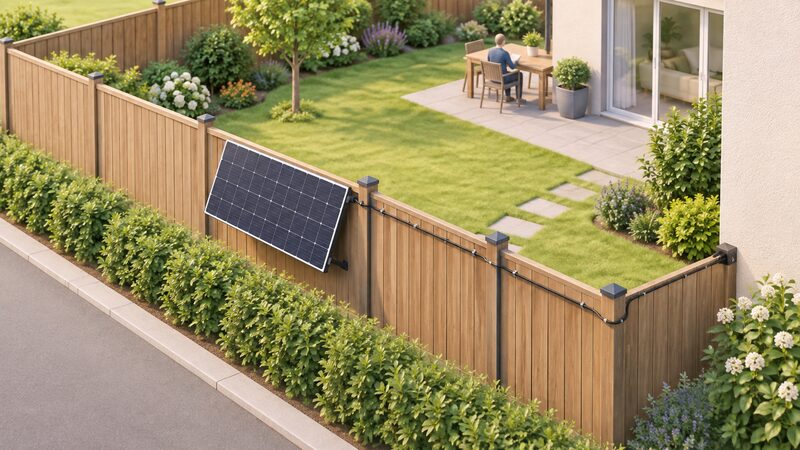
Output on a vertical surface: what to expect
The headline numbers for plug-in solar are set by the device limit, not by the mounting surface: around 800W maximum output and up to 720kWh a year, estimated2. What a fence changes is how close a given panel gets to its own rating. Panels work best at an angle of around 30 degrees, unshaded and south-facing3. Guidance for the strongest performance points to a south-facing location that receives plenty of direct sunlight and is free from shade16. Rooftop panels generate the most electricity when they face south because they capture as much sunlight as possible17.
A fence panel fixed flat to vertical boards sits at roughly 90 degrees, well away from the 30 degrees that guidance recommends, and it cannot be tilted towards the sun without a frame. The practical consequence is that a fence-mounted panel will produce less than the same panel at the recommended angle, and the gap widens in winter when the sun is low. Orientation matters too: a fence running east to west presents a south-facing surface, while a fence running north to south presents an east or west face, which receives sun for part of the day only.
Shade is the other variable a fence introduces. A boundary fence is often shaded by hedges, trees, sheds and the house itself, and shade falling across a panel reduces its output. The published performance figures for plug-in devices are not broken down by mounting angle, so a householder should treat the 720kWh estimate as an upper figure for a well-sited device rather than a prediction for a particular fence.
| Factor | What guidance says | Effect on a fence |
|---|---|---|
| Orientation | South-facing, unshaded16 | Depends on which way the fence runs |
| Angle | Around 30 degrees3 | A flat fence fixing is near vertical |
| Shade | Free from shade16 | Hedges, trees and buildings often intervene |
| Device limit | Around 800W maximum2 | Caps output whatever the mounting |
Green solar fence products and makers
The product landscape is still forming, and the official specification describes categories rather than brands. Plug-in solar can be classified into compact device, two-component device and multi-component device types18. A plug-in solar device comprises at least one PV module, a grid-following inverter, a connection lead fitted with a plug complying with BS 1363, and a mounting system for the panel5. Devices must carry a model number, name or other designation as permanent product marking, and operate at a rated frequency of 50Hz18.
Safety testing has been part of the rollout. The government's plug-in solar electrical safety study observed some variation in product performance19. That finding is worth holding alongside any maker's claims: compliant does not mean identical, and two devices meeting the same specification can behave differently in service.
On availability, major retailers have worked with the UK government on the rollout of plug-in solar panels, and they are now available to buy in stores and online12. The maker Plug In Solar describes its grid-tied kit as using solar panels to generate electricity from sunlight, converted from DC to AC by a micro inverter10. For a householder weighing a fence installation, the practical question is whether a given product's mounting system is designed for a vertical surface and whether its components carry the outdoor ingress protection the specification requires.
Installation, wiring and safety basics
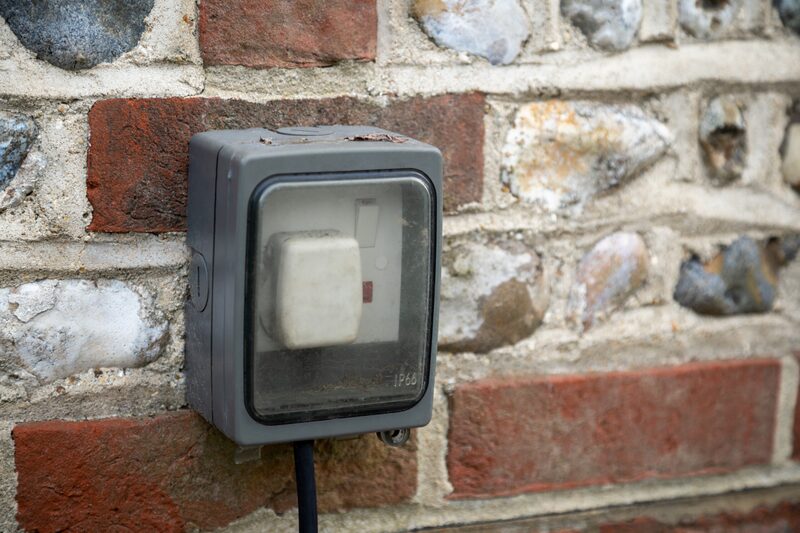
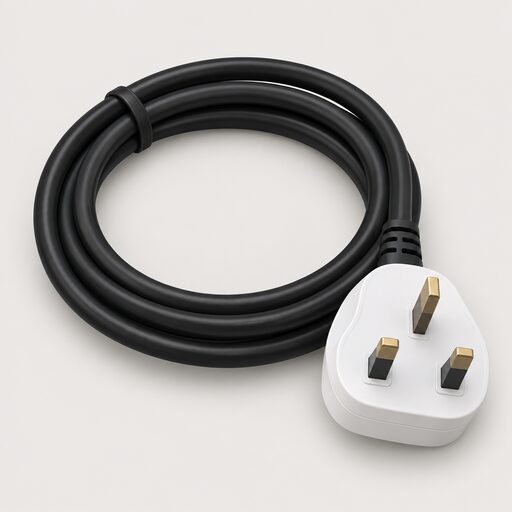
The wiring rules for plug-in solar are stricter than for a conventional appliance. A compliant device is designed to connect directly to a standard UK household socket, and the use of extension cables is not permitted20. Guidance is explicit: always connect the system directly to a suitable outdoor wall socket, and never plug a solar panel into an extension lead16. Components, connections, plugs and socket-outlets intended for outdoor locations must have a degree of ingress protection of at least IP55, while components intended for use inside a property must be better than IP445.
Plug-in solar panels are designed to be self-install, provided the manufacturer's instructions are followed2. Building regulations still bear on the work: the areas that mainly apply are structural safety, electrical safety and ventilation21. For a fence installation, structural safety is the live question, because a panel and its frame impose wind loading on whatever holds them, and a timber fence is expressly excluded from the permitted development right for plug-in solar7.
Two further points belong with safety. Solar panels switch off automatically during a power cut, a safety feature that prevents electricity being exported to the network, and they usually restart on their own once power returns22. And where a householder is not the freeholder, permission is needed: renters and flat owners need permission from their landlord or freeholder before installing plug-in solar panels, and leaseholders may also need permission from a managing agent where the installation affects the building2.
What it means for household independence
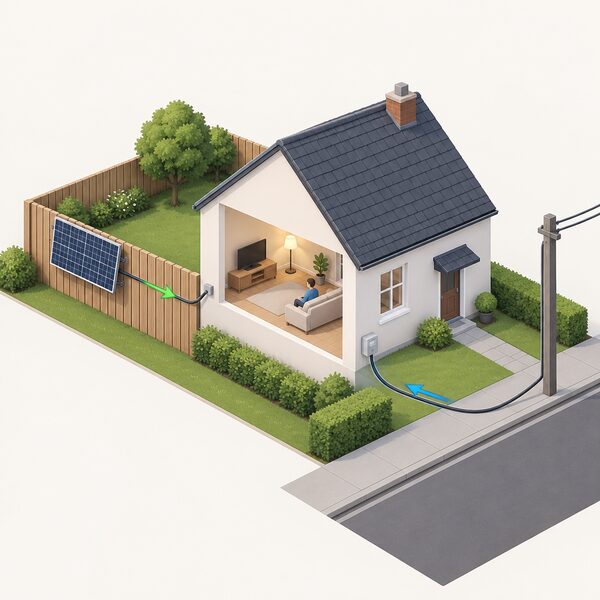
A fence-mounted plug-in system moves a household a short way towards self-sufficiency and no further. It generates up to 720kWh a year, estimated, against a device ceiling of around 800W, and that electricity is used in the home because it cannot be exported2. The household remains connected to the grid for everything the panel cannot cover, including higher-use appliances, evening demand and the whole of the winter2. It also remains dependent on a supplier for the electricity it still buys, and on the manufacturer for a device whose performance the government's own safety study found varies between products19.
What the fence adds is a route into generation for households that cannot use a roof: renters with a garden, flat owners with a boundary, and anyone unwilling to take on scaffolding or an installer. What it does not add is independence from the network. The panel switches off in a power cut and restarts when power returns, so it provides no backup22. Read alongside plug-in solar kits and balcony solar, the fence is best understood as one siting option within a small-system category, with the timber restriction as its defining limit.
Sources22 cited
- The Electricity and Gas (Standards of Performance) (Amendment) Regulations 2026, legislation.gov.uk, 2026
- Plug-in solar panels, Energy Saving Trust, 17 September 2026
- Plug-in solar panels, Which?, 15 September 2026
- Plug-in solar, Centre for Sustainable Energy, September 2026
- Plug-in solar final interim product specification, GOV.UK, July 2026
- Planning permission: solar equipment mounted on a house or a block of flats or on a building, Planning Portal, 17 September 2026
- Planning permission: stand-alone solar equipment, Planning Portal, 17 September 2026
- Solar panels and planning permission, Cornwall Council, 17 September 2026
- Solar panels planning permission checklist, Islington Council, 2026
- Plug In Solar DIY grid-tied solar power kit, Plug In Solar, 17 September 2026
- Solar panels, East Herts Council, 17 September 2026
- What to know about plug-in solar panels, Home Energy Scotland, September 2026
- Solar panel installation, Energy Saving Trust, 17 September 2026
- Renewable energy, Rother District Council, 17 September 2026
- POSTnote 771: Solar power, Parliamentary Office of Science and Technology, 25 June 2026
- Plug-in solar panels: five top tips to save money and stay safe, REA, 4 August 2026
- How do solar panels work?, Smart Energy GB, 7 September 2026
- Plug-in solar interim product specification (withdrawn), GOV.UK, June 2026
- Plug-in solar electrical safety study, GOV.UK, 16 June 2026
- Plug-in solar, Electricity North West, 20 September 2026
- Building regulations and renewables guidance, Bedford Borough Council, 17 September 2026
- Power cuts and emergencies, SSEN, 19 September 2026
 Plug-In Solar KitsCan you really plug solar panels into a normal wall socket in the UK, and is it legal now?
 Planning Permission EnglandMost homes in England can have solar panels fitted without planning permission, but does yours count as one of the exceptions?
 Plug-In Battery StoragePlug-in batteries are not legal in a grid-connected British home, even though plug-in solar panels are.
 Planning Permission WalesDo you need planning permission for solar panels on your house in Wales?
 Solar Panel CostsA typical UK home pays somewhere between four and eleven thousand pounds for solar panels fitted, with most landing in the middle.
 Balcony Solar SystemsCan you really plug solar panels into a normal socket, and what will it save you?