In this guide
Plug In Solar is a name householders search for, but it is not one company. It is the category of kit that became legal to buy and use across Great Britain from 27 August 2026, when the panels could be plugged into homes across the country1. The kits are sold by several suppliers and retailers, and the rules that govern them are set centrally rather than by any one brand.
The shape of the offer is fixed by those rules. Each plug-in solar kit produces up to 800W of power, enough to provide up to 20% of an average home's electricity use, and it comes with no installation cost2. A household is limited to a single 800W plug-in kit for safety reasons3. More than 50 compliant kits were listed on the type test register as of 16 September 20264.
What follows is the kit itself, how the socket connection works, who is selling what, what the incentives position actually is, and where the limits of a plug-in system sit for a household's energy independence.
What a plug-in solar kit contains
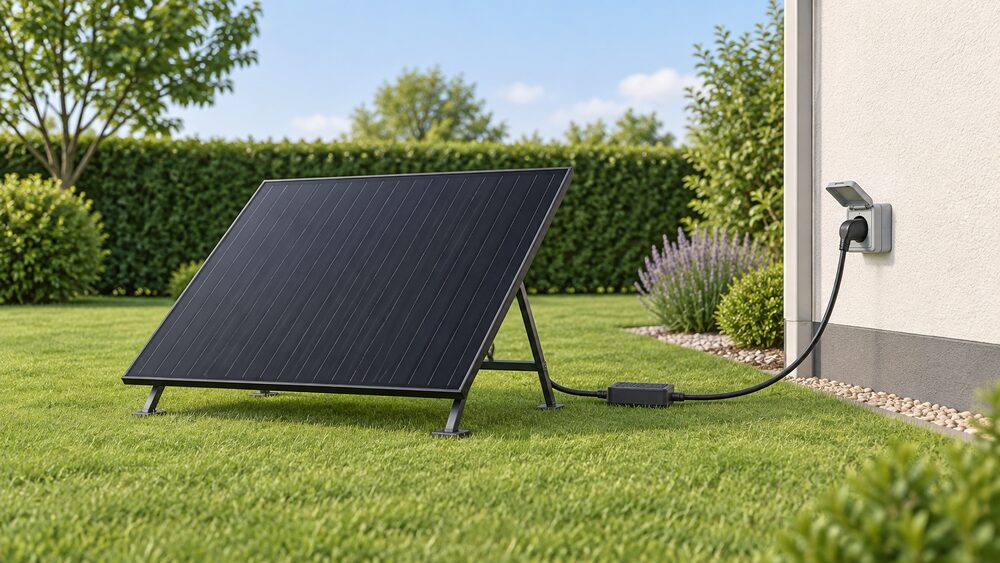
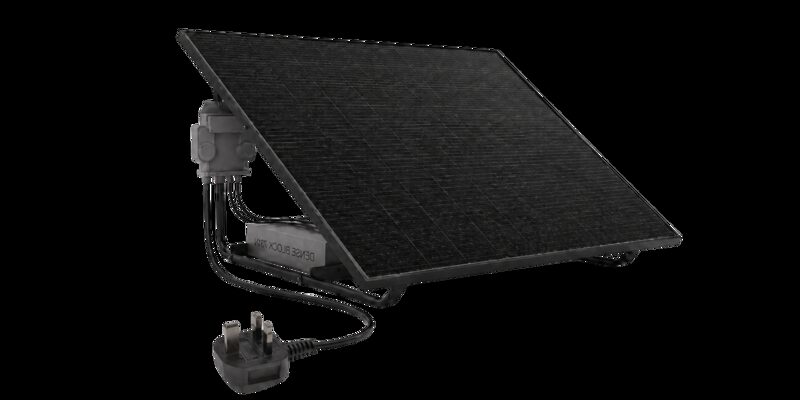
A kit is a small, complete generating set rather than a collection of parts. The Centre for Sustainable Energy describes kits as likely to include one or two panels, an inverter, mounting equipment, cable and a standard three-pin plug3. Which? gives the same list in more detail: one or two solar panels, a microinverter that converts direct current to usable alternating current, a lead fitted with a standard three-pin plug, mounting brackets and an app for monitoring4.
The official product specification sets a minimum. A plug-in solar device comprises at least one PV module, a grid-following inverter, a connection lead fitted with a plug complying with BS 1363 and a mounting system for the panel6. The same specification classifies devices into three types: one-component, two-component and multi-component7. That classification matters because it determines what has been tested as a unit.
Panel output in the kits now on sale is commonly 400W per panel, with one or two panels per system8. Which? records kits with two 435W bifacial all-black panels and an 800VA microinverter, and others with 2x460W panels and an adjustable bracket for walls, floors and balconies4. The type test register lists some kits as comprising UKSOL solar panels and Hoymiles microinverters, and others as including JA Solar panels4.
| Component | What it does | Typical specification |
|---|---|---|
| PV module | Generates DC electricity | 400W to 465W per panel, one or two per kit4 |
| Microinverter | Converts DC to mains AC | 800VA class, grid-following4 |
| Connection lead | Carries power to the socket | Plug complying with BS 13636 |
| Mounting system | Holds the panel | Frame for garden, balcony or wall4 |
| Monitoring app | Shows generation | Supplied with the kit4 |
How it works: a mains socket, no electrician
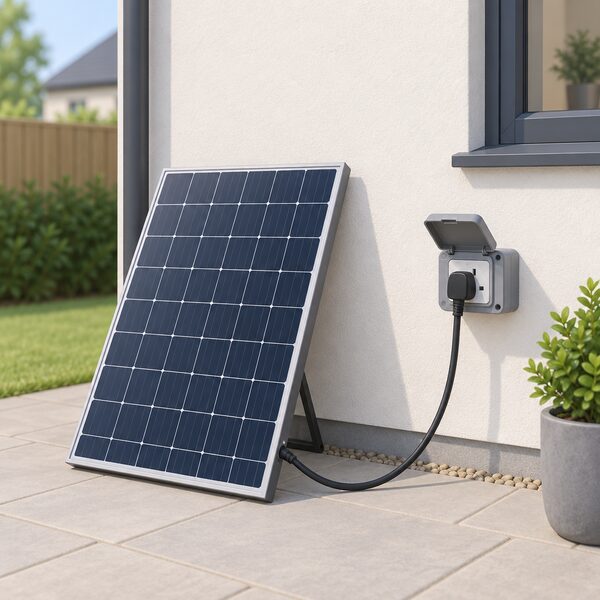
The defining feature is the connection method. The official specification describes a plug-in solar device as intended for connection to an existing low-voltage electrical installation using a standard UK mains plug and socket, without requiring installation of a separate electrical circuit for export6. The government consultation set out the same aim: to allow consumers to connect plug-in solar systems without batteries directly to a standard mains socket, provided products meet defined safety requirements9.
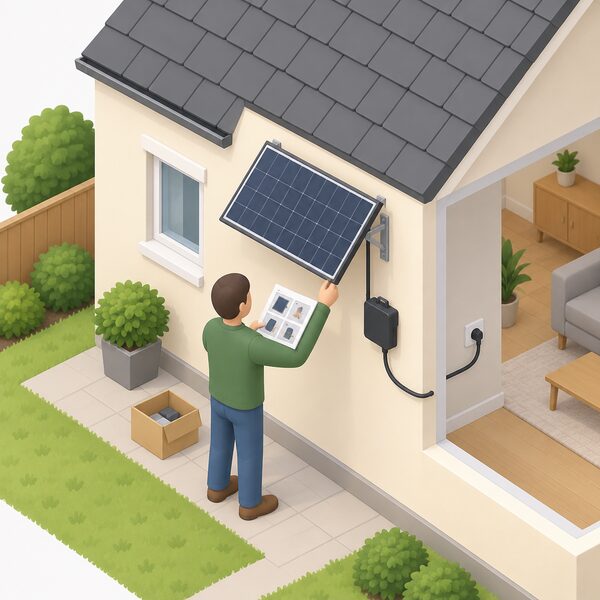
That removes the two things that make rooftop solar a project: scaffolding and a qualified installer. Plug-in solar panels are designed to be self-install, provided the manufacturer's instructions are followed5, and anyone can install them without the need for a professional installer or electrician4. The panels can be plugged directly into home sockets without additional wiring, reducing electricity taken from the grid10.
There are conditions on the socket itself. The device is designed to be connected to a UK mains socket solely by the manufacturer-supplied plug, and it shall only be connected to socket circuits, not to circuits supplying lighting or other fixed equipment11. Safety guidance is firmer still: always connect the system directly to a suitable outdoor wall socket, and never plug a solar panel into an extension lead9.
The connection is also portable in a way rooftop solar is not. One network operator's guidance is to plug into a standard UK socket, power everyday appliances, and take the kit when moving13. That is the practical difference between a kit and a fixed array.
The UK offer: retailers, suppliers and kits now available
Plug-in solar panels have been available to buy online and on the high street since the end of August 20264, and major retailers have worked with the UK government on the rollout, with panels now available in stores and online14. The government named Currys, B&Q, Screwfix and Amazon as retailers that have worked on the rollout and would soon have them available in stores and online2. Amazon, Argos, Currys and Wickes have all committed to stocking plug-in solar panels2.
The named suppliers behind the kits are a shorter list than the retailers. Which? records UKSOL plug-in solar kits available online at Argos, with hybrid mount kits coming soon4. It also records an InstaGen kit with two 435W bifacial panels, an 800VA microinverter and a universal mounting frame, and PowerXpress kits with 2x460W panels and an adjustable bracket4. Octopus Energy offered two plug-in solar bundles, both including JA Solar panels4.
| Supplier or range | Kit make-up | Price where published |
|---|---|---|
| UKSOL Compact 460W Plug-In Solar Pro Kit | One panel, ground mount only | from £599.004 |
| PatioSun range | Five kits, 445W Lite to 2x465W Max Plus | £449 to £7794 |
| InstaGen | Two 435W bifacial panels, 800VA microinverter | RRP £5494 |
| The Solar Centre starter kits | Rigid 430W and lightweight 200W semi-flexi | planned base kit £3304 |
| PowerXpress | 2x460W panels, adjustable bracket | installer and retailer quoted4 |
Prices are quoted as published by the sellers and the VAT position is not stated in those figures. The general market range is £500 to £1,000 for a solar panel kit3. A UKSOL kit contains the solar module or modules, an ENA-compliant microinverter, a 4m AC cable and 2m DC cables, and a purpose-designed mounting solution12.
Kits with or without government incentives: what the makers claim
The incentives position is narrower than the marketing around plug-in solar sometimes suggests. There is no general grant for a plug-in kit. What exists is a funding pilot specifically designed to put plug-in kits into low-income households, delivered through local authorities8. That is a targeted programme, not an entitlement.
The planning position is separate from money. Under the 2026 Order, solar PV expressly includes plug-in solar, which means plug-in solar is subject to the limitations and conditions in Classes A and B15. Cornwall Council's guidance on solar panels and planning permission sets out the permitted development framework that applies to domestic solar16. The underlying legislation defines solar PV as solar photovoltaics including plug-in solar17.
Where a scheme does require certification, the standard is explicit. The Barcud Solar Panel Installation Scheme Specification requires that solar PV systems are only installed and certified by MCS certified contractors working to the latest published MIS3002 standards18. That is a condition of a particular scheme, and it points to the difference between a self-installed plug-in kit and a contractor-installed system.
The wider context is that UK rooftop installations have been happening without government subsidies for rooftop installations20, and clean power records have continued to be broken as capacity has grown21. Plug-in kits sit inside that market rather than on top of a support scheme.
The Plug In Solar range: DIY kits, new-build kits and battery storage
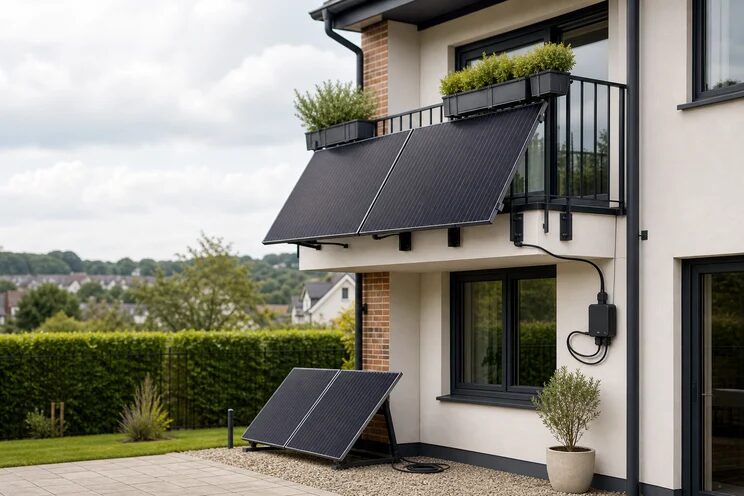
The range now on sale divides into a few recognisable shapes. The simplest is a single-panel kit on a ground mount, such as the UKSOL Compact 460W Plug-In Solar Pro Kit at from £599.004. The next step up is a two-panel kit with an adjustable bracket for walls, floors and balconies, which is what PowerXpress offers with 2x460W panels4. The largest kits in the current listings pair two 465W panels, as in the PatioSun Max Plus at £7794.
Mounting is where the range varies most, because the panel has to go somewhere. UKSOL lists a Hybrid Mount Plug-In Solar range with wall or ground mounting and four power options from 515W to 1260W, listed as coming on 1 October 202622. That range sits above the 800W connection ceiling, so the higher options are not straightforwardly a single plug-in device under the current rules.
Battery storage is the least settled part of the offer. Plug-in solar batteries are already being developed for the UK market8, but the government consultation that opened the market was framed around plug-in solar systems without batteries designed to be connected directly to a standard UK mains socket and to operate alongside the electricity network23. The interim product specification covers electrical design, British plug requirements, mounting systems and fire protection23.
Choosing a kit: what to check before buying
The first check is electrical, and it comes before purchase. Electrical Safety First advises that all homes are checked for suitability and safety by a competent electrician before buying plug-in solar panels24. The Renewable Energy Association's guidance is to have the home's electrical installation checked before installing a plug-in solar system, particularly in an older property9. The Energy Saving Trust publishes a plug-in solar checklist that may be helpful to review before purchasing9.
The second check is whether the specific model is on the list of devices that meet UK standards, which can be confirmed on the ENA Connect Direct LCT device register9. That register is the practical test of compliance, and it is the reason the count of compliant kits matters: more than 50 were listed as of 16 September 20264.
The third check is physical. Panels are often around 1m by 2m and weigh more than 20kg, so many consumers may seek to purchase them with mounting in mind24. The kit's own mounting frame, tilt angle and cable length determine whether a balcony, wall or garden position actually works.
On certification, MCS operates standards including MCS 005 for solar photovoltaic modules and MCS 017 for building integrated photovoltaic products25. Certified installers use MCS certified products, including solar heating panels and mounting kits, and an MCS certificate is a record that the installation was done by a certified installer using certified products26. A self-installed plug-in kit does not travel that route, which is why the type test register rather than an MCS certificate is the relevant check.
What owning a plug-in kit means for energy independence
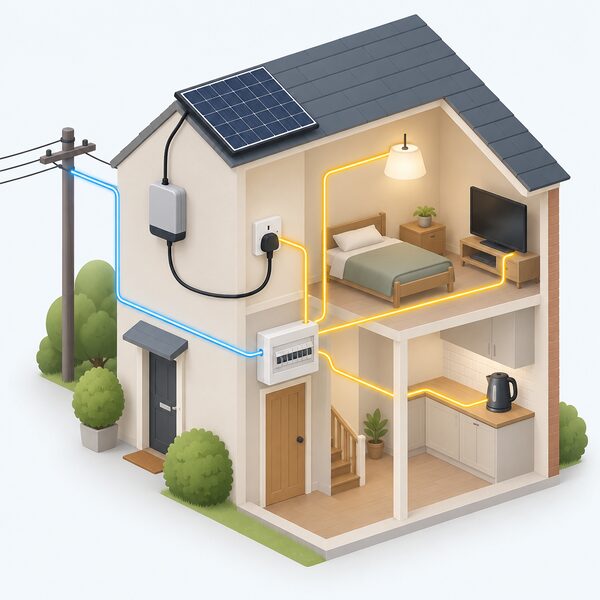
A plug-in kit changes one thing materially: it lets a household generate some of its own electricity without a contractor, a roof survey or a fixed installation. The kit plugs into a standard UK socket, powers everyday appliances, and can be taken along when the household moves13. That portability is a genuine form of independence, particularly for renters and for anyone who cannot commit to a roof.
The dependence that remains is substantial and worth stating plainly. The kit operates alongside the electricity network rather than instead of it23, so the home stays connected to a supplier and to the grid. Output is capped at around 800W, which is enough for everyday appliances but leaves higher-use appliances drawing from the grid5. Government figures put the contribution at up to 20% of an average home's electricity use2, which means the large majority of demand is still met by imported power.
There is also a safety-driven dependence. A standard plug-in kit is not a backup power supply and shuts down automatically if the grid supply fails12, so it offers nothing during an outage. The kit's inverter, its compliance status and its monitoring app tie the household to a manufacturer, and the app ties monitoring to a phone. For a household weighing the options, plug-in solar kits sit at the low-commitment end of the scale, while balcony solar covers the mounting question and plug-in solar vs professionally installed solar sets the two routes side by side. The wider picture of what self-generation can and cannot deliver is at solar panels and household energy independence.
Sources26 cited
- Households can save as plug-in solar panels come to market, GOV.UK, 2026-08-26
- Plug-in solar panels: Which? review, Which?, 2026-09-15
- Plug-in solar advice, Centre for Sustainable Energy, 2026-09
- Plug-in solar panels, Energy Saving Trust, 2026-09-17
- Plug-in solar interim product specification, DESNZ, 2026-07
- Plug-in solar consultation, GOV.UK, 2026-06-16
- Plug-in solar consultation document, GOV.UK, 2026-06-16
- Plug-in solar explained, Low Carbon Hub, 2026-07-09
- Plug-in solar panels: five top tips, Renewable Energy Association, 2026-08-04
- How plug-in solar can save UK homes, Carbon Brief, 2026-04-02
- Plug-in solar interim product specification (withdrawn), DESNZ, 2026-06
- Plug-in solar FAQs, UKSOL, 2026-09-17
- Generation and storage: plug-in solar, Electricity North West, 2026-09-19
- What to know about plug-in solar panels, Home Energy Scotland, 2026-09
- Solar panels and planning permission, Cornwall Council, 2026-09-17
- The Town and Country Planning (General Permitted Development) Order, legislation.gov.uk, 2026-09-17
- Barcud Solar Panel Installation Scheme Specification, Sell2Wales, 2026-06-15
- Free energy saver app and solar subscription trial, Low Carbon Hub, 2025-01-23
- As an extreme heatwave hits, UK homes with solar panels, Ember, 2026-06-24
- Britain continues to break clean power records, GOV.UK, 2026-05-28
- UKSOL plug-in solar range, UKSOL, 2026-10-01
- Plug-in solar consumer guide, Electrical Safety First, 2026-08
- MCS microgeneration certification, BSI, 2026-09-17
- Solar heating technologies, MCS, 2026-08-17
- Plug-in solar panels vs rooftop systems, Which?, 2026-04-27
- Plug-in solar to become legal in the UK, Which?, 2026-04-24