
In this comparison
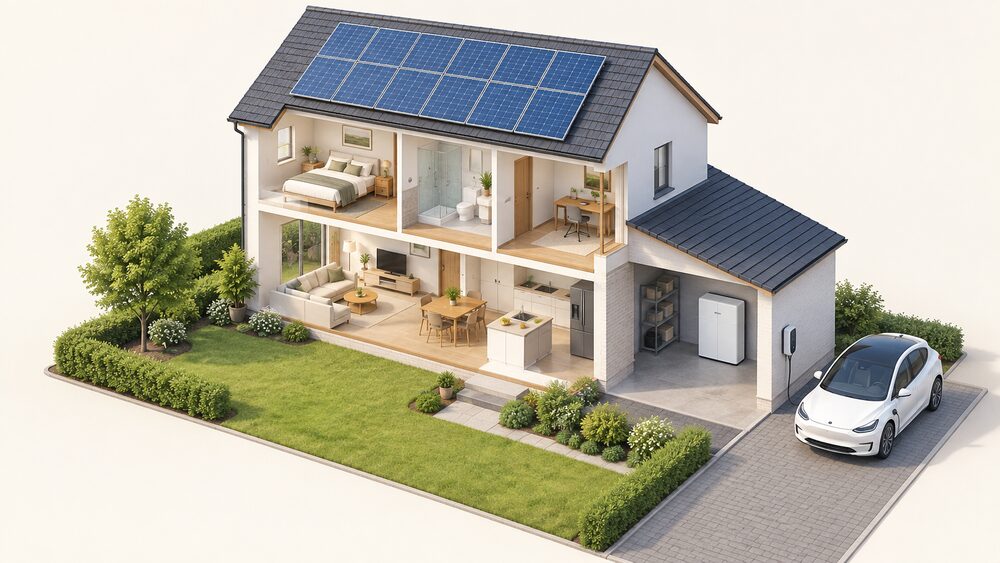
Charging an electric car from your own roof and charging it from the grid are two different transactions, and the difference is not only price. Solar generation can directly charge an EV if the right equipment is in place1. What a standard charger cannot do is tell the two apart: it draws electricity from the home supply without distinguishing between solar-generated power and grid electricity1. On a bright afternoon that hardly matters, because the panels are covering the load anyway. On a dull one, the car quietly pulls from the grid.
The cost gap is real but conditional. Charging from your own electricity is significantly cheaper than using grid power, and far cheaper than petrol or diesel over the same distance1. A grid charging estimate for 10,000 miles a year puts the annual figure at £5002. The solar share of that depends on system size, season, and how much charging happens while the sun is up. Charging during the day maximises direct use of solar power, making it the cheapest and greenest option2.
What follows is how the modes work, what a solar-aware charger actually does, where a battery changes the picture, and the rules that now apply to every new home charger sold in the UK.
Charging from solar vs the grid: what the cost difference looks like
The headline comparison is between self-generated electricity and bought electricity, and the gap has widened as grid prices moved. The cost of power from the grid increased by around half in the year to July 2022, which shifted the relative benefit of going solar5. Rooftop solar systems with home batteries reduce the amount of electricity drawn from the grid, and therefore the amount paid in bills6.
For an EV specifically, the arithmetic runs through the charger. A grid charging example for 10,000 miles a year comes to £500 per annum2. That figure assumes all the energy is bought. Every kilowatt-hour the panels supply directly removes a purchase, and every kilowatt-hour exported instead of used is a purchase that still has to be made, usually at a higher rate than the export tariff pays.
The system architecture affects both cost and capability, and the three common arrangements differ in ways that bear directly on an EV household.
| System type | Cost position | Grid charging | Note |
|---|---|---|---|
| On-grid inverter | Most affordable | Yes | No battery integration7 |
| Hybrid inverter | Most expensive, because of battery integration | Yes | Battery and panels share one inverter7 |
| DC-coupled, panels and battery installed together | Typically more efficient and tends to be cheaper | May not be able to charge from the grid8 | No grid fallback on a still, dark week in December8 |
What a household should expect in practice is a blended cost, not a solar cost. For most homeowners the practical reality is a hybrid approach where solar covers as much of the charging as it can and the grid fills the gaps1. The proportion swings with the seasons, and no published figure fixes it for a given home.

Standard chargers can't tell solar from grid power
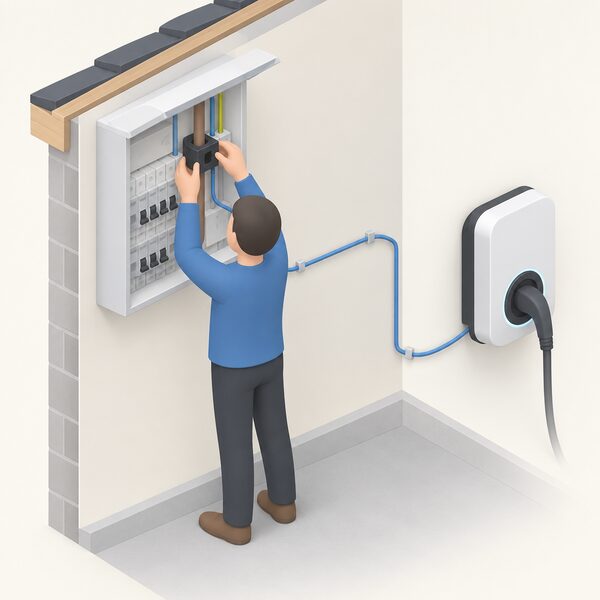
This is the single fact that determines whether a solar array changes anything about EV charging. Standard EV chargers draw electricity from the home supply without distinguishing between solar-generated power and grid electricity1. The charger sees a live supply at the consumer unit. It has no view of whether the electrons arriving came from the roof or from the network.
The same applies at the level of the solar system itself. When energy consumption is more than solar generated electricity, the property can draw energy from the national grid in the same way as when there was no solar PV9. Nothing breaks and nothing warns; the meter simply runs.
Solar-aware charging solves this by measurement rather than by magic. Smart chargers monitor real-time solar electricity production, adjust charging speed accordingly, and switch seamlessly between solar and grid supply depending on availability1. The charger needs a signal about generation, which comes from a current transformer clamp on the incoming supply, a wired connection to the inverter, or a wireless energy manager. Simpson & Partners chargers, for example, charge from solar using grid or property data from a wired or wireless energy manager10.
The practical consequence is that the hardware decision comes before the tariff decision. A charger without solar integration will charge the car perfectly well, and will do so at whatever the grid costs at that moment. It will not preferentially consume generation that would otherwise be exported.
Solar-only, hybrid and fast: the charging modes explained
Manufacturers use different names for broadly the same three behaviours, and the naming is where most of the confusion sits.
| Mode | What it does | Example |
|---|---|---|
| Solar-only | Holds the car to surplus generation alone, pausing when a cloud passes | Hypervolt Home 3 Pro super eco; Simpson & Partners with grid top-up optional12 |
| Hybrid or eco | Blends both sources, making up the difference from the grid | Easee Solar Grid + Solar13 |
| Fast or boost | Ignores generation and charges at the charger's full rate | Hypervolt Home 3 Pro Boost12 |
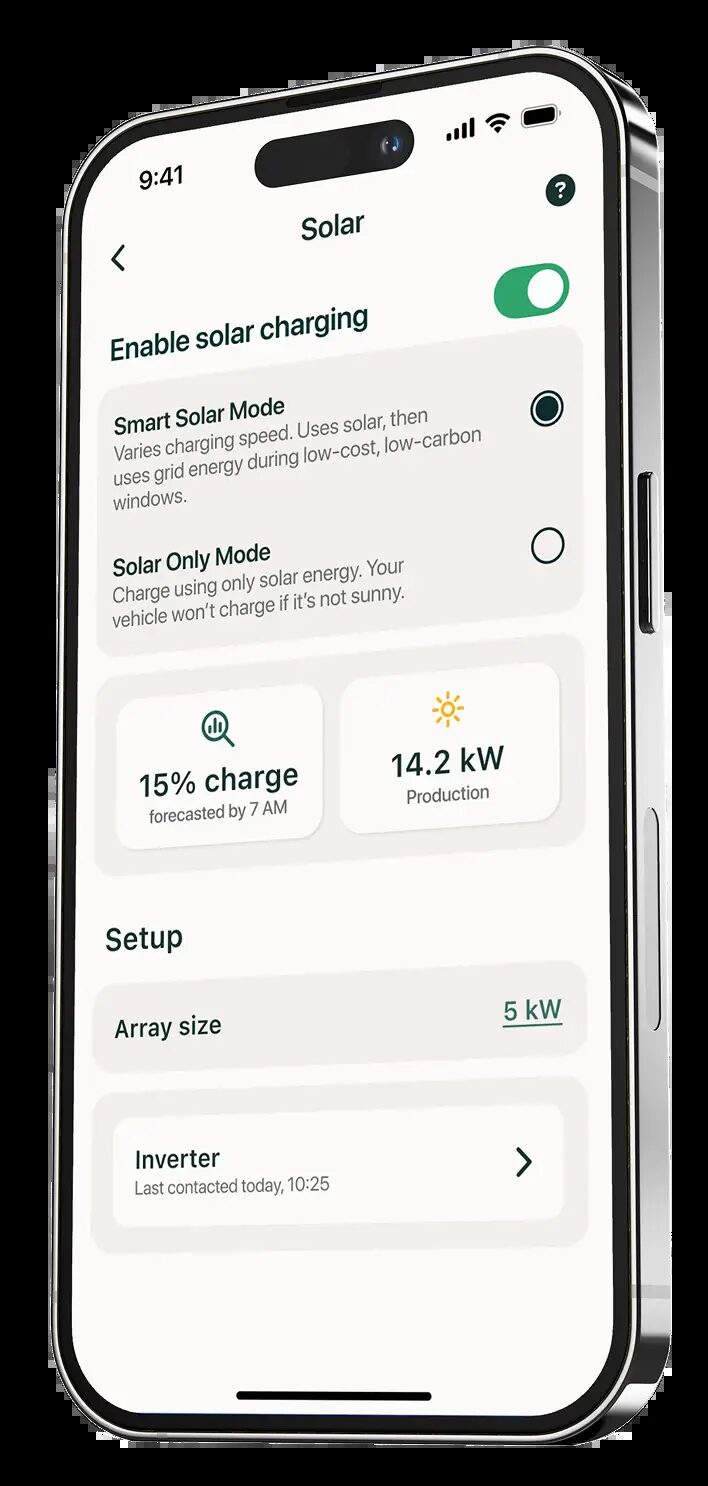
Solar-only. The charger holds the car to surplus generation alone, pausing when a cloud passes and resuming when output recovers. Hypervolt's Home 3 Pro offers three charging modes: Boost, Eco (solar and grid) and super eco (solar only)12. Simpson & Partners describes grid top-up as optional, with the charger able to charge only on solar10. This mode is the purest expression of energy independence and the least convenient, because charging time follows the weather rather than the clock.
Hybrid or eco. The charger blends both sources, taking whatever solar is available and making up the difference from the grid. Easee Solar's Grid + Solar mode charges the car with both energy from the grid and from the solar panels13. This is the mode most households settle on, because it guarantees the car is ready when needed.
Fast or boost. The charger ignores generation and charges at its full rate. This is the mode for a departure in two hours, and it is the mode that makes the solar array irrelevant for that session.
Some systems add a fourth behaviour: charging from the grid only when it is cheapest and greenest. waEV-charge describes its Solar Smart mode as the most cost efficient way to charge, since it uses grid power only when it is as green and low-cost as possible2. Growatt's THOR charger offers a PV linkage charge mode driven by solar within its GroHome system14. Wallbox's Solar Charging 3P optimisation carries a limitation worth knowing: to move back to three-phase grid charging, the EV cable needs to be unplugged and plugged in again15.
Separately from solar modes, chargers have charge speeds. Fast charging takes hours and is suitable for longer stays or overnight charging16. The three main types of EV charging are slow, fast and rapid17, and a home unit sits in the slow to fast band.
Chargers with solar optimisation: what to look for
Solar optimisation is a feature set, not a badge, and the useful specification is the one that names the inverter and battery it will work with. waEV-charge states that its EV chargers are designed to work with a range of compatible solar inverters, enabling optimisation of solar energy2. That phrasing is the standard to look for: a named compatibility list rather than a general claim.
The features that matter, according to independent guidance, are solar diversion, app control and dynamic scheduling. Solar diversion allows the charger to prioritise solar power for EV charging, minimising reliance on the grid18. App control and scheduling determine whether the household can see what is happening and set the behaviour.
Selected smart chargers feature solar integration, sometimes called Solar Match, detecting excess solar generation and diverting it into the EV battery instead of exporting to the grid4. The distinction between diversion and export is the whole point: exported units earn an export rate, diverted units avoid a purchase at the import rate.
Two hardware details are worth checking before ordering. Tethered chargers have a permanent lead and socket attached, while untethered chargers let you plug in separate cables2. Neither is better for solar, but the choice affects cost and how the unit sits on a wall. More importantly, EV chargers should be installed by a qualified electrician with relevant experience, with compatibility between the charger, solar system and any battery storage considered from the outset1. Retrofitting solar awareness to a charger that lacks it is not a software update.
Where batteries fit: charging at night from stored solar
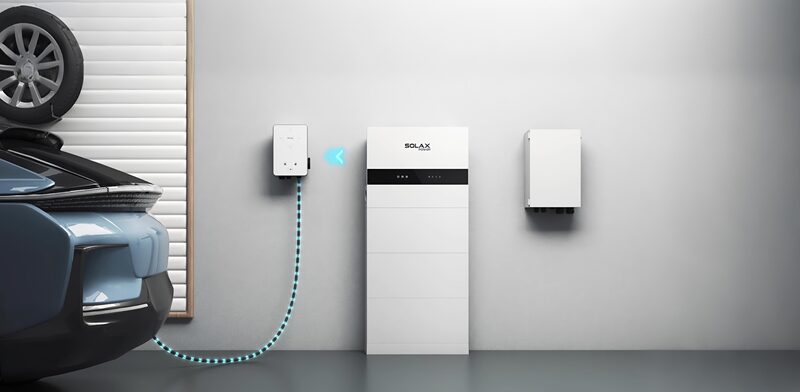
A battery is what turns a daytime generation profile into an all-day supply. A home battery captures surplus solar energy for later use including overnight EV charging, whereas without it unused solar electricity is wasted or exported to the grid, often at a relatively low rate1. That is the core case, and it is a case about timing rather than about total generation.
The mechanics are straightforward. During daylight hours, solar panels first power the home, then supply energy to charge the EV, and finally store any excess in the battery or export it to the grid for credit19. At night, the system prioritises stored battery energy to power the home and charge the EV; if the battery is depleted, it switches to grid power19. Charging at night is possible if the setup includes an energy storage system to store excess solar energy generated during daylight hours19.
A battery also opens a second, unrelated route to cheaper charging. It can be charged with cheap electricity from a supplier, typically on certain tariffs at night or in the middle of the day20. That is grid charging, not solar charging, but it lowers the cost of the units the panels cannot supply. Storing daytime generation for evening use also opens special export tariffs and lowers EV charging costs with an overnight EV tariff21.
The regulatory position is settled. Electrical batteries that store electricity generated by certain energy storage models and from the National Grid are within scope of the relevant legislation22. In Scotland, Home Energy Scotland provides independent guidance on battery storage for households20.
The honest limit is that a battery sized for a house is not sized for a car. A typical EV takes far more energy in one charge than a domestic battery holds, so the battery shifts the timing of a portion of the load rather than covering it. The grid remains the backstop, and the household remains a customer of a supplier.
Not every charger supports solar: checking before you buy

The purchase decision has three parts: whether the charger supports solar diversion at all, whether it works with the specific inverter and battery on site, and whether the installation is competent. Getting the first right and the second wrong produces a charger that can divert solar in principle and does not in practice.
Start with the electrical supply. SSEN recommends speaking to an electrician or installer first to check whether the home or business wiring can support an EV charger23. That check comes before any product choice, because it determines what can be installed.
Then confirm the solar behaviour in writing. OVO states that all of its chargers are solar compatible, with the condition that solar compatibility is only available when the charger is set to the correct setting for solar charging11. That is a fair description of how most units behave: the capability is present, and the mode has to be selected.
Independent guidance on home batteries suggests checking grid-charging tariffs and emergency power backup as part of the assessment24. Both bear on EV charging: a tariff determines what the grid fallback costs, and backup capability determines what the system does during an outage.
Finally, the installation itself. EV chargers should be installed by a qualified electrician with relevant experience, with compatibility between the charger, solar system and any battery storage considered from the outset1. NICEIC publishes householder guidance on renewables and electrical work25, and on EV charging points specifically26. For a household weighing whether a special charger is needed at all, the answer is that solar-only operation is a mode, and the mode has to exist in the unit chosen.
Smart charging rules coming for home chargers
Smart capability is no longer optional in the UK. The Electric Vehicles (Smart Charge Points) Regulations 2021 require that domestic EV chargers must be smart, capable of responding to signals to shift charging to off-peak periods3. All new chargers need to be smart, able to be set to charge when there is less demand on the grid or more renewable electricity is available27.
This matters for solar charging because the two behaviours share the same machinery. Smart chargers work with solar panels, and sometimes with the energy bill, to charge the car at the best, cheapest time, usually when the solar panels are making the most power2. A charger that can respond to a signal to shift load is a charger that can respond to a signal about generation.
Tariff eligibility runs alongside. A household needs a smart meter that works alongside a home EV charger to be eligible for an EV tariff28. The overnight window when grid demand is lowest runs from 1am to 5am4, and shifting charging into it is the standard grid-side complement to daytime solar charging.
There is a further development on the horizon. From 2027, EU regulations under the Alternative Fuels Infrastructure Regulation will impose requirements on home chargers covering smart charging, digital metering and vehicle communication29. The UK's own regime already requires the smart capability; the direction of travel in both markets is toward chargers that negotiate with the grid rather than simply drawing from it.
For a household, the practical reading is that the smart requirement is a floor, not a feature. Solar awareness sits above it, and it is the part that determines whether the roof reduces the electricity bought for the car.
Sources29 cited
- Can solar panels charge electric cars?, The CPA, 2026
- Solar integration, waEV-charge, 2026
- Section 722 EV charging complete guide, Elec-Mate, 2026
- EV smart charging at night, E.ON Next, 2026
- Energy price crisis drives massive growth in UK solar power, Solar Energy UK, 2022
- Batteries in the home, Solar Energy UK, 2026
- Inverter technologies compared, Sungrow, 2025
- Battery storage advice, Centre for Sustainable Energy, 2025
- Retrofitting your home: solar panels, Oxfordshire County Council, 2026
- Solar integration guide, Simpson & Partners, 2026
- Upgrading to a smart EV charger, OVO Energy, 2025
- Home electric vehicle chargers, Carwow, 2026
- Solar charging, Easee, 2026
- THOR smart charger, Growatt, 2026
- Home energy management, Wallbox, 2026
- Clean energy boost, Low Carbon Hub, 2024
- Driving an electric car: top tips, Zapmap, 2024
- Integrating solar panels with EV charging, Uswitch, 2025
- The complete guide to solar EV charging at home, SolaX Power, 2025
- Battery storage, Home Energy Scotland, 2026
- How to decide if solar panels are right for your home, ivie, 2026
- Electrical batteries legislation explanatory memorandum, legislation.gov.uk, 2026
- Existing electricity supplies, SSEN, 2026
- Is a home battery worth it?, IAA, 2026
- Renewables and electrics, NICEIC, 2026
- Everything you need to know about EV charging points, NICEIC, 2024
- Electric car charging at home, Which?, 2026
- EV energy tariffs, Uswitch, 2025
- Plug-in solar panels now available, Energy Saving Trust, 2026
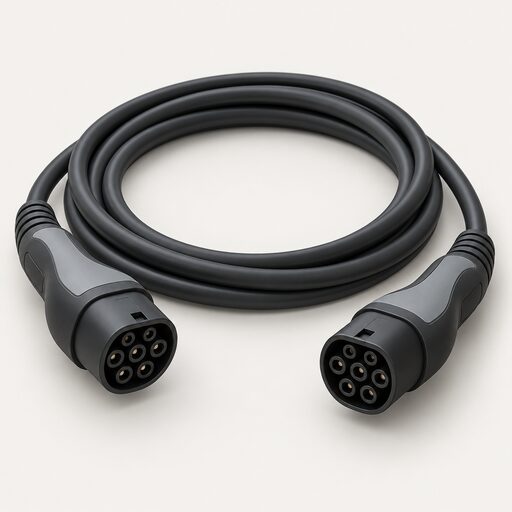 Types of Home EV ChargerWhich home charger suits your car and your driveway?
 Charging and Energy IndependenceCharging an electric car at home can cut your fuel costs, but how much does it really free you from the grid?
 Charging an EV from Solar PanelsCharging your car from solar panels means using the power your roof makes instead of sending it to the grid.
 Charging With a Home BatteryHow a home battery and an EV charger share one supply, whether a battery can usefully charge a car, and how combined systems are controlled so the battery is not discharged into the vehicle at a loss.
 What Is a Smart Charger?A smart EV charger is an internet-connected home charge point that schedules charging around tariff prices, grid demand and household load.
 Charging by Home TypeHow the practical and legal position for home EV charging changes by property type: flats and leasehold consent, terraced homes without frontage, shared car parks and metering, rural properties with long cable runs, and listed or conservation area homes.