
In this guide
In the UK, a small wind turbine for a house is governed in practice by the Microgeneration Certification Scheme, described as the quality mark for small-scale renewables such as small wind turbines1. Four documents matter to a household: the product standard MCS 006, which covers micro and small wind turbines2; the planning standard MCS 020 b, the wind turbine sound calculation used for permitted development installations4; the installation standard for small wind systems, which requires the work to be carried out by a contractor certificated for wind and the turbine itself to be certificated to MCS 0065; and the pre-sale information and performance estimate rules that apply before a contract is awarded6.
Certification is not a legal permission to own a turbine, but it is the gate to almost everything else. Permitted development rights for wind turbines in England, Wales and Scotland are conditional on compliance with the MCS planning standards or equivalent standards, and in Wales and under Planning Portal guidance those rights are accorded only where a certificated installer uses a certificated product7. The Smart Export Guarantee requires an MCS certificate or equivalent for wind installations up to 50kW9. MCS product certification for electrical technologies is limited to 50kW10.
What certification does not do is promise a yield. Certification tests the machine under defined conditions; the electricity a household actually gets depends on wind speed and location. Field trial work on domestic small-scale wind concluded that published power curves should be treated with caution until products are accredited, and called for turbines to be tested and certified at specific parameters under harmonised standards11. That is the gap this page sets out: a certificate tells you the product has been assessed, not that your garden is windy.
The standards that actually apply to a domestic turbine
MCS standards define and maintain quality, performance and consumer protection requirements for small-scale renewable energy technologies, covering products, installers and certification processes in the UK2. The scheme is an independent, UKAS-accredited quality assurance scheme for microgeneration products such as solar panels, heat pumps and wind turbines15, and it certifies, quality assures and provides consumer protection for microgeneration installations and installers across small-scale renewable electricity technologies including wind16. It is the standards organisation for small-scale renewables of 50kW or smaller17.
Small wind sits inside that framework in a particular way. Because a domestic machine is usually between two and eight metres high18 and stands close to a dwelling, the standards that bite hardest are about sound, siting and installation quality rather than structural design alone. Turbines attached to a house also bring building regulations into play: those regulations will normally apply to a turbine fixed to the dwelling, and an installer registered with the relevant competent person scheme may be authorised to self-certify the work without involving local authority building control19. The competent person framework includes a specific annex covering micro and small scale wind turbine systems20.
Two boundaries are worth stating plainly. First, the certification framework is sized for microgeneration: wind at a declared net capacity of 50kW or less is the regime a household will ever meet21. Second, a low voltage consumer's installation containing a source of energy must comply with British Standard requirements, so the electrical side of a turbine is regulated separately from the MCS product certificate. The standards for electrical safety and wiring for home generation and the G98 and G99 connection rules are additional to, not replaced by, a product certificate.
MCS 006: the product standard for micro and small wind turbines
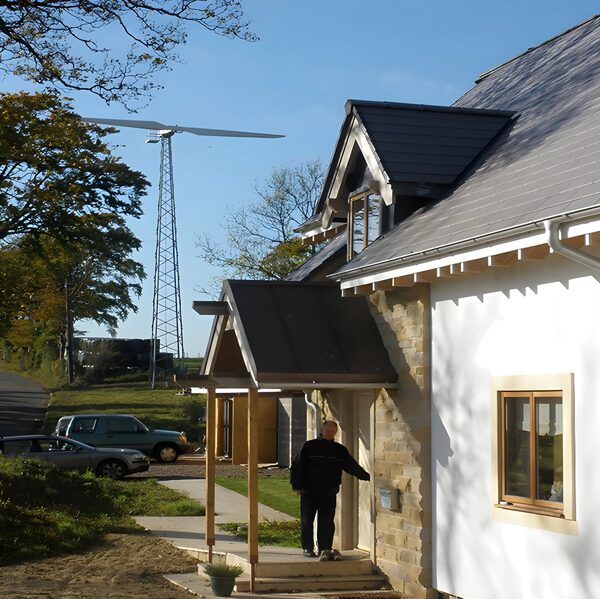
MCS 006 is the certification scheme for micro and small wind turbines3. It is a product standard: a turbine model is assessed against it by a certification body, and the certificate attaches to that model. Issue 3.0 incorporated the RenewableUK Small Wind Turbine Standard (2014) and a RenewableUK technical note giving guidance on inverter changes in small wind turbine systems4. That second point matters in practice, because a turbine and its inverter are certified as a system, and substituting an inverter is not a free change.
The standard has been the subject of real difficulty for the sector. When the Ryse Energy G-11 was certified, finding a product certification body that assessed against the Small Wind Turbine Standard (MCS 006) was described as one of the key obstacles22. One maker, SD Wind Energy, states that the SD6 small wind turbine has achieved the new MCS product certification standard, which it describes as an update to the latest revision of the RenewableUK Small Wind Turbine Standard23. Maker claims of that kind are useful for identifying which models exist in the certified pool; they are not independent evidence of performance.
For a household the practical consequence is a short list. The number of certified small wind products in the UK is small, and the certificate is model-specific, so a quotation naming a turbine type in general terms does not establish that the machine offered is certified. The installation standard for small wind requires that the wind turbine product be certificated in accordance with MCS 0065, so an uncertified product cannot be used in a compliant MCS installation at all. That is a genuine constraint on choice, and it is one reason the domestic wind market is far narrower than the solar market. The pages on domestic wind turbines and MCS certification for wind and hydro installations set out how that narrowing plays out.
MCS 020 b: sound calculation for permitted development
The MCS Planning Standards are defined in legislation as the standards specified in the scheme for air source heat pumps (MCS 020 a, Air Source Heat Pump Sound Calculation) and for small and micro wind turbines (MCS 020 b, Wind Turbine Sound Calculation, for permitted development installations)12. MCS 020 governs sound levels for air source heat pumps and small wind turbines24, and the scheme announced that it would split MCS 020 into two, one part for air source heat pumps and one for small wind turbines24. English planning legislation was amended in 2025 to replace a reference to MCS 006 with a reference to MCS 020 b for this purpose26. The MCS Planning Standards were updated on 20 March 202513.
That amendment is worth understanding, because it corrects a common confusion. MCS 006 is the product standard; MCS 020 b is the sound calculation a permitted development installation must satisfy. A turbine can be certified to MCS 006 and still fail a sound calculation on a particular plot, because the calculation depends on the distance to neighbouring habitable rooms and the acoustic situation of the site. The related pages on wind turbine noise, shadow flicker and neighbours and ETSU-R-97 noise assessment deal with the calculation and the wider noise regime.
How the four nations use the standard
| Nation | How the standard enters planning |
|---|---|
| England | Stand alone and building-mounted turbines are permitted development only if the installation complies with the MCS Planning Standards (MCS 020) or equivalent standards7 |
| Wales | Stand alone turbines must comply with the MCS Planning Standards or equivalent; permitted development rights are accorded only for equipment installed by a certificated installer using a certificated product8 |
| Scotland | Free-standing turbines and turbines on detached dwellinghouses must comply with the relevant MCS planning standards for wind turbines or equivalent standards28, a requirement carried into the 2024 permitted development classes29 |
| Northern Ireland | The defined MCS Planning Standards in the relevant regulations are the product and installation standards for air source heat pumps specified in MCS 02030 |
The nations therefore share a standard but not a route. England and Scotland write the condition into permitted development classes, Wales adds an explicit installer condition, and the Northern Ireland definition as drafted addresses heat pumps. Scottish proposals during the permitted development review included adding an MCS 020 compliance requirement to free-standing and dwelling-mounted domestic turbine rights, which is how the condition reached the current classes29. Household planning detail is in the separate pages for England, Scotland, Wales and Northern Ireland.
Design and installation: the MCS installation standards
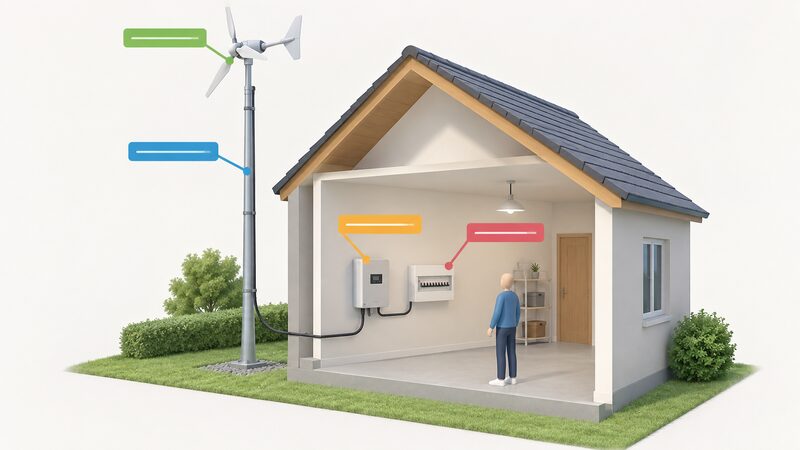
MCS installation standards define how small-scale renewable technologies should be designed and installed using MCS certified products2. For wind, the installation standard requires that the turbine be installed by an MCS contractor certificated in accordance with MIS 3003, the small wind installation standard, and that the product be certificated to MCS 0065. A certified installation is therefore a pairing: certificated contractor plus certificated product. A household buying through the scheme is told the system will be designed and installed in accordance with MCS standards, and that a handover pack is provided on completion including product details and the workmanship warranty1.
Certification of a business means, in the scheme's own terms, that it has the ability and expertise to fit, test and commission the equipment in compliance with ISO 17065, the accreditation standard for product and process certification bodies. Certified installers use certified small wind turbines, which the scheme says have been tested for quality, reliability and performance1, and install to industry standards while adhering to recognised safety practices1.
Two practical effects follow. The first is the permitted development condition already noted: one of the limits of permitted development rights for wind turbines and air source heat pumps is that equipment must be installed by an installer certificated through the scheme using a certificated product31. The second is that an installation carried out competently but outside the scheme may be perfectly safe and still be ineligible for export payments and unable to rely on permitted development. The Energy Saving Trust suggests obtaining quotes from at least three certified installers, and notes that an installer can assess the property and recommend a suitably sized turbine32. Sizing is addressed in the page on wind turbine output and sizing, and the work itself in installing and maintaining a domestic wind turbine.
Pre-sale information and performance estimates
The redeveloped scheme adds a class of standards that sit before the sale rather than after it. Pre-sale information and system performance estimate standards are the technical standards that set out how to carry out system performance estimates and what pre-sale information must be provided to a customer for an installation6. Published examples show the pattern: MCS 032, the solar PV and battery pre-sale information and system performance estimate standard, was first published as issue 1.0 with an issue date of 1 January 2025, is to be used in conjunction with the MCS Customer Commitment, and states that its requirements must be complied with before a contract is awarded to the customer33. A further code, MCS 038, is the pre-sale information and system performance estimate standard used alongside a newer installation standard34.
The significance for wind is the timing rule rather than the code. A performance estimate produced to a defined method, before the contract, changes the nature of the sales conversation: the estimate becomes part of the documentation the customer holds, not a verbal projection. That directly addresses the historic complaint about domestic small wind. Field trial evidence advised that potential customers treat published power curves with caution until products receive accreditation11.
"Potential customers should treat published power curves with caution until such time that products receive MCS accreditation"
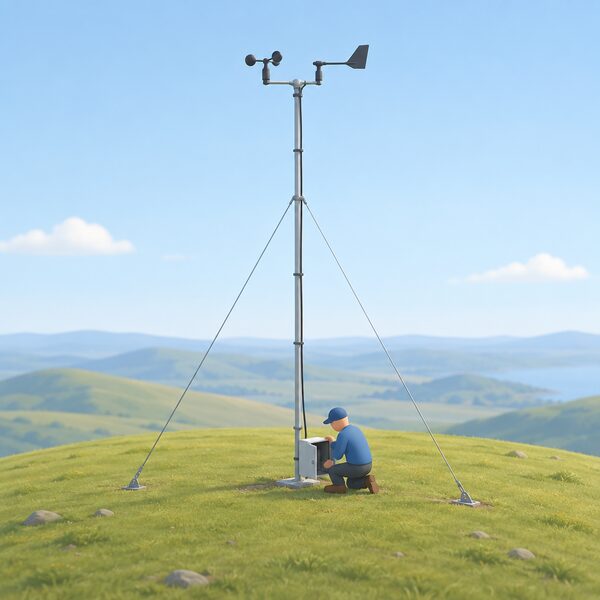
Pre-sale documentation does not remove the site risk. The estimate is only as good as the wind data behind it, which is why the siting evidence sits outside the standards framework. Guidance suggests considering a turbine only where the local annual average wind speed is five metres per second or more and where no major obstacles such as buildings, trees or hills are likely to reduce wind speed or increase turbulence, and ideally carrying out a professional assessment of local wind speed for a full year at the exact intended location35. Independent guidance notes that before spending thousands on a turbine it could be worth spending a few hundred on wind monitoring equipment such as a mast and data logger, and that an ideal site is a smooth hilltop with a clear open stretch, at least in the prevailing wind direction36. See wind speed and siting for a home wind turbine.
Harmonised testing: where the requirements are heading
The direction of travel in the domestic small wind sector has been towards testing to common parameters so that one turbine's figures can be compared with another's. Field trial work recommended that appropriate standards be introduced requiring domestic small-scale turbines to be tested and certified at specific parameters under harmonised standards11. The turbines in that trial were installed by installers accredited through the Government's earlier Clear Skies programme, which shows how long the certification question has been open11.
The MCS route has moved in the same direction by absorbing sector standards rather than writing from scratch: MCS 006 Issue 3.0 incorporates the RenewableUK Small Wind Turbine Standard (2014) and the RenewableUK technical note on inverter changes4. Government proposals for air source heat pump noise have similarly proposed linking noise prediction to the established microgeneration certification scheme rather than creating a parallel method37, and the planning standards themselves have been described as currently applying only to domestic properties37. The pattern is consolidation into a single UK certification scheme, with the sector's own test methods inside it.
The limitation to note is that the scheme's scope is domestic and small. Nothing in the framework was designed to allow a household to verify a manufacturer's yield claim independently; it standardises the test and the estimate method, and leaves the site to the site.
Certification and money: export payments and legacy tariffs

Certification is the condition attached to the schemes that pay for generation. For solar PV, wind and micro-CHP installations up to 50kW, the Smart Export Guarantee means presenting a Microgeneration Certification Scheme certificate or equivalent9. Eligibility for the guarantee extends to small wind of 5MW or less14, and the scheme was introduced for small-scale generators installing solar, wind or other renewable generation, supporting small-scale renewable electricity generation38. Licence conditions express the requirement precisely: for installations of 50 kilowatts or less generating from combined heat and power, solar photovoltaic or wind, the installation must be certified under MCS or an equivalent scheme and installed by an MCS or equivalent installer39.
| Scheme | Certification condition |
|---|---|
| Smart Export Guarantee | MCS certificate or equivalent for solar PV, wind and micro-CHP up to 50kW9; wind eligible up to 5MW14 |
| Feed-in Tariff (closed) | Certified product and certified installer required; the scheme is described as a certification scheme for microgeneration installation companies and products, defining and maintaining consistent standards40 |
| Permitted development | Compliance with MCS Planning Standards or equivalent, certificated installer using a certificated product7 |
The Smart Export Guarantee, the earlier Feed-in Tariff and the Renewable Heat Incentive all required the product and installer to be certified and to meet MCS standards41. The closed tariff is covered in the Feed-in Tariff for wind, hydro and micro-CHP, and current arrangements in selling electricity from a wind, hydro or CHP generator. For MCS product certification, the ceiling for electrical technologies is 50kW10, and the scheme covers microgeneration of 50kW or smaller generally17, so a domestic turbine sits comfortably inside the certified regime.
Checking a certificate, and what to check besides
Certified products and certified installation businesses are listed by the scheme, which is independent and UKAS-accredited15. A certificate identifies the specific model, and for installations the certificated contractor. Beyond the certificate itself, the conditions that decide whether an installation is lawful and worthwhile are largely local:
- Planning: always check with the local planning authority before a system is installed, since conditions differ by nation and by site, and permitted development limits include, for example, a requirement that the bottom of the blades be at least five metres from the ground42.
- Sound: MCS 020 b is a calculation for the specific installation, not a property of the turbine12.
- Building regulations: these normally apply to a turbine attached to the house, with a competent person self-certification route available19.
- Wind resource: a professional assessment of local wind speed over a full year at the exact location is the recommended evidence35.
- Documentation: a handover pack with product details and workmanship warranty is provided on completion of a certified installation1.
What certification means for household energy independence
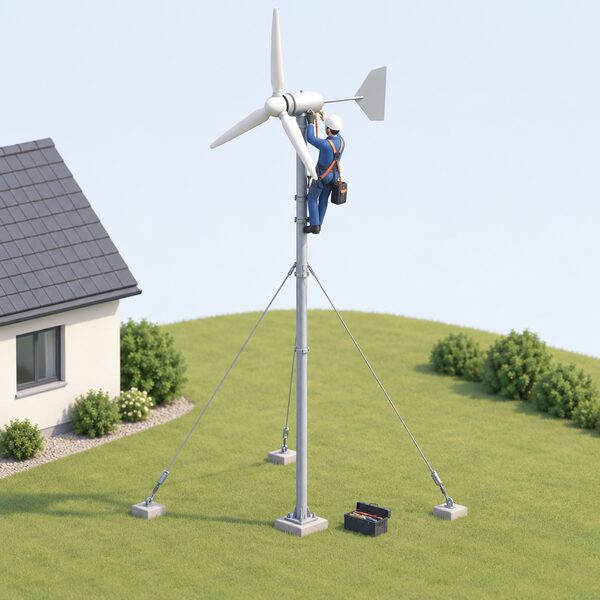
A certificate improves the odds and narrows the choice. It gives a household a machine assessed against a sector standard, an installer assessed against installation and commissioning requirements, a defined sound calculation, and a documented performance estimate produced before the contract is signed6. That combination is what makes a small wind turbine a credible part of a home's own generation rather than a gamble, and it is the reason the export schemes accept certified installations and refuse others9.
The dependence that remains is real. A certificate does not make wind blow: output depends on wind speed and location, and a site below the five metres per second guideline or shielded by buildings and trees will underperform whatever the product certificate says35. Turbines can have a life of up to 22.5 years but need service checks every few years to keep working efficiently35, which means a continuing relationship with a maintenance contractor and, for warranty purposes, a manufacturer that still exists. Export payments depend on a supplier and on scheme rules that have already changed once, when the Feed-in Tariff closed40. And the certified product pool for small wind is small, with certification body availability itself having been a documented obstacle22, so households have less freedom to choose than solar buyers do. A home wind turbine, properly certified and properly sited, reduces imported electricity; it does not remove the grid, the supplier or the manufacturer from the picture. The wider trade-offs are set out on the microgeneration pillar page and in micro wind, hydro and CHP and energy independence.
Sources42 cited
- Small wind turbines: consumer guidance, MCS, 2026-08-18
- MCS Standards, MCS, 2026-06-17
- MCS product certification scheme scope, BSI, 2026-09-17
- Updates to four MCS product standards, MCS, 2024-08-02
- MCS 020 Planning Standards, Issue 1.2, MCS, 2015-05-01
- Update on the redevelopment of MCS, MCS, 2024-11-27
- Stand alone wind turbines: permitted development, Planning Portal, 2026-09-17
- Planning permission for wind turbines, Welsh Government, 2026-09-17
- Smart Export Guarantee Annual Report Year 5, Ofgem, 2025-12
- Certifying your product, MCS, 2026-05-18
- Location, Location, Location: small-scale wind field trial report, Energy Saving Trust, 2009-07
- Town and Country Planning (General Permitted Development) Order, Schedule 2 Part 14, legislation.gov.uk, 2026-09-17
- Explanatory memorandum to SI 2025/560, legislation.gov.uk, 2025
- Smart Export Guarantee: consumer guidance, MCS, 2026-04-27
- MCS Microgeneration Certification Scheme, BRE Group, 2026-09-20
- ECO4 Flex and GBIS Flex information document, Ceredigion County Council, 2025-11
- Warm Homes Social Housing Fund wave 3 scheme guidance addendum, UK Government, 2026-06
- Microgeneration energy guide, Uswitch, 2026-06-08
- Wind turbines and building regulations, Planning Portal, 2026
- Competent person schemes: current schemes, UK Government, 2013-04-04
- Feed-in Tariffs guidance for licensed electricity suppliers, Ofgem, 2021-12-13
- Milestone for the small wind sector as a new turbine achieves MCS certification, MCS, 2025-01-23
- SD6 achieves latest MCS product standards, SD Wind Energy, 2026-09-20
- MCS to change standard in support of planning changes for air source heat pumps, MCS, 2024-11-22
- MCS publishes an updated version of MCS 020, MCS, 2025-03-20
- The Town and Country Planning (General Permitted Development etc.) (Amendment) Order 2025, legislation.gov.uk, 2025-05-06
- Building-mounted wind turbines: planning permission, Planning Portal, 2026-09-17
- Circular 1/2024: householder permitted development rights, Scottish Government, 2024-05-28
- The Town and Country Planning (General Permitted Development) (Scotland) Amendment Order 2024, legislation.gov.uk, 2024-05-24
- Planning (General Permitted Development) Order (Northern Ireland), legislation.gov.uk, 2015-02-25
- The Microgeneration Certification Scheme and permitted development, Planning Portal, 2026-09-17
- Wind turbines advice, Energy Saving Trust, 2026-05-20
- MCS 032:2025 Solar PV and Battery Pre-Sale Information and System Performance Estimate Standard, MCS, 2025-01-01
- Pilot for a new thermal energy storage systems installation standard, MCS, 2025-09-15
- Wind power for the home, nidirect, 2026-05-18
- Wind power information, Centre for Alternative Technology, 2025-06-27
- Permitted development rights: impact assessments, Scottish Government, 2026-09-17
- Smart Export Guarantee research briefing, House of Commons Library, 2026-05-13
- Draft licence conditions for the Smart Export Guarantee, UK Government, 2026-09-17
- Feed-in Tariffs Annual Report Scheme Year 13, Ofgem, 2023-12
- Smart Export Guarantee briefing, House of Commons Library, 2026-05-13
- Renewable energy FAQs, Electricity North West, 2023-02-23
 Building-Mounted Wind TurbinesWill a wind turbine on your roof actually make enough electricity to be worth it?
 Domestic Wind TurbinesCan a wind turbine really power a home, and is your site windy enough?
 Wind Turbine Planning in EnglandCan you put up a small wind turbine at home without asking the council first?
 Wind Turbine Planning in WalesDo you need planning permission for a wind turbine at home in Wales?
 Wind Turbine Output and SizingHow much electricity a home wind turbine makes depends far more on your wind than on its size.
 G98 and G99 Grid ConnectionConnecting a wind turbine, hydro turbine or micro-CHP unit at home raises the question of whether it needs G98 or G99.