
In this guide
Gledhill has been making hot water cylinders in Britain since 1926, when two brothers, Norman and Joe Gledhill, started manufacturing domestic copper cylinders in small premises in Blackpool1. The company remains a UK manufacturer, with all its cylinders built at a 118,000 square foot Manufacturing Centre of Excellence for Stainless Steel in Blackpool or a Manufacturing Centre of Excellence for Copper in Birmingham2. It was acquired by Groupe Atlantic in 2015 for an undisclosed sum3.
For a household, the practical questions are which cylinder is fitted, what it is made of, how long the warranty runs and where the serial number sits. The answers matter because Gledhill's installed base is large and includes the PulsaCoil thermal store, a unit found in apartment blocks where a conventional unvented cylinder cannot be discharged. Gledhill cylinders are sold only through the merchant trade, so price and availability come from a local plumbers' merchant rather than a published list2.
Warranty terms vary sharply by product type. Unvented cylinders carry 25 years on the cylinder and 2 years on components, open vented cylinders 10 years and 1 year, and thermal store appliances 5 years and 1 year2. The warranty begins from the manufacture date of the appliance, not the day it is installed2.
Gledhill: a century of UK cylinder manufacturing
Gledhill describes itself as a cylinder manufacturer with a history of innovation, quality and reliability since 19261, and by 2019 it was describing nearly 100 years of making cylinders, based solely in the UK4. The company states it has been producing copper cylinders for over 90 years5, and it prides itself on its history, experience and ability to continue the rare process of copper cylinder manufacture6.
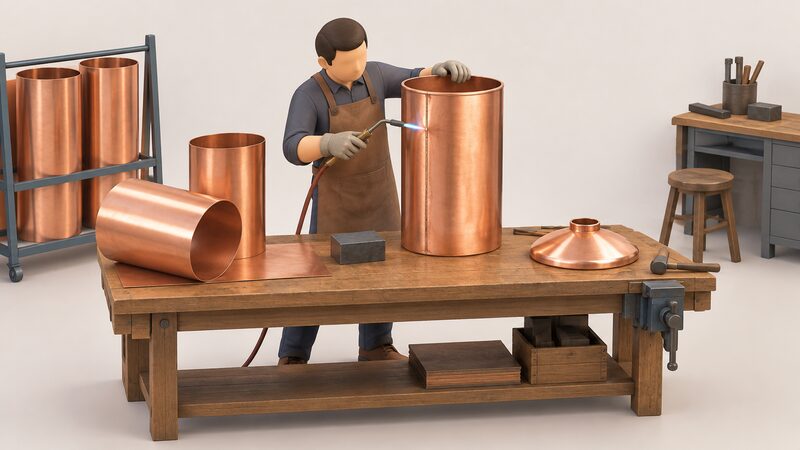
That process is genuinely manual. At the Manufacturing Centre of Excellence for Copper, components are supplied to experienced coppersmiths who carry out the manual method of copper cylinder making: marking out, folding, rolling, hole punching, handheld torch brazing, spinning of tops and bases, annealing of tapping areas and water testing6. It is a craft operation rather than a production line, and it is the reason bespoke work remains possible.
The innovation record includes a first: Gledhill was the first manufacturer of hot water cylinders in the UK to introduce foam insulation, in 19655. More recently the company has developed coil designs it describes as essentially three coils in one, unique to Gledhill, which it says require less power from the circulation pump because of better circulation7. That matters for heat pump and solar compatibility, where a large coil surface area allows the cylinder to absorb heat from a lower temperature source.
Ownership changed in 2015. Groupe Atlantic, an international manufacturer of thermal comfort solutions, acquired Gledhill for an undisclosed sum, having recently made acquisitions in the UK in the form of Hamworthy Boilers3. Groupe Atlantic operates 19 factories across Europe and distributes products to over 100 countries3. For a household, that means the brand sits inside a larger European group while manufacturing stays in Blackpool and Birmingham.
The range: thermal stores, unvented cylinders and heat interface units
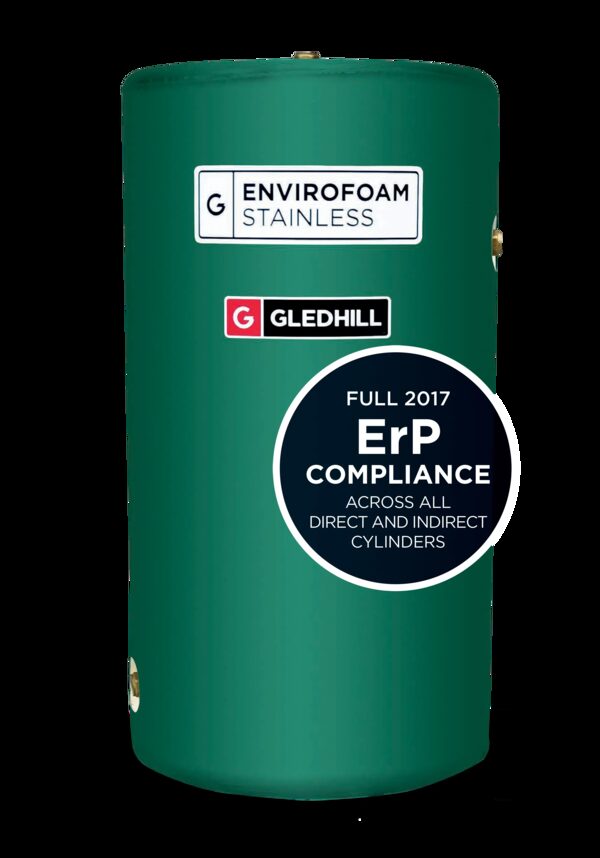
Gledhill's output divides into three broad families. The first is unvented cylinders, which take mains pressure cold water and store it as potable hot water. The second is thermal stores, which hold primary central heating water rather than tap water8. The third is vented cylinders, including the EnviroFoam Copper range, which Gledhill describes as one of the most environmentally sustainable cylinders available in the UK, and which is also available in stainless steel9.
The company's own standardised cylinder work covers copper or stainless steel cylinders, vented cylinders that are heat pump and solar ready, unvented cylinders that are heat pump and solar ready, heat pump buffer vessels from 8 to 100 litres, low loss headers, volumisers, high temperature header tanks and other bespoke copper and stainless steel products10. That list shows how far the cylinder market has moved from a simple tank: a modern installation may include a buffer vessel and a low loss header alongside the cylinder itself.
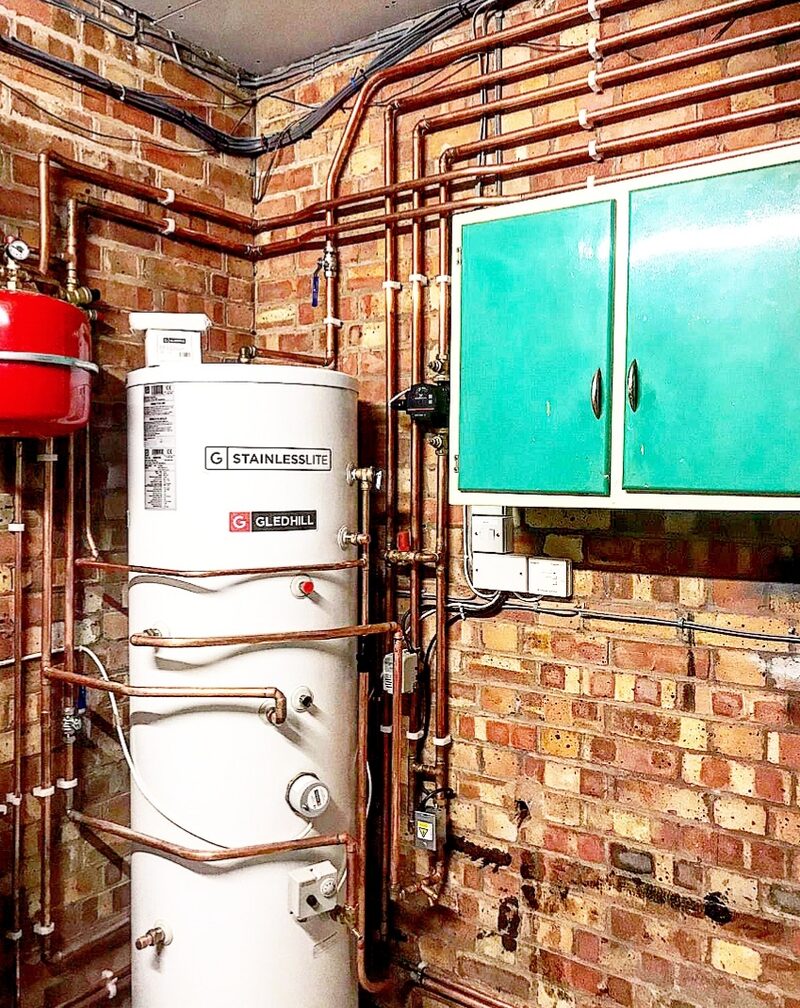
For heat pump applications specifically, Gledhill offers an unvented stainless steel unit within its flagship StainlessLite range, providing mains pressure domestic hot water11. The wider market has moved the same way: the Joule Zenith range of unvented cylinders, for example, is designed to simplify heat pump installations and includes pre-plumbed and unplumbed heat pump cylinders with integrated buffer and slimline options12. Cylinder choice is now a system design decision, not a like-for-like swap.
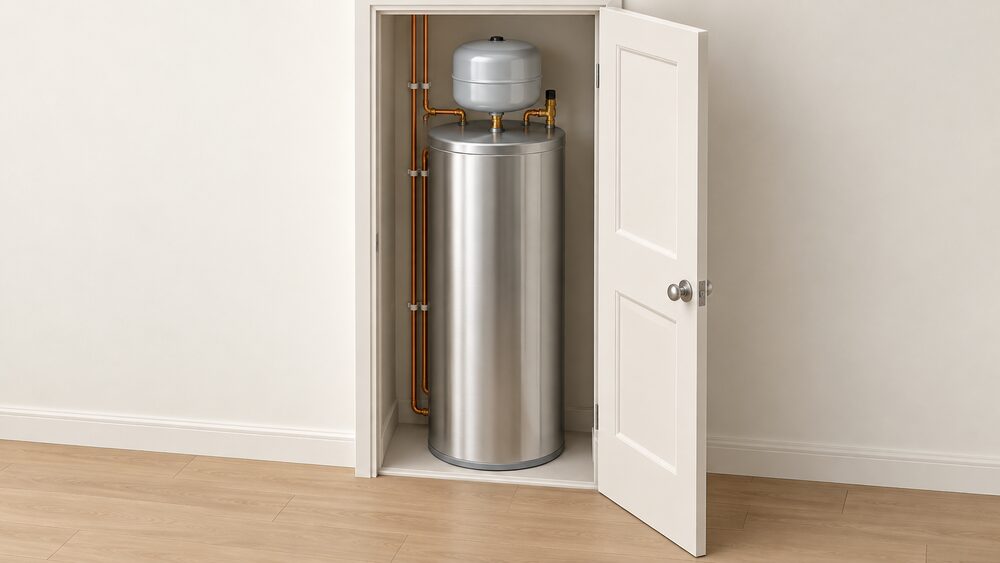
Dimensions are worth noting when replacing a unit. Gledhill states that dimensions for thermal store products and unvented cylinders are the overall size, which means insulation is included in the figure2. A replacement that looks the same on paper may not fit the same cupboard.
StainlessLite Plus, Platinum and Pro: which cylinder fits which home
The StainlessLite Plus is Gledhill's mainstream unvented cylinder and comes in direct and indirect patterns. Direct cylinders heat water with their own immersion elements; indirect cylinders take heat from a boiler or heat pump through a coil. A 120 litre StainlessLite Plus Direct was specified for a day nursery application13, and two 150 litre StainlessLite Plus unvented direct cylinders were installed at a glamping site in Nidderdale, bought from Travis Perkins Thirsk14. The range was revamped in 201714.
The Platinum range sits above it. Gledhill's Platinum unvented cylinders are manufactured from high specification duplex stainless steel11 and use a corrugated StainlessLite Supercoil for faster recovery times15. Their distinguishing feature is an internal expansion vessel, designed to eliminate the requirement for an external expansion vessel15. In a tight airing cupboard that is a real gain, since the external vessel and its connection are removed from the installation. All Platinum unvented cylinders come with a 25 year warranty with on-site support, though the maker directs readers to the relevant installation manual for full warranty information15.
The Stainless Pro range covers horizontal cylinders, introduced in 2021 in indirect patterns from 120 to 300 litres for height restricted spaces. A separate accessory, the Gledhill washing machine frame, is engineered from steel and holds the company's 120L to 250L hot water cylinders, accommodating all Platinum Direct cylinder sizes as well as over 50% of Platinum Indirect cylinders16.
| Range | Type | Material | Warranty |
|---|---|---|---|
| StainlessLite Plus | Unvented, direct and indirect | Stainless steel | 25 years cylinder, 2 years components2 |
| Platinum | Unvented, direct and indirect | High specification duplex stainless steel11 | 25 years with on-site support15 |
| Stainless Pro | Unvented horizontal, 120 to 300L indirect | Stainless steel | Not stated |
| EnviroFoam Copper | Vented | Copper, also in stainless9 | 10 years cylinder, 1 year components2 |
PulsaCoil thermal stores: how they differ from a plain cylinder
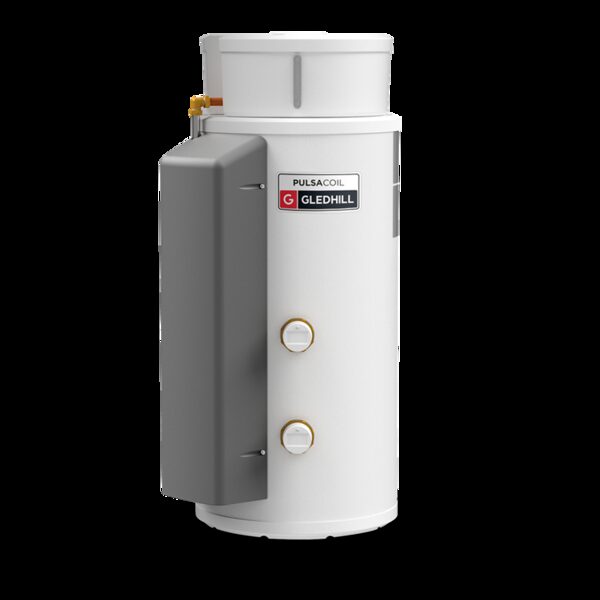
A PulsaCoil is not a cylinder of stored tap water. It is a thermal storage cylinder manufactured from high corrosion resistant stainless steel, and it is an open vented thermal store8. The distinction is fundamental: the tank is filled with primary central heating water, as opposed to potable hot water17. Hot water is produced by passing mains cold water through a heat exchanger inside the store, so the store never holds the water that comes out of the tap.
The PulsaCoil Stainless provides mains pressure hot water using off-peak electric, and offers the option to use a secondary heat source8. It has a circular feed and expansion tank, described as an improvement in aesthetics and a reduction in height compared with the previous rectangular option8. That height reduction matters in the cupboards and service voids where these units live.
The reason PulsaCoils are common in flats is regulatory as much as technical. In one Southampton installation, the recommendation was based on the product being ideal for an apartment block with no provision for discharge pipework18. An unvented cylinder needs a safety discharge route to a safe place, which a mid-floor flat often cannot provide. An open vented thermal store does not. The same case study notes that the light weight of the cylinder made it easy to manage within lifts and narrow corridors18.
Thermal stores are also a replacement market in their own right. Guidance on replacement thermal stores lists the Albion Mainsflow, Gledhill Boilermate, Gledhill Pulsacoil and Gledhill Torrent among the typical units being swapped out, and asks for the cylinder's height and diameter as the starting information19. Bespoke thermal stores are built to exact specification with custom coil configurations and connection arrangements, and are described as giving an unlimited hot water supply at operating temperature17.
Build quality: stainless steel, copper and foam insulation
Gledhill works in both metals, and the choice between them is not simply a quality ranking. The Stainless ES is manufactured from highly corrosion-resistant duplex stainless steel1, and the Platinum range uses high specification duplex stainless steel11. Duplex grades are chosen for resistance to corrosion in stored hot water, which is the failure mode that ends a cylinder's life.
Copper remains in production for vented and bespoke work. The EnviroFoam Copper range is available in the UK and is described by the maker as one of the most environmentally sustainable cylinders available9. Bespoke copper cylinders are produced at the Centre of Excellence for copper in Birmingham20.
Insulation is where the two metals diverge in practice. Gledhill's Platinum range uses high density HCFC free Envirofoam insulation15. A comparative study of copper and stainless steel cylinders gives a stainless steel cylinder an insulation thickness of 45, and recommends that a particular type of polyurethane foam insulation should be discontinued for use with stainless steel cylinders where the insulation is exposed to moisture in service21. That is a materials-compatibility point rather than a performance claim, and it is the kind of detail that matters when a cylinder sits in a damp cupboard or a cold loft.
The wider market uses the same materials. Newark Cylinders manufactures bespoke thermal stores and thermal store cylinders in copper and stainless steel17, and its standardised solutions cover copper or stainless steel cylinders, vented and unvented cylinders that are heat pump or solar ready, and buffer vessels10. Joule's Zenith cylinders are likewise manufactured from duplex stainless steel, described as a highly corrosion resistant material providing quality and durability12. Duplex stainless has become the default for unvented work across the sector.
Availability and delivery: next day from five hubs and 4,000 cylinders in stock
Gledhill's distribution model is built around stock rather than made-to-order. The company describes a structure of five distribution hubs, geographically situated for effective, widespread product delivery2, and states that its distribution network holds over 4,000 cylinders in stock at any point, meaning a cylinder can be delivered next day4. Same day collection is available on many products2.
That stock position is unusual for a manufacturer and it shapes how installations run. A heating engineer replacing a failed cylinder can often collect or receive one the next working day rather than waiting on a factory lead time, which shortens the period a household is without hot water. It also means a cylinder may have been manufactured some time before it is installed, which matters because the warranty runs from the manufacture date2.
The trade route is deliberate. Gledhill cylinders are only available through the merchant trade, and local plumbers' merchants provide price and availability2. There is no direct-to-householder sales channel, so a householder cannot buy a Gledhill cylinder and arrange fitting independently of a merchant and an installer.
Bespoke work runs on a different track. Orders go through the Gledhill Xpress service or a printed special order form, which the merchant sends to the central sales and logistics team at Blackpool headquarters, under a strict merchant only policy20. Custom specification covers tapping heights, connection sizes and positions20.
For support, general product enquiries go to 01253 474550 and technical advice for installers to 01253 47458422. Gledhill Building Products does not have field engineers to attend appliances; repairs run through its sister company Gledhill Response on 0800 1018 365 or response@gledhill.net2.
Warranty, registration and what happens when a cylinder fails
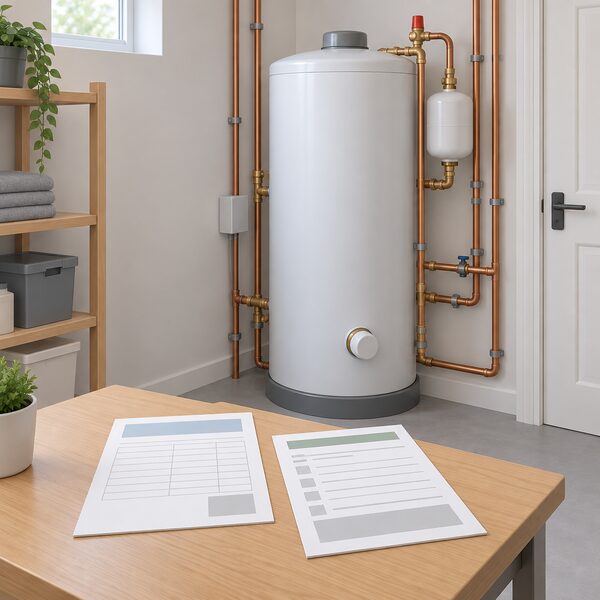
The warranty ladder is set by product type. Unvented cylinders carry 25 years on the cylinder and 2 years on the components, open vented cylinders 10 years on the cylinder and 1 year on components, and thermal store appliances 5 years on the cylinder and 1 year on components2. The StainlessLite Plus Direct is described as coming with a 25 year warranty with on-site technical support13, and the Stainless ES with a 25 year warranty1.
Two conditions shape how that cover works in practice. The first is the start date: the warranty begins from the manufacture date of the appliance2. A cylinder that has spent a year in a merchant's stock has a year less cover than one shipped straight from a hub. The second is registration: new products must be registered within 30 days of installation22.
Claims have a defined route. A householder or installer can submit a claim for the reasonable costs of removing the failed appliance and the installation costs of the new one, sent with the failed cylinder or by email to technicalsales@gledhill.net, quoting the returns reference number and supplying the serial number, installation commissioning certificate and annual service record2. For a faulty part, the part goes to Gledhill Supplier Returns with a completed warranty form; once confirmed faulty, Gledhill refunds the £30 cost and the engineer can also claim the labour cost2.
The annual service record requirement is worth noting. It means the warranty depends on a continuing servicing relationship, not just on the original installation. Independent guidance on faulty heating appliances is clear that goods must be of satisfactory quality23, which sits alongside, rather than instead of, a manufacturer's own terms.
Identifying a Gledhill cylinder and finding its serial number
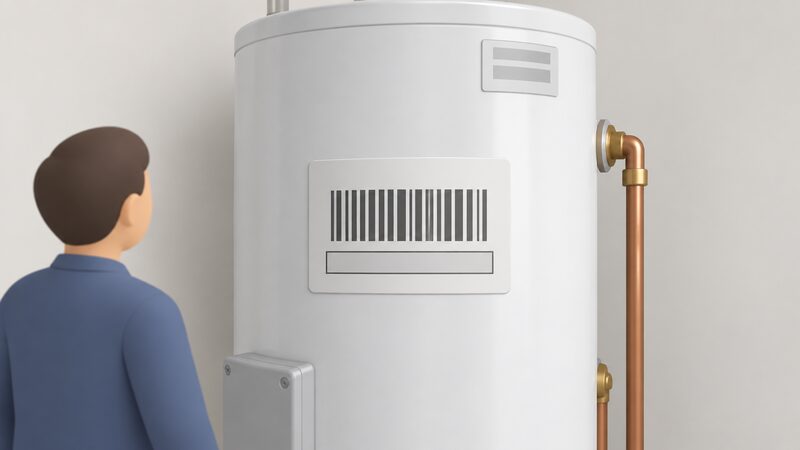
Identification starts with the appliance type. On unvented cylinders such as StainlessLite Plus and on thermal stores such as PulsaCoil and BoilerMate, the serial number is a 12 digit number in the format X XXXXX XXXXX X, printed underneath the bar code on the data label or information badge, and also on a dedicated label towards the top of the appliance2.
Open vented cylinders, PulsaCoil and BoilerMate units are the exception. Instead of a serial number, the appliance should have a delivery note in the format A12345 and a job number in the format XXX/XX, found on the appliance data label or information badge2. Anyone trying to register a warranty or order a part for one of these units needs those references, not a serial number.
For comparison, other manufacturers use different conventions. A Viessmann Vitocell 300-V carries a 16 digit serial number located on the back of the cylinder24. The lesson is general: the number, its length and its position vary by maker and by product, and the data badge is the place to start.
A PulsaCoil can also be recognised by its shape. The PulsaCoil Stainless has a circular feed and expansion tank, a change from the previous rectangular option that reduced the unit's height8. An open vented thermal store with a circular tank at the top is a strong indication of the type.
What owning a Gledhill cylinder means for energy independence
A cylinder is a storage device, and storage is where a household gains room to manoeuvre. The independence it offers is not independence from the grid; it is the ability to decide when the grid is used. A thermal store such as the PulsaCoil runs on off-peak electric and provides mains pressure hot water8, which shifts the electrical load to the hours when power is cheapest and, increasingly, when it is lowest carbon.
The measurement matters here. MCS defines grid electricity independence as the fraction of electricity consumed in the property which is met by self-consumed electricity, and self-sufficiency as the percentage of electricity consumed over a year met by either behind the meter solar or electrical energy storage25. A cylinder does not generate anything, so it does not raise either figure on its own. What it does is make the timing flexible, and electrical energy storage is described as a way of increasing self-consumption and reducing reliance on the grid26.
The dependence that remains is straightforward. A Gledhill cylinder is a component, not a system: it needs a heat source, whether a gas or oil boiler, a heat pump, an immersion element or a thermal store's off-peak electric supply. A gas-heated cylinder keeps the household on the gas grid and on a gas supplier, and a smart meter connection ties the property to that supply arrangement27. A PulsaCoil on off-peak electric keeps the household on the electricity grid and on a tariff that has to be available and worth having.
There is also a manufacturer dependence. Parts, warranty administration and technical identification all run through Gledhill and its merchant network, and the warranty requires an annual service record2. The company is UK-based and UK-manufacturing, which shortens the supply chain, but it is owned by Groupe Atlantic3, so ultimate control sits outside the UK.
The wider policy direction points the same way as the technology. Reducing dependency on imported gas is a stated aim of clean energy system investment28, and the argument that more homegrown energy means greater energy independence is made in the Scottish solar sector's own manifesto29. A well-insulated cylinder with a large coil is the component that lets a heat pump or solar thermal array deliver into a home, and it is the reason cylinder specification has become a system design question rather than a plumbing afterthought. For the wider picture, see hot water cylinders and home heating and energy independence.
Sources29 cited
- Gledhill's Stainless ES the ideal choice for a veterinary surgery in Scotland, Gledhill, 2026-04-17
- Gledhill FAQs, Gledhill, 2022-07-25
- Gledhill acquired by Groupe Atlantic, Gledhill, 2015-12-18
- Gledhill quality begins at home, Gledhill, 2019-02-11
- Gledhill Sales Director Neil Overton on the switch to stainless, Gledhill, 2018-09-20
- Manufacturing Centre of Excellence for Copper, Gledhill, 2018-11-23
- Cylinders providing a path to Net Zero, Gledhill, 2021-06-05
- PulsaCoil Stainless, Gledhill, 2025-06-17
- EnviroFoam Copper, Gledhill, 2025-06-17
- Standardised Cylinder Solutions, Newark Cylinders, 2026-04-17
- New build cylinder choice, Gledhill, 2021-03-25
- Zenith unvented cylinders, Joule, 2026-02-20
- Gledhill provides hot water for a day nursery, Gledhill, 2026-04-17
- Gledhill helps a Yorkshire glamping site, Gledhill, 2026-04-17
- Introducing Gledhill's Platinum range, Gledhill, 2021-01-31
- Washing machine frame, Gledhill, 2025-06-17
- Bespoke thermal stores and thermal store cylinders, Newark Cylinders, 2026-09-14
- Gledhill PulsaCoil ECO Stainless installed in Southampton, Gledhill, 2026-04-17
- Replacement hot water cylinder guide, McDonald Water Storage, 2020-04
- Bespoke copper cylinders, Gledhill, 2025-07-30
- Copper vs stainless steel research report, McDonald Water Storage, 2020-04
- Gledhill customer support, Gledhill, 2023-07-10
- Getting your broken boiler repaired or replaced, Citizens Advice, 2024-08-16
- Serial number locator for the Vitocell 300-V, Viessmann, 2023-03-24
- MCS 032: 2025, MCS Certified, 2025-01-01
- Electrical energy storage systems, Flexi-Orb, 2025-04-22
- Smart meters, SGN, 2026
- Response to Ofgem's call for input on energy system cost allocation, Citizens Advice, 2025-09-26
- Solar Energy Scotland manifesto, Solar Energy UK, 2026-09-17