In this guide
Joule is a cylinder manufacturer established in 2008, whose owners have been involved in cylinder manufacturing for more than 30 years, and which supplies the European market including the UK and Ireland1. Its UK operation is described as a cylinder manufacturer based in the Wirral, with a depot at Pontefract in West Yorkshire where collections are booked3. For a household, the practical point is that Joule makes unvented hot water cylinders rather than boilers: the cylinder is the store that decides how much hot water a home has, how fast it recovers, and how well it pairs with a heat pump or solar thermal array.
The range is broad. Stelflow indirect and direct cylinders run from 120L to 300L3, the custom stainless steel unvented range spans 90 to 2,000 litres5, and Joule direct cylinders are listed from 100 to 3,000 litres6. The company describes a complete range of A, B and C rated cylinders7. Joule publishes no list price for its cylinders, so costs are installer or merchant quoted rather than fixed by the maker.
The independence question is straightforward. A cylinder is a passive store: it holds water heated by whatever source the household already has, whether that is a gas or oil boiler, a heat pump, solar thermal or an immersion. Joule's own custom service is listed as compatible with all heat sources, including heat pump, solar thermal, solar PV, solid fuel and gas or oil boilers5. What a Joule cylinder does not do is remove the household from the grid, a fuel supplier or a heating appliance. It changes how well the heat that is generated is stored and delivered.
Joule: the company and what it makes
Joule describes itself as a leading manufacturer and supplier of heating, hot water and ventilation systems, established in 2008, with a nationwide network of trained customer support engineers1. Its own guidance adds that Joule and its owners have been involved in manufacturing cylinders for more than 30 years, and that it operates one of the most advanced production facilities supplying cylinders to the European market including the UK and Ireland2. A separate product page describes Joule UK as a leading cylinder manufacturer based in the Wirral, specialising in hot water cylinders and the design of domestic and commercial hot water and heating4.
The product scope runs wider than cylinders alone. Joule UK is described as a European heating manufacturer offering air source heat pumps, exhaust air heat pumps, cylinders, underfloor heating, radiators and ventilation systems3. The company states that it manufactures its own unvented cylinders and uses only recognised installers2. On the cylinder side specifically, Joule supplies direct unvented cylinders, horizontal cylinders, indirect cylinders and unvented cylinders, among others6.
The company page gives Unit 3, Leftfield Park, Park Road, Pontefract, West Yorkshire, WF8 4PS as the UK address, with a CRO number of 482712 and an EEE producer registration number of WEE/MM8931AA1. Collections are booked from the Pontefract depot3. The Wirral description and the Pontefract address appear on different pages, so the Pontefract address is the one given for company filings.
For a household, the significance of the company's shape is that Joule is a component maker rather than a heating brand in the way a boiler manufacturer is. It sells through merchants and installers, and its design service works with builders and specifiers as much as with individual homeowners. That matters when it comes to support: the route to help runs through the installer or the merchant first, and through Joule's own team second.
Cylinder range: vented, unvented, indirect and electric
Joule's unvented families are the core of the range. Stelflow is manufactured from duplex stainless steel and is available as indirect, direct, high gain, twin, horizontal and slimline models9. Cyclone is offered as indirect, direct, high gain, twin, horizontal, standard and slimline10. Evocyl comes in indirect, direct, twin, horizontal, pre-plumbed, high gain, slimline, heat only, heat only without controls, and system boiler with controls configurations11. Zenith is a range of unvented cylinders designed to simplify heat pump installations12.
The distinction between indirect and direct is the one that matters most to a household. An indirect cylinder takes its heat from an external source through a coil, which is what a boiler or heat pump does. A direct cylinder heats water with its own immersion element, which is what an electrically heated home uses. Joule direct cylinders are available in capacities from 100 to 3,000 litres with different immersion sizes and material constructions6.
Vented cylinders, which work from a header tank rather than mains pressure, sit in Joule's standardised and bespoke ranges rather than the named unvented families. The standardised service covers copper or stainless steel cylinders, vented cylinders that are heat pump and solar ready, unvented cylinders that are heat pump and solar ready, heat pump buffer vessels from 8 to 100 litres, low loss headers, volumisers, high temperature header tanks, and other bespoke copper and stainless steel products13.
| Family | Type | Configurations |
|---|---|---|
| Stelflow | Unvented | Indirect, direct, high gain, twins, horizontals, slimline9 |
| Cyclone | Unvented | Indirect, direct, high gain, twins, horizontal, standards, slimline10 |
| Cyclone Plus | Unvented | Indirect, direct, high gain, twins, standards, slimline14 |
| Evocyl | Unvented | Indirect, direct, twins, horizontals, pre-plumbed, high gain, slimline, heat only, system boiler with controls11 |
| Zenith | Unvented | Designed to simplify heat pump installations12 |
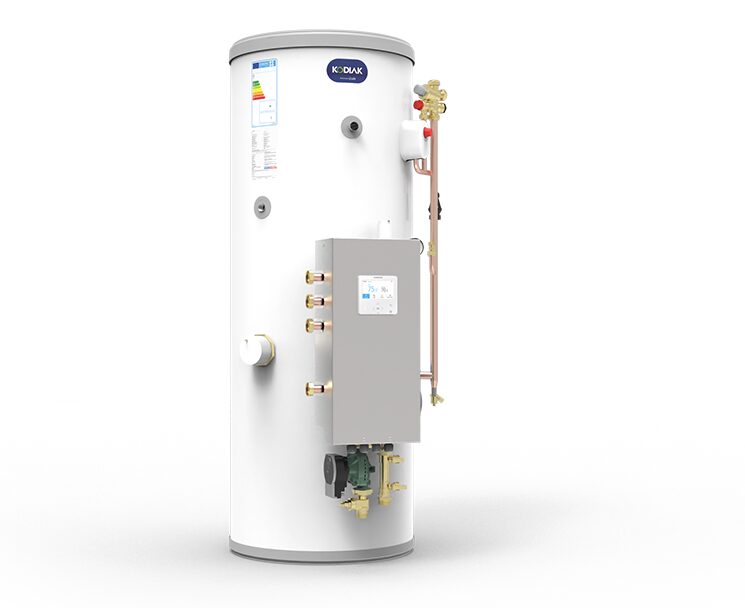
| Kodiak | Unvented, pre-plumbed | Integrates with the Samsung monobloc air source heat pump range8 |
Stainless steel construction and what it means for the cylinder's life
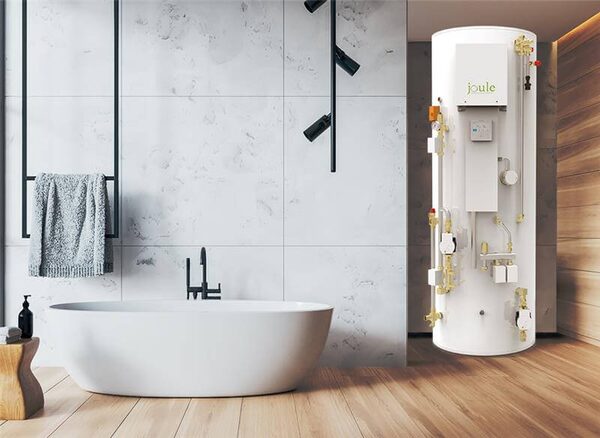
Joule builds its main unvented families from duplex stainless steel. Cyclone uses a duplex stainless steel body with stainless fittings and coils10, Cyclone Plus is built using high grade duplex stainless steel14, Evocyl is built with durable duplex stainless steel11, and Stelflow is manufactured from duplex stainless steel9. The company states that it manufactures its cylinders from stainless steel and maintains its quality specification on that basis6.
The manufacturing process is part of the claim. Joule states that it pickles and passivates all its cylinders, a post-welding metal treatment that it says treats the metal to ensure a durable long life coat6. Cyclone Plus is also fitted with a bespoke manufactured dip pipe, which Joule says gives a more efficient and greater increase of hot water, and comes with screwed connections and compression fittings for faster installation14.
On the trade-off between materials, a research report comparing copper and stainless steel cylinders found that the initial capital cost of purchasing a new cylinder was substantially higher for stainless steel in all instances investigated15. That is a maker-published comparison, so it should be read as the manufacturer's own assessment, but the direction of the finding is consistent with the material's cost. The same report gives a stainless steel cylinder a heat exchanger coil length of 10 metres15.
What this means in practice is that a stainless steel cylinder is a longer-life, higher-upfront-cost choice than a copper equivalent. The cylinder's actual lifespan still depends on water quality, system cleanliness and whether the installation is properly commissioned, none of which the material alone determines. Joule's own copper range, by contrast, is supplied in grade 3 and grade 2 with various combinations of connections, and includes combination tanks, Eco Solar tanks and Part L cylinders, all with a pre-fitted cylinder stat16. Joule states that its copper cylinders use a unique cold feed diffuser that improves cylinder efficiency by up to 10%16.
Pairing a Joule cylinder with heat pumps and solar thermal
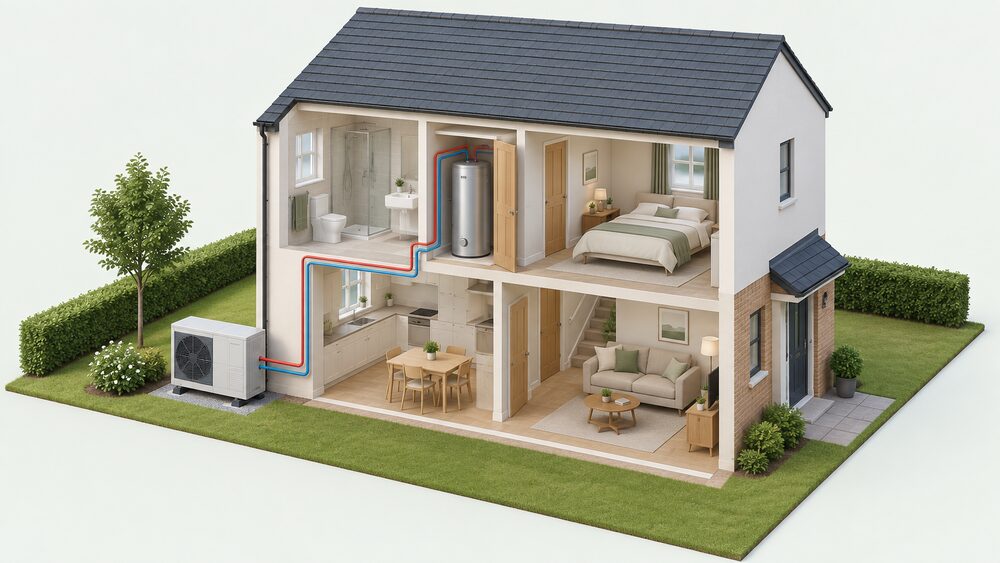
This is where a cylinder choice has the most bearing on a household's energy position. Joule states that some of its customers integrate their hot water cylinders with renewable energy sources such as heat pumps and solar thermal6. The custom cylinder service is listed as compatible with all heat sources, including heat pump, solar thermal, solar PV, solid fuel burners and gas or oil boilers5. The standardised service lists the same set of compatible heat sources13.
The named heat pump pairing is with Samsung. Joule states that the Kodiak cylinder completely integrates with the Samsung monobloc air source heat pump range, and that pre-plumbed cylinders come complete with integrated hydraulic components and advanced controls8. The Zenith PrePlumb is described as ideal for use with Joule Samsung air source heat pumps12. The Kodiak is also designed to minimise floor space and footprint while still offering optimum performance8.
On solar thermal specifically, independent guidance describes coupling a solar collector with a heat pump as a recognised system arrangement17. The Energy Saving Trust notes that many solar assisted heat pumps include an integrated hot water cylinder, which means a separate cylinder is not needed in that configuration18. That is a different arrangement from a standalone cylinder paired with a separate heat pump, and it is worth being clear which one applies before specifying.
The independence gain here is real but bounded. A cylinder that accepts heat pump and solar thermal input lets a household use more of its own generated heat and store it, rather than drawing hot water from a boiler firing on demand. What it does not do is remove the dependence on the heat pump's electricity supply, on the grid, or on the manufacturer's controls if a pre-plumbed package is used. A pre-plumbed cylinder also ties the hydraulic layout to one maker's components, which matters at service time.
Prices: what a Joule cylinder costs
Joule publishes no list price for its cylinders. Costs are installer or merchant quoted, and the figures that exist in the wider market are for the heating appliance rather than the cylinder. For context on the scale of a heat pump installation that a cylinder might sit alongside, the Energy Saving Trust looked at typical heat pump costs of around £11,700 on average19, and Smart Energy GB gives a range of £14,000 to £28,000 in Great Britain depending on type20. A Cadent consumer choice document estimates total costs of £6,800 to £17,700 with an average of £13,00021, and a parliamentary committee report puts an average heat pump at around £11,600, four times more expensive than a gas boiler22. Nesta gives about £10,500 to buy and install a heat pump, with a range from £8,000 to £15,00023.
Those figures vary widely because they cover different scopes: some include the cylinder and full system, some the appliance alone. They are not Joule prices and should not be read as such. For a Joule cylinder specifically, the only reliable route is a quote from an installer or merchant, and the price will move with capacity, whether the cylinder is indirect or direct, whether it is pre-plumbed, and whether it is a standard or bespoke build.
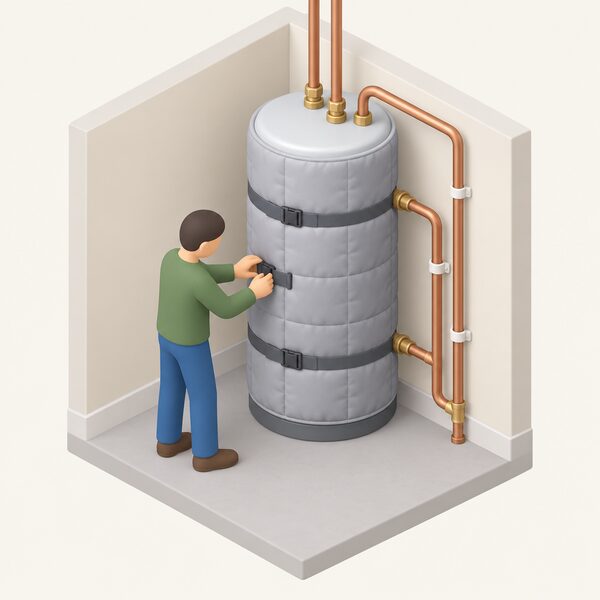
For smaller energy measures that bear on cylinder performance, the Energy Saving Trust gives a hot water cylinder jacket at about £3024, and Which? gives jackets at around £15 each, noting they pay for themselves in a year or less25. Those are insulation measures for an existing cylinder rather than a replacement, but they are the cheapest way to reduce standing losses from any cylinder, including a Joule one.
System design service: send your plans and get a proposal
Joule runs an in-house design team offering heating and plumbing design services3. The service provides design packages to the new-build domestic market and all types of properties, from self-build projects up to large sites for major house builders, involving all types of heating systems including solar and heat pumps, throughout the UK and Ireland3. The company's own filing also names a dedicated in-house design team1.
The custom cylinder route is a defined process. Joule states that it will review your requirements and send a tailored specification with pricing, followed by a detailed quotation with no obligation, then refinement, then build5. Connection customisation covers any connection size, quantity and position5. That level of specification matters where a cylinder has to fit a tight plant room or align with an existing pipe layout.
For a household, the design service is most useful at the point where the heating system is being planned rather than replaced piecemeal. A cylinder sized against the actual hot water demand of the house, and matched to the heat source, performs differently from one chosen by capacity alone. Joule's own guidance on choosing a cylinder points to pre-plumbed designs with a sleek layout that reduces the space requirements needed2.
The limit is that this is a maker's design service for its own products. It is not an independent system design, and it will specify Joule cylinders. Where a household wants an independent assessment of what the house needs, that comes from a separate designer or installer. The Joule service is best understood as a way to get a fully specified package quickly, with the cylinder and its connections resolved before installation starts.
Where Joule sits in the UK market and how to reach it
Joule supplies throughout the UK and Ireland3, and describes its production facilities as supplying the European market including the UK and Ireland2. The UK boiler market is the largest in Europe, according to an industry consultation26, which is the context in which a cylinder maker with a UK depot operates. The Clean Heat Market Mechanism, which sets obligations on boiler manufacturers, uses a threshold of 999 oil boilers in the UK market27, a reminder that the policy landscape around heating is shifting toward lower-carbon sources that cylinders serve.
On logistics, Joule UK's own site gave a last dispatch date of Friday 19 December 2025 before Christmas, with dispatches resuming on Monday 5 January 20263. That is a practical detail for anyone timing an installation around the holiday period.
Contact routes differ between pages, which is worth knowing before calling. The company page gives 0330 808 8488 and info@joule.ie1. A separate guidance page gives 01 513551094 and info@jouleuk.co.uk2. The ModulAir safety notice carries its own contacts, 020 3744 4200 and modulairuk@jouleuk.co.uk28. Because these differ, confirming which route applies to a specific product is sensible.
Owning a Joule cylinder: support, after-sales and on-site help
Joule's stated support position is a nationwide network of trained customer support engineers1, and the company says it uses only recognised installers2. Joule Academy offers on-demand courses with materials available to learn at your own pace, anytime, anywhere3. That training route matters for installers specifying pre-plumbed packages, where the hydraulic layout and controls are set by the maker.
The product-level details that bear on ownership are mostly about serviceability. Cyclone Plus comes fitted with branded safety components and a durable grey polycarbonate plastic outer temperature and pressure safety cover14. Evocyl is finished in a clean white outer casing11. Stelflow was redesigned with a new cold feed dip pipe, lower heat loss values, and higher, faster heat recovery rates9. Those are the features that determine how quickly hot water comes back after draw-off and how much heat the cylinder loses while standing.
The SmartPlumb package is the pre-plumbed option. Joule describes SmartPlumb as the next generation of unvented hot water storage, supplied with an ErP ready cylinder and pump, and calls it one of the most efficient cylinder packages available4. Pre-plumbed designs reduce the space requirements needed2, which is the main reason they are specified in new build and in plant rooms where floor area is tight.
The dependence to be clear about is the controls. A pre-plumbed cylinder arrives with integrated hydraulic components and advanced controls8, which means the control layer is the maker's. Servicing and fault diagnosis run through the installer and then Joule's support network, and the components are not interchangeable with another maker's package without reworking the pipework. For a household, that is a manageable trade for a compact, fully specified installation, but it is a trade rather than a free choice.
Sources28 cited
- About Joule, Joule
- Choosing the right cylinder, Joule
- Joule UK, Joule
- SmartPlumb by Joule, Joule
- Bespoke cylinder solutions, Newark Cylinders
- Leading hot water cylinder manufacture, Joule
- UK Cyclone Complete Brochure, Joule
- Kodiak unvented cylinders, Joule
- Stelflow unvented cylinders, Joule
- Cyclone unvented cylinders, Joule
- Evocyl unvented cylinders, Joule
- Zenith unvented cylinders, Joule
- Standardised cylinder solutions, Newark Cylinders
- Cyclone Plus unvented cylinders, Joule
- Copper vs stainless steel research report, McDonald Water Storage
- Copper vs stainless steel hot water cylinders, Joule
- Solar thermal and heat pump system integration, Solar Heat Europe
- Solar assisted heat pumps, Energy Saving Trust, 13 June 2025
- Renewable technologies: what really cuts energy bills, Energy Saving Trust, 12 August 2026
- How do heat pumps work, Smart Energy GB, 16 March 2026
- Savanta Cadent consumer choice, Cadent Gas
- Public Accounts Committee report, UK Parliament, 26 May 2024
- Heat pumps as an employee benefit, Nesta
- Tips to improve the EPC rating of your home, Energy Saving Trust, 3 August 2026
- Solid wall insulation costs and savings, Which?, 5 May 2026
- UK boiler market consultation, HHIC
- Clean Heat Market Mechanism, MCS Certified, 8 May 2026
- Product safety report: Joule ModulAir heat pump, GOV.UK, 9 July 2024
 Joule cylinders and heat pumpsCan a Joule cylinder run with a heat pump, and is the company's own heat pump safe?