

In this guide
Joule is an Irish-founded heating and hot water manufacturer, established in 2008, that now sells stainless steel hot water cylinders and air to water heat pumps into the UK from a base in Pontefract, West Yorkshire1. For a household, the practical question is usually narrower: whether a Joule cylinder can be paired with a heat pump, and what the company's own heat pump record looks like. On the first, Joule states that its stainless steel cylinders are compatible with its Samsung heat pump, solar thermal, underfloor heating and aluminium radiators2. On the second, the record includes a live product safety recall.
That recall is the first thing to know. A product safety report published on GOV.UK on 9 July 2024 identified a risk of fire from the Joule Hot Water Systems ModulAir Heat Pump, and states that the product does not meet the requirements of the Electrical Equipment (Safety) Regulations 20163. Affected units were manufactured since May 2023, and Joule Hot Water Systems UK Ltd has contacted owners to arrange an upgrade to the ModulAir All E Heat Pump4. Any household with a ModulAir unit installed since May 2023 should treat the recall notice, not the sales literature, as the governing document.
The rest of the range is cylinders first. Joule began as a small manufacturer of domestic copper hot water cylinders in Ireland in 2008, introduced the Cyclone unvented cylinder in 2009, and has developed its stainless steel cylinder range over the last 10 years1. It entered the air source heat pump market in 2012, partnered with manufacturers including Samsung, and launched the Kodiak Heatpump in 20221.
Joule: the company behind the cylinders and heat pumps
Joule describes itself as a leading manufacturer and supplier of high-quality heating, hot water and ventilation systems, with a dedicated in-house design team and a nationwide network of highly trained customer support engineers1. The company was established in 2008 and carries CRO number 482712 and EEE producer registration number WEE/MM8931AA1. Its UK operation is at Unit 3, Leftfield Park, Park Road, Pontefract, West Yorkshire, WF8 4PS, and the main UK contact number is 0330 808 8488, with email at info@joule.ie1.
The corporate history explains the shape of the range. Joule began in 2008 making domestic copper hot water cylinders in Ireland, expanded to a larger Dublin facility and introduced the Cyclone unvented cylinder in 2009, and launched solar thermal solutions in 20101. It established a manufacturing and distribution centre in Liverpool in 2011 to serve UK customers, entered the air source heat pump market in 2012, and added Smart Plumb pre-plumbed systems and the InvaHeat underfloor heating brand in 20131. Aluminium radiators followed in 2014 under the Riva name, and the InvaVent ventilation range in 20171.
The UK footprint has moved several times. Joule acquired RM Cylinders Ltd and opened a Technical Sales and Design facility in Galway in 2018, then moved its facilities out of the Wirral and into the RM factory at Castleford in 20191. It moved to a permanent location in Pontefract in 2022, the same year it launched the Kodiak Heatpump, and in 2024 invested in robotic welding lines, reconfigured its production facility and introduced the Modulair EAHP1. For a household, that matters less as history than as an indicator of where spares, service and design capacity sit: the cylinder side of the business is long established and UK-distributed, while the heat pump side is newer and has already produced one recall.
From copper cylinders to heat pumps: how the range developed
The cylinder business is the older and broader half of Joule. The company states that it has developed its range of stainless steel hot water cylinders over the last 10 years, and that because it has one of the widest ranges of models available, it is able to present a solution for any hot water application2. Its stainless cylinders are constructed with Duplex stainless steel5. The Cyclone range is listed as single phase6.
The heat pump side arrived in 2012, when Joule entered the air source heat pump market and partnered with manufacturers including Samsung1. That partnership model, rather than wholly in-house development, is visible in the product listing: Joule sells a Joule-Samsung monobloc air source heat pump with a 7 year warranty, and its air source heat pump range is listed with a 7 year warranty and an operation range down to -20°C6. The Kodiak Heatpump followed in 2022 and the Modulair EAHP in 20241.
Independent certification work in the wider market gives a sense of how heat pump ranges are typically assessed. Heat pump KEYMARK certification operates on what its own documentation calls a robust model range approach, and Joule holds KEYMARK certificates covering air source heat pump models7. That is a testing and certification point rather than a performance claim: it establishes that specific models have been assessed under a recognised scheme, not how any one installation will perform.
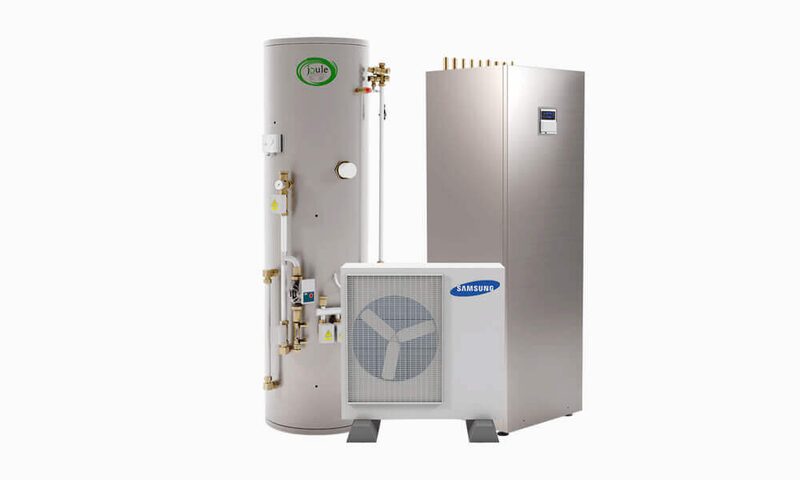
Cylinders: unvented, indirect, horizontal and stainless steel
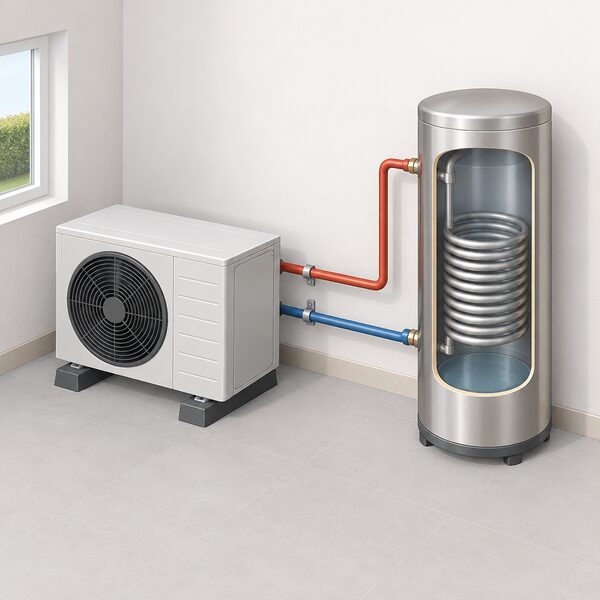
Joule's stainless steel hot water cylinders are available in Indirect, Direct, Horizontal, Vented, Unvented, Solar, Twin Coil, Triple Coil, High Gain and Slimline types2. That list covers the main domestic configurations: indirect cylinders heated by an external source such as a heat pump or boiler, direct cylinders with their own immersion element, horizontal models for low spaces, vented and unvented arrangements, and solar and multi-coil variants for systems with more than one heat source.
The copper side of the range is separate and includes Combination tanks, Eco Solar tanks and Part L cylinders5. Copper and stainless steel behave differently in service, and Joule has published its own comparison of the two5. The choice between them is a specification decision for the installer rather than a headline performance difference, but it affects weight, cost and the coil surface available for heat transfer.
For a heat pump specifically, the cylinder is not a passive tank. Independent guidance notes that in many heat pump models the hot water cylinder is built into the case of the heat pump as a fully integrated system, while in others it is separate10. A Joule cylinder paired with a Joule or Samsung heat pump sits in the second category: a separate store, sized and coiled to suit the heat pump's output and flow temperature. That is the arrangement most UK retrofits use, and it is why cylinder selection and heat pump selection are usually made together rather than independently.
Joule heat pumps: air to water, R290 and the Samsung partnership
Joule's heat pump line is air to water, and the refrigerant in the current models is R290. KEYMARK certification documents list an Air Source Heat Pump, R290, under models JMU150HC and JMU150HC3N, described as an outdoor air to water heat pump7. A separate certificate covers an air source heat pump, R290, model VAHM-V8N5M-A, also listed as an outdoor air to water heat pump8.
R290 is propane, and it carries a specific safety dimension that households should understand. The Heat Pump Association has published a statement on the R290 safety zone, and the guidance for manufacturers is that they have a key responsibility to ensure their products meet all relevant safety legislation as well as health and environmental protection requirements11. That is a general obligation on all makers, not a finding about Joule.
The Samsung partnership is the other half of the heat pump story. Joule entered the air source heat pump market in 2012 and partnered with manufacturers including Samsung1, and it lists a Joule-Samsung monobloc air source heat pump with a 7 year warranty6. Monobloc means the refrigerant circuit stays inside the outdoor unit, with water pipework running into the house, which is the arrangement most commonly fitted in UK homes.
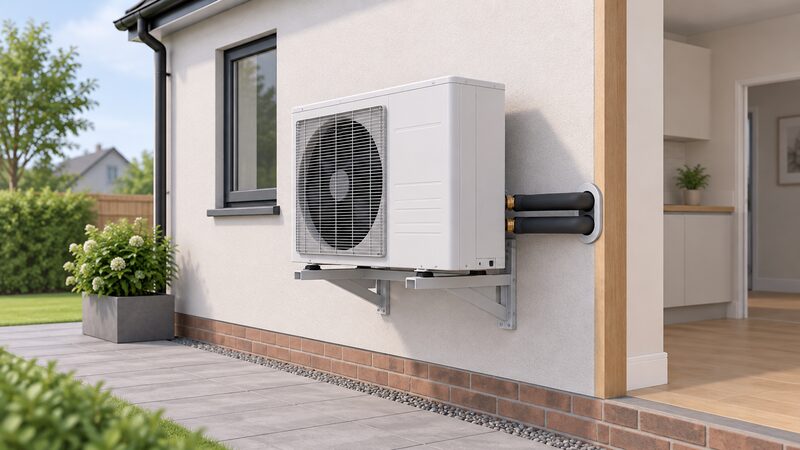
Compatibility: pairing a Joule cylinder with a heat pump, solar or underfloor heating
Joule states that its stainless steel cylinders are compatible with its Samsung heat pump, solar thermal, underfloor heating and aluminium radiators2. That is the maker's own compatibility claim for its own products, and it is the clearest statement available on what the cylinder range is designed to sit alongside.
The wider system context is well established independently. Heat pumps can work with radiators or underfloor heating, though some types can work without either12. Underfloor heating is often installed in combination with a heat pump and works with all types of heating systems13, and heat pump systems are described as ideal for underfloor heating systems because of the low flow temperatures involved14. None of that is specific to Joule, but it explains why a cylinder and an emitter strategy are chosen together: the lower the flow temperature the heat pump runs at, the more the cylinder coil and the emitters both need to be sized for it.
Solar thermal is the third input. Joule launched a range of solar thermal solutions in 2010 and lists Solar and Twin Coil cylinder types1. A twin coil cylinder allows a solar thermal circuit and a heat pump to heat the same store, with the solar coil typically sitting below the heat pump coil. That arrangement reduces the volume of water the heat pump has to raise, though it depends on roof orientation and collector area rather than on the cylinder alone.
What this means for independence is mixed. A Joule cylinder paired with an air to water heat pump moves space heating and hot water off gas and onto electricity, which is the main shift. It does not remove dependence on a supplier: the heat pump runs on grid electricity, and the household remains exposed to electricity prices and to the network. Adding solar thermal or photovoltaics reduces the imported share but does not eliminate it, and the cylinder itself adds no independence of its own beyond storing heat for use later.
System design service: sending plans for a complete proposal

Joule has a dedicated in-house design team1, and the company has published guidance on sending plans in for a complete system proposal. The design service is aimed at producing a specification that covers the heat pump, the cylinder and the associated components as one system rather than as separate purchases.
Commissioning is where design meets installation. Official guidance for Wales states that heat pumps and any dedicated ancillary products, for example integrated hot water cylinders, should be commissioned in accordance with both the manufacturer's instructions and the appropriate system design parameters15. That dual requirement is the reason a design proposal matters: a cylinder commissioned to the maker's instructions but not to the system's design parameters can underperform even when both components are correct in isolation.
Joule also runs training for the trade. Its installer heat pump course is designed for heating engineers to give them the additional knowledge required to install and commission Joule heat pump systems, and it is completely free and takes place online6. For a household, the practical implication is that the quality of the installation depends on the installer having completed that kind of training, and on the design having been done before the equipment was ordered.
Noise assessment is part of the design process in England and Wales. The MCS 020 calculator requires the heat pump make and model and the heat pump installation location for a single heat pump assessment, with project details optional16. MCS has also consulted on the inclusion of air-to-air heat pumps for the Heat Pump Design Standard17. Those are the standards a design proposal has to satisfy, and they sit alongside the manufacturer's own instructions rather than replacing them.
Cost: what a Joule system sits within
Joule does not publish a list price for its cylinders or heat pumps in the material available, so prices are installer-quoted. What can be said is what the wider market costs, which is the context a Joule quote will sit in.
Independent figures put air source heat pump installation at £8,000 to £12,00018, and a separate estimate puts total costs at £6,800 to £17,700 with an average of £13,00019. The Energy Saving Trust looked at typical heat pump costs of around £11,700 on average20. Running costs are a different figure: heat pumps cost around £800 to £1,050 a year to run, making them one of the cheapest electric heating options21.
| Item | Figure | Source basis |
|---|---|---|
| Air source heat pump installation | £8,000 to £12,000 | Independent guidance, 202518 |
| Total heat pump cost | £6,800 to £17,700, average £13,000 | Independent statistics, 202619 |
| Typical heat pump cost | around £11,700 on average | Independent guidance, 202620 |
| Annual running cost | £800 to £1,050 a year | Independent guidance, 202621 |
| Hot water cylinder jacket | about £30 | Independent guidance, 202622 |
| Cylinder jackets | around £15 each | Independent guidance, 202615 |
Cylinder insulation is the cheap end of the same picture. A hot water cylinder jacket costs about £3022, and jackets at around £15 each pay for themselves in a year or less15. Those are retrofit measures for an existing cylinder rather than a reason to choose one brand over another, but they are the lowest-cost way to reduce standing losses from any store.
UK manufacturing, availability and support network
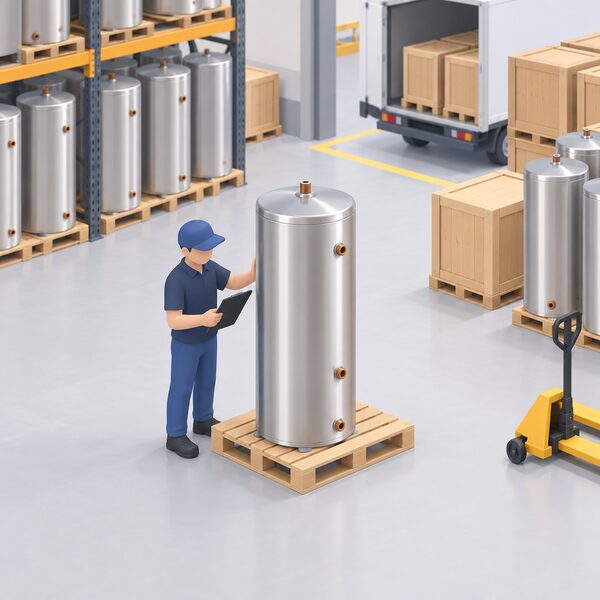
Joule's UK base is Pontefract, West Yorkshire, and the company supplies stainless steel hot water cylinders across the UK1. Its support arrangements are a nationwide network of highly trained customer support engineers and an in-house design team1. The UK contact number is 0330 808 8488 and the email address is info@joule.ie1.
The recalled ModulAir product has its own contact route. Joule Hot Water Systems UK Ltd can be reached on 020 3744 4200 or at modulairuk@jouleuk.co.uk, and the company has contacted owners to arrange an upgrade to the ModulAir All E Heat Pump3. That is the number and address to use for anything relating to the recall rather than general sales.
On the wider supply chain, official guidance notes that support is also available for installers and manufacturers to expand supply chains in the UK23. That is a policy context rather than a Joule-specific commitment, but it bears on availability: cylinder and heat pump supply in the UK has been a constraint across the market, and Joule's own history of moving and expanding its production facilities reflects that pressure1.
For a household weighing energy independence, the position is this. A Joule cylinder paired with an air to water heat pump moves hot water and space heating onto electricity, which reduces direct gas dependence but leaves the home on the grid and on an electricity supplier. The cylinder stores heat rather than generating it, so it adds flexibility rather than independence. The heat pump side of the business is newer than the cylinder side, and the ModulAir recall means that for any unit manufactured since May 2023 the recall notice, not the product page, is the document that governs. Households comparing options across the market can read the wider picture in heat pumps, hot water cylinders for heat pumps and heat pumps and household energy independence.
Sources23 cited
- About Joule, Joule, 2026
- Stainless steel hot water cylinders in high demand, Joule, 17 September 2026
- Product Safety Report: Joule Hot Water Systems ModulAir Heat Pump, GOV.UK, 9 July 2024
- Joule Hot Water Systems ModulAir Heat Pump recall, Electrical Safety First, 2026
- Copper vs stainless steel hot water cylinders, Joule, 17 September 2026
- UK Cyclone Complete Brochure, Joule, 17 September 2026
- Heat Pump KEYMARK Certificate 041-K118-05, Heat Pump KEYMARK, 23 December 2025
- Heat Pump KEYMARK Certificate 041-K112-04, Heat Pump KEYMARK, 22 December 2025
- Heat Pump KEYMARK press release, Heat Pump KEYMARK, 10 June 2015
- Exhaust air heat pumps, Energy Saving Trust, 5 June 2025
- HPA UK statement on R290 safety zone, Heat Pump Association, 12 May 2026
- Heating your home, Energy Saving Trust, 19 May 2026
- Underfloor heating systems, NICEIC, 17 September 2026
- Your home guide to heat pumps, OFTEC, 17 September 2026
- Approved Document L Volume 1 consultation, Welsh Government, August 2025
- MCS 020 noise assessment calculator, MCS Certified, 19 September 2026
- MCS standards consultations, MCS Certified, 2026
- The real cost of a heat pump, Low Carbon Hub, 30 October 2025
- Savanta Cadent consumer choice, Cadent Gas, 2026
- Renewable technologies: what really cuts energy bills, Energy Saving Trust, 12 August 2026
- Electric heating advice, Centre for Sustainable Energy, June 2026
- Tips to improve the EPC rating of your home, Energy Saving Trust, 3 August 2026
- Heat pumps used in central heating, England and Wales, Office for National Statistics, 28 October 2025
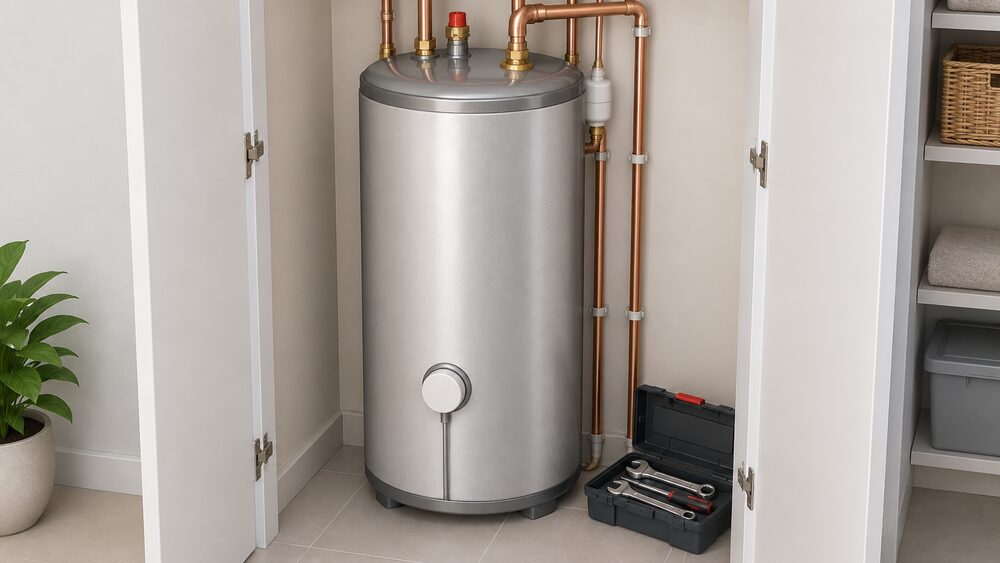 Joule cylinders and hot water productsJoule makes hot water cylinders rather than boilers, so the size you choose decides how much hot water your home has and how quickly it refills.