
In this guide
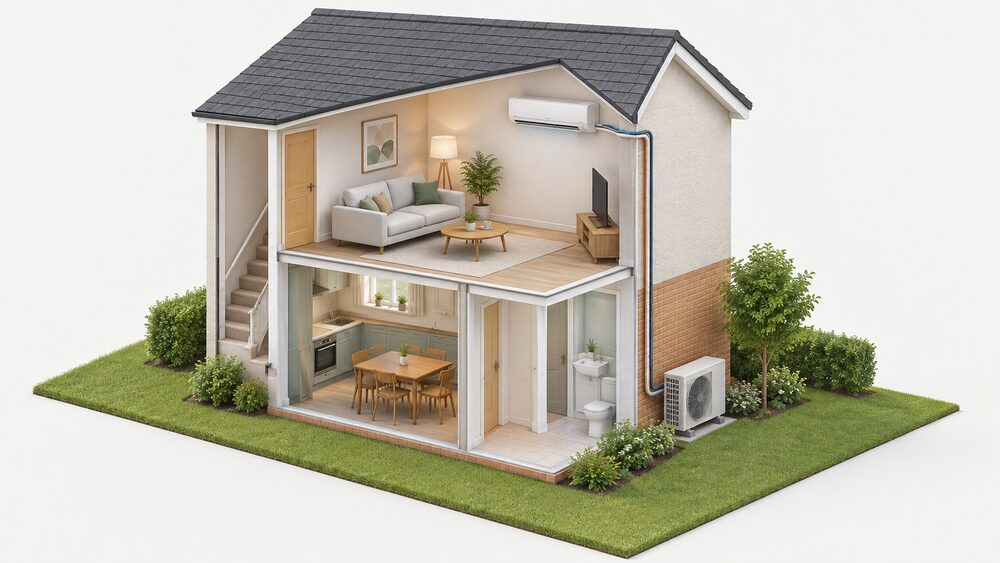
Panasonic sells domestic air conditioning in the UK as an air-to-air heat pump: a system that cools in summer and heats in winter from the same indoor unit. The company's domestic range carries built-in Wi-Fi for smart control, nanoe™ X air purification on the models that include it, and R32 refrigerant across the air-to-air and air-to-water lines1. Panasonic guarantees the outdoor unit compressors on its domestic air to air heat pumps for five years1.
The technology is well established rather than novel. Air source heat pumps are the most common type of domestic heat pump in Great Britain, and the Energy Saving Trust expects growing UK interest in the air-to-air variant specifically because it can cool as well as heat, works in homes with limited space, and suits homes with no existing radiator system3. Panasonic's own framing is that an air-to-air heat pump is an ideal solution for houses in use all year round that need large spaces cooled in summer and heated in winter2.
What follows is what the published material supports: the range, the purification and refrigerant technology, the control chain, the specification figures, and the dependence a household takes on when it installs one.
What Panasonic makes for UK homes: air to air heat pumps
Panasonic's domestic air conditioning line is an air-to-air heat pump, sold through its GB_en site and supported across Europe1. The distinction matters because Panasonic also makes Aquarea, an air-to-water heat pump for heating, cooling and domestic hot water production, which is a different product with a different installation10. The air-to-air units are the ones that appear in domestic cooling queries.
The case for the air-to-air form is set out by independent guidance rather than by the maker. Air-to-air heat pumps offer the added benefit of supplying air conditioning, keeping a home cool during the summer, and they also provide cooling during hot weather11. The Energy Saving Trust lists the potential benefits as cooling as well as heating, the ability to work in homes with limited space, and suitability for homes without an existing radiator system4. For park homes, an air-to-air heat pump is described as ideal because it provides both heating in winter and cooling in summer13. Air source heat pumps generally are suitable for most homes in the UK14.
Panasonic's own description of the application is narrower: houses in use all year round that require large spaces to be cooled in summer and heated in winter2. The maker also frames the energy source as renewable or freely available energy from the ambient air, and the air quality benefit as indoor air cleaned of pollen, dust and other particles2.
Nanoe™ X air purification: what it does
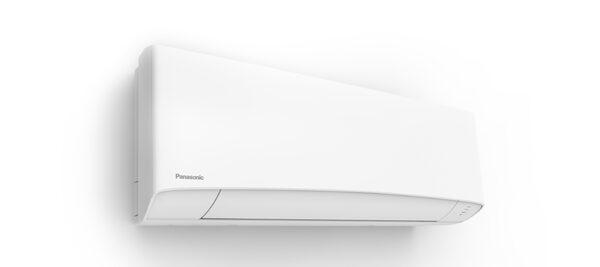
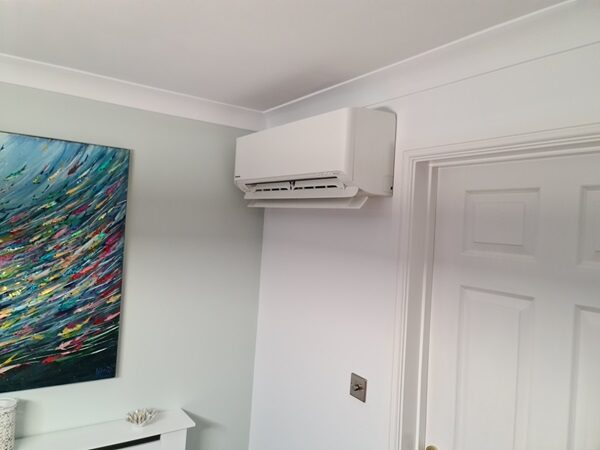
Nanoe™ X is Panasonic's air purification technology, and it is listed as a feature of the domestic air to air heat pump range under the phrase cleaner air with nanoe™ X technology1. The mechanism, as the maker describes it, is hydroxyl radicals: nanoe™ X technology with the benefits of hydroxyl radicals, where hydroxyl radicals have the capacity to inhibit pollutants, certain viruses, and bacteria to clean and deodorise8.
It is not fitted to every unit in the same way. The Floor Console comes with nanoe™ X as standard2. The TZ super-compact air conditioner carries it as a headline feature8, and the CONEX range includes the nanoe™ X function15. On the control side, the Comfort Cloud app can activate nanoe™ X, described as the advanced technology to deodorise and create a healthier environment, on certain series only6.
That last qualifier is the practical point. Whether a given indoor unit has nanoe™ X, and whether it can be switched on remotely, depends on the series, so it is a specification to check on the model rather than a feature to assume across the range. The claims about inhibiting pollutants, viruses and bacteria are the manufacturer's own and are stated as such; they are not accompanied in the published material by independent test results.
R32 refrigerant: what it means for your system
Panasonic lists R32 as the refrigerant for its air source heat pumps5 and describes it as an environmentally friendly refrigerant on its air-to-air heat pumps2. R32 is not a Panasonic distinction. Daikin's Altherma 3 H HT uses R3216, the NIBE F2050-6 and F2050-10 both list R32 refrigerant for reduced environmental impact17, and a Daikin multi air conditioner outdoor unit lists R-3219. R32 is the mainstream refrigerant across current UK domestic heat pumps and air conditioning.
For a household, the refrigerant choice has two practical consequences. The first is that the circuit is a sealed, pressurised system: it is not a user-serviceable part of the installation, and work on it falls under F-gas rules rather than general DIY. The second is that refrigerant type is fixed at manufacture, so it is not something a later service can change.
The published material does not give a global warming potential figure for R32, a charge weight in kilograms, or a leak detection threshold for any Panasonic domestic unit, so none can be stated here. What can be said is that the refrigerant is listed consistently across the maker's own pages and across competing products, which means a buyer comparing systems is not choosing between refrigerants so much as between installations.
Smart control: Comfort Cloud and built-in Wi-Fi
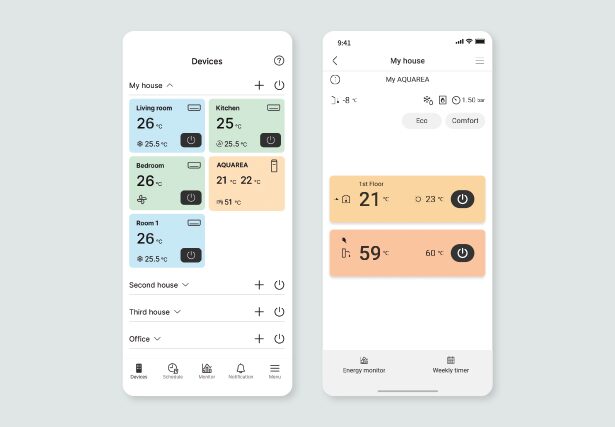
Panasonic's domestic air to air heat pumps have built-in Wi-Fi for smart control1. That is the hardware half of the chain. The software half is the Panasonic Comfort Cloud app, described by the maker as a powerful and intuitive smart solution designed to help manage and monitor Panasonic heat pumps from anywhere, 24/720. The app is a free download6.
What the app does, in the maker's words: remote operation via Wi-Fi15, setting temperature by monitoring real time indoor and outdoor temperatures, and activating nanoe™ X on certain series6. Panasonic also states that the Comfort Cloud app manages Panasonic air conditioners as well as heat pumps20, and that it puts total control of indoor air quality at your fingertips2. On the Aquarea air-to-water side, the M-series unit is listed as compatible with Panasonic Comfort Cloud and Aquarea Service Cloud for remote monitoring, diagnostics and weather compensation9.
There is a second control layer for installers and larger systems. The Panasonic H&C Control App covers on/off, mode, temperature, airflow volume and airflow direction, a weekly timer, all energy saving functions, alarm display and history, filter sign, auto-address, test run, sensor value monitor, simple and detailed setting modes, key lock, ventilation fan control, display contrast adjustment, rotation and redundancy, quiet mode, nanoe™ X, power consumption and unit naming15. That is a commissioning and service tool rather than a householder's interface.
Specifications and range at a glance
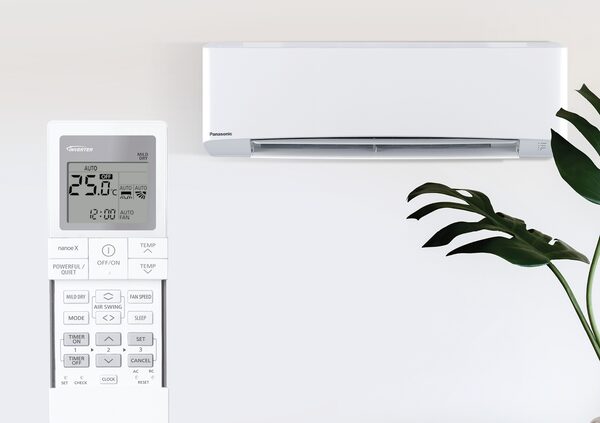
The published figures below are the ones tied to named products. Where a figure belongs to a different maker's product it is marked as such, because it is a comparison point rather than a Panasonic specification.
| Product | Type | Published figure |
|---|---|---|
| Panasonic domestic air to air heat pumps | Air-to-air | Built-in Wi-Fi; 5 year outdoor unit compressor warranty1 |
| Panasonic air source heat pump | Air-to-water | Output range 5 to 12kW; refrigerant R325 |
| Panasonic TZ super-compact | Indoor unit | 779 mm wide; backlit remote control8 |
| Panasonic Floor Console | Indoor unit | nanoe™ X as standard2 |
| Panasonic fan coil units | Fan coil | AC 5 speeds; low consumption fan motor; drain pan and filter included21 |
| Panasonic counter flow ventilation | MVHR | 80% ePM1 filters22 |
| Daikin Multi+ Class 90 (comparison) | Multi split | Operating range cooling up to 46 degrees C19 |
The fan coil figures are worth reading carefully because they conflict on their face: the same product page lists fan motor and number of speeds as AC 5 speeds and, separately, fan speeds as 3 speeds21. Both figures appear on the same source, and the documents do not resolve which applies to which model in the listed range. A household specifying a fan coil should confirm the speed count for the exact unit.
The TZ super-compact is the smallest indoor unit documented here at 779 mm wide, described as an elegant and compact chassis, and it comes with a high class, easy-to-use remote control with backlight8. That local remote matters for the independence question below.
What owning a Panasonic unit means for household independence
An air-to-air heat pump changes what a household buys. It draws heat from the ambient air rather than from a gas supply, so the home's heating and cooling both run on electricity2. That removes a gas connection from the equation for the rooms it serves, and it removes a gas supplier. It does not remove the grid: the unit runs on mains electricity, and the household remains a customer of an electricity supplier unless it generates its own.
The control chain is the second dependence. Local control continues without a network connection, since the TZ ships with a backlit remote8 and the ventilation products have a touch display and startup wizard for commissioning23. Remote scheduling, energy monitoring and remote diagnostics, however, run through the Comfort Cloud app, a Wi-Fi connection and Panasonic's own service6. A household that wants the remote features is depending on broadband and on the manufacturer's app continuing to work.
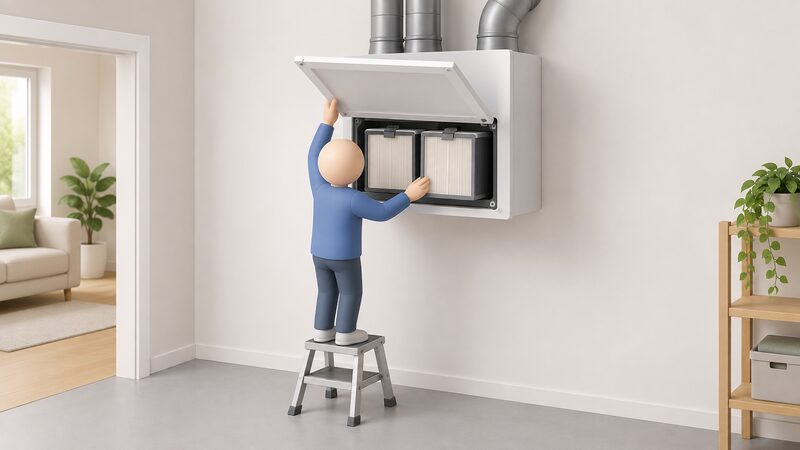
Panasonic also makes heat recovery ventilation, which bears on independence in a different way. The unit is designed to provide fresh filtered air into the home while keeping a high thermal comfort, and most of the energy from the exhausted air is used to precondition the incoming air, leading to lower heating requirements in the building10. The residential ventilation unit and the Aquarea heat pump can be controlled with one single user-friendly controller10, and the ventilation unit can control an Aquarea H or J generation heat pump from its control panel where the PAW-AW-MBS-H and PAW-VEN-ACCPCB accessories are fitted23. A built-in humidity sensor in extract air can be used for demand control23. Counter flow units are described as suitable for single family houses or apartments with low energy requirements, with compact dimensions for simplified installation and a panel accessible for maintenance and inspection22.
Cost and installation considerations
No published Panasonic price for a domestic air conditioning unit or installation appears in the material available, so prices are installer-quoted and no range can be given. What is documented is the shape of the decision. Traditional fixed air conditioning carries drawbacks that need weighing: cost, available space, installation disruption, aesthetics and air distribution performance all need to be considered24. Those five factors are the ones that separate a straightforward high-wall installation from a ducted or multi-room one.
There is also a statutory layer. Air conditioning systems above the threshold in the Building Regulations are subject to inspection, and the inspection report must include an assessment of the air-conditioning efficiency and the sizing of the system compared to the cooling requirements of the building, and contain appropriate advice on possible improvements to the system, replacement of the system and alternative solutions25. That is a requirement on the system and its documentation rather than on the householder, but it explains why a properly commissioned installation comes with sizing evidence.
On the maker's side, Panasonic Heating and Cooling Solutions has more than 50 years of experience and sells to more than 120 countries1. The UK purchase route runs through the GB_en site, where the Aquarea M-series unit directs buyers to choose a retailer to explore purchasing options9. Where a dispute with an installer cannot be settled directly, the APHC consumer complaints process requires all complaints to be submitted on its complaint notification form with supporting evidence, available on 0121 711 5030 or at info@aphc.co.uk26. That covers APHC members, not the manufacturer.
Warranty, registration and support
Panasonic guarantees the outdoor unit compressors on its domestic air to air heat pumps for five years1. That is the only warranty term in the published material that attaches specifically to the air-to-air range. The longer terms that appear in the same product family belong to the Aquarea air-to-water models: the M-series T-cap carries up to a 7 year extended parts and labour warranty29, and the M-series 16kW carries up to 7 year extended parts and labour warranty30. Those are different products and should not be read across to an air conditioning unit.
Registration practice follows the general pattern: it can usually be done on the manufacturer's website, or by calling them28. Registering matters beyond administration, because it is how a household is notified if a problem is identified with the appliance27.
On support, Panasonic operates a UK and Europe route through its GB_en site9. Fault diagnosis on a controlled system surfaces first in the H&C Control App, which includes alarm display and history, filter sign and sensor value monitor15. No Panasonic fault code list is published in the material available, so no code meanings can be given here.
Where the range has limits
The limits are worth stating as plainly as the benefits. The published material gives no Panasonic price, no SEER or SCOP figure for a named domestic air conditioning unit, no sound pressure level in decibels, and no refrigerant charge weight. A household comparing Panasonic against another maker on efficiency or noise has nothing from these documents to compare on, and would need the unit's own energy label and the installer's survey.
The comparison figures that do exist belong to other products. A seasonal COP of 5.2 is published for some air-conditioning unit specifications, with Daikin given as an example of a maker that states it31. That is a Daikin figure, not a Panasonic one, and it is included only to show what a published seasonal performance figure looks like when a maker provides one.
There is also a safety dimension to any appliance bought online. A radiator fan sold through several marketplaces was recalled across batches 967, 968 and 970, with the batch number located on the packaging next to the barcode and on the label on the base of the product27. The recall is for a different product entirely, but the batch location pattern is the one to expect on small electrical goods, and it is why registering an appliance matters27.
Finally, the running cost of any electric cooling depends on when it runs. Shifting appliance use to cheaper periods is a recognised demand flexibility approach32, and solar generation changes the arithmetic further: during a heatwave, UK solar homes generated power equivalent to five hours of daily air conditioning use31. That is a national figure rather than a Panasonic one, and it describes what a household with panels can offset rather than what a unit costs to run.
Sources32 cited
- Domestic air conditioning ranges, Panasonic
- Heating with air conditioning, Panasonic
- How do heat pumps work, Smart Energy GB
- Heat pump questions answered, Energy Saving Trust
- Air source heat pumps, Nu-Heat
- WLAN control with Panasonic Comfort Cloud, Panasonic
- Aquarea T-CAP, Panasonic
- TZ super compact with nanoe X technology, Panasonic
- Aquarea M-series 9kW air to water heat pump, Quiet Mark
- Heat recovery ventilation unit, Panasonic
- What it's really like to have a heat pump, Which?
- The best heating for your home, Which?
- Park homes advice, Centre for Sustainable Energy
- Domestic heating technology options, Nesta
- CONEX new devices and apps, Panasonic
- Daikin Altherma 3 H HT heat pump, Quiet Mark
- NIBE F2050-6 heat pump, Quiet Mark
- NIBE F2050-10 heat pump, Quiet Mark
- Daikin 4 port multi air conditioner, Quiet Mark
- New Aquarea Smart Cloud, Panasonic
- Fan coils, Panasonic
- Counter flow ventilation, Panasonic
- Residential ventilation unit with heat recovery, Panasonic
- HVAC choices for the home, CIPHE
- The Building Regulations 2012, Part 4, legislation.gov.uk
- APHC complaints process, APHC
- Register your appliance with the manufacturer, Electrical Safety First
- Common mistakes that can invalidate your boiler warranty, Which?
- Aquarea M-series T-cap 9kW air to water heat pump, Quiet Mark
- Aquarea M-series 16kW air to water heat pump, Quiet Mark
- UK solar homes power equivalent of five hours of daily air con use during heatwave, Ember
- Demand flexibility: running appliances at cheaper times, Electrical Safety First
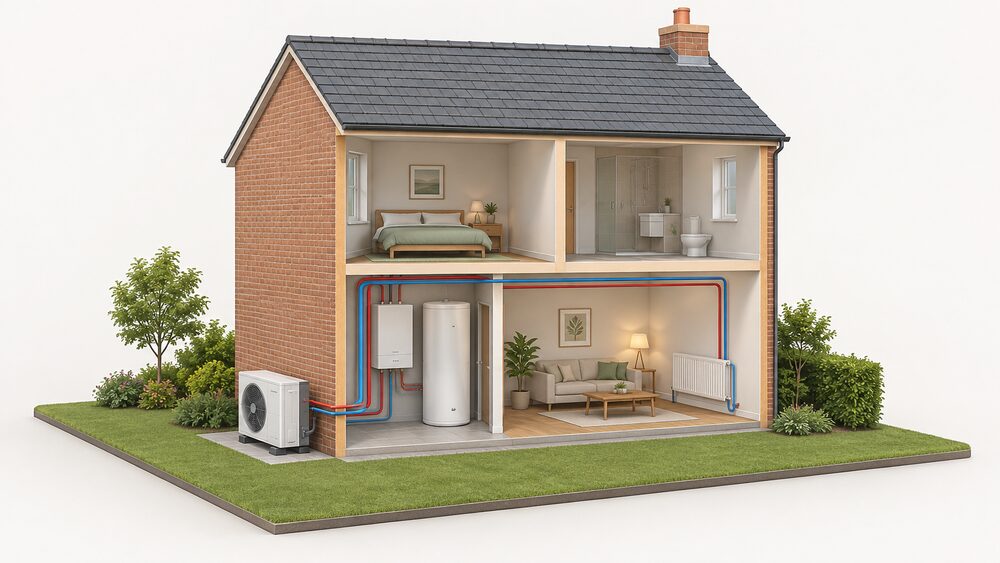 Panasonic Aquarea air source heat pumpsThinking about a Panasonic Aquarea heat pump for your home?