

In this guide
SALUS Controls is a heating controls brand sold in the UK through the GB section of saluscontrols.com and through authorised merchants, covering wired and wireless thermostats, underfloor heating control sets, wiring centres and a Zigbee network coordinator1. The range is broad rather than deep: a household can buy a simple dial thermostat, a non-programmable wired unit, a programmable wired thermostat, a wireless thermostat, or a multi-zone underfloor set, and the differences between them matter more than the badge4.
The single most important thing to know about the brand's smart side is that the app changed. SALUS announced that the SALUS Smart Home App would be discontinued at the end of November 2024 and replaced by the SALUS Premium Lite App, with user data migrated automatically over a period that could take a few days3. Anything written before that date about the SALUS Smart Home app describes a platform that no longer exists.
For a household weighing energy independence, SALUS sits in the middle of the market. Local control at the thermostat and at a wired programmer keeps working without a broadband connection, but remote scheduling, zone management and app access depend on a home network, the maker's servers and a manufacturer's app3. That is the dependence to weigh against the convenience.
What SALUS makes: thermostats, radiator controls and zoning
SALUS builds the control layer of a heating system rather than the heat source. The product line covers room thermostats, underfloor heating control sets, wiring centres and a Zigbee coordinator that ties wireless devices together1. The company's own description of the CO10RF is that it manages communication between compatible SALUS Smart Home devices, including thermostats and radiator controls2.
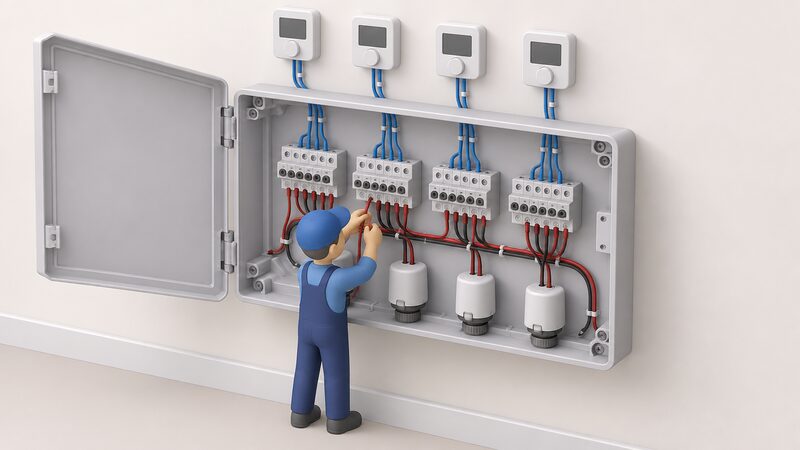
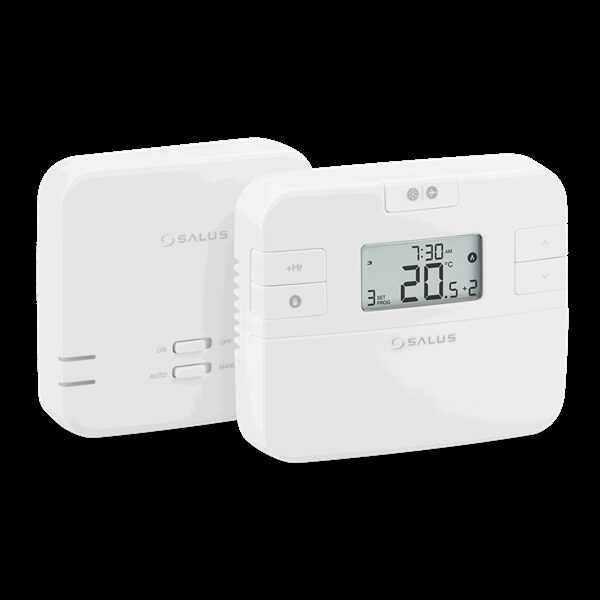
The range splits into three practical groups. First, simple wired thermostats: the RT10-230V uses a setpoint dial for simple temperature control, and the VS35B and VS35W are wired digital thermostats described as non-programmable4. Second, programmable and wireless units: the VS30W is a wired digital programmable thermostat, and the VS10BRF is a wireless digital thermostat at 230V1. Third, zoning and underfloor hardware: the KL04NSB wiring centre extension controls 4 zones and supports actuators and thermostats, with a maximum of 4 room thermostats, and the FGQ-6 underfloor heating control set includes a central wiring centre, a room thermostat and a thermal actuator across 6 heating circuits10.
Radiator control is part of the picture too. Thermostatic radiator valves control the temperature of each room by opening and closing automatically to control the flow of hot water through the radiator they are fitted to, and central heating system controls including thermostatic radiator valves are named in the energy-saving materials legislation13. A full set of heating controls is generally described as a programmer, thermostatic radiator valves and a room thermostat15.
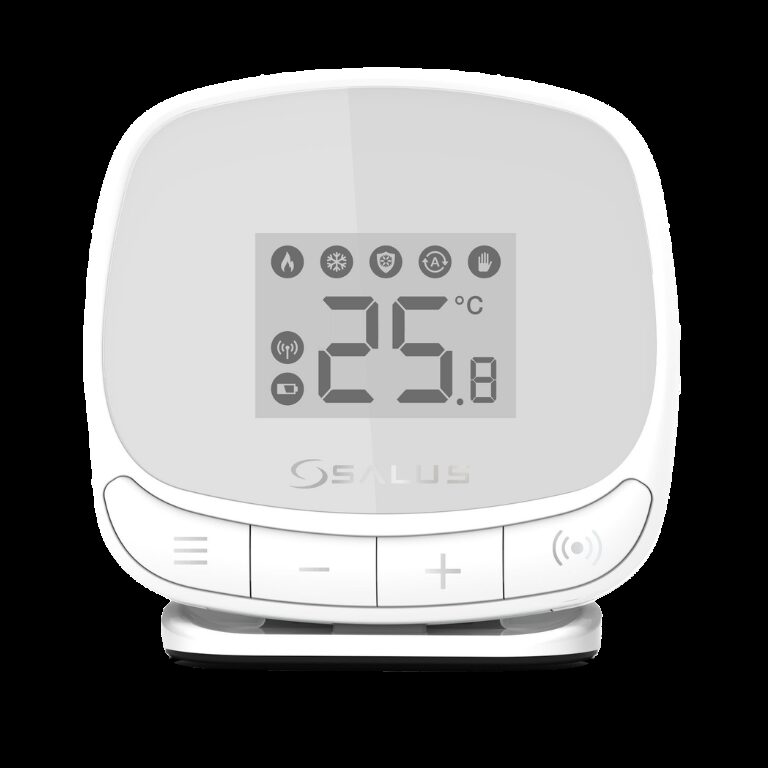
The range: what each thermostat does
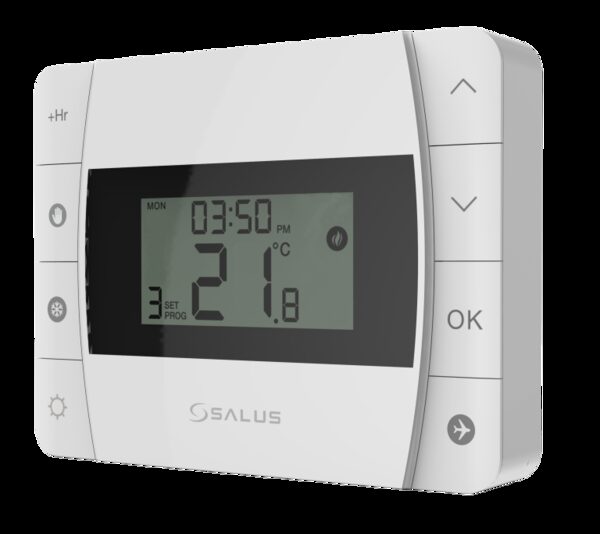
The model-level differences are mostly about programming, sensor support and output type. The VS30W, VS35W, VS35B and BTR230-9010 all use a PWM temperature control algorithm, which varies the proportion of time the heating is on rather than switching it hard on and off1. The BTR230-9010 adds a silent TRIAC output for noiseless operation, a 5°C to 35°C range, a 230V power supply and a 55x55x47mm body in the 55x55 format that fits standard switch systems5. The RT10-230V covers a 5 to 35°C range4.
Sensor support is where the underfloor models separate themselves. The VS35B and VS35W both offer external sensor support to fine-tune underfloor heating comfort, and the VS10BRF is listed as compatible with a floor sensor as well as suitable for radiator heating6. The BTR230-9010 is also listed as compatible with a floor sensor and supports heating or cooling when used in compatible systems5.
| Model | Type | Programming | Notable feature |
|---|---|---|---|
| RT10-230V | Wired thermostat | Setpoint dial | 5 to 35°C range4 |
| VS35B | Wired digital thermostat | Non-programmable | External sensor support, PWM6 |
| VS35W | Wired digital thermostat | Non-programmable | External sensor support, PWM12 |
| VS30W | Wired digital thermostat | Programmable | PWM control algorithm1 |
| VS10BRF | Wireless digital thermostat, 230V | Wireless | ZigBee network, floor sensor option7 |
| BTR230-9010 | Wired thermostat, 230V | Manual override | Silent TRIAC output, 55x55 format5 |
| RT20 | Hardwired room thermostat | Hardwired | Battery powered16 |
The Quantum is the brand's slimmer line. It was launched in four versions across the SQ and WQ ranges, with an overall depth of 10mm, and includes a warm floor feature designed to overcome solar gain issues by helping maintain warmth in the floor during long periods of solar gain11. The hardwired Quantum SQ610 is listed as providing precise temperature control for electrical heating, underfloor heating and radiator heating, and as compatible with other Salus control devices17.
Compatibility: what works with a CO10RF
The CO10RF is the hub of the wireless side. It is a coordinator using Zigbee technology at 2.4 GHz, powered via a supplied mains adapter, and it links with the KL08RF and TRV10RFM2. Its job is to manage communication between compatible SALUS Smart Home devices, including thermostats and radiator controls2. A household adding wireless SALUS devices should treat the coordinator as the piece that determines what can talk to what.
Beyond the coordinator, compatibility is model by model. The VS10BRF is compatible with the ZigBee network and suitable for radiator heating7. The SIR600 Smart IR AC Controller is compatible with SALUS Smart Home devices and works paired with a SALUS Smart Home thermostat, and it is controlled through the SALUS Premium Lite App18. The Quantum SQ610 is compatible with other Salus control devices17.
That check matters more than the brand name. A thermostat that switches a boiler on and off through a volt-free contact will work with most gas boilers, but a unit designed for electric underfloor heating, such as the BTR230-9010 with its 230V supply and TRIAC output, is a different electrical proposition5. The wider question of which controls suit which boiler is covered in smart thermostat boiler compatibility and in the pillar guide to heating controls.
Smart control: the move to SALUS Premium Lite
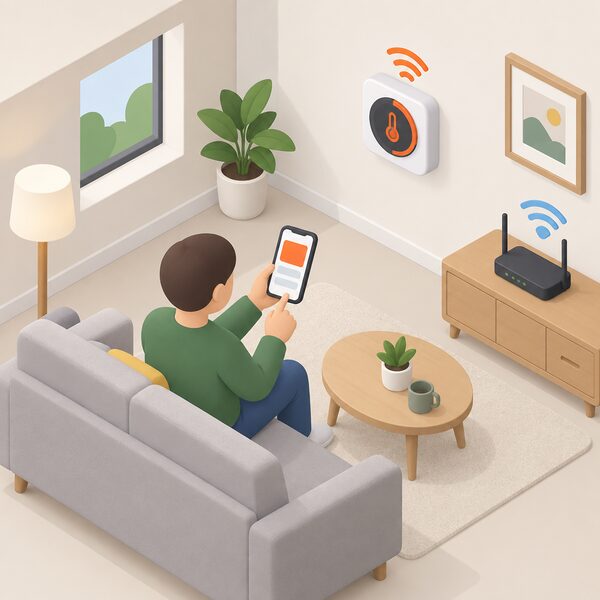
The app change is the defining event in the brand's recent history. SALUS announced that the SALUS Smart Home App would be discontinued at the end of November 2024, with user data automatically migrated to the new SALUS Premium Lite App over a period that may take a few days3. The Premium Lite App is described as managing temperatures, schedules, and single or multiple heating zones remotely, and smart heating bundles are listed as available now from authorised SALUS merchants3.
The SIR600 controller is controlled from anywhere using the SALUS Premium Lite App, which is the clearest statement of what the app does across the range18. Independent guidance describes the general category in the same terms: smart thermostats can be programmed, or remotely controlled, to quickly and easily manage your home's temperature, and smart heating controls let a household access temperature settings using a mobile app20.
The dependence this creates is worth stating plainly. Local control at the thermostat continues without an internet connection, but remote scheduling, multi-zone management and app access depend on a home broadband connection, the maker's servers and a manufacturer's app. Energy monitors and smart thermostats generally come at an additional cost and are operated via an app on a mobile or tablet, and premium services can carry subscription costs21. The wider pattern of cloud dependence is set out in heating controls and energy independence and in smart thermostat subscriptions.
Who SALUS is: ownership, offices and UK management
SALUS is an international controls business with a UK-facing sales operation. The company has offices across Hong Kong, China and the US, and Dean Jepson is named as SALUS European managing director11. That structure matters to a household because it shapes where support sits: the products are sold through the GB section of saluscontrols.com and through authorised SALUS merchants, and smart heating bundles are listed as available from those merchants3.
The brand's UK presence is strongest in the trade and merchant channel rather than in direct consumer retail. Product pages sit on the GB section of the site, and the range is distributed through merchants rather than a single national retailer10. For a household, that means the merchant or installer who supplied the unit is normally the first point of contact for support, warranty and spares.
The company's own positioning is as an innovator. In a 2019 press release it stated that it files 250 patents for new technologies each year, and the same release introduced the Quantum thermostat in four versions across the SQ and WQ ranges11. That figure is the maker's own claim from 2019 and has not been independently verified here; it should be read as a statement of intent rather than a measured output.
Innovation and the evidence base
The technical thread running through the range is PWM control, which appears on the VS30W, VS35W, VS35B and BTR230-90101. Pulse width modulation varies the duty cycle of the heating output to hold a temperature more steadily than a simple on-off switch, and it is the mechanism behind the brand's claim to precise control. The Quantum adds a humidity sensor on the SQ610 and the warm floor feature on the wider Quantum line17.
Independent evidence on smart thermostats as a category is thinner than the marketing suggests. The Centre for Sustainable Energy was commissioned by Passiv UK to research the Passiv Smart Thermostat, which is a case study of one product rather than a verdict on the category22. On the official side, smart thermostats appear in the ECO4 innovation measures: innovation measure 016 is a Smart Thermostat, approved on 24 January 2022, and the product named in that approval is the Secure Meters C1727 Smart Thermostat23. The ECO4 measures table also lists Smart Thermostat under the measure type Smarttherm25.
That rule is the practical test of whether a control counts as a smart thermostat for official purposes, and it is separate from whether a product is sold as one. A household looking at any brand, SALUS included, is looking at a control that may or may not appear on that list.
Where to buy in the UK
SALUS products reach UK households through merchants and installers rather than a single retail chain. Smart heating bundles are listed as available now from authorised SALUS merchants, and the product pages sit on the GB section of saluscontrols.com3. The range spans thermostats, wiring centres, underfloor control sets and the CO10RF coordinator, so a full system is normally assembled from several parts rather than bought as one box2.
Pricing is not published by the maker for the SALUS range in the material available here, so costs are merchant-quoted and vary by model and by whether the unit is bought alone or as part of a bundle. No published SALUS price is available to quote, and no comparable figure for another brand is offered here, so the entry point for a wireless thermostat in the UK market cannot be stated from the evidence on this page.
The Quantum SQ610 is listed with taxes included on a UK retailer page, which is the clearest statement of VAT treatment across the range17. For everything else, the price a household sees is the price the merchant quotes, and installation is a separate cost. The general shape of controls pricing is covered in how much do heating controls cost.
Where the range has limits

The limits are worth stating as firmly as the benefits. SALUS does not publish a general fault code list, a single reset procedure or a single serial number location across the range in the material available here, so diagnosis and support depend on the manual for the specific model and on the merchant who supplied it. The BTR230-9010 offers a manual override and a cooling mode function, and the RT10-230V is controlled by a setpoint dial, but neither is a substitute for model-specific documentation5.
The app dependence is the second limit. Remote control, zone management and the SIR600's air conditioning control all run through the SALUS Premium Lite App, which depends on a home network and the maker's servers3. If the app platform changes again, as it did in November 2024, the household follows the migration rather than choosing it3.
The third limit is scope. SALUS makes controls, not boilers or heat pumps, so it does not change what fuel a home runs on. A SALUS thermostat can reduce waste and improve zoning, but the household remains on the gas grid or on electric heating, and on a supplier, for the heat itself. The controls layer is where independence is won or lost at the margin, not where the fuel decision is made. For the wider picture, see smart thermostats and heating zoning.
Sources26 cited
- VS30W Wired Digital Programmable Thermostat, SALUS Controls, 2026-09-20
- CO10RF Zigbee Network Coordinator, SALUS Controls, 2026-09-20
- Smart Heating Control Packs, SALUS Controls, 2026-03-10
- RT10-230V Wired Thermostat, SALUS Controls, 2026-09-20
- BTR230-9010 Wired Thermostat, SALUS Controls, 2026-09-20
- VS35B Wired Digital Thermostat Non-Programmable, SALUS Controls, 2026-09-20
- VS10BRF Wireless Digital Thermostat 230V, SALUS Controls, 2026-09-20
- FGQ-6 Underfloor Heating Control Set, SALUS Controls, 2026-09-20
- Guide to Smart Meters, Energy Saving Trust, 2026-07-15
- KL04NSB Wiring Centre Extension for KL08NSB, SALUS Controls, 2026-09-20
- Press Launch for the SALUS Quantum Thermostat, SALUS Controls, 2019-11-26
- VS35W Wired Digital Thermostat Non-Programmable, SALUS Controls, 2026-09-20
- ECO4 New Measures and Products Guidance v3.0, Ofgem, 2026-03-26
- Energy Act 1994, Schedule 7A Part 2 Chapter 2, legislation.gov.uk, 2026-09-17
- Energy Efficiency, Cadent Gas, 2026-09-20
- RT20 Battery Powered Room Thermostat, SALUS Controls, 2026-09-20
- Salus Quantum Hardwired Thermostat SQ610, Kiasa, 2026-09-20
- SIR600 Smart IR AC Controller, SALUS Controls, 2026-09-20
- What Is a Smart Thermostat, Smart Energy GB, 2026-08-19
- How a Smart Thermostat Can Save You Money This Winter, Ivie, 2025-11-18
- How Do You Know If You Have a Smart Meter, Smart DCC, 2026
- Passiv Smart Thermostat Research, Centre for Sustainable Energy, 2025-05-29
- ECO4 Innovation Approved Innovation Measures v1.6, Ofgem, 2022-01-24
- ECO4 Innovation Approved Innovation Measures v1.1, Ofgem, 2022-01-24
- ECO4 Measures Table v4.0, Ofgem, 2025-07-29
- Great British Insulation Scheme Scoring Methodology, Ofgem, 2025-08-06