
In this answer
Short answer
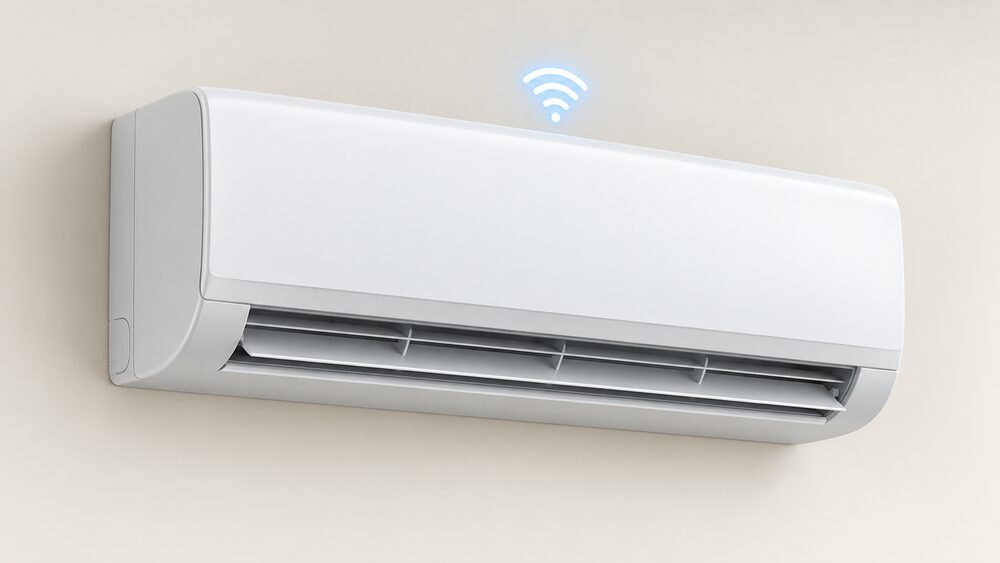
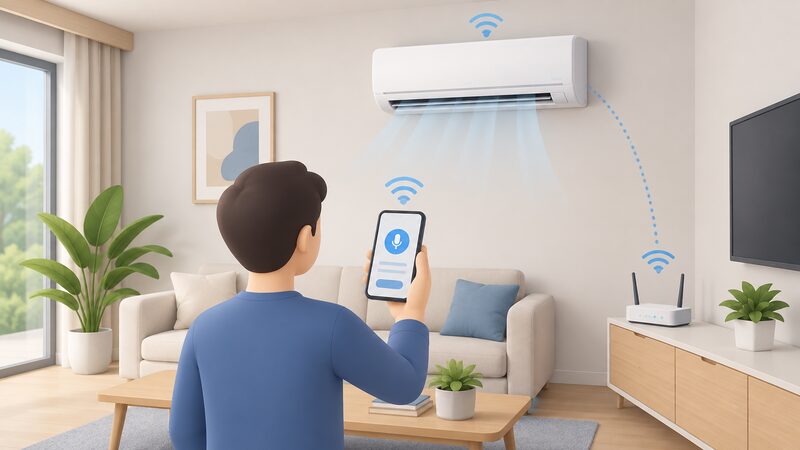
Voice control is a per-model specification, not a feature of a product class. Lux Air states that selected models offer WiFi connectivity and compatibility with Alexa and Google, and that selected portable units also add heating, WiFi controls and UV-C air treatment1. The Lux Air portable air conditioning heat pump lists WiFi control, Alexa, Google and mobile app control, and voice control for Amazon Alexa or Google Home2. The 5.0kW designer air con heat pump inverter system lists Wi-Fi and voice enablement via Alexa and Google Home3.
That pattern repeats across the wider market. Mitsubishi Electric's MSZ-AY and MSZ-AP R32 inverter wall mounted unit is listed as Alexa compatible, with the maker noting that this only applies to MSZ-AP-VGK models4. Fujitsu General takes a different route: its AGEG12KVCA offers an optional WLAN adapter that enables the air conditioner to be operated by smartphone or tablet from outside the home5. Smart control is therefore something to confirm on the individual product page, not to assume from a range name.
Smart control: which Lux Air models work with Alexa and Google Home
The compatibility claim is made at two levels. At range level, Lux Air states that selected models offer WiFi connectivity and compatibility with Alexa and Google, and that selected portable AC units also offer heating, WiFi controls, Alexa and Google compatibility, and UV-C air treatment1. At product level, the specification is explicit. The Lux Air portable air conditioning heat pump lists WiFi control as yes, Alexa, Google and mobile phone app controllable, and voice control for Amazon Alexa or Google Home2. The 5.0kW designer air con heat pump inverter system lists Wi-Fi, Amazon Alexa and Google speech controllable as yes6.
The same collection pages describe the wider Lux Air air con heat pump inverter system as Wi-Fi and voice enabled via Alexa and Google Home3. That is a range-level description, and it sits alongside the maker's own caution that compatibility applies to selected models only1. Where a range description and a product specification differ in scope, the product specification is the one that governs what a particular unit will do.
The practical consequence for a household is that smart control is a purchasing decision made model by model. A voice assistant adds convenience: the unit can be switched on, switched off or adjusted without finding a remote. It does not change the cooling capacity, the efficiency of the compressor or the amount of electricity drawn. For a household weighing energy independence, the smart layer is a control benefit, not an energy benefit, and it depends on a home WiFi network and on the manufacturer's app and cloud service continuing to operate.
Cooling capacity: 9,000, 12,000 or 14,000 BTU for your room
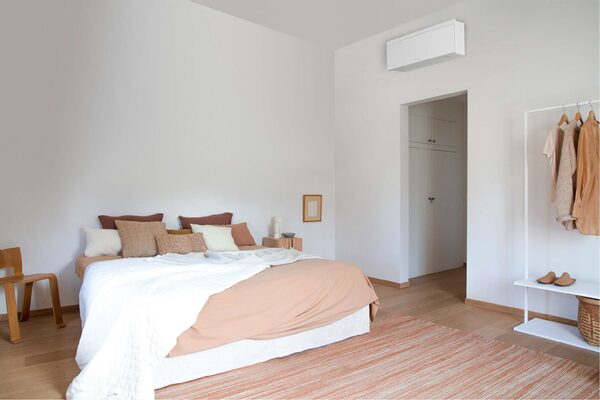
Capacity is quoted in both kW and BTU, and the two scales run in parallel. The published sizing table gives 1.5 kW or 5,000 BTU up to 12 m² (120 ft²); 2.0 kW or 7,000 BTU up to 16 m² (160 ft²); 2.5 kW or 9,000 BTU up to 20 m² (200 ft²); 3.5 kW or 12,000 BTU up to 30 m² (300 ft²); 4.5 kW or 15,000 BTU up to 40 m² (400 ft²); 5.0 kW or 18,000 BTU up to 45 m² (450 ft²); 6.2 kW or 21,000 BTU up to 50 m² (500 ft²); 7.0 kW or 24,000 BTU up to 55 m² (545 ft²); 8.0 kW or 27,000 BTU up to 65 m² (645 ft²); 10.0 kW or 34,000 BTU up to 80 m² (800 ft²); 12.5 kW or 43,000 BTU up to 100 m² (990 ft²); and 14.0 kW or 48,000 BTU up to 110 m² (1,090 ft²), based on standard room heights up to approximately 2.7 metres7.
| Output | Room size | Note |
|---|---|---|
| 2.5 kW / 9,000 BTU | up to 20 m² (200 ft²) | typical bedroom or small office7 |
| 3.5 kW / 12,000 BTU | up to 30 m² (300 ft²) | typical living room7 |
| 5.0 kW / 18,000 BTU | up to 45 m² (450 ft²) | larger open-plan space7 |
| 10.0 kW / 34,000 BTU | up to 80 m² (800 ft²) | whole-floor coverage7 |
Other sources frame the same question differently. Hitachi's guidance cites a US Department of Energy recommendation that a 600 sq/ft space with an 8 ft ceiling needs a 12,000 BTU air conditioner11. Netatmo puts window air conditioners at a cooling capacity range of 5,000 to 12,500 BTU12. For portable units specifically, independent guidance suggests aiming for 18,000 BTUs for the best results13. These figures do not contradict each other so much as describe different unit types and different assumptions about ceiling height, climate and how much of the day the unit runs.
The sizing table itself carries unresolved internal differences. One entry places 10.0 kW or 34,000 BTU at up to 80 m² (800 ft²) while another places 65 m² (645 ft²) at the same output, and the two figures disagree7. Where a household is between two sizes, the honest position is that published tables are a starting point and a survey is the reliable route. The air conditioning sizing page sets out the kW, BTU and room size relationship in more detail.
Rooms that need more cooling power: sunlight, big windows and poor insulation
The table figure assumes a standard room. Lux Air states plainly that rooms with large windows, strong sunlight or poor insulation may require a higher cooling capacity1. That single caveat explains most of the gap between what a sizing table predicts and what a room actually needs.
The building physics behind it is well documented. A third of the heat generated in a home can escape through the walls, and installing insulation helps retain the heat paid for14. The same fabric that lets heat out in winter lets it in during a heatwave, which is why insulation and shading appear together in official and independent advice. The National Energy Action guidance recommends improving homes so they stay warm in winter and cool in summer, investing in ventilation, shading and passive cooling, and ensuring energy is affordable for essential needs including cooling15.
Glazing and conservatories are the sharpest cases. Official Welsh guidance states that a sunspace needs to be designed as an extension, with lots more insulation and energy efficient glazing in place16. A conservatory or a garden room with a large glazed area will therefore sit well above the table figure for its floor area. The cooling by home type page covers top floors, conservatories, garden rooms and lofts, and passive cooling sets out what can be done before buying capacity at all.
For a household, the choice is between buying a larger unit and reducing the load. Shading, ventilation and insulation reduce the heat entering the room, which lowers the capacity needed and the electricity used. A larger unit sized for an unshaded room will run harder and longer than a smaller unit in a shaded one.
Cooling and heating in one unit: what selected models offer
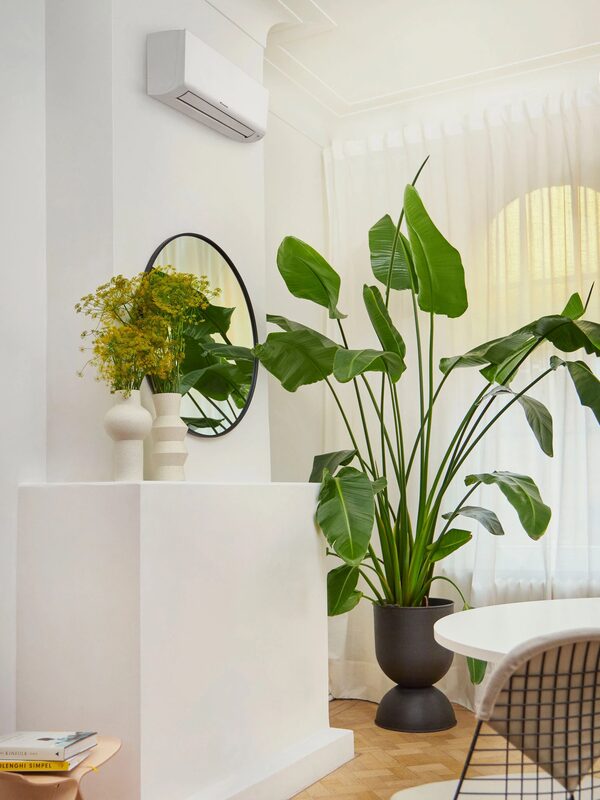
Selected Lux Air models offer both cooling and heating, and the maker advises checking the individual product specification before ordering1. The Lux Air portable air conditioning heat pump is one such unit2. The 5.0kW designer air con heat pump inverter system is another6.
This is not a Lux Air peculiarity. Air-to-air systems can also offer cooling17, and the technology funded under the Boiler Upgrade Scheme extension is described as able to provide heat in winter and cooling in summer18. Daikin describes air conditioners as air-to-air heat pumps and offers wall-mounted models, floor-standing units under windowsills and concealed ceiling units in false ceilings19. Thermia's Aura is presented as one solution for heating and cooling with a built-in air-conditioning function20. Hitachi notes that a single split-system air conditioner is designed to provide climate control to one room within a house21.
The distinction that matters is between a cooling-only unit and a reverse-cycle unit. A reverse-cycle air conditioner is a heat pump that runs in both directions, so the same hardware delivers winter heat and summer cooling. Fixed wall mounted air conditioning is usually better for regular use, especially in bedrooms, living rooms, offices and garden rooms, and can provide heating as well as cooling on many models7. For a household, that changes the economics: a unit used year-round displaces some gas or electric heating as well as providing summer comfort. The air conditioning that heats page covers reverse-cycle units and air-to-air heat pumps in full.
Installation: no permanent fitting, but an exhaust hose is required
Lux Air portable air conditioners require no permanent installation. The unit is positioned near a suitable window, the exhaust hose connected and the warm air vented outside1. That is the whole installation, and it is why a portable unit suits a rental property or a room where a fixed split is not an option.
Venting is not optional. Independent guidance states that portable units need to be properly vented to the outside using a special fitting for the window, and that if the vent is just put through an open window the heat will come back in8. A hose hung out of an open window defeats the purpose of the appliance: the warm air removed from the room returns, and the window opening admits more.
Positioning follows from the venting requirement. A wall-mounted air conditioner is a fixed unit, most of the time installed high up on the wall of the room to be cooled10. A portable unit sits on the ground with no lengthy installation process required10, and is on castors so it can be wheeled from one room to another, though it can only cool small spaces23. A fixed wall mounted air conditioner costs more than a portable model but is generally more efficient at cooling the home23.
For a fixed system, the physical footprint is modest. Wall-mounted internal units tend to be 80cm wide, 30cm tall and 20cm deep24, and air-to-air systems require only small refrigerant pipes, typically 6 to 12mm diameter, between outdoor and indoor units24. The air conditioning installation page covers survey, pipework, drainage and commissioning, and does a portable air conditioner need venting deals with the portable case in detail.
What a portable air conditioner means for household energy independence
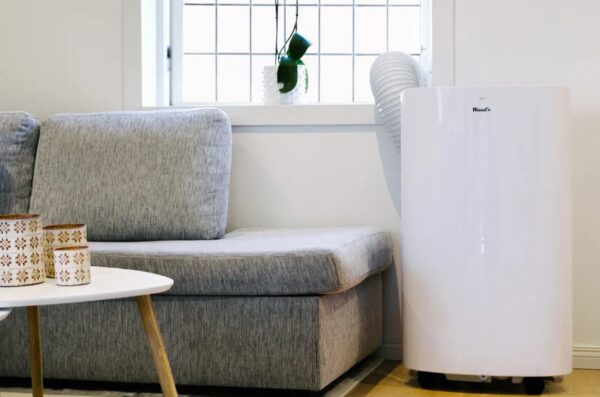
A portable air conditioner is the most independent cooling appliance available to a UK household and the least efficient. It needs no installer, no fixed pipework and no permission, and it can be moved between rooms or taken to another property. It also uses 30 to 50% more electricity than fixed systems8, and it depends on a window being available for the exhaust hose.
That trade-off defines the energy position. A plug-in unit draws from the grid through a standard socket, so the household remains dependent on a supplier and on the wholesale price of electricity for every hour it runs. It offers no reduction in that dependence. What it does offer is optionality: cooling can be added to one room without a fixed installation, and removed again.
A fixed reverse-cycle system changes the picture differently. It is more efficient at cooling than a portable unit23, and where it provides heating as well as cooling it displaces some of the household's other heating demand. That is a partial step towards independence from gas, though not from electricity. The home cooling and energy independence page develops that argument, and air conditioning running costs sets out the electricity side.
The dependence that remains is worth stating plainly. Smart control runs through a home WiFi network and a manufacturer's app, so voice and remote control depend on a company's cloud service continuing to exist. A fixed system depends on a certified engineer for installation and on refrigerant rules for servicing. A portable unit depends on a window and on a grid connection. None of these is a route to self-sufficiency on its own; each reduces or reshapes a different part of the household's energy position.
Sources24 cited
- Lux Air portable AC that cools, heats and sterilises, CoolEasy, 2026
- Lux Air 4kW 14000 BTU portable air conditioning heat pump, CoolEasy, 2026
- Heating and cooling systems, CoolEasy, 2026
- MSZ-AP R32 inverter heat pump wall mounted air conditioning unit, Mitsubishi Electric Living Environmental Systems, 2026
- AGEG12KVCA indoor unit, Fujitsu General, 2026
- Lux Air 5.0kW 18000BTU designer air con heat pump inverter system, CoolEasy, 2026
- Air conditioning size guide, CoolEasy, 2026
- How to keep your home cool in hot weather, Centre for Sustainable Energy, 2026
- Easy-fit single split air conditioning systems, CoolEasy, 2026
- How does air conditioning work?, Netatmo, 2026
- What size of air conditioner do I need?, Hitachi Air Conditioning, 2026
- Smart air conditioner comfort guide, Netatmo, 2026
- Is air conditioning worth it in the UK?, Uswitch, 2026
- Boost your comfort by upgrading your insulation, Plymouth Energy Community, 2026
- Tips for babies in a heatwave, National Energy Action, 2026
- Planning permission: greener homes and conservatories, Welsh Government, 2026
- Air source heat pump, MCS Certified, 2026
- NAPIT welcomes government announcement on extra technologies in the Boiler Upgrade Scheme, NAPIT, 2025
- How to choose an air-to-air heat pump, Daikin UK, 2026
- Thermia Aura air source heat pump, Thermia, 2026
- Air conditioner buying guide: which one is right for your home, Hitachi Air Conditioning, 2026
- Make your home gas safe, Plymouth Energy Community, 2026
- Packaged air conditioning, Netatmo, 2026
- Air-to-air heat pumps: common questions on air conditioning, Nesta, 2026
 Controls and Wi-FiWhich air conditioning controls work without the internet, and which need Wi-Fi?
 Types of Air ConditioningPortable, wall-mounted, multi-room or ducted: which air conditioning suits your home?
 Cooling and Heat PumpsCan an air conditioner heat your home as well as cool it?
 The Full Cooling and Air Conditioning GuideDo you really need air conditioning in a British summer, or would a fan and better shading do the job?
 Air Conditioning NoiseHow loud will an air conditioner be inside your home, and how much noise will the outdoor unit make for you and your neighbours?
 Warm Air Heating SystemsWarm air heating works by pushing heated air through vents in your floors or walls.