In this guide
Lux Air is a UK consumer brand of portable air conditioning units sold directly to householders, with no permanent installation and no outdoor condenser. The range is built around three cooling capacities: 9,000 BTU, described by the maker as ideal for smaller bedrooms and home offices; 12,000 BTU, for medium-sized rooms and living spaces; and 14,000 BTU, a stronger option for larger rooms1. Selected models add heating, WiFi control, Alexa and Google compatibility, and UV-C air treatment1.
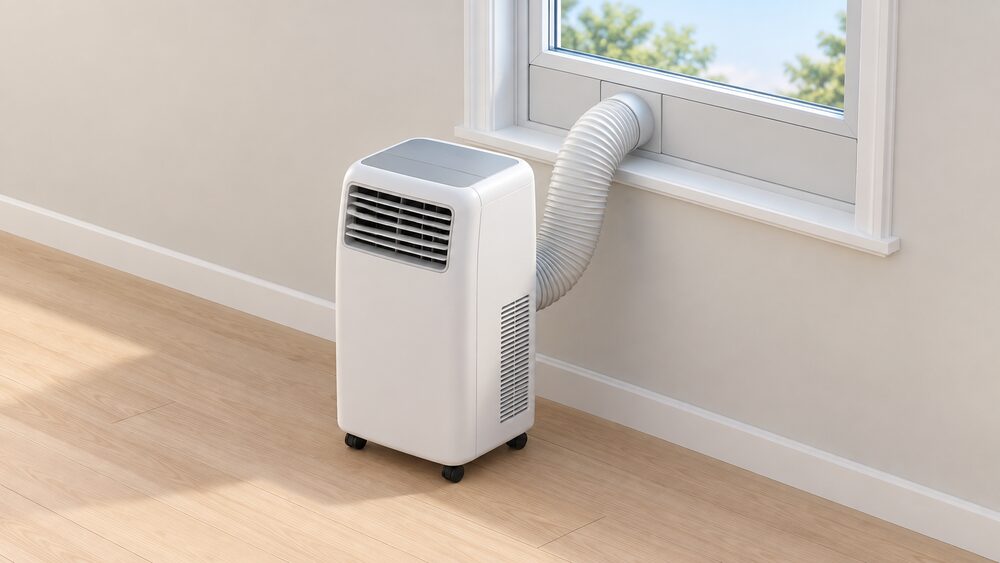
The appeal for a household is that nothing is fixed to the building. Lux Air states that its portable air conditioners require no permanent installation: the unit is positioned near a suitable window, the exhaust hose is connected, and warm air is vented outside1. That makes the category relevant to renters, flats and rooms where a wall-mounted split system is not an option, and it is why portable units have spread quickly: 2.2 million UK homes now have one, according to a 2026 press release, and those units draw around 1kW of power each2.
The limits are equally clear. A portable unit is a single-room appliance that must be vented, it stays dependent on mains electricity and a supplier, and its cooling output is rated under conditions a real room rarely matches. This page sets out what Lux Air sells, how the sizes compare, what the smart features actually require, and what owning one means for a household's energy independence.
What Lux Air makes: portable air conditioners for UK homes
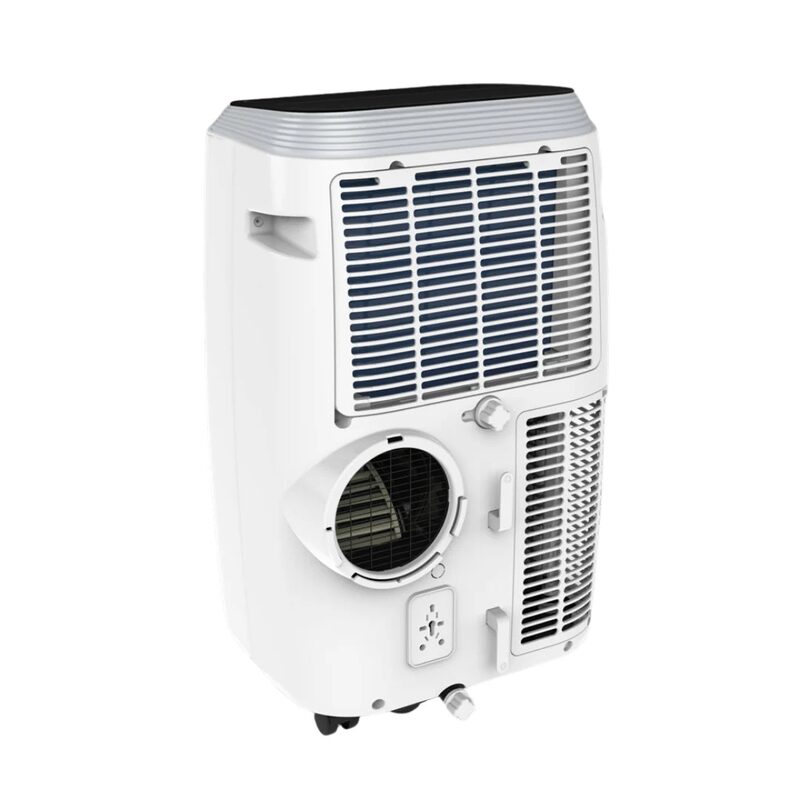
Lux Air's product line is portable, single-room air conditioning sold to UK householders. The units are self-contained: the compressor, the evaporator and the controls all sit in one cabinet on castors, and the only connection to the outside is a flexible duct that carries warm air away. There is no external condenser, no refrigerant pipework run through a wall, and no need for an F-gas certified engineer to commission it.
The 14,000 BTU heat pump model shows what the specification looks like in practice. It carries adjustable fan speeds for rapid cooling or minimum noise, a timer, air filters, an anti-mould coating, a digital display, a remote control, a ducted hose and easy-roll casters3. That is a fuller feature set than the smallest units, and it reflects the position of the 14,000 BTU model at the top of the range.
The wider market for this category is well established in the UK. Pro Breeze, for example, sells portable air conditioners with a window kit for quick setup and no permanent installation, and notes that some of its units double as dehumidifiers, cooling the room while helping reduce humidity and tackle damp4. De'Longhi's Pinguino range is likewise sold for the UK market5. Lux Air competes in that space on capacity, features and direct sale rather than on installation service.
For a household, the significance is that this is cooling you can buy and use without touching the fabric of the building. It is also cooling that does nothing for the building itself: no shading, no insulation, no ventilation strategy. Those measures are covered in passive cooling and external shading, shutters and awnings, and they change the heat load a unit has to remove.
The range by size: 9,000, 12,000 and 14,000 BTU
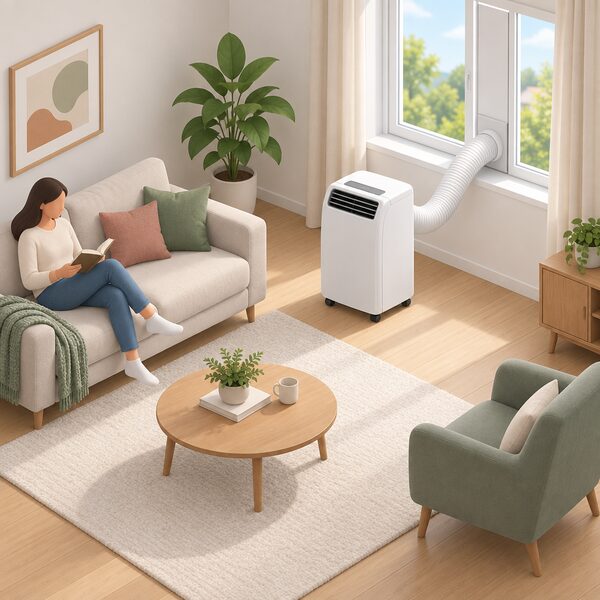
Lux Air's own sizing guidance maps each capacity to a room type. The 9,000 BTU model is described as ideal for smaller bedrooms and home offices; the 12,000 BTU model as suitable for medium-sized rooms and living spaces; and the 14,000 BTU model as a stronger option for larger rooms1. The 9,000 BTU unit is listed as a 2.5kW (9000 Btu) portable air conditioning unit1.
The 14,000 BTU heat pump model is the most fully specified. It is sold as cooling, heating and sterilising the air in spaces up to 35m², with conservatories up to 22m² given as a maximum3. Lux Air's own sizing guidance places it as a stronger option for larger rooms, above the 12,000 BTU models for medium-sized rooms and living spaces and the 9,000 BTU models for smaller bedrooms and home offices3.
The 12,000 BTU model is described as providing both cooling and heating functions, for year-round comfort in any room6. Lux Air's sizing guidance places it as suitable for medium-sized rooms and living spaces, between the 9,000 BTU models for smaller bedrooms and home offices and the 14,000 BTU models for larger rooms6.
| Model | Cooling capacity | Heating | Coverage stated |
|---|---|---|---|
| Lux Air portable air conditioning unit | 2.5kW (9,000 BTU)1 | Not stated | Smaller bedrooms and home offices1 |
| Lux Air portable air conditioning heat pump | 3.5kW (12,000 BTU)6 | Cooling and heating6 | Medium-sized rooms and living spaces1 |
| Lux Air portable air conditioning heat pump | 14,000 BTU3 | Cooling and heating3 | Up to 35m², conservatories up to 22m²3 |
| LuxAir all-in-one air con unit | 2.9kW cooling7 | 2.6kW heating7 | Not stated |
The 14,000 BTU model is listed both as covering spaces up to 35m² and, in a second listing, as up to 35m² with conservatories capped at 22m²3. The conservatory figure is the more cautious of the two and is the one to work from in a glazed room.
Choosing the right BTU for your room
Capacity is the decision that matters most, and the supplier's own size guide gives a table to work from. It pairs 2.5kW (9,000 BTU) with rooms up to 20m² (200 ft²), 3.5kW (12,000 BTU) with rooms up to 30m² (300 ft²), 4.5kW (15,000 BTU) with rooms up to 40m² (400 ft²), and 10.0kW (34,000 BTU) with rooms up to 80m² (800 ft²)8. The same guidance notes that a 3.5kW system is often better for larger bedrooms, larger home offices, garden rooms, small living rooms, or spaces with more sunlight and glazing8.
That last clause is the important one. Lux Air states plainly that rooms with large windows, strong sunlight or poor insulation may require a higher cooling capacity1. A south-facing room with a lot of glass is not the same load as an internal bedroom of the same floor area, and the table is a starting point rather than a rule.
Independent guidance sits higher than the maker's table. One comparison advises aiming for 18,000 BTUs for the best results9, which is above the largest Lux Air unit. That figure reflects the reality that portable units are rated at a single point and lose output as room temperature falls, and that a single-duct machine pulls some cooled air out of the room along with the exhaust. The two positions are not a contradiction so much as a difference in what is being promised: the maker's table describes what a unit can cool, the independent figure describes what will feel convincingly cool in a hot room.
For a household, the practical consequence is that oversizing slightly is safer than sizing to the exact floor area, and that the smallest unit in the range is best treated as a bedroom and study appliance rather than a living room one. Room-by-room sizing is set out in more detail in what size air conditioner do you need.
Cooling only, or heating too: what selected models add
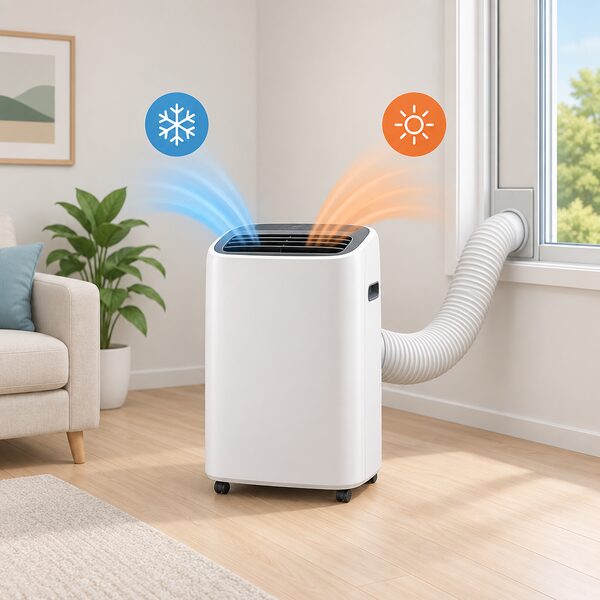
Lux Air states that selected models offer both cooling and heating, and advises checking the individual product specification before ordering1. That is the honest position: the range is mixed, and the capacity badge alone does not tell you whether a given unit reverses.
Where heating is present, it is a heat pump function rather than a resistive element, which is the same principle as an air-to-air heat pump. Independent guidance describes air-to-air heat pumps as offering the added benefit of supplying air conditioning, keeping a home cool during the summer10. The reverse is what matters here: a unit that can move heat in either direction can warm a room in shoulder seasons as well as cool it in summer.
The 14,000 BTU model is the clearest example, sold as cooling, heating and sterilising the air3. The 12,000 BTU model is described as providing both cooling and heating functions for year-round comfort in any room6. The all-in-one unit is listed with 2.9kW cooling and 2.6kW heating7.
Two practical points follow. First, heating mode changes the condensate behaviour: the 14,000 BTU model has an automatic inbuilt condensate pump in heat mode, and evaporates water through the exhaust hose in cool mode, with manual emptying needed only in extremely humid conditions3. Second, a portable heat pump is a single-room heater, not a substitute for a whole-home system. How reverse-cycle units compare with fixed installations is covered in air conditioning that heats, and the running-cost comparison with a plain electric heater is at air conditioning vs electric heater running efficiency.
Smart features: WiFi, Alexa and Google compatibility
Lux Air states that selected models offer WiFi connectivity and compatibility with Alexa and Google1. The 14,000 BTU model is listed with WiFi control, Alexa, Google and mobile phone app control, and voice control for Amazon Alexa or Google Home3. The all-in-one unit is listed with WiFi compatibility, a remote control and an LED display for easy operation7.
The pattern across the range is that connectivity is a selected-model feature, not a standard one. A buyer wanting app control needs to confirm it on the specific unit rather than assume it from the brand. The same is true across the market: a comparable 14,000 BTU portable unit from another UK brand is listed as Alexa and Google assistant compatible, controllable by voice, with built-in WiFi for smartphone control11.
What the smart layer actually requires is worth stating plainly. Voice control and app scheduling depend on a home WiFi network, a broadband connection, the manufacturer's app and the manufacturer's servers. Local control at the unit and on the supplied remote continues without any of that, but remote scheduling and monitoring do not. That is a dependence on a company and a connection, not just on electricity.
For a household thinking about independence, the sensible reading is that smart features are a convenience layer on top of a working appliance, not a reason to buy one. The wider picture of what app control adds and what it costs in dependence is at air conditioning controls and WiFi.
Installation: no permanent fitting, but a window is needed
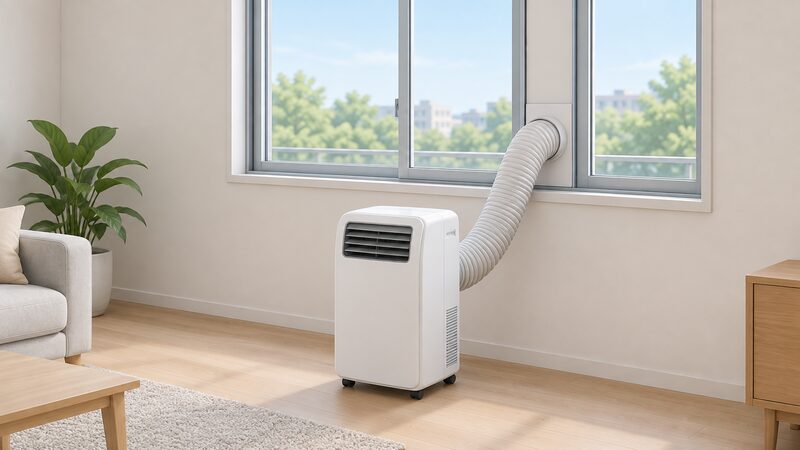
Lux Air states that its portable air conditioners require no permanent installation: the unit is positioned near a suitable window, the exhaust hose is connected, and warm air is vented outside1. Nothing is fixed to the wall, no refrigerant pipework is run, and no outdoor unit is mounted.
The window is not optional. Independent guidance is explicit that portable units need to be properly vented to the outside using a special fitting for the window, and that a vent simply put through an open window will let heat back in13. That is the single most common way a portable unit underperforms its rating: the exhaust goes out, but the same opening lets hot outside air straight back in, and the unit fights a losing battle.
The wider market treats this as standard. Pro Breeze portable air conditioners come with a window kit for quick setup and no permanent installation4. A comparable 14,000 BTU portable unit is described as not requiring an external condenser, refrigerant piping or outside contractors, needing no permanent installation and being ready to use straight out of the box14.
For a household, this is the core of the appeal and the core of the compromise. Nothing is altered in the building, which matters in rented homes and flats where consent for a fixed installation may not be available. In exchange, the appliance occupies floor space, needs a window it can reach, and cannot be concealed. Options that avoid the window entirely are covered in air conditioning without an outdoor unit, and the rental case is at can you use a portable air conditioner in a rental property.
Why the exhaust hose matters
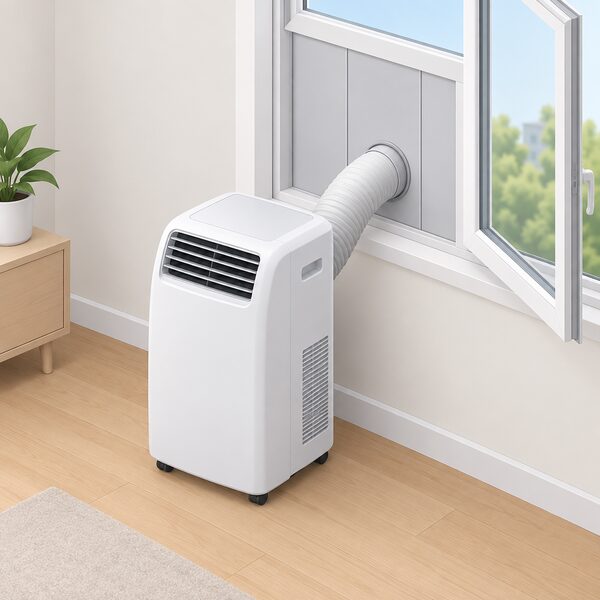
The exhaust hose is the part of a portable air conditioner that decides whether it performs. A single-duct portable unit draws room air across its evaporator, uses it to carry heat away from the condenser, and pushes that warmed air out through the hose. Because the air leaving the room has to be replaced, outside air is pulled in through any gap, and in a sealed room the unit creates a slight negative pressure that works against it.
That is why the venting method matters more than the capacity badge. Independent guidance is clear that a hose put through an open window lets heat back in13. A window sealing plate closes that path, and the difference between the two setups is the difference between a unit that cools a room and one that runs continuously without getting on top of the heat.
Hose length is a related constraint. Lux Air does not publish a hose length for its portable units. A comparable 14,000 BTU portable air conditioner from another UK brand lists a 1.5m hose14. Longer runs are not documented by the makers, and a longer hose gives the warm air more time to shed heat back into the room before it reaches the window, which is why portable units are designed to sit close to the opening they vent through.
Condensate is the second thing the hose handles. The 14,000 BTU Lux Air model evaporates water through the exhaust hose in cool mode, with manual emptying needed only in extremely humid conditions3. A comparable unit is described as self-evaporating, reusing most of the condensation internally and expelling it through the exhaust system14. In a UK summer that usually means no drain hose to manage, though a very humid spell can change that. The detail is covered in does a portable air conditioner need drainage.
What owning a portable unit means for energy independence
A portable air conditioner is the least independent form of cooling a household can buy, and it is worth being direct about why. It runs entirely on mains electricity, so it depends on the grid and on an electricity supplier. It does nothing to reduce the heat entering the building, so it treats the symptom rather than the cause. And on selected models, the smart features add a further dependence on broadband, an app and a manufacturer's servers1.
The scale of that electrical dependence is not trivial. A 2026 press release puts the 2.2 million UK homes with portable air conditioning units at around 1kW of power each2. Independent guidance gives a typical portable range of 900 to 2000W, with higher BTUs drawing more power15. A unit run for several hours a day in a hot spell is a meaningful addition to a household's electricity use, and it lands at the time of year when the grid is under least strain but the bill is least welcome.
What a household gets in return is optionality. Nothing is fixed, nothing needs consent, and the appliance can move house with the occupant. For a renter, a flat, or a room that overheats for a few weeks a year, that is a real advantage over a split system. For a household aiming at genuine energy independence, the more durable moves are the ones that stop heat getting in: shading, ventilation strategy and insulation. Those are set out in passive cooling and home cooling and energy independence.
"they need to be properly vented to the outside using a special fitting for the window. If the vent is just put through a"
The honest summary is that a Lux Air unit buys comfort in one room, on demand, with no installation and no permission needed. It does not buy independence: it adds a load to the grid, a dependence on a supplier, and on some models a dependence on a manufacturer's app. Households weighing it against a fixed system should compare the two directly at split vs portable air conditioning for UK homes, and against the cheapest cooling of all at air conditioning vs fans.
Sources15 cited
- Lux Air portable AC that cools, heats and sterilises, Cool Easy, 2026
- The cost of keeping cool: four million homes now use air conditioning, Uswitch, 2026
- Lux Air 4kW (14000 BTU) portable air conditioning heat pump, Cool Easy, 2026
- Portable air conditioners, Pro Breeze, 2026
- De'Longhi Pinguino PAC EX93 Extreme portable air conditioner, Quiet Mark, 2026
- Domestic home air cooling solutions, Cool Easy, 2026
- Heating and cooling systems, Cool Easy, 2026
- Air conditioning size guide, Cool Easy, 2026
- Is air conditioning worth it in the UK?, Uswitch, 2026
- What it's really like to have a heat pump, Which?, 2025
- electriQ AirFlex 14000 BTU portable air conditioner, electriQ, 2026
- electriQ AirFlex Smart 14000 BTU portable air conditioner, electriQ, 2026
- How to keep your home cool in hot weather, Centre for Sustainable Energy, 2026
- electriQ AirFlex 14000 BTU portable air conditioner with venting kit, electriQ, 2026
- Ratings of electrical appliances, Electrical Safety First, 2026
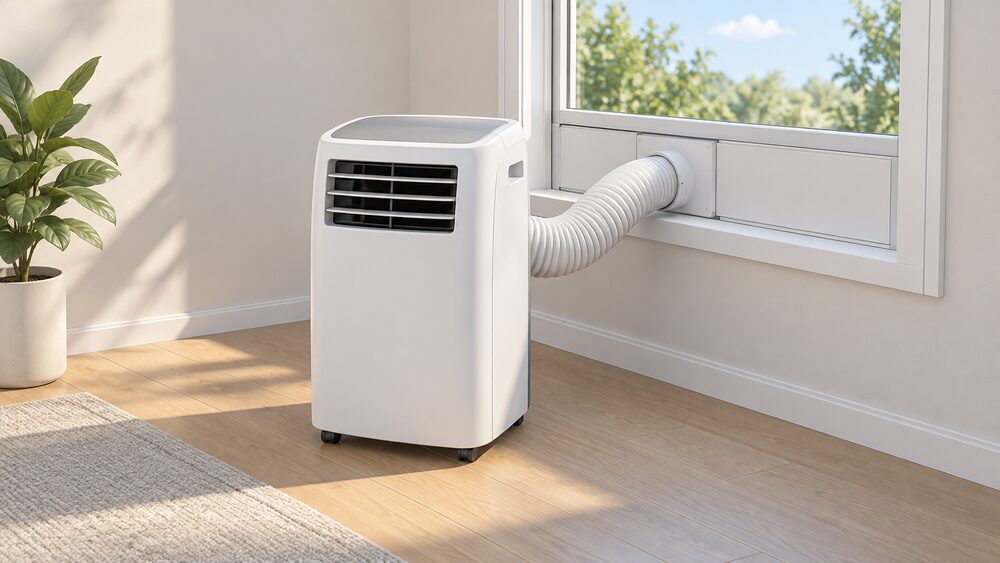 Lux Air 3.5kW (12000 Btu) portable air conditioning heat pumpThe Lux Air 3.5kW (12000 Btu) portable air conditioning heat pump cools and heats, needs no permanent installation, and is rated for rooms up to 30m².