
In this answer
Short answer
No. Standard Wi-Fi goes down in a power cut, because the router that broadcasts the signal has no battery of its own. Your home's internet and landline phone connection will stop working in a power cut, along with gas boilers and heating and electrical appliances1. The broadband line may still be live at the cabinet, but nothing in the house is listening to it.
What survives is anything with its own battery. Provided there is mobile reception, the internet remains available on a mobile phone when the power has gone out2. A cordless phone will not work, because the base station needs mains power3. A wired landline handset may keep working if the line is not carried over full fibre, and where a landline will not work during a power cut, the provider may offer a free solution, such as a back-up battery unit, for a minimum of one hour, that would enable calls to the emergency services1.
The gap is bridgeable, but only deliberately. An uninterruptible power supply can help keep communications platforms, like your Wi-Fi connections and computer and tablet devices, running, though a small domestic unit provides a few minutes of emergency battery backup if power fails4. A home battery may do more, but not all systems are suitable for power cuts5.
Why the router needs mains power to keep the signal alive
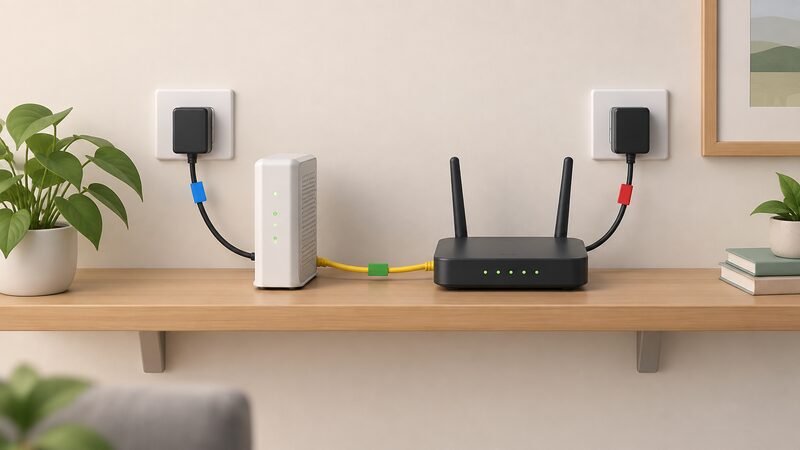
A router is a small computer with a radio in it. It has no internal battery, so the moment the supply to its socket fails, the radio stops and every device in the house loses its access point. The same applies to the optical network terminal or cable modem that feeds it, and to any mesh node or range extender on the same circuit. Keeping the Wi-Fi alive therefore means keeping two or three small boxes alive at once, not one.
The supply itself fails for ordinary reasons. Network operators describe their networks as reliable, but power cuts still happen, and planned cuts exist so engineers can safely work on the cables that provide power to a property, with temporary interruption being the safest way to work8. In Northern Ireland, the Big Network Rebuild requires power outages, meaning homes, farms and businesses may experience electricity supply interruptions while work is ongoing, with some repeat outages required on certain sections of network10.
There is also a diagnostic point worth knowing before assuming the fault is external. If your neighbours still have power but your home does not, it is likely there is a problem with the fuses or trip switches in your home11. A router that dies while the rest of the street is lit is a different problem from a network fault, and the fix is at the consumer unit rather than at the substation.
Under an emergency, cuts are organised rather than random. Rota load disconnection helps to prevent overloading or blackouts during periods of high demand, ensuring a stable and reliable electricity supply for everyone12. That is the mechanism behind the timetabled blocks described below, and it is why a household can sometimes know in advance which hours it will be dark.
What keeps working and what stops

The dividing line is simple: anything with an internal battery keeps going, anything drawing from a wall socket stops. Gas boilers and heating, electrical appliances, and your home's internet and landline connections will stop working in a power cut1. Gas supplies and meters will usually continue to work normally during a power cut, but most boilers may not work because they use electricity for pumps, fans and electronic controls13. A gas hob can often be lit by match; a gas boiler cannot run without electricity.
| Service | During a power cut | Why |
|---|---|---|
| Home Wi-Fi and router | Stops1 | No internal battery |
| Cordless phone | Stops3 | Base station needs mains power |
| Mobile data | Works with reception2 | Handset battery |
| Gas supply and meter | Usually continues13 | No electricity needed at the meter |
| Gas boiler and heating | Stops1 | Pumps, fans and controls need power |
| Landline (where provider supplies backup) | May continue for at least one hour1 | Provider-supplied battery unit |
Mobile coverage is the practical fallback, but it is not unconditional. During emergency rota disconnections, mobile phone service will be extremely limited and might drop out entirely14. That is a different situation from an ordinary local fault, where the network usually stays up and the handset carries the load.
Preparation advice from network operators is consistent: keep a mobile phone fully charged so you can use it to go online for updates or call if you have a power cut, keep a torch handy, have warm clothes, blankets and food which does not need heating accessible, and follow your network operator on social media for local updates12. Portable power banks can hold enough power to charge up a mobile several times, and are well worth having to hand2.
Battery backup options: UPS units and router power banks
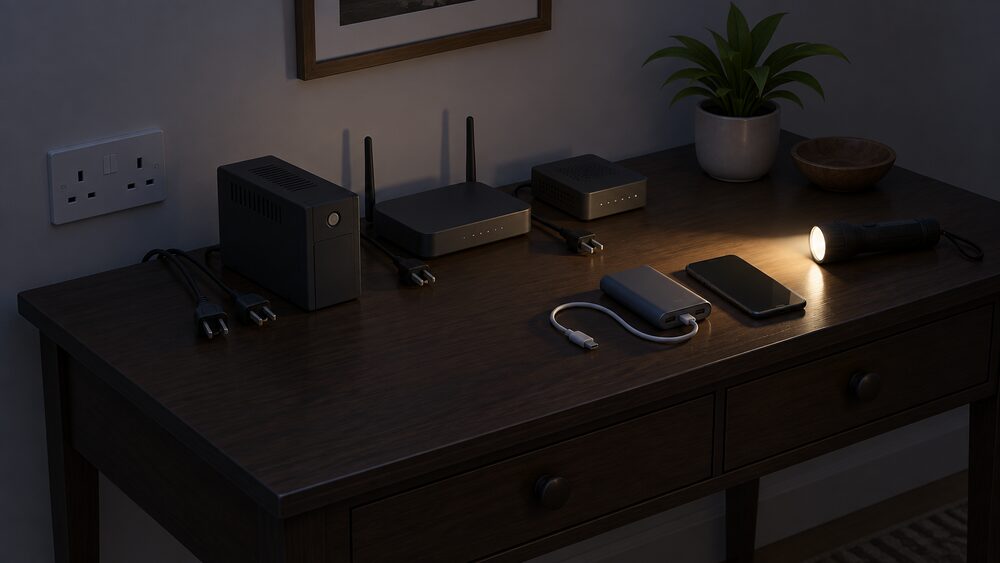
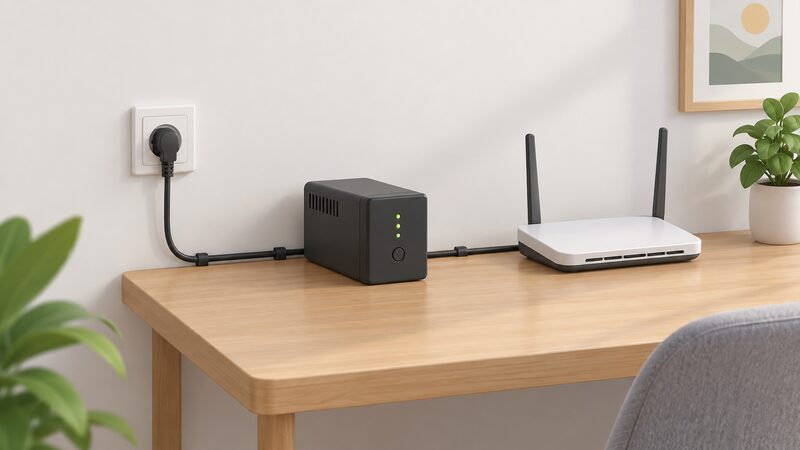
Two approaches cover most households. The first is an uninterruptible power supply, a box that sits between the wall socket and the router and switches to its own battery within milliseconds of a supply failure. These provide a few minutes emergency battery backup if power fails, and can help keep communications platforms, like your Wi-Fi connections and computer and tablet devices, running4. That is a graceful-shutdown device, not an all-evening one, unless it is sized well beyond the load.
The second is a portable power bank or power station, which is charged in advance and plugged into the router when needed. Portable power banks can hold enough power to charge up a mobile several times2. A power station with a mains output can run a router and modem for far longer than a small UPS, at the cost of being a manual intervention: someone has to be at home to plug it in.
Sizing starts with the load. Router and modem power supplies are small: one maker datasheet lists 5V 200mA DC for its pocket Wi-Fi units15. Add the wattage of everything intended to stay alive, then compare it with the UPS rating. A unit carrying only a router and modem will run far longer than one also carrying a desktop, monitor and printer.
Can a home battery or solar system keep the Wi-Fi on?
Sometimes, and the answer depends on the inverter rather than the panels. Typically solar panels cannot power your home during a power cut, unless the home is off the grid or has additional equipment16. Your solar panels will automatically switch off during a power cut, a safety feature that prevents electricity being exported to the network while engineers may be working on it14. Generation alone therefore does nothing for the router.
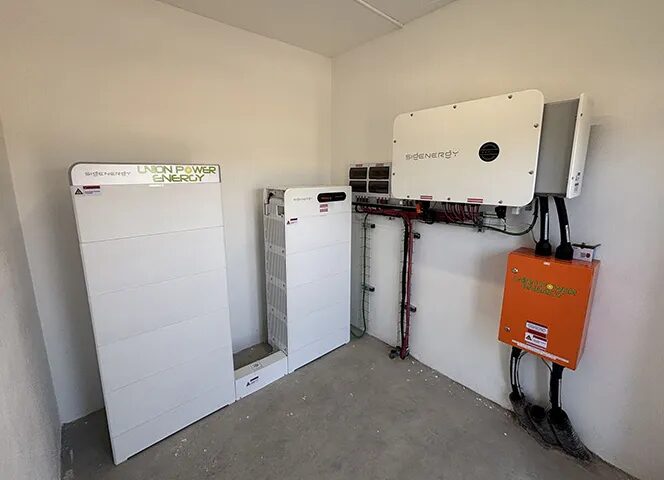
Storage changes that. The more expensive battery systems can also provide electricity during a power cut11. In some cases these storage devices can provide back-up supplies for use in a power cut, but this is not always possible9. If you are looking to protect yourself against power cuts with a home battery, not all systems are suitable, and the installer is the person who can say whether a given battery will work in a power outage, and for how long5.
Where a battery does back up a circuit, the household effect is broader than connectivity. Rooftop solar systems with home batteries mean less electricity is drawn from the grid, reducing the amount paid in bills17. Battery storage can also draw power from the grid when it is at a cheaper rate than normal, allowing you to save money18. Homes with batteries consistently show lower total daily grid consumption across three seasons, with winter energy consumption seeing an increase attributed to a suspected arbitrage pattern19.
"At household-level, further innovation in home battery technology, vehicle-to-everything (V2X), and solar can provide households with additional backup options during power outages"
One limit applies during an emergency. Under the Emergency Power Cut Rota, your own generation will not be able to export electricity to the wider electricity network at the times when you have emergency power as part of the rota6. A battery can serve the house; it cannot sell to the grid while the rota is running.
Staying connected through storms and severe weather
Storms are the main cause of widespread, long outages. During storms power cuts can happen21. Network operators plan for that: when a severe weather warning is received, staff and resources are mobilised, materials and emergency crews are sent to areas most likely to be affected, and heavy machinery is put on standby22. Restoration is then a matter of access and damage, not of the household's own equipment.
Information is the thing a household can actually control. Social media and your local network operator's website are the best places for key updates and restoration times in storms1. Operators also run support for customers who need it: Electricity North West's temporary support service keeps customers updated throughout the power cut23, and for customers with poor mobility, whether planned or unplanned, the customer contact team will be in touch throughout the power cut to make sure they are ok and have the latest information24. In Northern Ireland, the Customer Care Register provides regular contact during a power cut with up-to-date information25.
For households that depend on a connection, the practical position is that Wi-Fi is a convenience and mobile data is the fallback, and neither is guaranteed during an emergency rota. A UPS or power bank keeps the router alive for a defined period; a home battery may extend that to the length of an outage if the system supports backup. What none of them removes is the underlying dependence: on the grid for recharging, on a broadband supplier for the line, and on a mobile network for the fallback. The backup power pillar sets out the wider options, and UPS sizing covers matching a unit to a load.
Sources25 cited
- Power cuts, Energy Networks Association
- What to do in a power cut, Which?, 2026-06-04
- Tips to prepare for a power cut, Electricity North West
- Care and assisted living providers, Energy Networks Association
- Solar panel battery storage, Which?, 2026-05-14
- Emergency planning portal for residential customers, SSEN
- Preparing for a power cut, Centre for Sustainable Energy, 2026-08
- Why do we experience power cuts?, Electricity North West
- Why do planned power cuts happen?, Electricity North West
- The Big Network Rebuild: how will it impact me?, NIE Networks
- What to do in a power cut, Met Office
- What happens in an energy shortage, Energy Networks Association
- Gas supply updates, SGN
- Emergency power cuts, Electricity North West
- DataHub 1000 datasheet, SolaX Power
- Solar power facts, Energy Saving Trust, 2026-08-13
- Batteries in the home, Solar Energy UK
- Battery storage, MCS Certified
- Grid impacts of heat pumps, EVs and solar revealed, Energy Systems Catapult, 2025-08-18
- Well-adapted energy system, Climate Change Committee
- Get winter ready, Energy Networks Association
- Response to storms, NIE Networks
- Temporary support, Electricity North West
- Extra support for poor mobility, Electricity North West
- Critical care register, NIE Networks
 Backup Power and EPSWill your lights stay on when the power goes out?
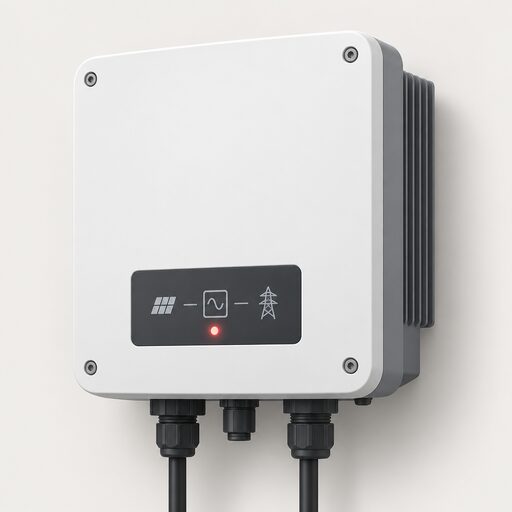 Islanding and Anti-IslandingWhy do solar panels switch off in a power cut, and can you keep the lights on anyway?
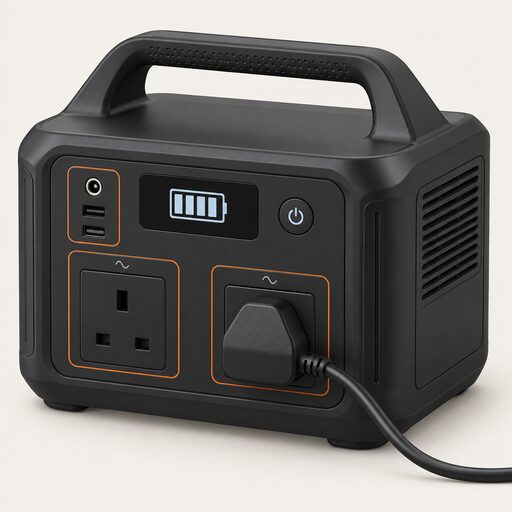 Backup Power for HeatingWhy gas boilers, heat pumps and storage heaters stop in a power cut, what a portable power station can and cannot carry, how to size one, and what home battery systems do when the mains fails.
 Leaving the Electricity GridCan you really cut your home off the grid completely, and what does it cost to have your electricity supply removed for good?
 Controls and Wi-FiWhich air conditioning controls work without the internet, and which need Wi-Fi?
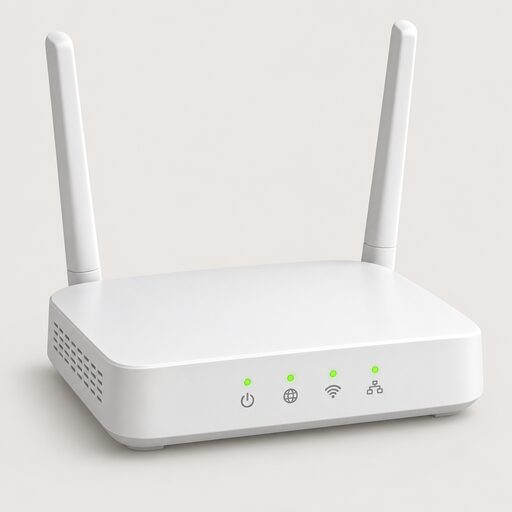 Home UPS SystemsA home UPS keeps your broadband, computer or boiler running through short power cuts and flickers, switching over instantly rather than after a second or two.