
In this answer
Short answer
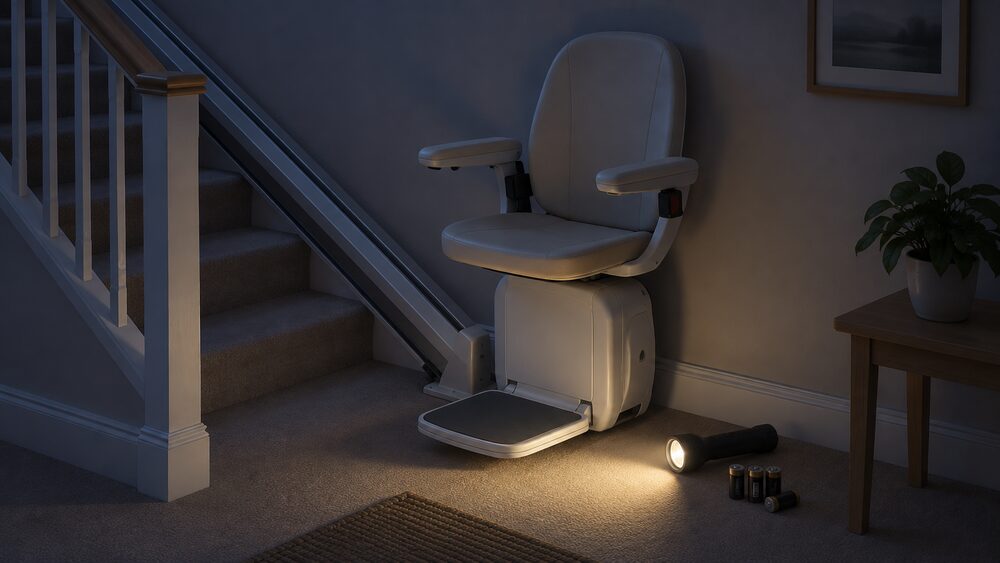
Most stairlifts will keep working in a power cut. The lift runs on its own battery, not on mains electricity, and most stairlifts have a battery backup for exactly this situation1. The mains supply does one job: it keeps that battery charged while the lift sits parked on its charging point.
The practical limit is the battery, not the grid. Most manufacturers recommend that the battery should last for at least five trips without power, and the advice is to check with the installer for the specific model3. That figure is a manufacturer recommendation rather than a guaranteed runtime, and it assumes the lift was left on its charger and the battery is in good condition.
For a household that depends on a stairlift, this matters more than for most appliances. A lift that stops between floors is not an inconvenience; it is a loss of access to part of the home. The good news is that the backup is built in. The caveats are that it is finite, that it depends on charging habits, and that it degrades with the battery.
How the battery backup works
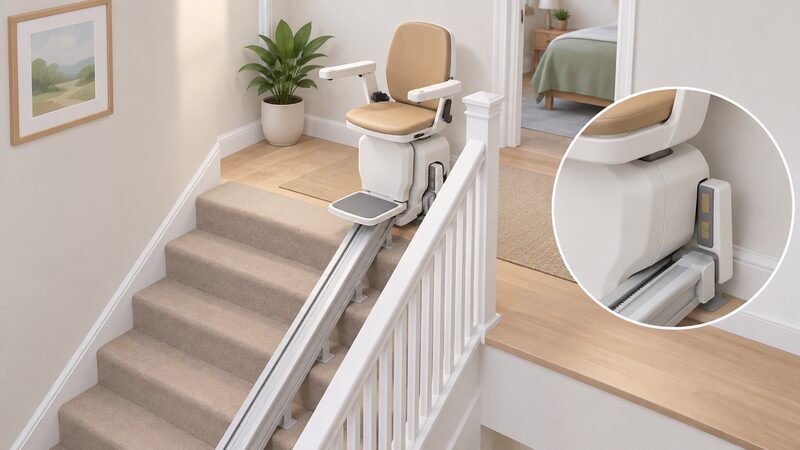
A stairlift is a battery machine. The motor that carries the carriage up and down the track draws its power from an onboard battery, and the mains connection exists to keep that battery charged. When the power fails, the lift does not notice, because it was never running off the mains in the first place.
This is a different arrangement from a home battery system, and the distinction is worth understanding. A domestic battery storage system does not normally provide power in a power cut unless additional equipment and configuration is included6. The more expensive battery systems can also provide electricity during a power cut, but not all systems are suitable, and the advice is to ask the installer whether a given battery will work in an outage and for how long7. A stairlift, by contrast, carries its own small battery and its own backup as standard.
The same principle appears in other backup equipment. A smart energy management system, for instance, is described by one maker as having a "brain" that instantly provides backup power when the grid goes down and prioritises critical loads rather than draining the battery blindly9. A stairlift does something simpler: it keeps its own reserve and uses it when the mains disappears.
What the household still depends on is the manufacturer or installer for the battery, the service visit and any replacement parts. The lift is independent of the grid for a handful of trips, and dependent on a company for everything that keeps those trips available.
How long a stairlift runs in a power cut
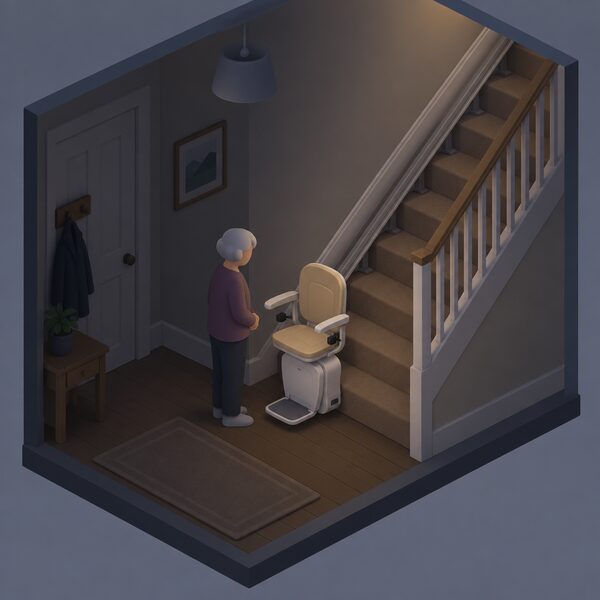
The headline figure is at least five trips without power, which is what most manufacturers recommend the battery should deliver3. That is the number to plan around. It is not a duration in hours, because a stairlift journey is measured in trips up and down a staircase, and the energy each trip takes depends on the length of the track and the weight carried.
Five trips is enough to cover a short outage comfortably. It is not enough to cover a long one if the lift is in constant use. For context on how long outages run, emergency rota load disconnection, the controlled switching off of blocks of customers, would leave different block letters without power for typically around three hours once or twice a day10. No emergency power cuts are currently planned, and those measures would only be used in emergencies10.
The comparison with other backup equipment is instructive. A passenger lift in a block of flats is a different machine entirely, and building standards allow an Energy Efficiency Rating of B for passenger lifts travelling less than 25m or at speeds of less than 1.6m/s, primarily hydraulic lifts11. That is a rating for a building's lift, not a domestic stairlift, and it says nothing about backup capacity. The domestic stairlift's five trips is a far smaller reserve, sized for a single household rather than a building.
In practice, a household should expect the lift to complete a normal day's use during a short cut and to become a rationed resource during a long one. The lift will not fail suddenly at the end of the fifth trip; it will slow and eventually stop as the battery drains. That gives some warning.
Charging: why a stairlift must stay parked on its charger
The single most important habit is parking the lift on its charging point. The battery only charges when the carriage is at the charging position, so a lift left part way along the track is a lift running down its reserve.
This is where the household's own behaviour, not the network, determines whether the backup is ready. A lift parked correctly overnight will be fully charged for the morning. A lift left at the bottom of the stairs after the last trip of the evening will have whatever charge it held, and the next power cut will find it short.
There is a wider support route for households where the lift is medically necessary. Energy suppliers have protections for customers with a health condition or disability which needs a continuous supply of electricity, with stairlifts named among the examples12. That protection concerns the supply itself rather than the lift's battery, but it is the mechanism by which a household flags that an interruption has consequences beyond inconvenience. Network operators also publish guidance for care and assisted living providers, including checking the mains power backup for all critical equipment and checking how long the backup battery can last13.
What to do if the power stays off
If the power does not come back quickly, the first step is to establish whether the outage is local or confined to the home. If neighbours still have power but the home does not, it is likely there is a problem with the fuses or trip switches in the home rather than a network fault14. If neighbours have also lost power, the outage should be reported on the power cut helpline, 10515. That line is free and available 24 hours a day5.
While the power is off, the standard safety advice applies. Never touch damaged electricity equipment, check on vulnerable family and friends, keep the freezer door closed, report the power cut, turn off cookers, heaters and sensitive equipment, and leave a light on16. Leaving a light on is the simplest way to know when the power returns17.
For the stairlift itself, the priority is conserving the battery. Every trip uses charge that cannot be replaced until the mains returns. If the lift has a manual operation handle, that offers a way to move the carriage without drawing on the battery at all, and many stair lifts have a handle for manual operation in case of difficulties3. That is the fallback when the reserve is gone.
Keeping the stairlift maintained so the backup is ready
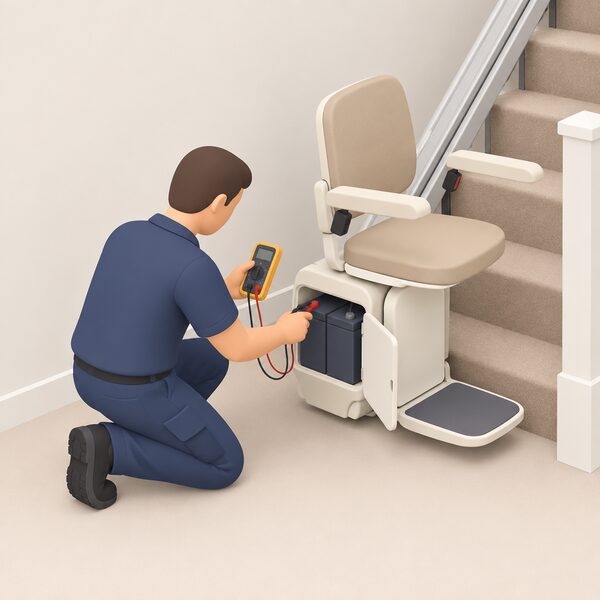
The backup is only as good as the battery behind it. Good quality batteries will need replacing every five to ten years depending on how much they are used4. That interval is the one to hold in mind when planning, and it shortens with heavier use.
The signs that a battery is nearing the end of its life are practical rather than technical: a lift that slows under load, stalls, or manages fewer trips than it once did between charges. Because the battery is a service item, the check belongs with the annual service visit, and the manufacturer or installer is the party who can confirm whether replacement is due.
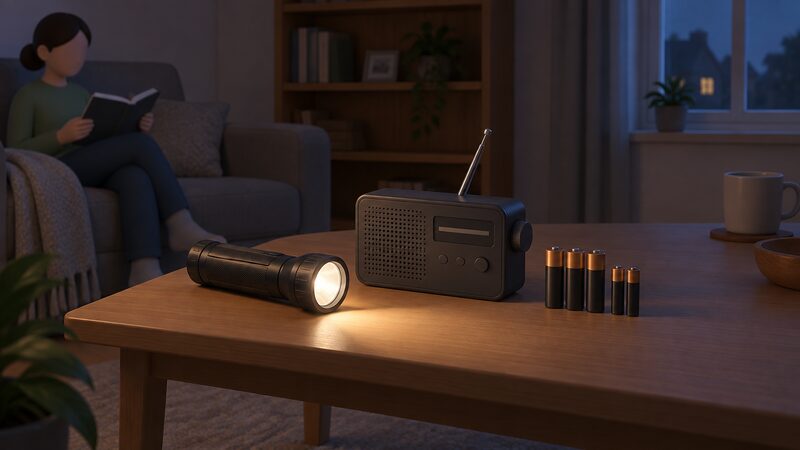
Preparation around the lift is straightforward. Keep a torch handy in case of power cuts, and keep torches, a battery powered radio and spare batteries in reserve18. Keep a mobile phone charged, keep warm clothes, blankets and food that does not need heating accessible, and follow the network operator on social media for local updates20. A battery powered radio tuned to a local station and a note of key contacts are the other items on the standard list20.
"Check your mains power backup for all critical equipment"
For a household, the stairlift is one of the few appliances that arrives with its own power cut plan built in. It will carry someone up and down the stairs for at least five trips without the grid, and it will keep doing so for as long as the battery is charged, healthy and replaced on schedule. What remains outside the household's control is the length of the outage and the supply chain behind the battery. What stays inside it is the habit of parking the lift on its charger.
Sources20 cited
- Preparing for a power cut, Centre for Sustainable Energy, 2026-08
- Tips to help you during a power cut, Electricity North West, 2026-09-19
- Tips to prepare for a power cut, Electricity North West, 2026-09-19
- Renewable energy storage, Electricity North West, 2026-09-19
- Powercut105, Energy Networks Association, 2026-08-19
- Solar power facts, Energy Saving Trust, 2026-08-13
- Making the most of your solar PV panels, Centre for Sustainable Energy, 2026-08
- Solar panel battery storage, Which?, 2026-05-14
- Smart energy management systems, SolaX Power, 2026-04-08
- Emergency power cuts, Electricity North West, 2026-09-19
- Future Homes and Buildings Standards Consultation Response, Ministry of Housing, Communities and Local Government, 2026-03
- Stop your energy supplier installing a prepayment meter, Citizens Advice, 2026-09-17
- Care and assisted living providers, Energy Networks Association, 2026-09-17
- What to do in a power cut, Met Office, 2026-09-20
- Find out if your energy meter is faulty, Citizens Advice, 2026-09-20
- Power cuts advice, NIE Networks, 2026-09-19
- Power cuts help, NIE Networks, 2026-09-20
- Staying safe and warm this winter, Northern Gas Networks, 2025-11-03
- What happens in an energy shortage, Energy Networks Association, 2026-09-17
- Preparing for a power cut, SSEN Distribution, 2026-09-19
 Backup Power and EPSWill your lights stay on when the power goes out?
 Maintaining Backup PowerWill your generator actually start when the power goes off?
 The Full Backup Power GuideHow long do UK power cuts usually last, and what can keep your fridge, heating or phone going until the power comes back?
 Portable Power StationsWhat can a portable power station actually keep going in a power cut, and for how long?
 UPS Sizing ExplainedWhat size uninterruptible power supply do you need, and how long will it keep your devices running in a power cut?
 Portable Power Station SizeHow big a portable power station does a home actually need, and how long will it keep things running in a power cut?