
In this answer
Short answer
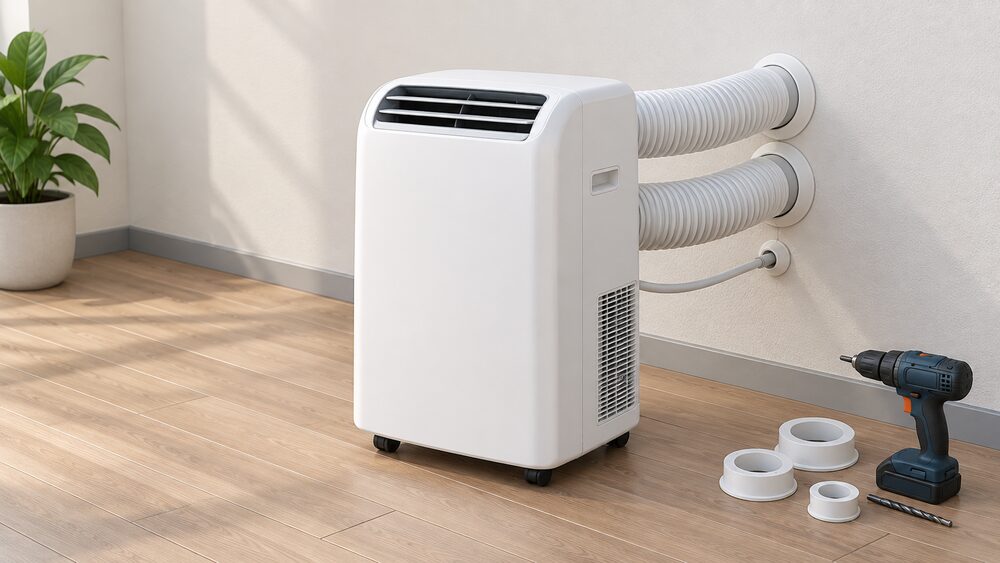
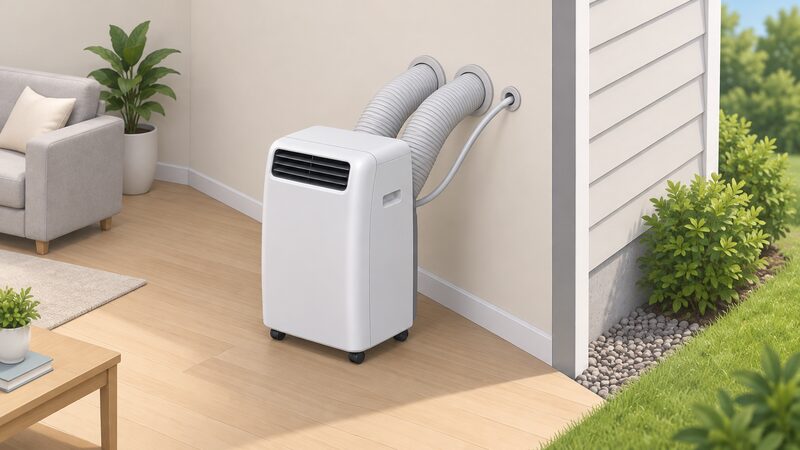
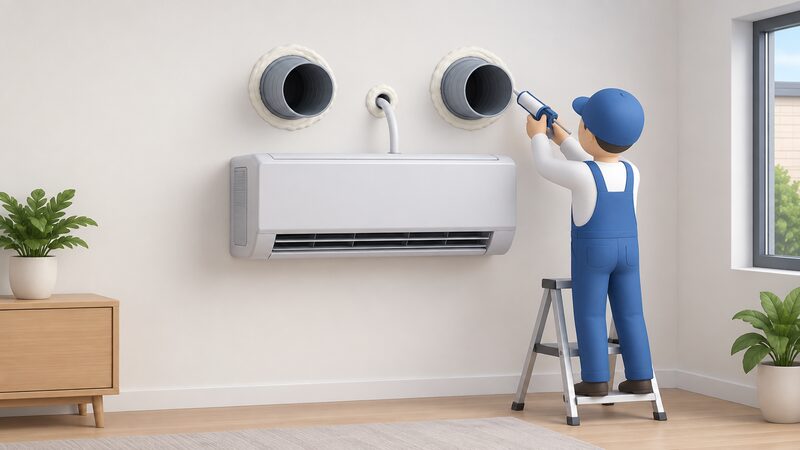
A twin duct DIY air conditioning unit is a portable air conditioner that draws fresh air in through one duct and pushes hot air out through a second, rather than using a single hose. The maker describes the arrangement plainly: "Twin duct air conditioners use two separate ducts, one for fresh air intake and one for exhaust"1. The same product page states that these units "require three holes for installation. One hole, small in size, releases the unit's ge..."1, with two larger openings for the exchange of cool and hot air.
On price, the published figures do not agree. The same distributor lists the Vision Compact Twin Duct Air Conditioning Unit and Heat Pump in white at £1,949.95 and at £1,624.96, both dated 17 September 2026, and the two figures are unresolved1. Wider guidance puts small capacity air-to-air units at approximately £1,000 to £2,000 each2, and one ducted ceiling mounted unit at around £1,0003. Running costs sit in a different order of magnitude: a typical portable air conditioner of 1,000 to 1,500W costs around 26 to 39p per hour, roughly 14 to 20 times more than a fan4.
What a twin duct DIY air conditioning unit is
The defining feature is the duct arrangement. A single hose portable unit pulls cooled room air, uses it to cool the condenser and expels it, which draws replacement air in through gaps in the building fabric. A twin duct unit separates the two air paths, so intake and exhaust are kept apart1. That is the whole of the technical difference, and it is the reason the installation is a wall job rather than a window job.
The installation itself is presented as within reach of a householder. The maker states that "These systems are designed for DIY installation, with pre-charged pipework and all the necessary fittings included"1. Pre-charged pipework matters because it removes the need for refrigerant handling on site, which is the part of air conditioning work that falls under f-gas rules and certified engineers. The trade-off is the wall work: three penetrations, one of them for condensate, which has to drain somewhere sensible.
It is worth separating this product from two things it is not. It is not a ducted system of the kind described in air-to-air heat pump guidance, where "The heat pump warms the air in an air handling unit, which is roughly the size of a boiler"6, with ducts running through ceiling voids. Nor is it a fixed split system. It is a portable appliance that has been given a permanent, wall-based connection to the outside. For the wider picture of where this sits, see types of air conditioning and portable air conditioners.
Cost: what you can expect to pay
The purchase price is the least settled part of the subject. The distributor's own listing carries two figures for the same model, £1,949.95 and £1,624.96, both dated 17 September 2026, and no ruling resolves them1. A householder comparing quotes will therefore find the retail position unclear, and the two figures remain unresolved.
Official guidance gives a broader band rather than a product price. Scottish Government guidance on energy retrofit puts "small capacity air-to-air units costing approximately £1,000-£2,000 each"2. That figure is dated 28 November 2023 and covers small capacity air-to-air units generally, not twin duct portables specifically, so it is a reference point rather than a quotation for this product.
For context on what else sits in a household's cooling and comfort budget, the figures are modest by comparison. A built-in double electric oven has an average annual running cost of £61 and an air fryer £337. A dehumidifier runs at approximately 4p to 15p per hour depending on size and settings8. Smart heating controls are priced at £195 to just under £470 for the Wiser Kit 1, plus installation costs if required9. None of these is a substitute for cooling, but they show the scale of the appliance market a twin duct unit is priced into.
What drives the price up or down
Capacity is the first driver. Manufacturer sizing tables run from 2.0 kW, or 7,000 BTU, for a room up to 16 m² (160 ft²), up to 10.0 kW, or 34,000 BTU, for a room up to 80 m² (800 ft²)10. A larger unit costs more, and the table gives the householder a way to judge whether a quoted output is matched to the room rather than overspecified.
Controls are the second. Controllers cost from about £90 to £26011, so a unit sold with a wired controller rather than a handset carries a visible premium. Whether that premium is worth paying depends on how the unit will be used, which is a household decision rather than a technical one.
The third driver is the installation route itself. A DIY unit avoids labour, but the wall work is real work. Independent guidance on insulation draws the line clearly: "While DIY is a viable route for cold lofts and pipes, it's best to stick with the professionals if you're considering wa..."12. That ruling is about insulation, not air conditioning, but the principle transfers: work that penetrates the building fabric and involves drainage is where DIY confidence needs to be honest.
Finally, the wider energy context sets the backdrop. The UK energy price cap stood at £1,755 a year for a typical dual fuel bill paid by Direct Debit between 1 October and 31 December 202513. Operating cost and debt allowances account for around £300 of an annual household bill for a typical dual fuel customer14. The Warm Home Discount adds £39 to the typical dual fuel bill, recovered through standing charges15, and is put at £39 a year for the average dual fuel household in a separate consultation16. These are the numbers against which any new electrical load is judged.
Running costs and energy use
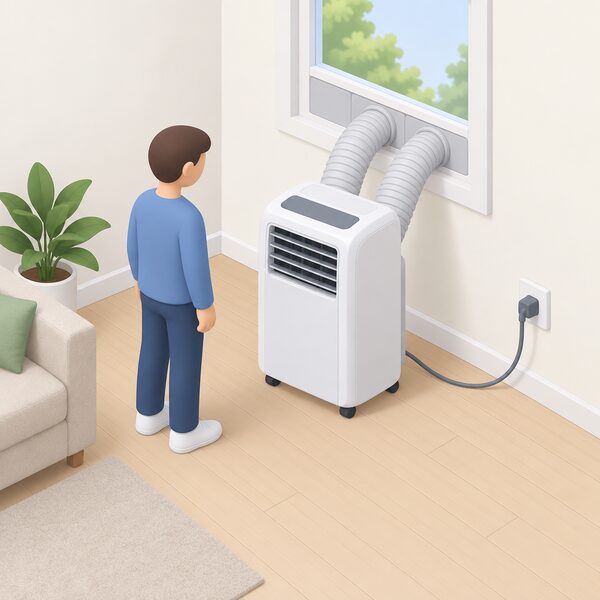
Running cost is where a twin duct unit's case is made or lost. A typical portable air conditioner drawing 1,000 to 1,500W costs around 26 to 39p per hour, which the guidance describes as roughly 14 to 20 times more than a fan4. A multi-split or ducted system of 1 to 5 kW costs £0.26 to £1.31 per hour, based on the July 2026 Ofgem price cap of 26.11p per kWh5. The two ranges overlap at the bottom, which is the useful point: a small twin duct unit and a small fixed system are not far apart in hourly cost, and the difference between them is mostly about how often and how long each runs.
For scale, a worked example elsewhere puts a dehumidifier run for 24 hours at 27p per unit at 351p, or £3.5117. Direct electric heating, used as a stand-in for electric wallpaper in a typical three-bed semi-detached house for space heating only, is put at £2,700 a year18. An EPC D home of 90m² has energy bills of £1,995, an additional £42119. A typical dual fuel annual bill in January to March 2026 is over £500 more than in winter 2020-2120.
The independence question follows from this. A twin duct unit runs on electricity from the grid, through a supplier, at whatever tariff applies. It does not reduce gas dependence, because it does not heat. It does reduce exposure to overheating, which is a comfort and health matter rather than a fuel one. Where a household has solar panels, the daytime running cost of a cooling unit can be offset against generation, but the unit itself remains a grid-connected load. See air conditioning running costs for the fuller treatment.
Installation: what DIY involves and what it costs you in time
The maker's position is that the system is designed for self-installation, with pre-charged pipework and fittings included1. That removes the refrigerant step. What remains is the wall work: three holes, one small for condensate and two larger for air exchange1, plus the making good, the sealing and the drainage route.
The comparison that matters is with other DIY jobs a householder might already have done. Loft insulation is described as a simple and effective way to reduce heating bills that "you can even do it yourself"21, and as the easiest and cheapest insulation to install, doable depending on DIY skills and loft access22. Cold loft insulation is called simple to do as a DIY project, with materials available from most high street DIY stores23. Draught-proofing is described as "one of the cheapest and most effective ways to improve comfort in your home"24, with DIY installation saving £25 to £50 a year25.
Those jobs share a property that a twin duct installation does not: they are reversible and they do not create permanent openings in a weatherproof wall. A hole for a duct is a permanent change to the building, and it needs to be sealed properly or it becomes a draught path and a condensation risk. Trickle vents are fitted to windows precisely because controlled ventilation reduces condensation and the mould growth and internal surface damage that follow26. An unsealed duct penetration works in the opposite direction.
Where a twin duct unit fits a household's independence
The honest answer is that it is a partial measure. A twin duct unit gives a household cooling without an installer, without refrigerant handling on site and without a fixed outdoor unit on a wall. That is real independence from the trade and from the scheduling that comes with it. It is not independence from the grid, from a supplier or from electricity prices, because the unit runs on mains power at whatever the tariff is.
The dependence that remains is worth naming. The unit depends on a manufacturer for parts and support, on a distributor for availability, and on the electricity network for every hour it runs. It does not heat, so it does nothing about gas dependence. It does not store energy, so it cannot shift load away from peak times. Where a household has solar generation, running the unit in daylight hours is the one route by which cooling can be partly self-supplied, and that is a matter of timing rather than of the appliance.
Set against that, the unit addresses a genuine and growing problem. Overheating is a comfort and health issue, and cooling a single room is often enough. For households weighing the options, cooling and energy independence sets out the wider picture, and air conditioning cost covers the fixed-system route. The twin duct DIY unit sits between the two: more permanent than a window kit, less committed than a split system, and priced at a level where the two published figures do not yet agree.
Sources26 cited
- Twin Duct DIY Air Conditioning, CoolEasy, 2026-09-23
- Heat in buildings: multiple ownership and mixed use buildings, Scottish Government, 2023-11-28
- Air source heat pumps vs air conditioning, Hive, 2025-10-17
- Summer energy tips, National Energy Action, 2026-08-13
- Is air conditioning worth it in the UK?, Uswitch, 2026
- Air to air heat pumps, Energy Saving Trust, 2026-09-11
- How much your appliances cost to run, Which?, 2026-10-01
- Condensation, damp and mould, Plymouth Energy Community, 2026-09-20
- What are smart thermostats?, Uswitch, 2026-02-05
- What size of air conditioner do I need?, Hitachi Air Conditioning, 2026-09-17
- Smart air conditioner comfort guide, Netatmo, 2026-09-20
- Make your home more energy efficient in one weekend, Which?, 2026-08-28
- Energy statistics, Uswitch, 2025-10-01
- Energy price cap operating cost and debt allowances, Ofgem, 2025-05-23
- Warm Home Discount cost recovery, GOV.UK, 2025-12-08
- Warm Home Discount cost recovery consultation, Consumer Scotland, 2026-01-07
- What uses watt, Plymouth Energy Community, 2026-09-20
- Electric wallpaper explained, Energy Saving Trust, 2026-03-26
- Watt a Save 2026, Home Builders Federation, 2026-02-02
- Energy price cap explained, Welsh Government, 2026
- Planning permission: micro combined heat and power, Planning Portal, 2026
- Is permission needed for installing new roof tiles?, Planning Portal, 2026
- Planning permission: insulation, Welsh Government, 2026-09-17
- DIY draught-proofing, Centre for Sustainable Energy, 2026-07
- Draught-proofing, Which?, 2026-05-05
- Ventilation and trickle vents, Glass and Glazing Federation, 2026-09-20
 Running CostsA portable air conditioner costs roughly twenty to forty pence for every hour it runs, while a fixed unit uses far less electricity for the same cooling.
 Air Conditioning CostPublished UK equipment prices and the parts of an installed price for portable, single split, multi-split and whole-house air conditioning.
 Domestic Wind Turbine CostA home wind turbine usually costs between nine thousand and nineteen thousand pounds, but the real price depends on its size and how it is mounted.
 Split Air ConditioningA split air conditioning system cools or heats one room using an indoor unit and an outdoor unit linked by pipes.
 Heating Controls CostA smart thermostat usually costs between about a hundred and two hundred and fifty pounds, but fitting can push that higher.
 How Much Does a Heat Pump CostA heat pump usually costs around eleven thousand pounds installed, though quotes vary a lot depending on your home.